Get in Touch with Aubrik Company

Last updated: October 2026
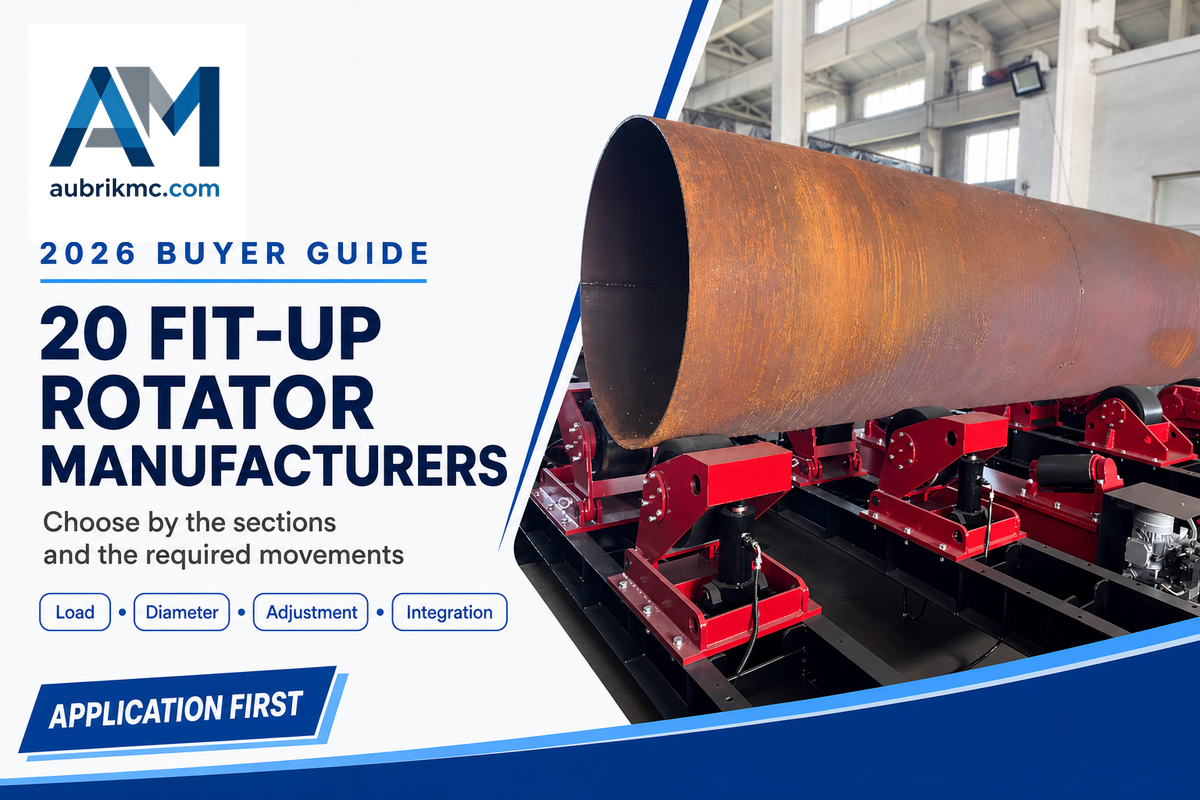
The best fit up rotator manufacturers include Aubrik for hydraulic alignment across load classes, Key Plant for powered growing lines, Pemamek for integrated vessel assembly, LJ Welding for modular tank fitting, and Webb for thin-wall shell tracking. The right shortlist depends on the sections being joined and the movements needed at the joint.
Assembling pressure vessels requires more than a smoothly operating cylinder. The two shell ends must meet at the required position before the first tack weld, and the supports must hold the workpiece in that condition. Various differences in equipment used for fit-up are discussed in this report, so buyers can include the relevant differences in a product query.
Quick Picks
- Best for hydraulic alignment across multiple load classes: Aubrik.
- Best for powered three-axis growing-line movement: Key Plant.
- Best for integrated vessel assembly and welding: Pemamek.
- Best for modular tank fitting with explicit section loads: LJ Welding Automation.
- Best for individual-wheel positioning on large vessels: Koike Aronson Ransome.
- Best for thin-wall, large-diameter shell tracking: The Webb Corporation.
Disclosure: This guide is published by Aubrik. We list ourselves first because this is our website, not because we claim to be the market leader. The other 19 manufacturers are grouped by what they are best for, in no particular order within each group.
How We Selected These Manufacturers
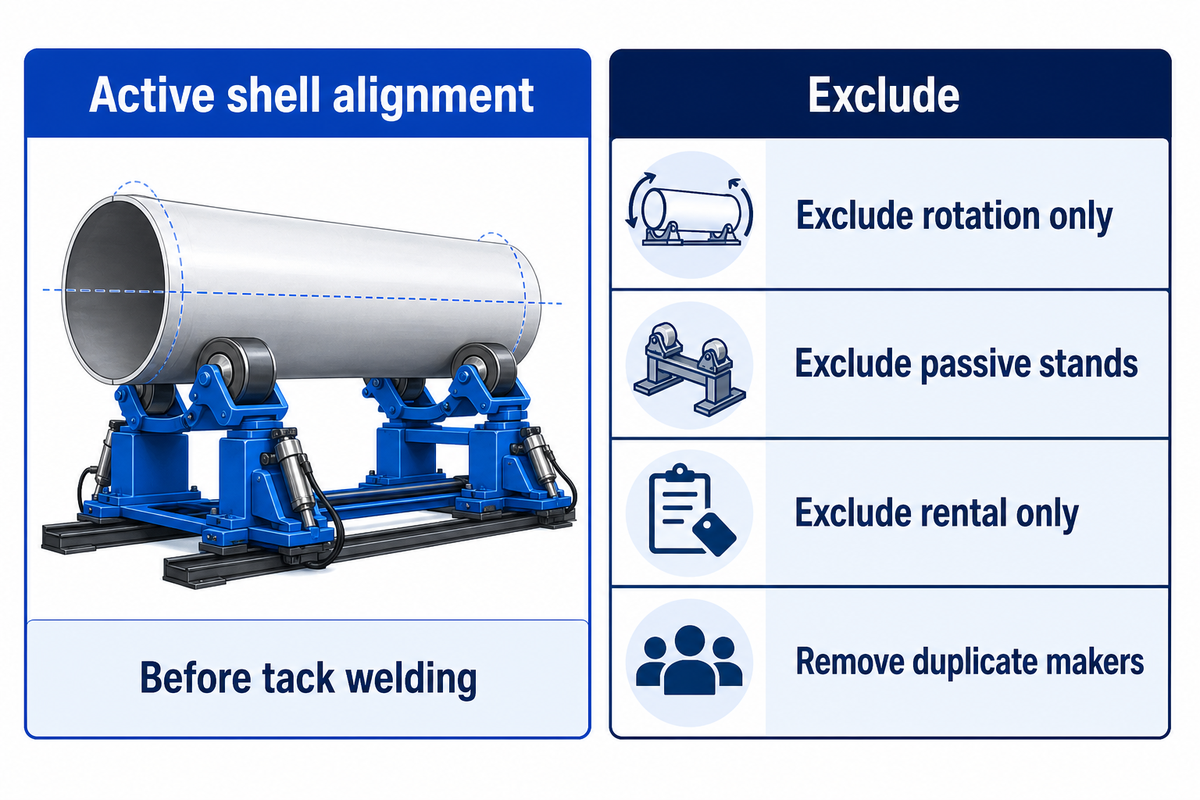
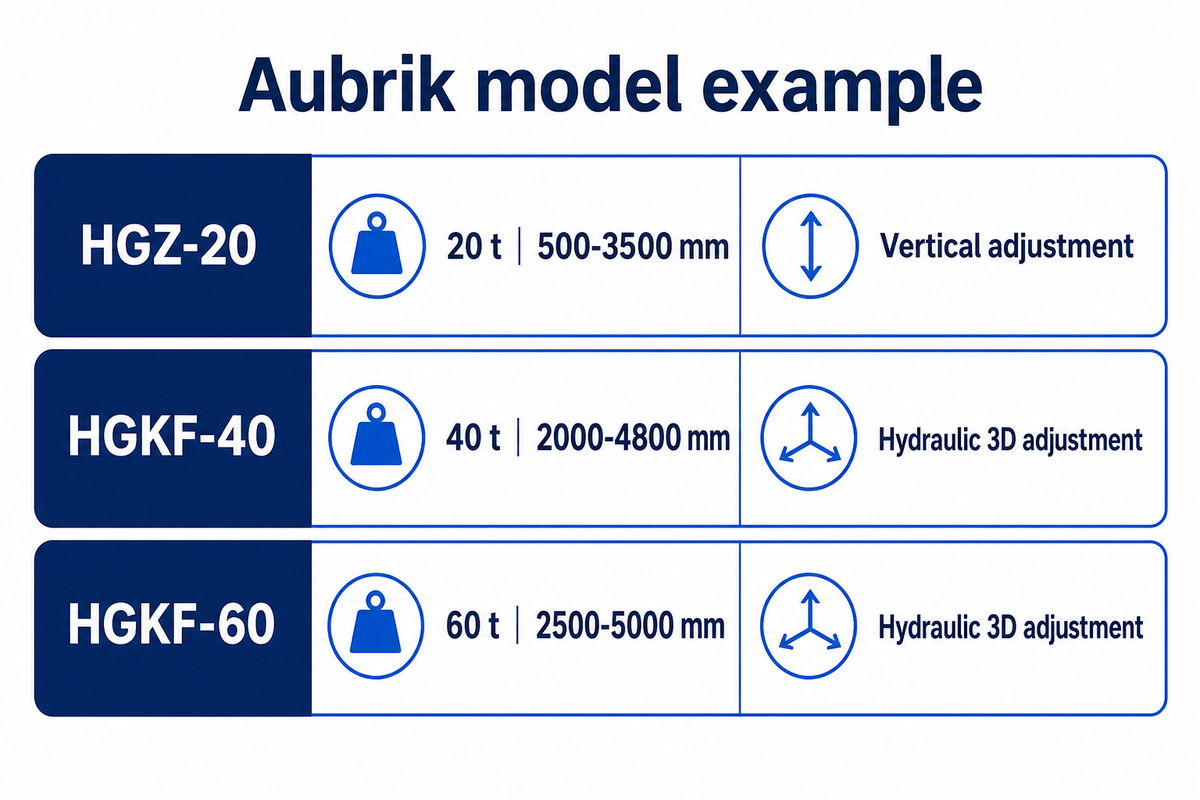
We reviewed a worldwide candidate pool and selected 20 manufacturers with public evidence of equipment that actively aligns adjoining cylindrical sections before tack or circumferential welding. Company websites, product catalogs and published histories were checked in October 2026. For example, Aubrik’s published model table distinguishes the 20 t HGZ-20, 40 t HGKF-40 and 60 t HGKF-60, so model-level fitting functions matter alongside capacity.
We didn’t consider equipment that merely rotated sections, passive stands, or equipment of a pipe-clamping or rental-only nature. We didn’t consider equipment that represented a duplicate of, or was manufactured by, the same company as an equipment type already identified in this report. Equipment was rated as the “best” for a given application based upon fit, and not based on market dominance or the results of performance tests against competing equipment.
What Makes a Fit-Up Rotator Different?
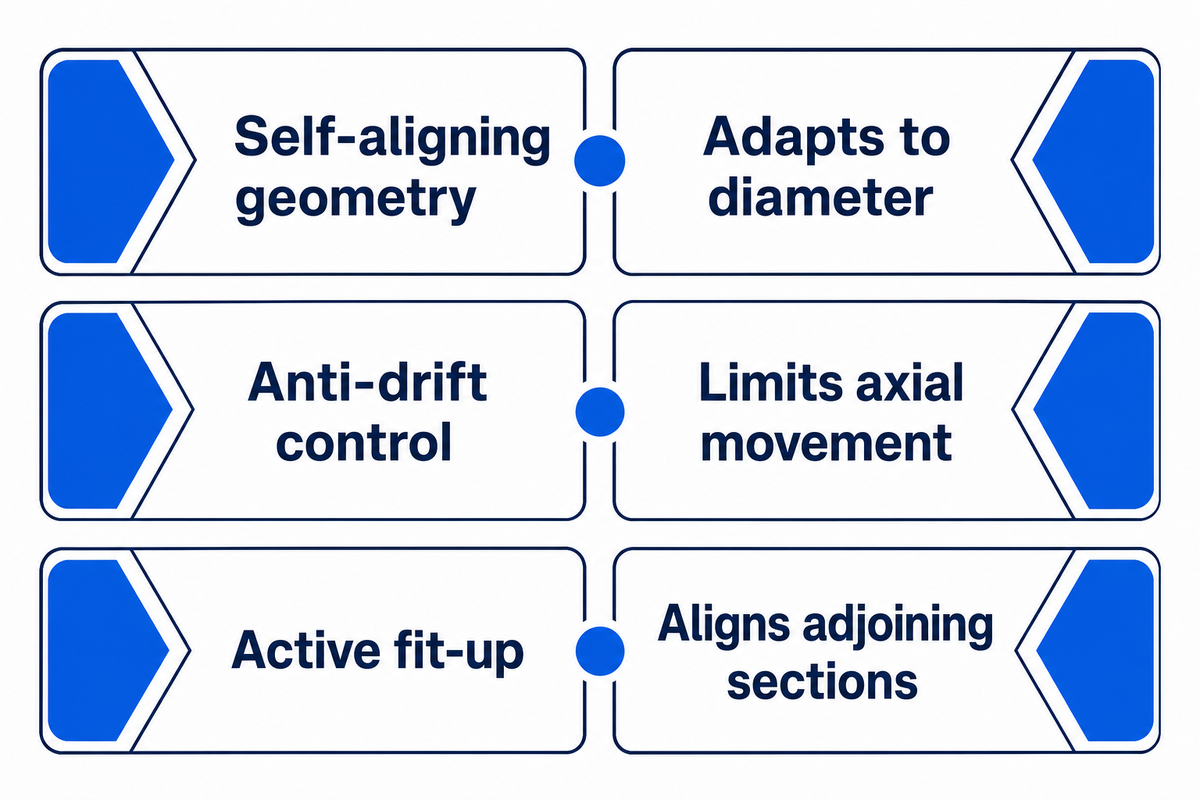
A fit-up rotator is a specialized system designed to bring cylindrical shell ends together before welding. A conventional welding rotator is designed for the purpose of support and rotation. Whether a welding rotator manufacturer is capable of providing an active fitting equipment system depends on controlled adjustment for section-to-section assembly, not simply on whether its roller geometry is self-aligning.
Self-aligning roller geometry adapts to the cylinder’s diameter, while anti-drift control addresses axial movement during rotation. Neither feature alone establishes that a machine can actively position and align two separate shell courses for fitting.
The active movement may be hydraulic height adjustment, independent wheel positioning, lateral shifting, axial travel or a combination of these. Some fit-up roller beds are idlers used with a separate powered unit. Hydraulic rotator or fitting rotator units can therefore form only one part of the alignment and welding arrangement. Others form part of an integrated assembly station. The welding rotators and turning rolls range illustrates why the product family and the actual fitting function need to be identified separately.
Which movements are powered, independently controlled and measured under load?
Compare
- Load on each supported section.
- Powered adjustment directions under load.
- Minimum as well as maximum shell diameter.
Avoid assuming
- A whole-line rating applies to one support.
- Self-aligning geometry supplies active fit-up.
- A custom maximum is a standard model rating.
Fit-Up Rotator Manufacturer Comparison
The Fit-Up Capability Map provides information on the equipment and situations for which the equipment can be used (fit-up function) as well as restrictions. The year the company started doing business (Founded Year) is provided with each company profile. If there’s a difference between the year the company started doing business and the year the company was legally established, this is also indicated. Information is provided by equipment manufacturers. Boundaries of capacity and units are provided by the manufacturers.
Founded Year can describe historical roots rather than today’s legal entity: Key Plant traces its business to 1956. The UK company register dates its current company to 2009.
| No. | Company Name | Headquarters | Founded Year | Best For | Brief Introduction | Main Products | Key Advantages | Potential Disadvantages | Official Website |
|---|---|---|---|---|---|---|---|---|---|
| 1 | Aubrik / Wuxi ABK Machinery Co., Ltd. | Wuxi, China | 1999 | Hydraulic alignment of tank, pressure-vessel and wind-tower sections across multiple load classes | Welding equipment manufacturer | Hydraulic fit-up rotators, turning rolls, welding manipulators and wind-tower lines | HGZ-20 provides hydraulic vertical adjustment; HGKF-40 and HGKF-60 list hydraulic three-dimensional adjustment | Adjustment functions vary by model; the 2000 t custom project scope is not a standard machine rating. | https://aubrikmc.com/ |
| 2 | Akyapak | Bursa, Turkey | 1962 | Fixed and travelling fit-up stations in plate-fabrication shops | Metalworking and welding machinery manufacturer | Fit-up rotators, welding automation, plate rolls and structural fabrication machinery | Fixed and travelling units bring shell sections together while a cable pendant operates the fit-up station | The fixed and travelling layout requires a planned rail route and suitable floor space. | https://akyapak.com/ |
| 3 | Wicon | Konya, Turkey | 1985 | Fit-up stations connected to column-and-boom welding equipment | Welding automation manufacturer within Ömer Atiker Holding | WFROT fit-up rotators, positioners, column-and-boom systems and robotic welding systems | WFROT systems offer optional motorized travelling and synchronization with column-and-boom equipment | Motorized travel and synchronization are options rather than assumed base equipment. | https://wicon.com.tr/ |
| 4 | Cu-Built | Bhosari, Pune, India | 1995 | Shell-to-shell assembly with separate axial and radial adjustment | Welding automation and industrial crane manufacturer | Shell-to-shell fit-up rotators, welding manipulators, positioners and industrial cranes | Hydraulic axial thrust and radial cylinders support alignment of adjoining same-diameter shells | The described standard application joins same-diameter shells; tapered transitions need a different engineered scope. | https://cubuilt.com/ |
| 5 | Amin Machinery | Vitthal Udyognagar, Anand, India | 1972 | Conical-section fit-up within heavy fabrication projects | Welding and heavy fabrication machinery manufacturer | Fit-up stations, welding rotators, column-and-boom equipment and positioners | Dedicated fit-up stations address conical pipe and tower assembly rather than only cylindrical rotation | Cone geometry and support layout determine the station design; a generic turning-roll rating is insufficient. | https://aminmachinery.com/ |
| 6 | Primo Automation | Chennai, India | 1995 | Fit-up and transfer equipment within wind-tower welding lines | Welding automation and special-purpose machinery manufacturer | Hydraulic fit-up rotators, growing lines, positioners and automated welding systems | Fit-up equipment is offered alongside bogie and trolley transfer arrangements for wind-tower production | Transfer and line-control integration add project scope beyond a standalone roller bed. | https://primoautomation.com/ |
| 7 | SENLISWELD | Wuxi, China | 1999 | Hydraulic fit-up supports paired with existing driven turning rolls | Welding automation equipment manufacturer | Fit-up rotators, conventional rotators, manipulators and positioners | The 20 t fit-up option uses wireless operation for hydraulic height adjustment | The fit-up support must be paired with the appropriate conventional drive or idler package. | https://www.senlisweld.com/ |
| 8 | RESIZE / Wuxi Yuanpeng Machinery | Wuxi, China | Not publicly disclosed | Comparing paired hydraulic fit-up sets by unit load and diameter | Manufacturer-backed welding automation brand | Fit-up roller beds, welding rotators, manipulators and positioners | Catalog tables separate total set capacity from individual-unit capacity | A paired-set rating must not be assigned to one support; the 60 t set lists 30 t per unit. | https://resizeweld.com/ |
| 9 | Pemamek | Loimaa, Finland | 1970 | Integrated pressure-vessel assembly and welding production | Automated welding and production systems manufacturer | PEMA assembly stations, growing lines, roller beds and column-and-boom welding systems | PEMA assembly stations combine shell assembly with the wider welding production process | An integrated assembly station requires coordinated layout, handling and welding interfaces. | https://pemamek.com/ |
| 10 | Key Plant | Leek, Staffordshire, UK | 1956 (Court Burn Welding roots) | Powered three-axis fit-up and growing-line transfer | Welding automation and handling equipment manufacturer | Growing lines, fit-up beds, turning rolls, welding manipulators and positioners | Growing-line systems combine powered alignment and transfer for large shell assemblies | A custom growing line needs engineered rails, transfer paths and control interfaces. | https://www.keyplant.com/ |
| 11 | IRCO Automation | Burlington, Ontario, Canada | 1963 | Project-engineered fit-up lines for exceptionally heavy vessels | Welding automation and positioner manufacturer | Tank fit-up lines, turning rolls, positioners and welding manipulators | A published tank-fitup project handles a 700,000 lb vessel | Heavy-vessel lines require project-specific engineering rather than a single interchangeable catalog configuration. | https://ircoautomation.com/ |
| 12 | LJ Welding Automation | Edmonton, Alberta, Canada | 1976 | Modular tank fit-up with explicit per-section load limits | Welding automation and handling equipment manufacturer | ALG tank fit-up rotators, turning rolls, positioners and welding manipulators | ALG412 and ALG512 tables distinguish whole-system load from load on each supported section | Total capacity does not replace the separate load limit for each supported tank section. | https://www.ljwelding.com/ |
| 13 | Motofil | Ílhavo, Portugal | 1981 | Large-diameter tower cans and heavy cylindrical assemblies | Robotic welding and industrial automation manufacturer | Fit-up turning rolls, welding manipulators, positioners and robotic cells | Fit-up turning rolls target large cylindrical sections, with hydraulic elevation and rail movement options | The published range starts at 4000 mm diameter, which does not cover many small vessels. | https://www.motofil.com/ |
| 14 | Irizar Heavy Industries | Edmonton, Alberta, Canada | 1999 | Stock 40-metric-ton fit-up equipment with a custom heavy-system path | Heavy welding and fabrication equipment manufacturer | FUR fit-up rotators, turning rolls, manipulators, positioners and forming equipment | The published offer separates a stock FUR-40 from larger custom fit-up equipment | The largest FUR configurations are custom projects rather than the stock FUR-40 offer. | https://www.jirizar.com/ |
| 15 | Koike Aronson Ransome | Arcade, New York, USA | 1946 (Aronson); Koike roots 1918 | Independent wheel positioning for large-vessel fit-up | Cutting, welding and positioning equipment manufacturer | Powered fit-up rolls, turning rolls, positioners and welding manipulators | Each wheel can move up/down and left/right under load; cart and drive arrangements support butting and weld-out | Cart travel and powered weld-out depend on the selected drive and cart configuration. | https://www.koike.com/ |
| 16 | The Webb Corporation | Webb City, Missouri, USA | 1881 | Thin-wall, large-diameter shell seam tracking | Plate forming and welding machinery manufacturer | Fit-up turning rolls, tank turning rolls, plate rolls and welding equipment | The fit-up arrangement supports thin-wall, large-diameter shells while tracking the seam | The thin-wall tracking arrangement serves a different job from a heavy hydraulic three-axis fit-up station. | https://webbcorporation.com/ |
| 17 | Carpano Equipment | Bologna, Italy | 1992 | Upper-wheel hydraulic alignment before tack welding | Welding automation equipment manufacturer | Fit-up rotators, conventional rotators, welding positioners and manipulators | Hydraulic upper-wheel adjustment aligns shell edges while distributing the load across supports | Capacity and diameter are engineered to the application rather than a single standard model envelope. | https://www.carpano.it/ |
| 18 | Lincoln Electric | Cleveland, Ohio, USA | 1895 | Manual hydraulic fit-up within a broader welding equipment package | Welding equipment and automation manufacturer | ROTAMATIC TR fit-up roller beds, conventional roller beds, welding power sources and automation | A central automatic hydraulic pump is optional; standard fit-up beds use a manual hydraulic pump | Automatic pumping is an option; the standard manual-pump specification is not fully automatic fit-up. | https://www.lincolnelectric.com/ |
| 19 | Bota Heavy Industry | Luoyang, China | Not publicly disclosed | Independent hydraulic roller-group alignment with automation interfaces | Welding and cutting automation manufacturer | Hydraulic fit-up rotators, conventional rotators, manipulators and welding positioners | Hydraulic roller-group adjustment supports shell-edge alignment and automated welding integration | Integration of the fit-up architecture requires a complete model-by-model capacity and stroke specification plus agreed controls for existing welding equipment. | https://www.bota-welding.com/ |
| 20 | Zhouxiang | Wuxi, China | 1991 | Four-wheel hydraulic fit-up in the 40 and 60 t classes | Welding and fabrication machinery manufacturer | Hydraulic fit-up rotators, conventional rotators, manipulators and wind-tower production lines | Four independently adjustable rolling wheels support fit-up alongside a conventional drive unit | The two published models start at 2000 and 2500 mm diameter respectively, limiting smaller-shell applications. | https://zhouxianggroup.com/ |
Hydraulic Fit-Up Rotator Manufacturers for Multi-Size Fabrication
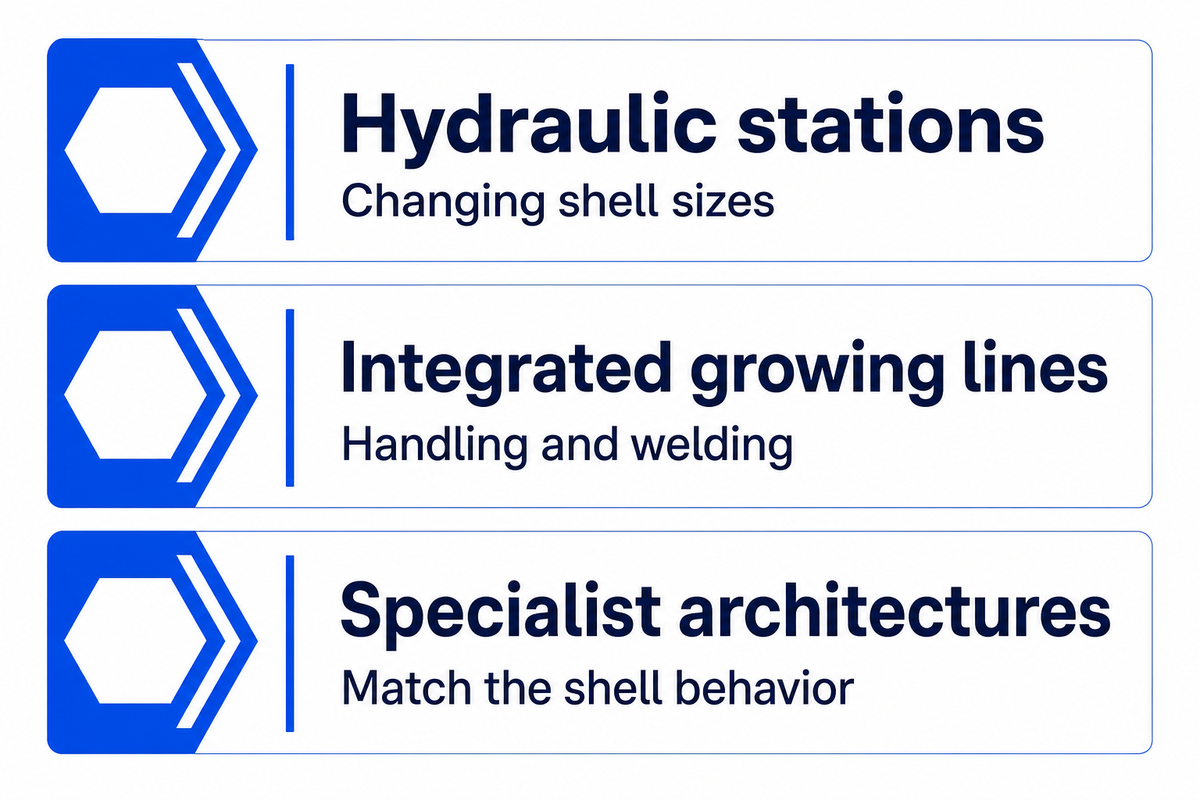
These manufacturers offer hydraulic fitting equipment for changing vessel, tank and tower-section work. The products differ in adjustment directions, support arrangements and the extent of the supplied welding system.
1. Aubrik / Wuxi ABK Machinery Co., Ltd.: Best for Hydraulic alignment of tank, pressure-vessel and wind-tower sections across multiple load classes
Headquarters: Wuxi, China · Founded: 1999 · Type: Welding equipment manufacturer
Official website: https://aubrikmc.com/
Main products: Hydraulic fit-up rotators, turning rolls, welding manipulators and wind-tower lines
Published fit-up capability: HGZ-20: 20 t and 500–3500 mm; HGKF-40: 40 t and 2000–4800 mm; HGKF-60: 60 t and 2500–5000 mm.
Aubrik's catalog is useful when a fabricator handles several shell sizes rather than one repeated tower design: the HGZ-20 covers 500–3500 mm diameters, while the HGKF-40 and HGKF-60 address larger sections with different hydraulic adjustment functions. According to its product table, the HGZ-20 supplies vertical movement, whereas the HGKF models provide three-dimensional adjustment; that distinction matters more than treating every fit-up welding rotator as the same machine with a larger motor. The broader range of turning rolls and welding manipulators gives the buyer a route from a fitting station to a coordinated welding installation. Model selection still controls the available movements, and the company's custom 2000 t scope belongs to separately engineered projects rather than a standard catalog machine.
2. Akyapak: Best for Fixed and travelling fit-up stations in plate-fabrication shops
Headquarters: Bursa, Turkey · Founded: 1962 · Type: Metalworking and welding machinery manufacturer
Official website: https://akyapak.com/
Main products: Fit-up rotators, welding automation, plate rolls and structural fabrication machinery
Published fit-up capability: Fixed and rail-travelling units with hydraulic vertical adjustment and lateral trolley movement.
Akyapak's fit-up arrangement combines a fixed unit with a travelling unit, which is a practical layout for bringing rolled shell sections together before tack welding. Its product description separates hydraulic up-and-down adjustment from the trolley's lateral movement, giving a buyer a clearer picture of how section position is changed than a general promise of precise alignment. A cable pendant lets the operator command the fitting station while observing the joint, and the company's wider metalworking range also covers upstream plate fabrication. This choice suits a shop planning a dedicated fitting area, although the fixed-and-travelling arrangement needs a rail route and floor layout that remain usable as the assembly grows.
3. Wicon: Best for Fit-up stations connected to column-and-boom welding equipment
Headquarters: Konya, Turkey · Founded: 1985 · Type: Welding automation manufacturer within Ömer Atiker Holding
Official website: https://wicon.com.tr/
Main products: WFROT fit-up rotators, positioners, column-and-boom systems and robotic welding systems
Published fit-up capability: Height adjustment with polyurethane rollers and a 5 m cable pendant; motorized travel and column-and-boom synchronization options.
Wicon places its WFROT fit-up equipment within a wider welding automation offer that includes column-and-boom systems, positioners and robotic equipment. According to the product page, the station combines height adjustment, polyurethane rollers and a 5 m cable pendant, while motorized travelling and synchronization with a welding column are available options. That makes the architecture relevant when the procurement task includes both fitting the shell and coordinating the subsequent circumferential welding process. The distinction between base equipment and options is the main purchasing boundary here: a basic fit-up quotation shouldn’t be read as a complete synchronized production line.
4. Cu-Built: Best for Shell-to-shell assembly with separate axial and radial adjustment
Headquarters: Bhosari, Pune, India · Founded: 1995 · Type: Welding automation and industrial crane manufacturer
Official website: https://cubuilt.com/
Main products: Shell-to-shell fit-up rotators, welding manipulators, positioners and industrial cranes
Published fit-up capability: Published 5–200 T configurations for 500–4000 mm diameters, with hydraulic axial and radial adjustment.
Cu-Built describes its hydraulic shell-to-shell equipment in terms of axial thrust and radial cylinder adjustment, rather than rotation alone. Its published offer covers configurations from 5 to 200 T and 500–4000 mm shell diameters, with variable-frequency drives and steel or polyurethane roller arrangements selected for the application. Separate adjustment directions are useful when the operator must bring two shell ends together and correct their relative position before the circumferential joint is tacked. The stated standard task is joining same-diameter shells, so a cone-to-cylinder transition or a strongly tapered workpiece changes the engineering scope instead of merely changing the nominal load capacity.
5. Amin Machinery: Best for Conical-section fit-up within heavy fabrication projects
Headquarters: Vitthal Udyognagar, Anand, India · Founded: 1972 · Type: Welding and heavy fabrication machinery manufacturer
Official website: https://aminmachinery.com/
Main products: Fit-up stations, welding rotators, column-and-boom equipment and positioners
Published fit-up capability: Hydraulic fit-up for wind-tower and conical-pipe sections, using roller-center adjustment to change end height.
Amin Machinery's fit-up offer is relevant to fabricators whose work includes conical pipe or wind-tower sections as well as straight cylinders. The company describes hydraulic fitting in which changes to roller-center distance alter the supported end height, allowing adjoining sections to be brought into position before welding. Its wider manufacturing offer includes heavy welding rotators, manipulators and positioners, making the fitting station part of a broader fabrication-equipment discussion. Cone geometry sets the useful boundary: local diameter, taper and support spacing determine how the workpiece sits on the rollers, so the maximum capacity of an unrelated conventional rotator doesn’t define this fit-up station's working envelope.
6. Primo Automation: Best for Fit-up and transfer equipment within wind-tower welding lines
Headquarters: Chennai, India · Founded: 1995 · Type: Welding automation and special-purpose machinery manufacturer
Official website: https://primoautomation.com/
Main products: Hydraulic fit-up rotators, growing lines, positioners and automated welding systems
Published fit-up capability: Hydraulic left/right and top/down positioning with bogie or trolley transfer options.
Primo Automation describes fit-up movement through hydraulic cylinders that position the section left or right and up or down. The same product range includes bogie and trolley arrangements for moving workpieces, which makes Primo relevant when the job involves transferring a fitted shell into another production station rather than leaving it on one bed. Its wider wind-tower and welding automation offer provides a basis for discussing those handling steps together with the welding equipment. Transfer hardware and control coordination remain additional project scope, however, so a standalone fit-up support and a working tower production line should be treated as different purchasing packages.
7. SENLISWELD: Best for Hydraulic fit-up supports paired with existing driven turning rolls
Headquarters: Wuxi, China · Founded: 1999 · Type: Welding automation equipment manufacturer
Official website: https://www.senlisweld.com/
Main products: Fit-up rotators, conventional rotators, manipulators and positioners
Published fit-up capability: Listed fit-up sizes include 5, 10, 20, 40, 60 and 100 t; hydraulic roller adjustment supports shell alignment.
SENLISWELD's dedicated fit-up page separates hydraulic fitting supports from the conventional rotators that provide the rest of the operating arrangement. The listed sizes include a 20 t option with wireless operation for hydraulic height adjustment, alongside other load classes for differing shell work. This is useful for a fabricator evaluating whether a hydraulic fit-up support can become part of an existing turning-roll installation rather than replacing every item at once. The fitting support isn’t a complete independent welding station: it has to work with an appropriate drive or idler package, with the supported section and adjoining assembly sharing a compatible center height and movement sequence.
8. RESIZE / Wuxi Yuanpeng Machinery: Best for Comparing paired hydraulic fit-up sets by unit load and diameter
Headquarters: Wuxi, China · Founded: Not publicly disclosed · Type: Manufacturer-backed welding automation brand
Official website: https://resizeweld.com/
Main products: Fit-up roller beds, welding rotators, manipulators and positioners
Published fit-up capability: The 60 t fit-up set is listed as 30 t per unit, with a 750–4800 mm diameter range.
RESIZE provides a particularly useful distinction in its fit-up tables: the 60 t set is identified as 30 t per unit, with a 750–4800 mm shell diameter range. That separation helps a buyer compare quotes which otherwise use the same capacity label for a pair of supports, an individual unit or the complete assembly. The manufacturer-backed brand presents hydraulic fit-up equipment alongside conventional turning rolls and welding manipulators, supporting comparisons across the fitting and welding stages. A paired-set total can’t be assigned to one support, and uneven loading is therefore a sizing issue even when the overall shell weight appears to fit the headline rating.
Integrated Fit-Up Systems and Growing Lines
These offers put the fitting station into a wider handling or welding arrangement. A dedicated growing line, a modular tank-fitting system and a rail-mounted station are different architectures; the profiles below identify the documented approach.
9. Pemamek: Best for Integrated pressure-vessel assembly and welding production
Headquarters: Loimaa, Finland · Founded: 1970 · Type: Automated welding and production systems manufacturer
Official website: https://pemamek.com/
Main products: PEMA assembly stations, growing lines, roller beds and column-and-boom welding systems
Published fit-up capability: Assembly station and fixed-jig configurations for shell fit-up, with conical-section handling and line integration.
Pemamek's PEMA offer is strongest as a discussion about the whole assembly process: shell positioning, growing the vessel and integrating the welding stations. Its power-generation material describes assembly-station and fixed-jig arrangements, with roller support and handling provisions for cylindrical or conical workpieces. A buyer planning repeated vessel production can therefore compare the fitting operation alongside transfer, access for welding and the rest of the production sequence, rather than specifying isolated roller beds first. That broader scope also determines the purchasing effort, because an integrated assembly station needs coordinated floor space, handling paths and controls before its contribution to production output can be judged.
10. Key Plant: Best for Powered three-axis fit-up and growing-line transfer
Headquarters: Leek, Staffordshire, UK · Founded: 1956 (Court Burn Welding roots) · Type: Welding automation and handling equipment manufacturer
Official website: https://www.keyplant.com/
Main products: Growing lines, fit-up beds, turning rolls, welding manipulators and positioners
Published fit-up capability: Powered X, Y and Z adjustment using ball-screw or hydraulic systems under load.
Key Plant describes growing-line fit-up with powered X, Y and Z movement, using ball-screw or hydraulic systems to adjust the supported workpiece under load. This provides a clear basis for buyers who need several adjustment directions and controlled transfer as successive shell sections become a longer assembly. The company traces its manufacturing heritage to Court Burn Welding in 1956, while the present UK company was incorporated in 2009; those are different historical facts, not competing dates for one legal event. Installation creates the practical constraint: a custom growing line needs rails, transfer routes and control interfaces engineered as part of the same project.
11. IRCO Automation: Best for Project-engineered fit-up lines for exceptionally heavy vessels
Headquarters: Burlington, Ontario, Canada · Founded: 1963 · Type: Welding automation and positioner manufacturer
Official website: https://ircoautomation.com/
Main products: Tank fit-up lines, turning rolls, positioners and welding manipulators
Published fit-up capability: Custom tank fit-up example for a 700,000 lb vessel, with multiple positioning movements and powered rails.
IRCO's published tank-fitup line illustrates a project-engineered approach through a system for a 700,000 lb vessel. The described arrangement combines vertical, lateral and longitudinal positioning with rotation and powered rail movement, giving a heavy-fabrication buyer a concrete example of how alignment and handling can be coordinated. This makes IRCO relevant when the inquiry starts with an unusually large vessel and a required sequence of movements, rather than a standard roller-bed model number. The published load belongs to that custom project; it’s evidence of the project scope, not a blanket rating for every IRCO line or every support within it.
12. LJ Welding Automation: Best for Modular tank fit-up with explicit per-section load limits
Headquarters: Edmonton, Alberta, Canada · Founded: 1976 · Type: Welding automation and handling equipment manufacturer
Official website: https://www.ljwelding.com/
Main products: ALG tank fit-up rotators, turning rolls, positioners and welding manipulators
Published fit-up capability: ALG412: 60 tons total and 4 tons per 8 ft section; ALG512: 20 tons total and 5 tons per 5 ft section.
LJ makes the section-load question unusually visible in its ALG tables: the ALG412 is listed at 60 tons total with 4 tons per 8-foot section, while the ALG512 is listed at 20 tons total with 5 tons per 5-foot section. LJ uses US short tons in these model specifications. Those distinctions help a fabricator compare modular tank fit-up layouts using the actual mass carried at each section rather than only the finished tank's total weight. The dedicated range combines support, adjustment and driven handling for bringing tank sections together, within LJ's broader turning-roll and welding automation portfolio. Section load remains the deciding constraint, which can be reached even when the total assembly is below the advertised system capacity.
13. Motofil: Best for Large-diameter tower cans and heavy cylindrical assemblies
Headquarters: Ílhavo, Portugal · Founded: 1981 · Type: Robotic welding and industrial automation manufacturer
Official website: https://www.motofil.com/
Main products: Fit-up turning rolls, welding manipulators, positioners and robotic cells
Published fit-up capability: Hydraulic roller elevation with variable-speed rotation and rail options; published diameter range begins at 4000 mm.
Motofil's fitup turning rolls combine hydraulic elevation with variable-speed rotation and optional movement on rails. The published diameter range begins at 4000 mm, placing the offer in a large-shell discussion that’s relevant to substantial tower cans and other heavy cylindrical assemblies. Hydraulic elevation allows the fitting position to be adjusted, while the wider automation range gives a buyer a route to discuss welding and handling interfaces around the station. The lower diameter boundary is important: a machine suitable for a large tower can isn’t automatically suitable for a smaller vessel, and rail travel alone shouldn’t be mistaken for a complete continuous growing-line process.
14. Irizar Heavy Industries: Best for Stock 40-metric-ton fit-up equipment with a custom heavy-system path
Headquarters: Edmonton, Alberta, Canada · Founded: 1999 · Type: Heavy welding and fabrication equipment manufacturer
Official website: https://www.jirizar.com/
Main products: FUR fit-up rotators, turning rolls, manipulators, positioners and forming equipment
Published fit-up capability: Hydraulic fit-up for shell courses; FUR-40 stock offer and project-specific heavy FUR configurations.
Irizar's public offer separates a stock FUR-40 fit-up rotator from larger, project-specific FUR configurations. The fit-up equipment uses hydraulic positioning of shell courses, and the company also supplies turning rolls, welding manipulators and other heavy fabrication machinery from its Canadian operation. That combination is useful for a buyer comparing a defined 40-metric-ton requirement with a possible later move into a much heavier custom assembly system. The purchasing boundary is the stock-versus-custom distinction: the availability of a FUR-40 doesn’t establish the delivery scope or lead time of the largest FUR configurations listed for engineered projects.
Fit-Up Specialists for Particular Shell and Roller Arrangements
The remaining manufacturers illustrate several ways to solve the alignment task, from individual-wheel motion to thin-wall tracking and manual hydraulic fitting. Choose the mechanism around the shell and joint rather than the largest number in the catalog.
15. Koike Aronson Ransome: Best for Independent wheel positioning for large-vessel fit-up
Headquarters: Arcade, New York, USA · Founded: 1946 (Aronson); Koike roots 1918 · Type: Cutting, welding and positioning equipment manufacturer
Official website: https://www.koike.com/
Main products: Powered fit-up rolls, turning rolls, positioners and welding manipulators
Published fit-up capability: Published 30–1200 tons fit-up range with individually powered wheel movements under load.
Koike Aronson Ransome's powered fit-up rolls focus on adjustment at the individual wheel: each wheel can move up or down and left or right while carrying the workpiece. The published fit-up range extends from 30 to 1200 tons, with cart arrangements and drive options used to bring sections together and support weld-out. This architecture is relevant when a large vessel needs local correction at the supports, rather than only a common rise or fall of the complete roller bed. The working package depends on the selected cart and drive configuration, so fitting movement, rail travel and powered rotation must be compared as separate functions within the quotation.
16. The Webb Corporation: Best for Thin-wall, large-diameter shell seam tracking
Headquarters: Webb City, Missouri, USA · Founded: 1881 · Type: Plate forming and welding machinery manufacturer
Official website: https://webbcorporation.com/
Main products: Fit-up turning rolls, tank turning rolls, plate rolls and welding equipment
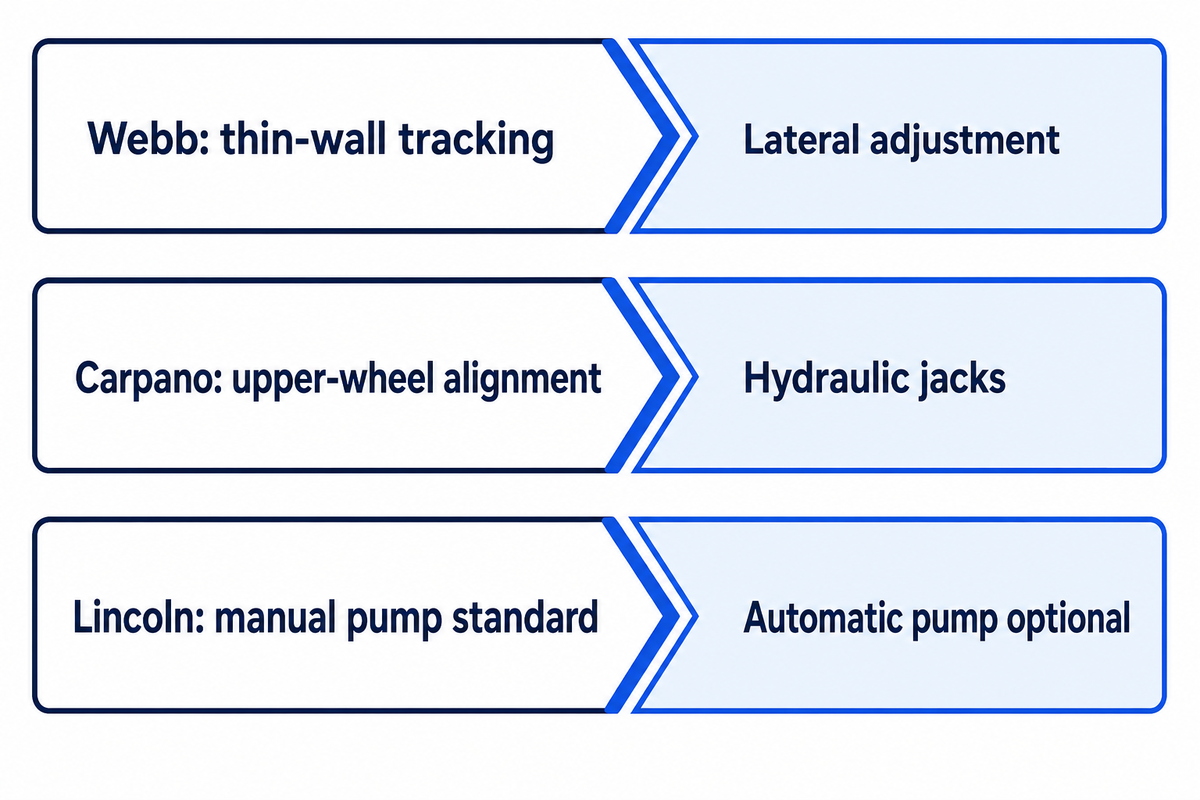
Published fit-up capability: Variable-speed fit-up rolls with lateral adjustment and a tracking arrangement for thin-wall shell seams.
Webb's fit-up arrangement addresses thin-wall, large-diameter shells through variable-speed turning, lateral adjustment and a tracking arrangement near the seam. That combination is relevant where the challenge is supporting and matching relatively flexible shell edges while rotating the assembly for fitting and welding. The company also builds other tank turning rolls and plate-working equipment; the mechanism and capacity of each fit-up model suit a different fabrication job. This is a specialized thin-wall tracking approach, and its suitability should be judged against that job rather than treated as interchangeable with a heavy hydraulic station offering three powered alignment axes.
17. Carpano Equipment: Best for Upper-wheel hydraulic alignment before tack welding
Headquarters: Bologna, Italy · Founded: 1992 · Type: Welding automation equipment manufacturer
Official website: https://www.carpano.it/
Main products: Fit-up rotators, conventional rotators, welding positioners and manipulators
Published fit-up capability: Hydraulic jacks on upper wheels align adjoining edges before tack welding.
Carpano uses hydraulic jacks to move the upper wheels of its FIT-UP rotator and bring adjoining vessel edges into position for tack welding. The product description also emphasizes distributing the load across the supports, which connects the fitting action with how the shell is carried rather than treating alignment as a separate clamp operation. This is a useful architecture for buyers who want controlled edge matching before the assembly proceeds to the main circumferential weld. Carpano describes capacity and vessel diameter as configurable to the application; that’s a custom engineering offer, so it doesn’t supply one universal catalog envelope or an unlimited load rating.
18. Lincoln Electric: Best for Manual hydraulic fit-up within a broader welding equipment package
Headquarters: Cleveland, Ohio, USA · Founded: 1895 · Type: Welding equipment and automation manufacturer
Official website: https://www.lincolnelectric.com/
Main products: ROTAMATIC TR fit-up roller beds, conventional roller beds, welding power sources and automation
Published fit-up capability: ROTAMATIC TR fit-up beds: 30–200 tons per paired set in the cited catalog; manual hydraulic vertical adjustment as standard.
Lincoln Electric's ROTAMATIC TR catalog distinguishes the hydraulic fitting beds from the motorized conventional LP bed used with them. The cited catalog lists paired fit-up sets from 30 to 200 tons and identifies a manual hydraulic pump as the standard means of producing up-and-down movement, with an automatic central pump available as an option. This gives buyers a route to hydraulic fitting within a broader welding equipment package without assuming that every hydraulic cylinder requires a fully automatic control system. The operating distinction matters when comparing quotations: the standard manual-pump arrangement is a different scope from automatically powered adjustment across two fitting sections.
19. Bota Heavy Industry: Best for Independent hydraulic roller-group alignment with automation interfaces
Headquarters: Luoyang, China · Founded: Not publicly disclosed · Type: Welding and cutting automation manufacturer
Official website: https://www.bota-welding.com/
Main products: Hydraulic fit-up rotators, conventional rotators, manipulators and welding positioners
Published fit-up capability: Independent hydraulic adjustment of roller groups for vertical positioning and horizontal alignment.
Bota's hydraulic fit-up page describes independent adjustment of each roller group to change the supported section's height and horizontal alignment. The company connects that mechanism with assembly of wind-tower sections, tanks and pipes, and with interfaces to automated welding equipment. For a buyer evaluating hydraulic correction of shell-edge mismatch, the useful feature is the ability to position the roller groups independently instead of relying on rotation alone. The engineered offer needs to present a complete capacity-and-stroke specification for each model, because the final machine envelope and control interfaces must fit the existing welding equipment as well as the stated alignment mechanism.
20. Zhouxiang: Best for Four-wheel hydraulic fit-up in the 40 and 60 t classes
Headquarters: Wuxi, China · Founded: 1991 · Type: Welding and fabrication machinery manufacturer
Official website: https://zhouxianggroup.com/
Main products: Hydraulic fit-up rotators, conventional rotators, manipulators and wind-tower production lines
Published fit-up capability: ZHGK-40: 40,000 kg, 2000–4800 mm; ZHGK-60: 60,000 kg, 2500–5000 mm.
Zhouxiang publishes two defined hydraulic fit-up models: the ZHGK-40 at 40,000 kg for 2000–4800 mm workpieces and the ZHGK-60 at 60,000 kg for 2500–5000 mm workpieces. Its description identifies four independently adjustable rolling wheels and a fitting arrangement that works alongside a conventional drive unit. Those model-specific figures make the company relevant when a fabricator's shell family falls within the stated 40 or 60 t classes and needs controlled matching before welding. The minimum diameters are a real selection boundary, since a lighter shell can still fall outside the roller geometry even when its weight is comfortably below the machine's nominal capacity.
How to Choose: Match the Machine to Shell Geometry and Load
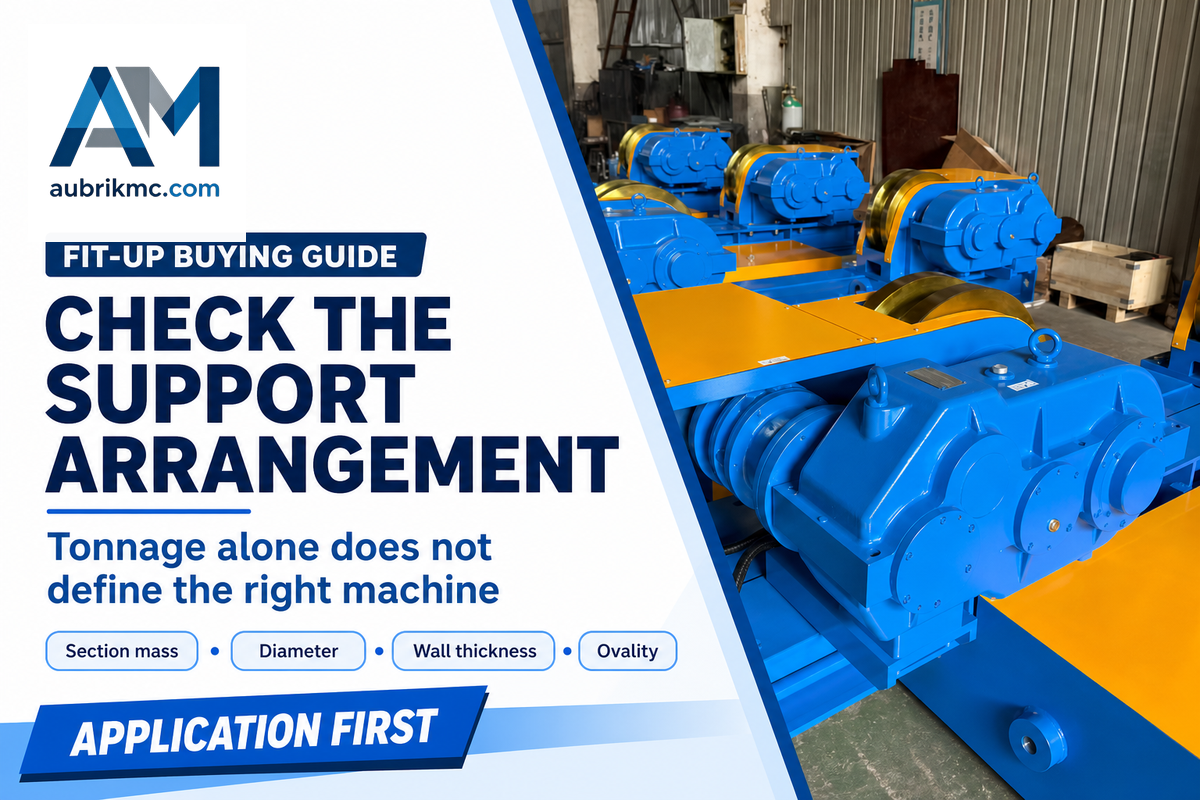
Your shortlist begins with the workpiece that the station must actually support, move and hold. Send every manufacturer the same operating envelope, including the difficult small-diameter or tapered sections. Equipment that carries the largest finished vessel may still be wrong for its first few shell courses. Aubrik’s fit-up rotator operating and alignment guide covers the equipment selection process in more detail.
1. Separate section mass from assembly and support loads
Temporary tools and fixtures should be considered when analyzing a system. Specify the mass of each shell section, the growing assembly and the load carried by each support. Design of a system based on assumptions of equal load distribution isn’t valid. Equal load distribution among the roller beds of a system shouldn’t be assumed.
LJ’s section ratings and RESIZE’s per-unit ratings show why two capacity labels can describe different things. Record whether the quotation refers to one unit, one paired set or the complete line, and whether the figure is a support, lifting or rotation rating. The fit-up capacity sizer can help organize weight and outside-diameter inputs for an initial enquiry; final selection still requires the actual shell and support arrangement.
In heavy machinery manufacturing, heavy workpieces can carry temporary tooling whose mass changes during assembly. Include that tooling in the supported load supplied with the enquiry.
2. Describe diameter, wall thickness, taper and ovality
Specify maximum and minimum outside diameters at the fitting plane, along with wall thickness, section length, taper and expected shell ovality. For rotators for pipe fabrication, provide local pipe diameter at supporting areas. These affect contact with the roller and the deformation of the supported shell. Long cylindrical structures require a support system in conjunction with the stiffness of the structure, and a general rotator description of pipe doesn’t address this requirement. Diameter of thin and thick section tanks can be similar, and the support geometry can greatly affect their deformation.
Ask for the roller contact arrangement, wheel material and method used to assess local contact pressure and shell stability. Polyurethane wheels, steel wheels and different roller widths are design choices with application consequences, not a universal quality hierarchy. Motofil’s published lower diameter boundary and Zhouxiang’s model ranges show why checking only the largest cylinder leaves a substantial gap in the enquiry.
Thin-wall storage tanks and thick vessel shells can demand different support arrangements. A pipe rotator selected for one geometry needs a separate assessment when the wall stiffness or contact arrangement changes.
3. Define hi-lo, root gap and the required adjustment axes
For pipe butt joints and other applications of butt welding, separation at the joints is to be expected, and the clearance between the edges is called root gap. These are to be distinguished from the edge misalignments that are called hi-lo. For pipe welding, the required joint preparation and geometry are to be taken from the respective fabrication specification. Edge alignment can occur due to lateral or vertical movements. Controlled axial movements can bring the two separated sections together. The effects of these movements and support layout on the overall system must be analyzed in conjunction with each other.
For each joint specify movements requiring independent control, the usable stroke, and whether adjustment is necessary under the full fitting load. State the location and method for evaluating loaded accuracy and repeatability through the full joint circumference. Information regarding unloaded positioning or cylinder strokes doesn’t determine the joint tolerance, and neither does a statement of “three-dimensional” adjustment.
4. Match drive, idler and load-holding functions
Identify the roller beds that drive the workpiece, the idlers that support it, and how their motion is coordinated during fitting and weld-out. Also include in the specification the allowed imbalance of the workpiece, as well as its speed, traction, and starting behavior. Finally, include the nominal tonnage of the load. Note the working height of the column-and-boom welding manipulator. Also indicate if there are any impediments to accessing the joint.
Clients should specify expected holding arrangements and request information concerning locks and other load retention provisions for hydraulic welding rotators. What are the operating pressure limitations? Under what access conditions will equipment maintenance be performed? Identify the various functions of the hydraulic pump station and control packages. Which functions are controlled by a pendant or a wireless signal? Separately identify the ranges of tilt, elevation and lateral travel. The rotator takes over fine positioning, but the fabrication process still needs a crane for loading and unloading.
Specify the hydraulic control functions available at a pendant or wireless remote, and the emergency stop functions to be demonstrated at acceptance. A fit-up rotator for accurate edge matching can reduce manual repositioning; loading and unloading still need a planned lifting method.
How to Choose: Define Acceptance Tests and Total Installed Cost
Evaluate the operating systems offered and determine what functions are integrated in each system. Understand what functions are integrated in the base equipment versus what functions are integrated and offered as add-on systems. Knowing the bare machine price doesn’t guarantee an apples to apples comparison of price as other suppliers may have included various systems and sub-systems as part of the base price.
5. Specify the growing-line interfaces and production sequence
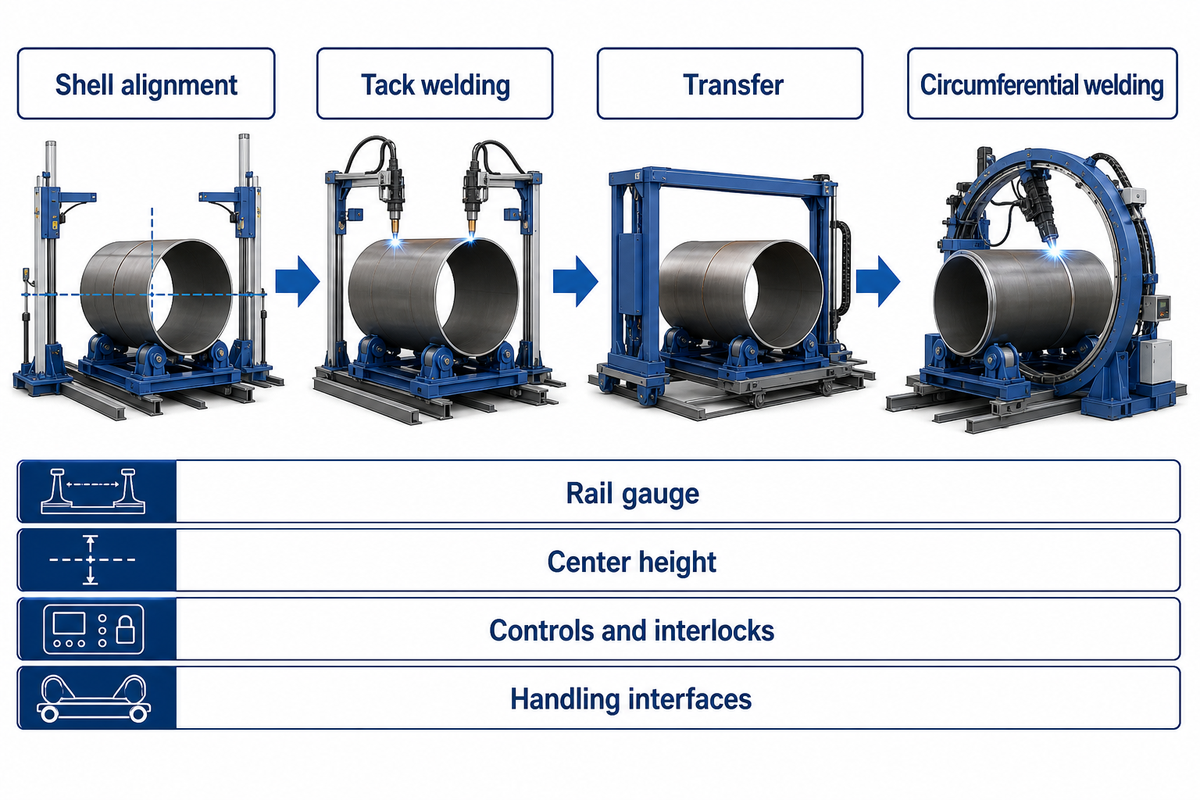
Describe the loading, shell alignment, tack welding, transfer, circumferential welding, and removal of an assembled unit on a welding production line. Cover pressure vessel welding and the welding of cylindrical tower sections. Mention the sequence of the stations for the actual product and touch on rail gauge, center height, automatic handling system, manipulator, controls, interlocks, and the kind of hand-off required at the stations. Consider the type of welding to be done and the kind of equipment and sequence to be used in the system.
State whether the sequence includes manual welding, TIG welding or automatic welding. Efficient welding depends on preparation and access as well as roller motion. Across machinery manufacturing, tank welding and shipbuilding assemblies can require different handling sequences even when their components share cylindrical geometry.
Estimate the production takt time for the complete sequence and include in the estimate the time required to handle and inspect the product. Increasing rotation speed doesn’t necessarily increase the line output. Discuss the estimated production of the wind-tower production lines and indicate the responsibilities of the supplier for the interfaces. Discuss other equipment located in the shop.
6. Distinguish shop fabrication from field tank erection
The solutions offered typically use a supported shell segment of fabrication, and are more applicable to shop fabrication of a pressure vessel than to an on-site construction of a large vertical storage tank. A process machine suitable for supporting cylindrical workpieces during welding may also be used for fabricating tank shells, but such a machine doesn’t, in and of itself, constitute a complete field-erection system for tanks.
Provide details about the installation site and conditions. Describe workpiece orientation. Discuss available lifting methods and the conditions of the floor and foundation. Knowledge about pipe welding and fabrication (oil and gas production vessels and wind turbine towers) is useful to explain general principles concerning methods and sequences for lifting and transporting components. General application names are a starting point; the actual arrangement is the basis for assessment. Within machinery manufacture, similar structures may be part of different welding applications.
7. Agree representative loaded acceptance tests
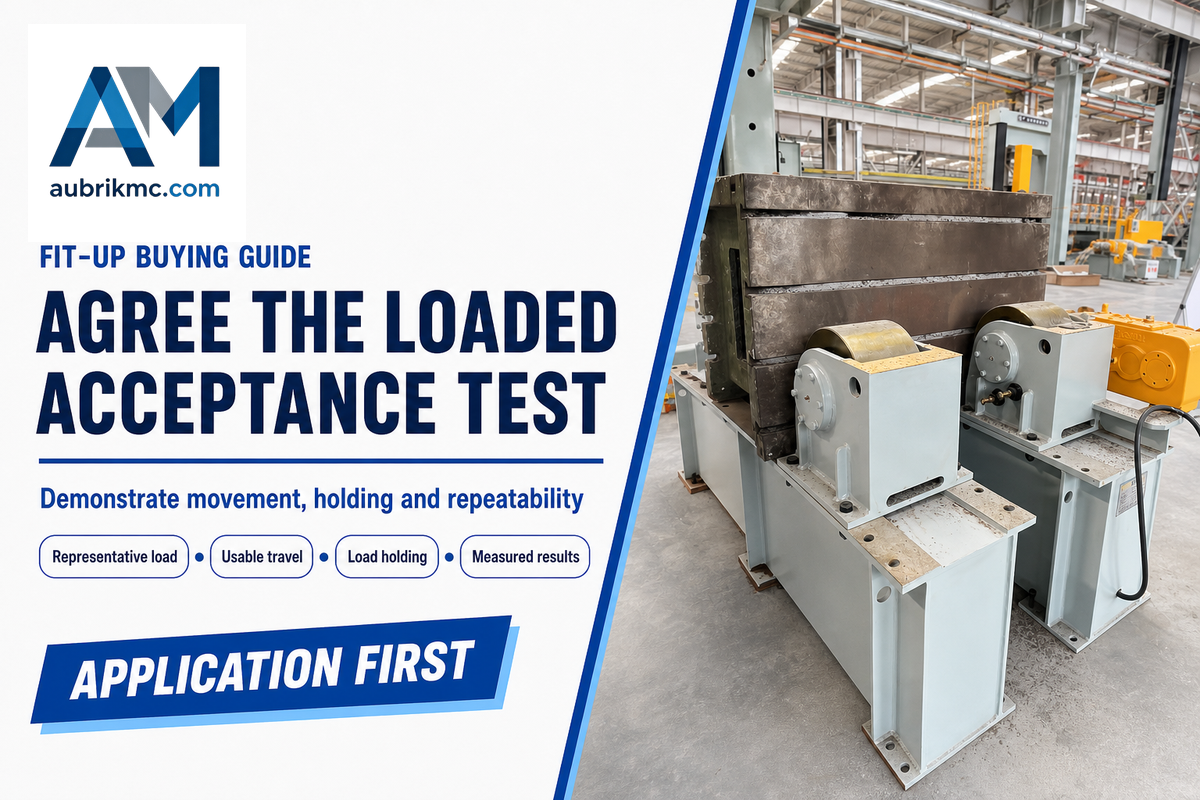
It’s understood that a Factory Acceptance Test (FAT) for a large diameter shell requires representative geometry and loading, with an agreed substitute in the case where a full-size shell can’t be provided. The FAT should demonstrate the required adjustment directions, usable travel, rotation controls and transition to the welding process. To verify edge to edge fit of a fit-up rotator, measure the joint at the agreed locations, and don’t rely on the appearance of the joint. A smooth weld doesn’t necessarily indicate that the fit-up requirement has been achieved. Define the measurement points, instruments and repeatability procedure before the test, so a smooth demonstration does not substitute for the required results.
State the requirements regarding the configuration of the welding machine as agreed by the supplier. Include load holding, hydraulic condition, leaks, remote controls, emergency-stop functions and relevant interlocks in the agreed inspection scope. Decisions regarding acceptable Hi-Lo and root gap at the joint position are taken based on drawings, the welding procedure, and the requirements of fabrication. Drawings, the welding procedure and the applicable fabrication requirements determine acceptable hi-lo and root gap; a machine’s brand or a general AWS, ASME or API reference doesn’t supply one limit for every joint.
8. Compare the complete installed-cost scope
Request that each supplier contractually break out the machine, hydraulic power units, controls, cables, rails, and foundations; freight and installation; and commissioning and training of operators. Provide details of expected spares, and identify seals, hoses, cylinders, bearings, and roller covers. For a custom scope of work, show the effort and acceptance associated with interconnecting the fitting station to the production equipment. Manufacturers may customize a heavy-duty station, but the quotation should identify the requested scope of work.
Future costs depend on expected usage, maintenance and production interruption as well as the purchase price. A contractor may take a different view on the value of adjustment and setup if, for example, the work is performed in a shop with frequent diameter changes, compared to repetitive work in a tower plant.
Key takeaway
A fit-up rotator earns its place on the shortlist when its section loads, diameter envelope, loaded adjustment movements and handling interfaces match the fabrication job.
Frequently Asked Questions
Which is the best fit up rotator manufacturer?
View Answer
The best fit-up rotator manufacturer depends on section weight, diameter, wall thickness, allowable hi-lo, required adjustment axes, automation level and local service needs. Compare makers against the same shell drawings and acceptance conditions. A catalogue hydraulic unit may suit changing vessel jobs, while a coordinated growing line may suit repeated tower production. There is no single global winner for every fabrication shop. Local commissioning support and spare-part availability can also change which supplier is practical for a particular installation.
What is a fit-up rotator?
View Answer
A fit-up rotator is a powered roller-bed system that supports cylindrical sections and adds controlled adjustment so adjoining shell courses can be aligned before tack or circumferential welding. Hydraulic or mechanical movement changes the supported section's position. A separate powered drive unit may supply the rotation needed for subsequent welding.
What is the difference between a fit-up rotator and a welding rotator?
View Answer
A standard welding rotator mainly supports and rotates a cylinder, while a fit-up rotator adds active alignment functions for matching adjoining cylindrical sections before welding. High load capacity alone does not establish fitting capability. An installation can combine dedicated fit-up supports with powered and idler rolls for the subsequent weld.
What is the difference between a fit-up rotator and a self-aligning rotator?
View Answer
A self-aligning rotator primarily adapts its roller geometry to different diameters, while a fit-up rotator actively adjusts section position to control alignment, hi-lo or gap. Both functions may share an installation, but the specified adjustment axes establish its fitting capability.
Which fit-up rotator is best for wind towers?
View Answer
The best fit-up rotator for wind towers matches the tower's section weights, diameter range, wall thickness and incoming ovality, then provides the adjustment and line interfaces required for production. Evaluate tapered sections as well as the largest can. Hydraulic stroke, loaded fitting accuracy, shell support and transfer arrangements matter alongside nominal tonnage. Include flange mass and the sequence for adding each section, then assess how the fitting station connects to tack welding, circumferential welding and inspection within the production line.
How much does a fit-up rotator cost?
View Answer
Fit-up rotator pricing varies with load, diameter, hydraulic axes, roller configuration, controls, automation, foundations and custom engineering. Compare quotations with the same acceptance scope, including freight, commissioning, installation and spares. A bare roller-bed price does not represent the installed system.
Prepare a Fit-Up Rotator Enquiry
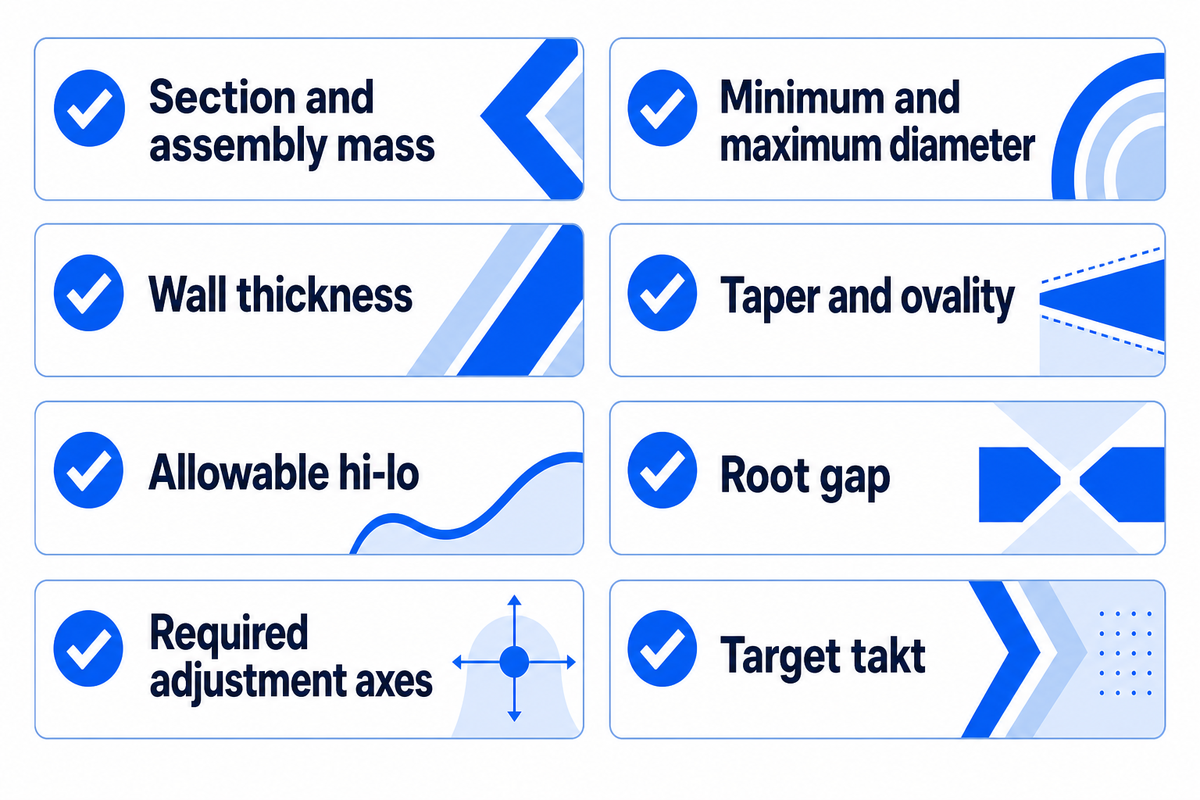
Section drawings of the shells to be fabricated along with an assembly sequence should be provided. Information on the mass of each shell section and the assembly, minimum and maximum outside diameter, wall thickness, taper, incoming ovality, allowable hi-lo, root gap, required adjustment axes and target takt should be provided. The supplier should define the required adjustment for alignment. Provide information on the available cranes and welding equipment along with the available space to assist the supplier in defining the required interface.
Aubrik’s hydraulic fit-up rotator models provide a starting point for tank, pressure-vessel and wind-tower enquiries. Larger or unusual shells call for project-specific sizing. The best fit comes from matching the machine to that envelope and agreeing the acceptance scope before ordering.
Send Aubrik your section drawings
References & Sources
Company profiles and model figures are drawn from the manufacturers’ official histories and fit-up product catalogs, checked in October 2026. Their official websites appear beside each entry. Published specifications describe the named model or project; they aren’t independent comparative test results.
- Key Plant Automation Limited company record, Companies House: current UK entity incorporated on 24 March 2009, distinct from the manufacturer’s earlier business heritage.