Get in Touch with Aubrik Company
Top 20 Cobot Welding Manufacturers for Different Welding Jobs

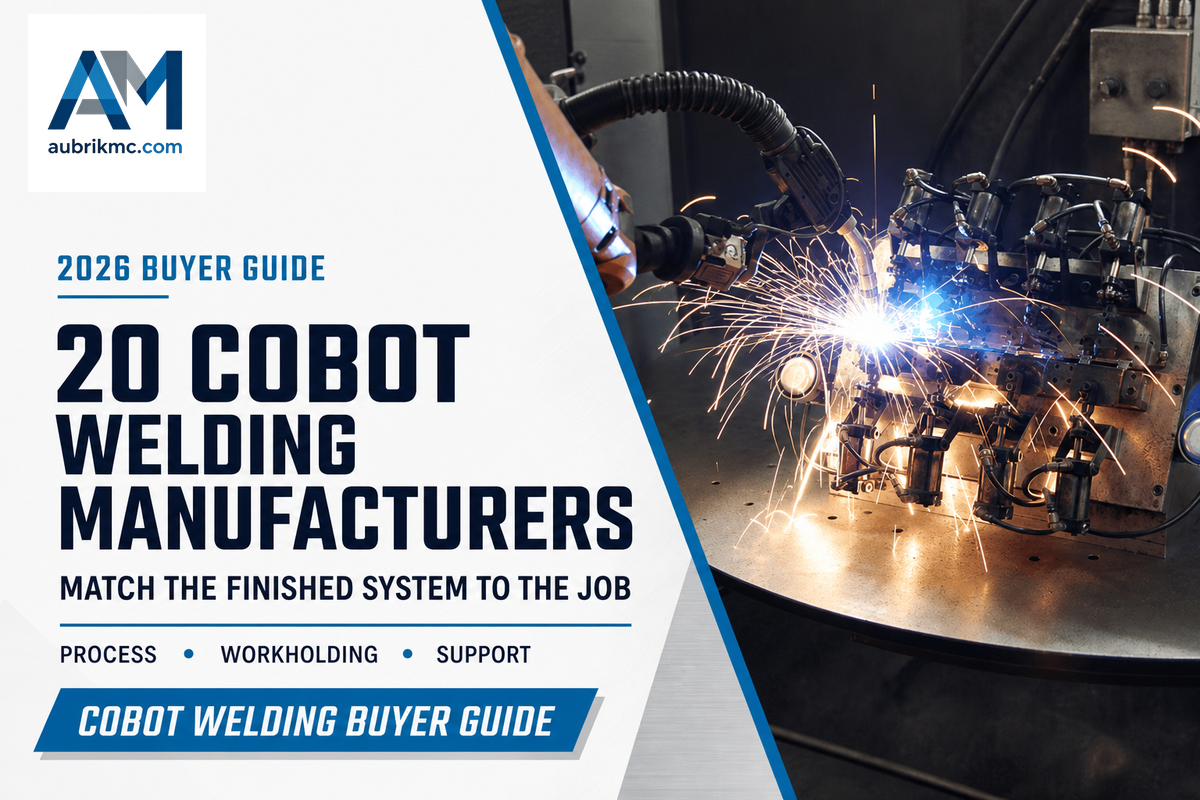
Last updated: October 2026
The best cobot welding manufacturers include Fronius for compact enclosed cells, Hirebotics for app-controlled MIG welding, IPG Photonics for laser welding and cleaning, and Novarc for pipe spools. Aubrik offers custom cells for high-mix fabrication. Compare these welding solutions against the joint, process, workholding and support needed for your production.
Quick Picks: Match the Welding System to the Job
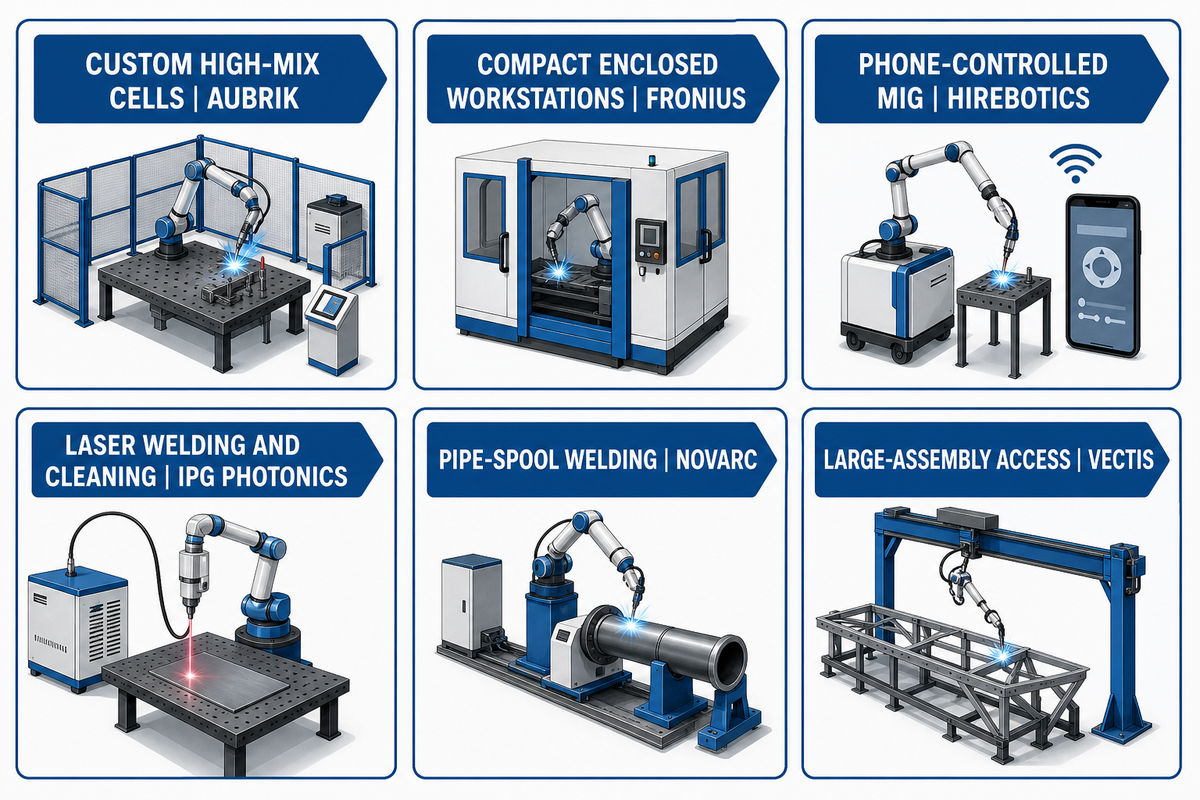
- Best for custom cobot welding cells for high-mix fabrication and collaborative production: Aubrik
- Best for compact enclosed workstations: Fronius CWC-S
- Best for phone-controlled MIG welding: Hirebotics Cobot Welder
- Best for laser welding and cleaning: IPG Photonics LightWELD Cobot System
- Best for pipe-spool welding: Novarc SWR
- Best for taking a welding cobot to large assemblies: Vectis Automation
Disclosure: This guide is published by Aubrik. We list ourselves first because this is our website, not because we claim to be the market leader. The other 19 manufacturers are grouped by what they’re best for, in no particular order within each group.
How We Selected These Cobot Welding Manufacturers
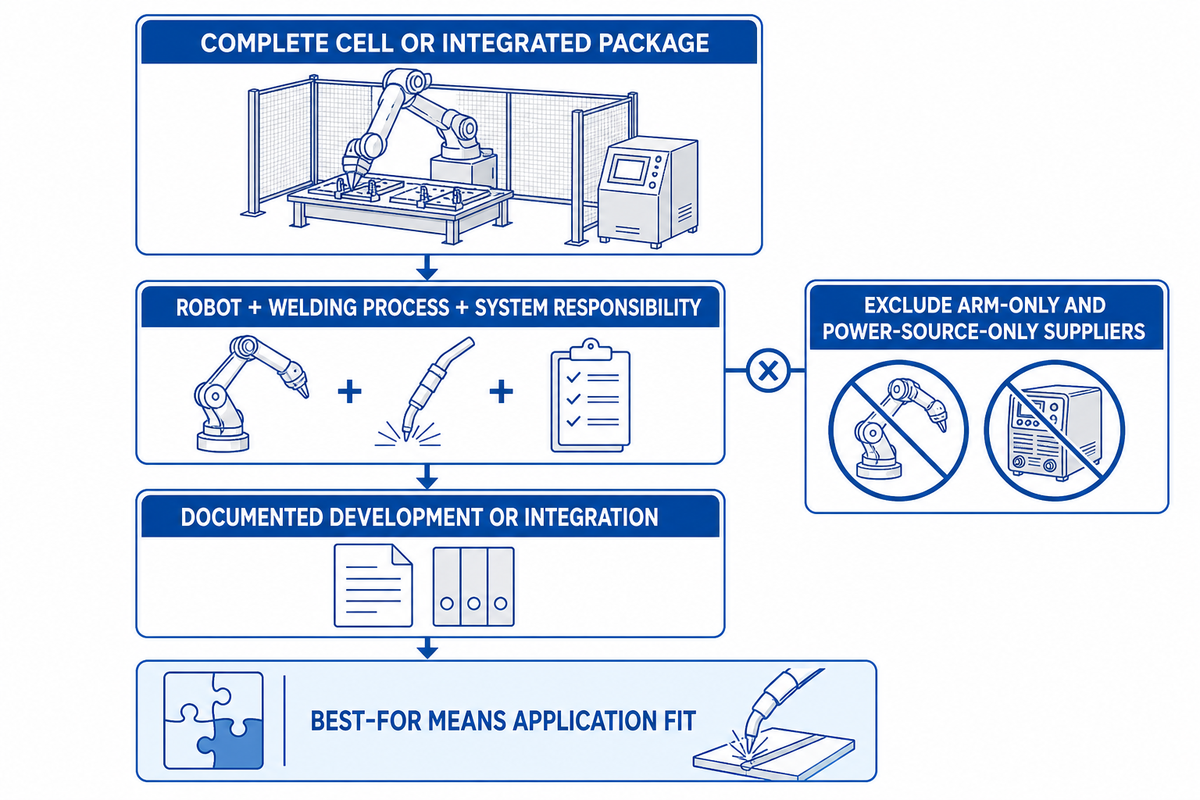
We reviewed manufacturers and welding automation integrators who presented a complete cobot cell or integrated welding package on their websites. As evidence, the robot had to be shown with the welding process and system responsibility; a pick-and-place demonstration arm wasn’t sufficient. Distributors, brokers, directories, suppliers of robot arms or welding power sources only, and suppliers of welding equipment in the absence of a system integration or development role were excluded. Companies that also sell equipment qualify only through their documented system development or integration work. Information was verified against the companies’ official websites and public domain sources in October 2026.
The scope of the study is restricted to enclosed cells, flexible workstations and integrated packages that support the tooling. Systems and workstations have different boundaries of installation, e.g. a welding bundle may consist of a robot, power source, and controls, and leave the fixture table to the user. The table identifies such cases. Company cards describe named systems. Each manufacturer’s catalog may have several welding and/or robot machines, but not all such machines are considered collaborative products in this comparison. Best-for labels indicate machine fit for an application, not market share or performance.
Comparison of Complete Cobot Welding Systems in 2026
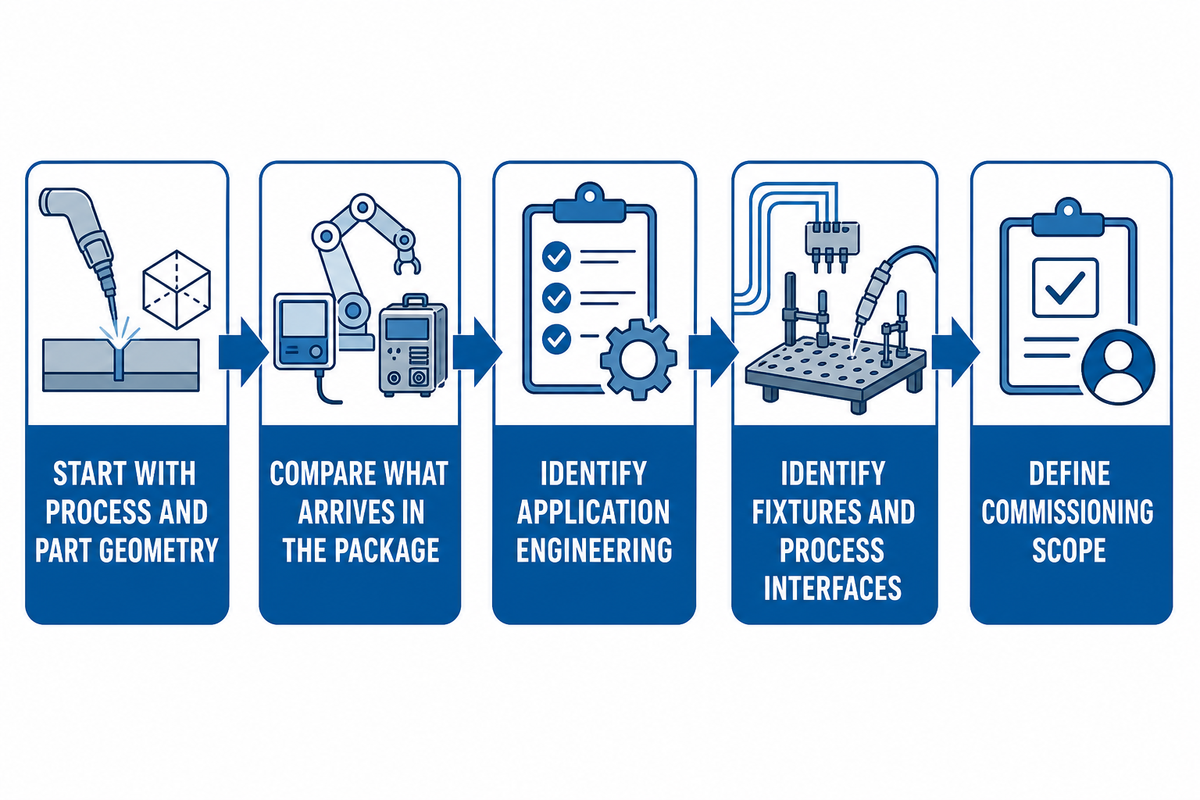
For this 2026 comparison, start with the process and part geometry, then compare what arrives in the package against your production needs. A compact enclosed MIG cell, a TIG workstation and a pipe-spool robot solve different welding tasks. A familiar robot brand can appear in several suppliers’ cells because the integrator owns the application engineering, fixtures, process interfaces and commissioning scope. The entries below focus on that finished welding offer. For Böhler Welding, the year shown is the 2013 adoption of its current group name; its corporate history traces the Böhler & CO roots to 1870.
| No. | Company Name | Headquarters | Founded Year | Best For | Brief Introduction | Primary Cobot Welding Systems | Key Advantages | Potential Disadvantages | Official Website |
|---|---|---|---|---|---|---|---|---|---|
| 1 | Aubrik | Wuxi, Jiangsu, China | 1999 | Best for custom cobot welding cells for high-mix fabrication and collaborative production | Custom cells with configurable process equipment and workholding. | Cobot cells, fixtures and positioners | Application-specific cell engineering | Scope and cycle time depend on the selected part, process and fixtures. | aubrikmc.com |
| 2 | Lincoln Electric | Cleveland, Ohio, USA | 1895 | Best for CRX welding packages with Power Wave process control | Welding OEM integrating FANUC cobots with Lincoln process hardware. | Cooper Cobot package | Power Wave R450 and torch-based teaching | Custom tables, fixtures and positioners extend the base package. | www.lincolnelectric.com |
| 3 | Lorch | Auenwald, Germany | 1957 | Best for modular MIG/MAG and TIG cells with positioning options | Welding OEM combining its processes with modular cobot automation. | MyCobot MIG/MAG and TIG packages | Cobotronic plus travel and positioning options | Travel, positioning and sensing depend on selected modules. | www.lorch.eu |
| 4 | Migatronic | Fjerritslev, Denmark | 1970 | Best for preconfigured MIG/MAG or TIG packages for simple parts | Welding OEM offering preconfigured robot and process combinations. | CoWelder | MIG/MAG and TIG configuration choices | Listed working radii are 850 or 1,300 mm. | www.migatronic.com |
| 5 | CLOOS | Haiger, Germany | 1919 | Best for QINEO MIG/MAG packages with integrated welding macros | Welding OEM delivering the system with group integrator MPA Technology. | Cobot Welding System | QINEO hardware and welding macros | Welding table and anti-glare screen are optional. | www.cloos.de |
| 6 | Fronius | Pettenbach, Austria | 1945 | Best for compact enclosed cells for defined component sizes | Welding OEM supplying a compact enclosed cobot station. | CWC-S | Defined process package and component envelope | Rotary option reduces the usable component envelope. | www.fronius.com |
| 7 | Yaskawa Motoman | Kitakyushu, Japan | 1915 | Best for enclosed MIG/MAG cells with direct-teach programming | Robot OEM offering a defined MIG/MAG cobot welding cell. | Weld4Me CE | Direct teaching and functional safety unit | Requires connection to welding-fume extraction. | www.yaskawa.eu.com |
| 8 | Böhler Welding | Düsseldorf, Germany | 2013 | Best for matched consumables and process equipment in enclosed cobot cells | Welding OEM matching its equipment, consumables and automation. | CO-BRO and CO-BRO GUARD | Defined package contents and enclosed-cell option | GUARD is MIG/MAG; TIG uses another package. | www.voestalpine.com/welding |
| 9 | EWM | Mündersbach, Germany | 1957 | Best for enclosed MIG/MAG cells with a two-station indexing table | Welding OEM supplying enclosed cells with integrated or external-source options. | XQbot 1 and XQbot 2TT | Integrated process equipment and indexed workholding | EPS variants need an external source; 2TT indexing is manual. | www.ewm-group.com |
| 10 | IPG Photonics | Marlborough, Massachusetts, USA | 1990 | Best for laser welding and cleaning on one cobot platform | Laser manufacturer offering an integrated collaborative welding and cleaning system. | LightWELD Cobot System | Single interface for laser and robot | Laser enclosure and joint preparation differ from arc-welding requirements. | www.ipgphotonics.com |
| 11 | Hirebotics | Nashville, Tennessee, USA | 2015 | Best for phone-controlled MIG welding with a preassembled workstation | Manufacturer combining a preassembled welding station with Beacon software. | Cobot Welder | Phone control and Smart Puck teaching | Multipass and seam tracking require separate subscriptions. | www.hirebotics.com |
| 12 | Miller Electric | Appleton, Wisconsin, USA | 1929 | Best for reconfigurable welding packages that expand with production | Welding OEM offering complete Copilot models and reconfigurable Builder packages. | Copilot and Copilot Builder | Pallet-based reconfiguration and model-specific sensing | Advanced sensing and aluminum-feed features require selected models. | www.millerwelds.com |
| 13 | Spartan Robotics | Nashville, Tennessee, USA (listed company address) | Not publicly disclosed | Best for MIG welding around fixtures with a seven-axis arm | Integrator combining seven-axis motion with Fronius welding equipment. | Spartan Welder | WeldX teaching and additional arm articulation | Extra articulation does not enlarge the chosen cell envelope. | www.spartan-robotics.com |
| 14 | Vectis Automation | Loveland, Colorado, USA (founding location) | 2019 | Best for moving the welding cobot to large or awkward assemblies | Integrator combining welding packages with mobile and extended-range deployments. | Aero, Hydro, Synchro and deployment systems | Rover mobility and coordinated Revo positioning | Revo needs open space for safety distances. | vectisautomation.com |
| 15 | Novarc Technologies | Burnaby, British Columbia, Canada | 2013 | Best for pipe-spool welding with positioner and vision integration | Specialist manufacturer integrating spool welding, vision and positioning. | SWR | Pipe-focused sensing and weld-data recording | Requires the supplied welding source; specialized for spool work. | www.novarctech.com |
| 16 | Airgas | Radnor, Pennsylvania, USA | 1982 | Best for BotX deployment with rental and implementation support | BotX co-developer offering implementation with Red-D-Arc. | BotX XHR and XSR | Rental, lease or purchase with setup and training | XHR needs internet; aluminum requires an upgrade. | www.airgas.com |
| 17 | Linde Gas & Equipment | Burr Ridge, Illinois, USA (listed company address) | Not publicly disclosed | Best for compact MIG workstations with optional plasma cutting | Integrator offering its Lancer MIG welding workstation. | Lancer Cobot Welding System | Tooling table with optional plasma cutting | Aluminum and fume collection require options. | www.lindedirect.com |
| 18 | ESCCO | Hereford, United Kingdom | Not publicly disclosed | Best for UK installation with configurable welding and fume extraction | UK integrator combining cobots, welding equipment, tables and commissioning. | ESCCO Cobot Welding Package | Installation, training and extraction integration | Extraction and extra axes require application-specific configuration. | www.escco.co.uk |
| 19 | Heidenbluth | Fuldabrück-Bergshausen, Germany | 1973 | Best for TIG packages with linear travel and part positioning | Integrator offering Starter and Advanced welding packages with installation. | Welding Package Starter and Advanced | TIG, linear axis and rotary-table options | TIG and wider positioning belong to Advanced scope. | www.heidenbluth.com |
| 20 | APT Manufacturing Solutions | Hicksville, Ohio, USA | 1996 | Best for CRX welding bundles for existing fixture tables | Integrator offering welding bundles for existing workholding. | MOD-WELD Cobot Weld Bundle | Clever Torch and integrated operator controls | Owner supplies mounting; soft metals need extra options. | aptmfg.com |
Configured Cobot Welding Packages
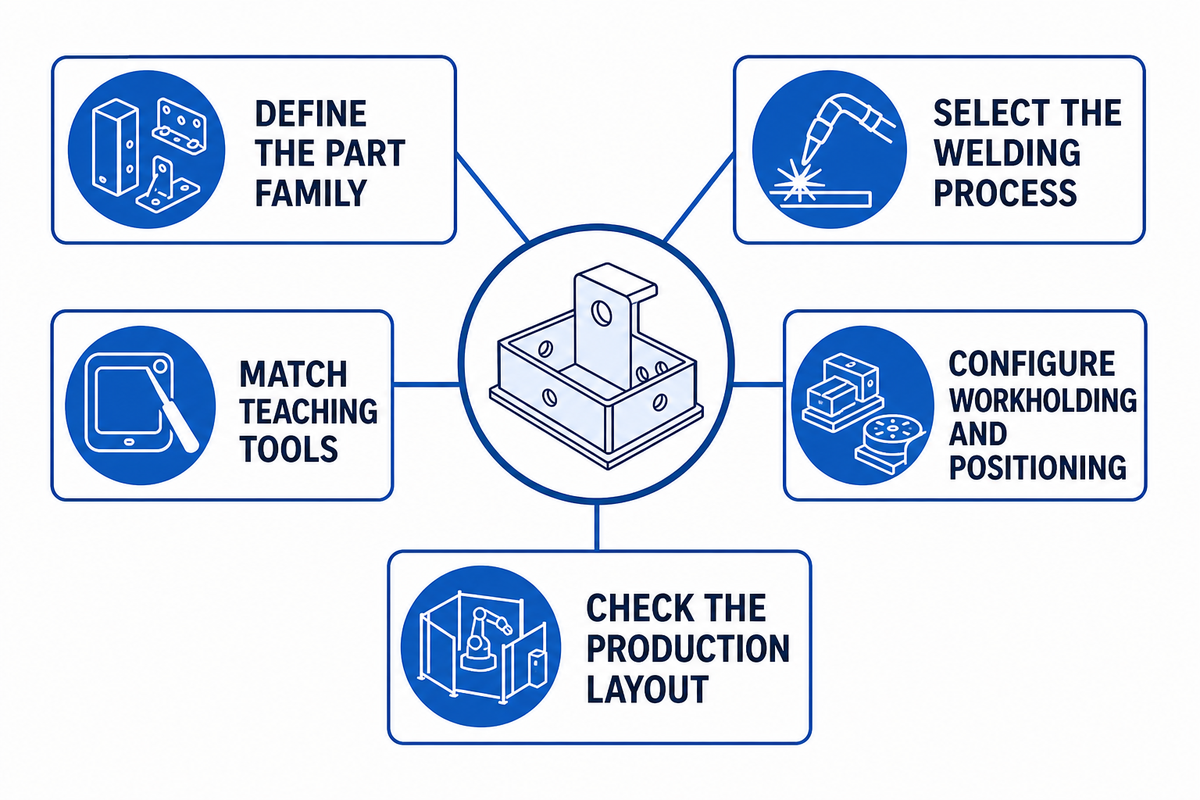
The systems combine a robotic system with the welding process to provide buyers an opportunity to define the part family and configure the system to suit an existing or new production layout. The process, teaching tools and the range of work holding and positioning options differentiate the systems.
1. Aubrik: Best for custom cobot welding cells for high-mix fabrication and collaborative production
Headquarters: Wuxi, Jiangsu, China · Founded: 1999 · Type: welding-system integrator
Official website: https://aubrikmc.com/
Main products: Configured cobot welding cells, welding fixtures, positioners and robotic welding systems
Welding processes / integration scope: Application-specific MIG/MAG and TIG integration; torch, workholding and cell layout selected around the part
Certifications / credentials: Aubrik’s website lists an ISO 9001 quality system; this is a company-level claim.
Published highlight: Engineering-led cell configuration connects the cobot with fixture and positioner choices.
Aubrik presents collaborative welding as part of its wider robotic welding systems offer, with configuration pages for the process, workholding and production layout rather than a single fixed workstation. Its cobot page separates Light, Standard and Heavy product tiers, while the broader integration offer accommodates fixtures and positioning equipment needed to expose the joint to the torch. That makes its cobot welding solution relevant to a fabricator whose changing parts require an engineered cell concept, especially when repeatable workholding matters as much as the robot itself. Custom cell scope, cobot payload and cycle time depend on the part, fixture, welding process and selected configuration.
2. Lincoln Electric: Best for CRX welding packages with Power Wave process control
Headquarters: Cleveland, Ohio, USA · Founded: 1895 · Type: welding-equipment OEM and system integrator
Official website: https://www.lincolnelectric.com/
Main products: Cooper Cobot package, Power Wave R450 and AutoDrive 4R100
Welding processes / integration scope: Steel and stainless arc welding; custom risers, tabletops, positioners and fixtures available
Published highlight: The Cooper package combines a FANUC CRX arm, Power Wave R450, wire feeder and torch controls.
Lincoln Electric’s Cooper brochure identifies the welding hardware explicitly: a FANUC CRX-10iA or CRX-10iA/L, Power Wave R450 welder, AutoDrive 4R100 wire feeder and integrated pushbutton torch control. The operator records approach points and weld start or end points at the torch, while the Lincoln arc-welding plug-in places these instructions on the tablet programming timeline. Lincoln also describes an engineering route for custom risers, tabletops, positioners and fixtures, giving established Power Wave users a way to retain their preferred process platform within a collaborative welding project. Those custom workholding and positioning elements extend the standard package scope and affect the installed price.
3. Lorch: Best for modular MIG/MAG and TIG cells with positioning options
Headquarters: Auenwald, Germany · Founded: 1957 · Type: welding-equipment OEM and collaborative-system supplier
Official website: https://www.lorch.eu/
Main products: MyCobot system kit, Cobotronic, MIG/MAG and TIG welding packages
Welding processes / integration scope: Lorch process equipment with a Universal Robots cobot; linear axis, rotary-tilt table and seam-sensing options
Published highlight: Cobot Move, Cobot Turn 100 A and SeamPilot expand the modular welding package.
Lorch’s MyCobot approach combines a Universal Robots arm with its Cobotronic interface and the company’s own welding process equipment, including MIG/MAG and TIG package choices. The published system family adds Cobot Move linear travel, the Cobot Turn 100 A rotary-tilt table and SeamPilot seam detection, so a buyer can build around torch access instead of comparing arm reach alone. Lorch also describes layout, assembly and operator instruction through its cobot partner network, making this a practical option for workshops that want a common process platform across different part families. Linear travel, positioning and seam sensing are selected modules, so their functions shouldn’t be assumed in a basic package.
4. Migatronic: Best for preconfigured MIG/MAG or TIG packages for simple parts
Headquarters: Fjerritslev, Denmark · Founded: 1970 · Type: welding-equipment OEM and automated-system supplier
Official website: https://www.migatronic.com/
Main products: CoWelder, Sigma Select, Pi 350 AC/DC and Omega 300 Advanced
Welding processes / integration scope: UR5 or UR10 packages with selected MIG/MAG or TIG power sources and cold-wire options
Certifications / credentials: Migatronic describes CoWelder as CE approved on its product page.
Published highlight: CoWelder offers 18 configurations across robot radius and welding-machine choices.
Migatronic organizes CoWelder selection into the robot’s working radius, the welding machine and the machine configuration, which gives a first-time buyer a concrete route through the available options. Its page describes 18 configurations using Sigma Select, Pi 350 AC/DC or Omega 300 Advanced, covering simple welding through pulse MIG/MAG and TIG with or without cold-wire feed. That process-led selection is useful for repeat orders of relatively simple workpieces where the main task is choosing a suitable welding package and teaching a repeatable path. The listed UR5 and UR10 configurations have working radii of 850 mm and 1,300 mm respectively, so welds outside the selected robot’s reachable working envelope require a different layout or part presentation.
5. CLOOS: Best for QINEO MIG/MAG packages with integrated welding macros
Headquarters: Haiger, Germany · Founded: 1919 · Type: welding-equipment OEM with group system integrator MPA Technology
Official website: https://www.cloos.de/
Main products: Cobot Welding System, QINEO power source, QINEO-RPU and QWD-A wire drive
Welding processes / integration scope: MIG/MAG package with wire feed and torch; optional table and powered protective screen
Certifications / credentials: The Cobot Welding System brochure states CE conformity; this is a manufacturer declaration.
Published highlight: CLOOS and group company MPA Technology supply the Ready to weld package together.
CLOOS identifies the Cobot Welding System as a joint offer with MPA Technology, its group company responsible for special-purpose machinery and integration from design through commissioning. The brochure lists the QWD-A wire drive, QINEO-RPU, QINEO welding power source, cobot, wire-feed system and torch, supported by touch-panel welding macros and a foot-switch Freedrive function. For a shop standardizing on QINEO, that arrangement connects process selection with teaching and restart behavior without making the buyer assemble the central welding components individually. The welding table and electrically movable anti-glare screen are optional in this package, so the physical workstation is a configuration choice rather than a universal inclusion.
Enclosed Welding Cells and Laser Systems
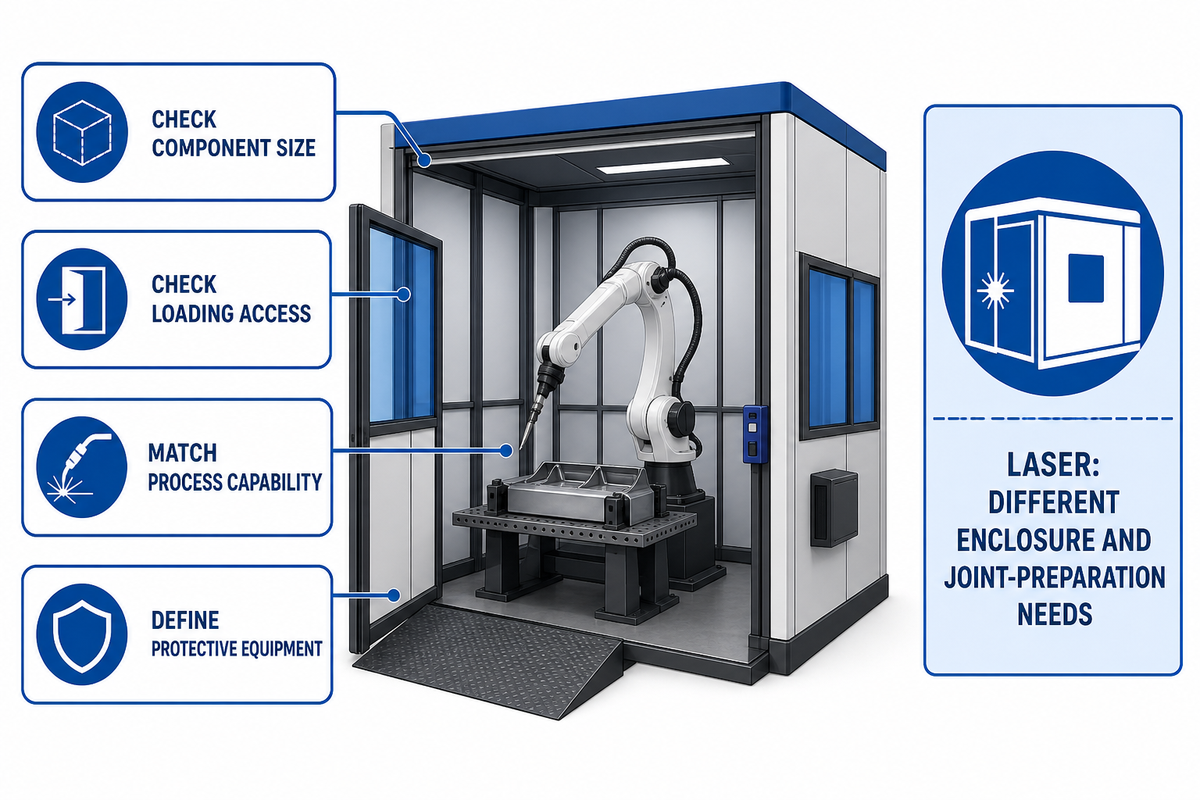
A defined cell envelope brings loading arrangements and protective equipment into the purchasing comparison early. Options for enclosed arc-welding cells and laser systems with enclosures are available. Process capability, access and the size of the components play together because an attractive welding specification can’t make up for a part that won’t fit.
6. Fronius: Best for compact enclosed cells for defined component sizes
Headquarters: Pettenbach, Austria · Founded: 1945 · Type: welding-equipment OEM and welding-cell manufacturer
Official website: https://www.fronius.com/
Main products: CWC-S Cobot Welding Cell with TPS 320i Pulse
Welding processes / integration scope: FANUC CRX-10iA, cooling, wire feeder, torch package, safety housing and optional rotary unit
Certifications / credentials: Fronius describes the CWC-S safety housing as CE-compliant.
Published highlight: CWC-S lists a 1,500 × 1,000 × 700 mm component area without its rotary unit.
Fronius publishes a particularly tangible CWC-S configuration: TPS 320i Pulse welding equipment, CU 1100i cooling, WF 25i wire feeder, MHP 700i hosepack and MTB 400i torch body within the cobot cell. Guide-and-press teaching records the weld contour, while drag-and-drop instructions define the process and WeldConnect helps select parameters using material, seam and shielding-gas inputs. The manufacturer’s maximum component area is 1,500 × 1,000 × 700 mm without the rotary unit, which makes this a useful shortlist choice when a fabricator wants to compare the actual cell envelope early. According to the Fronius CWC-S product page, the rotary-unit configuration has a maximum component length of 860 mm and diameter of 450 mm, which limits the size of rotating workpieces.
7. Yaskawa Motoman: Best for enclosed MIG/MAG cells with direct-teach programming
Headquarters: Kitakyushu, Japan · Founded: 1915 · Type: robot OEM and complete welding-cell supplier
Official website: https://www.yaskawa.eu.com/
Main products: Weld4Me CE, HC10DT IP67 cobot and YRC1000 controller
Welding processes / integration scope: MIG/MAG welding cell with table, glare protection, functional safety unit and Welding Wizard
Certifications / credentials: According to Yaskawa, Weld4Me CE is a CE-certified welding station after extraction connection.
Published highlight: Weld4Me CE combines the HC10DT IP67, YRC1000, welding table and glare protection.
Yaskawa’s Weld4Me CE announcement describes a complete welding station built around the HC10DT IP67 cobot and YRC1000 controller with a functional safety unit, welding table and glare protection. Welding Wizard and direct teaching let an operator guide the arm and record a job using buttons at the flange, while the programming pendant remains available for more involved MIG/MAG tasks. Its defined table-and-screen arrangement is useful when a buyer wants a recognizable cell architecture and access to the robot manufacturer’s welding functions within the same proposal. The published configuration becomes ready for operation after connection to welding-fume extraction, making that plant interface a necessary part of the installation.
8. Böhler Welding: Best for matched consumables and process equipment in enclosed cobot cells
Headquarters: Düsseldorf, Germany · Founded: 2013 · Type: welding-equipment and consumables OEM with integrated systems
Official website: https://www.voestalpine.com/welding/
Main products: CO-BRO packages, CO-BRO GUARD and URANOS NX
Welding processes / integration scope: MIG/MAG or TIG AC/DC packages; GUARD provides an enclosed MIG/MAG cell
Company history: 2013 is the current group-name date; the company traces its Böhler & CO origins to 1870.
Published highlight: CO-BRO packages list power source, feeder, cooling, torch, clamping accessories and two days of training.
Böhler Welding’s offer connects filler metal, welding process and equipment through its Böhler Arc approach, with CO-BRO packages and the enclosed CO-BRO GUARD as distinct system choices. According to the metal-fabrication page from Böhler Welding, its CO-BRO packages include power sources, wire feeders, cooling units, software, torches, clamping accessories and two days of training, while GUARD integrates URANOS NX equipment with the collaborative arm and a full enclosure. This is a useful fit when process engineering wants consumables and machine settings considered together, especially for shops moving several material grades into repeatable automated work. CO-BRO GUARD is presented specifically as a MIG/MAG cell, whereas TIG AC/DC belongs to another package, so those process routes should remain separate in a purchasing comparison.
9. EWM: Best for enclosed MIG/MAG cells with a two-station indexing table
Headquarters: Mündersbach, Germany · Founded: 1957 · Type: welding-equipment OEM and complete-cell manufacturer
Official website: https://www.ewm-group.com/
Main products: XQbot 1 and XQbot 2TT with integrated Phoenix XQ 355 DW
Welding processes / integration scope: FANUC CRX-10iA, Cool50-2 U40, MIG/MAG torch, wire feed, gas control and System 16 workholding
Certifications / credentials: EWM states that XQbot cells are CE-compliant and fully shield the arc during operation.
Published highlight: The XQbot 2TT uses a hand-operated indexing table for loading outside the welding station.
EWM’s integrated-source XQbot version combines the Phoenix XQ 355 DW welder and Cool50-2 U40 cooling module with a FANUC CRX-10iA, MIG/MAG torch, ROB 5 wire feeder and digital gas regulation. XQbot 1 uses a fixed System 16 tooling plate, while XQbot 2TT adds a hand-operated indexing table so loading can take place outside the active welding station. The enclosure shields the arc and supports effective fume extraction, making this a clear option for a workshop that wants a defined cell with process equipment and workholding already combined. The EPS versions are prepared for an external welding source rather than including one, and the two-station table is manually indexed rather than an automatic positioner.
10. IPG Photonics: Best for laser welding and cleaning on one cobot platform
Headquarters: Marlborough, Massachusetts, USA · Founded: 1990 · Type: laser-equipment OEM and welding-system manufacturer
Official website: https://www.ipgphotonics.com/
Main products: LightWELD Cobot System, LightWELD laser sources and safety enclosures
Welding processes / integration scope: Laser welding and cleaning with hand-guided teaching, one-screen process control and enclosure options
Published highlight: The interface controls the robotic arm plus laser welding and cleaning presets.
IPG’s LightWELD Cobot System brings its laser source, collaborative arm and process interface into a named system, rather than leaving the buyer to combine an unrelated laser with a robot. According to the product page, operators hand-guide the arm, save jobs and manage welding or cleaning presets from the same screen; integrated and modular free-standing safety enclosures are also offered. This combination suits a shop that already sees value in laser joining or surface cleaning and wants to repeat those operations with controlled motion across changing batches. The laser application introduces enclosure and joint-preparation requirements that differ from a conventional arc-welding station, so the floor layout follows the complete laser process.
Operator-Led and Specialist Welding Systems
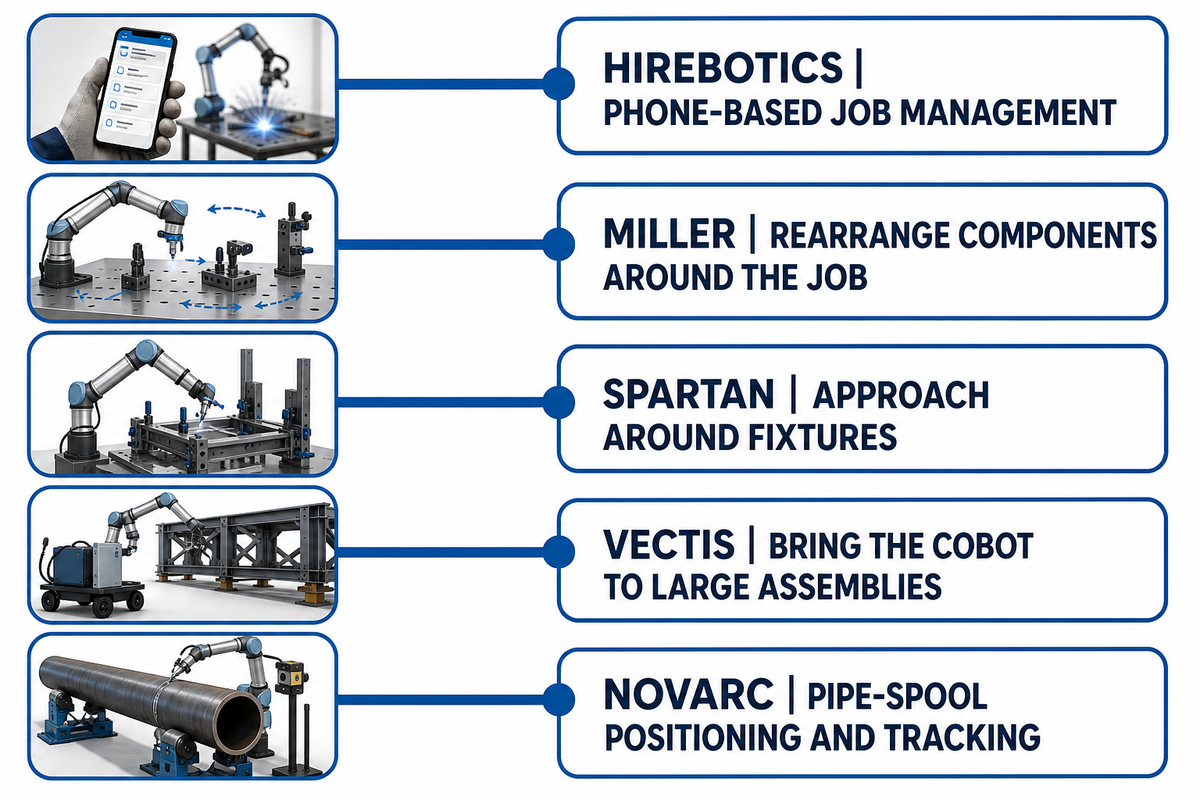
Difference in software, access to the torch and the way the equipment interfaces with the part defines this category. There are several special features, like the ability to teach via a cell phone or position the arm in a more free, flexible manner, or make the equipment mobile, alongside pipe-spool and pallet-based special features. The special features address different production bottlenecks. The most relevant feature depends on where time is lost in the welding workflow.
11. Hirebotics: Best for phone-controlled MIG welding with a preassembled workstation
Headquarters: Nashville, Tennessee, USA · Founded: 2015 · Type: welding-system manufacturer and software developer
Official website: https://www.hirebotics.com/
Main products: Cobot Welder, Beacon and Smart Puck
Welding processes / integration scope: UR8 Long, Miller Auto Deltaweld 350, Tregaskiss torch, mobile cart and operator controls
Published highlight: The current Cobot Welder ships pre-mounted and pre-wired with Beacon and Smart Puck.
Hirebotics lists a current Cobot Welder package built around the UR8 Long, Miller Auto Deltaweld 350, Tregaskiss MIG torch and a mobile cart workstation with operator controls. Welders hand-guide the torch using Smart Puck and manage saved parts through Beacon on a phone, tablet or browser, making the interaction familiar to a team that wants to avoid conventional pendant programming for routine work. Its product page also distinguishes available hardware add-ons from future items marked coming soon, which helps keep the base workstation separate from a much larger proposed cell. Multipass and seam-tracking software carry separate subscription prices, so ongoing software cost matters alongside the physical equipment.
12. Miller Electric: Best for reconfigurable welding packages that expand with production
Headquarters: Appleton, Wisconsin, USA · Founded: 1929 · Type: welding-equipment OEM and collaborative-system supplier
Official website: https://www.millerwelds.com/
Main products: Copilot, Copilot Builder and Copilot Builder with Blue iQ
Welding processes / integration scope: Packaged welding automation; pallet-based reconfiguration and selected sensing or aluminum-feed models
Published highlight: Copilot Builder components detach from their pallet and can be rearranged for the application.
Miller separates its Copilot family into entry-level systems and Copilot Builder arrangements whose components arrive on a pallet and can be detached and rearranged around the job. The current family includes Blue iQ models for adaptation to joint gaps and location, aluminum-feed options and a FANUC long-arm Builder variant, giving buyers several distinct paths beyond the initial workstation. Miller also lists online training modules and customer-service access across Copilot models, which is useful to a plant seeking process equipment and operator learning material from the same supplier. Those sensing, aluminum-feed and long-arm functions belong to selected configurations, so the entry-level Copilot shouldn’t be compared as though every family feature were included.
13. Spartan Robotics: Best for MIG welding around fixtures with a seven-axis arm
Headquarters: Nashville, Tennessee, USA (listed company address) · Founded: Not publicly disclosed · Type: welding-system integrator
Official website: https://www.spartan-robotics.com/
Main products: Spartan Welder, Spartan WeldX and Fronius process package
Welding processes / integration scope: Seven-axis cobot system with workholding, welding hardware, software, training and support
Certifications / credentials: Spartan identifies itself as a Fronius Authorized Integrator Partner at premier level; this is a partner credential.
Published highlight: The system combines seven-axis motion, Fronius process control and guided WeldX programming.
Spartan’s current offer is a complete MIG welding system that lists the robot, Fronius process package, WeldX software, workholding, training and support together. The seven-axis arm provides another way to approach inside corners and reach around fixtures, while guided WeldX tools let the operator teach, edit, save and reuse welding jobs from the pendant. That makes its buyer fit most specific for parts whose torch angles become awkward in a conventional setup, rather than for a claim that every job will run faster because the arm has an extra joint. The additional motion freedom still works inside the selected workholding and cell envelope, so it doesn’t make an oversized assembly fit automatically.
14. Vectis Automation: Best for moving the welding cobot to large or awkward assemblies
Headquarters: Loveland, Colorado, USA (founding location) · Founded: 2019 · Type: welding-system integrator and fabrication-software developer
Official website: https://vectisautomation.com/
Main products: Aero, Hydro and Synchro welding packages; Rover, Park’N’Arc and Slide deployments
Welding processes / integration scope: Universal Robots systems with air-cooled, water-cooled or push-pull process packages and positioning options
Published highlight: Rover and Slide bring the cobot to the work; Revo adds coordinated dual-axis positioning.
Vectis separates process packages from deployment methods, allowing air-cooled Aero, water-cooled Hydro or aluminum-oriented Synchro equipment to be combined with different ways of presenting the work. Rover takes the cobot toward large assemblies, Park’N’Arc extends its working range by rotation, and Slide provides a manually actuated linear track, while Revo turns the part with coordinated dual-axis motion. The product page also details ArcPilot through-arc tracking and AutoTCP tool calibration, making its offer particularly useful when access, relocation and repeatable setup are central to the production problem. Revo requires an open footprint for safety distances, so the positioning option can consume more floor area than a simple mobile welding cart.
15. Novarc Technologies: Best for pipe-spool welding with positioner and vision integration
Headquarters: Burnaby, British Columbia, Canada · Founded: 2013 · Type: specialist welding-system manufacturer
Official website: https://www.novarctech.com/
Main products: Spool Welding Robot SWR, NovEye and NovData
Welding processes / integration scope: Pipe and vessel welding with supplied Lincoln power source, positioner integration and weld-data tools
Certifications / credentials: Novarc states SWR compliance with applicable machinery, electrical and collaborative-robot requirements.
Published highlight: SWR supports NovEye root tracking and integrates with up to five positioners; SWR-F supports four.
Novarc’s SWR is built around pipe-spool production, combining the welding robot with a supplied Lincoln Electric Power Wave R450 and Novarc’s positioning and control approach. The published options include NovEye root-seam tracking, root-pass memorization and automated distance control, while NovData records weld parameters and daily production activity for traceability. Integration with up to five positioners, or four for SWR-F, makes the system particularly relevant where operators prepare several spool joints and the robot moves between welding positions instead of handling flat fixtures on a small table. This is a specialized pipe-welding purchase, and Novarc explicitly supplies the power source with SWR rather than connecting the system to a customer’s existing welder.
Deployment, Regional Integration and Existing-Tooling Packages
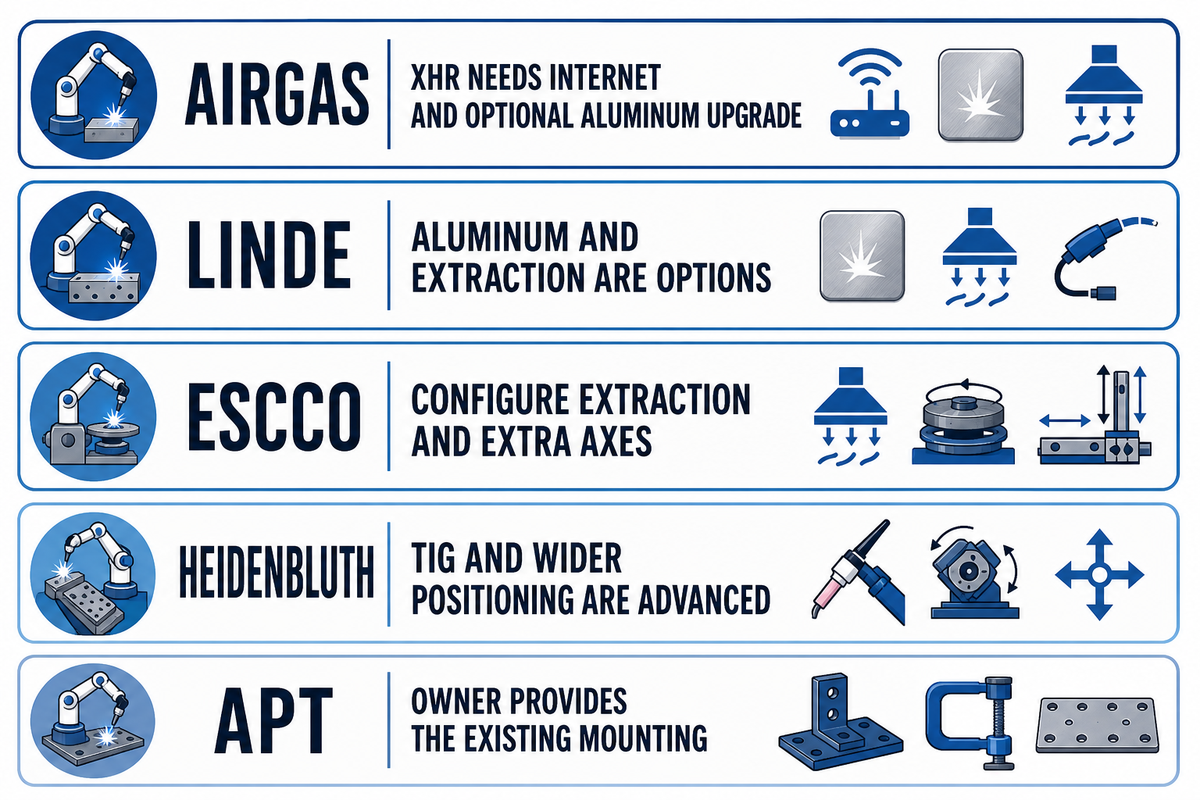
Automation solutions place commercial deployment, local integration or current tooling at the core of the system. Solutions covering integrated welding systems with existing equipment on the shop floor and integrated automation systems with provided workstations and training combine installation and integration in different ways. These solutions tend to address project-defined requirements for the scope of work of the supplier versus the work that remains for the plant.
16. Airgas: Best for BotX deployment with rental and implementation support
Headquarters: Radnor, Pennsylvania, USA · Founded: 1982 · Type: BotX system co-developer with Air Liquide and Red-D-Arc
Official website: https://www.airgas.com/
Main products: BotX XHR and BotX XSR collaborative welding systems
Welding processes / integration scope: UR10e, welding package, tables and tooling; Red-D-Arc installation and operator training
Published highlight: XHR uses Miller XMT packages; XSR uses OTC packages and operates offline.
Airgas states that BotX was jointly developed with Air Liquide and Red-D-Arc, making the relevant offer its own collaborative welding system rather than a listing of third-party robot arms. The product comparison separates the cloud-connected XHR with Miller XMT equipment from the offline XSR with OTC welding equipment, and lists UR10e arms, table arrangements and a starter tooling kit. Setup and training are included, with Red-D-Arc weld-automation specialists identified for installation, which makes the rental, lease or purchase route useful when production demand changes over time. XHR requires internet access and lists aluminum capability as an optional upgrade, so it isn’t interchangeable with XSR for every material and connectivity requirement.
17. Linde Gas and Equipment: Best for compact MIG workstations with optional plasma cutting
Headquarters: Burr Ridge, Illinois, USA (listed company address) · Founded: Not publicly disclosed · Type: Lancer branded welding-system integrator
Official website: https://www.lindedirect.com/
Main products: Lancer Cobot Welding System with UR10e
Welding processes / integration scope: MIG workstation with 60 × 48 inch area, BINZEL torch and Miller or Lincoln process options
Published highlight: Lancer combines 5/8-inch tooling holes with optional Hypertherm plasma integration.
Linde Gas & Equipment’s Lancer is a named workstation with a UR10e, a 60 × 48 inch work area, 5/8-inch tooling-hole compatibility and a BINZEL air-cooled torch. Its published setup accommodates Miller or Lincoln MIG equipment, while a Hypertherm Powermax option adds plasma cutting and a portable fume collector is available separately. The combination is relevant to a small fabrication shop that needs repeat welds on a compact table and sees a practical use for cutting within the same broader equipment platform. The standard cobot doesn’t arrive ready to weld aluminum, which needs the optional package; extraction is likewise a separate configuration item rather than an automatic inclusion.
18. ESCCO: Best for UK installation with configurable welding and fume extraction
Headquarters: Hereford, United Kingdom · Founded: Not publicly disclosed · Type: welding-system integrator
Official website: https://www.escco.co.uk/
Main products: ESCCO Cobot Welding Package with SmoothTool
Welding processes / integration scope: Universal Robots arm, Fronius or Miller welder, Siegmund table, extraction and additional-axis options
Published highlight: ESCCO includes demonstration, on-site installation, commissioning and operator training.
ESCCO describes its Cobot Welding Package as a complete turnkey offer, bringing together a Universal Robots arm, Smooth Robotics software, a Fronius or Miller welder and a Siegmund table. Its page names demonstration, on-site installation, commissioning and operator training, and offers mobile Kemper extractors, on-torch extraction and dedicated welding cells. The company also presents Mettech Precision as a customer using its cobot system, giving the package a concrete fabrication-shop application alongside the component list. For a UK workshop wanting those installation tasks coordinated by one integrator, it’s a relevant option, although extraction layout and additional axes remain application-specific choices within the configured scope.
19. Heidenbluth: Best for TIG packages with linear travel and part positioning
Headquarters: Fuldabrück-Bergshausen, Germany · Founded: 1973 · Type: welding-system integrator
Official website: https://www.heidenbluth.com/
Main products: Welding Package Starter and Welding Package Advanced
Welding processes / integration scope: Universal Robots cobot, Siegmund table, Fronius or EWM processes, enclosure and positioning options
Certifications / credentials: Heidenbluth states that its Welding Packages include a CE declaration for the entire system.
Published highlight: Advanced adds TIG, a linear axis and rotary or rotary-tilting table choices.
Heidenbluth distinguishes a Starter MIG/MAG package from an Advanced arrangement that adds TIG welding and a broader set of positioning accessories. The product page lists Universal Robots cobots, Siegmund tables, Fronius or EWM process equipment, enclosure choices and fixed-price installation, commissioning and on-site training by its technicians. The Advanced options include a linear axis, rotary table and rotary-tilting table, making the offer relevant to a fabricator whose TIG joints require controlled orientation or whose assembly extends beyond one fixed arm position. TIG and those wider positioning options belong to the Advanced scope, so a Starter quotation represents a materially different system rather than the same cell at a lower price.
20. APT Manufacturing Solutions: Best for CRX welding bundles for existing fixture tables
Headquarters: Hicksville, Ohio, USA · Founded: 1996 · Type: welding-system integrator
Official website: https://aptmfg.com/
Main products: MOD-WELD Cobot Weld Bundle with Clever Torch
Welding processes / integration scope: FANUC CRX-10iA/L or CRX-25iA, Miller or Fronius source, torch and integrated operator panel
Published highlight: Clever Torch uses separate movement and teaching buttons with APT-integrated robot controls.
APT’s MOD-WELD Cobot Weld Bundle identifies FANUC CRX-10iA/L and CRX-25iA robot choices alongside Miller or Fronius welding equipment and its Clever Torch teaching interface. The integrated operator panel provides cycle start and teach-enable functions, while torch-mounted buttons separate movement from point recording, giving a fabricator a defined welding package for tooling it already owns. Its published options include torch service equipment and a thick-plate software package, so the buyer can add process-specific functions without confusing them with the standard bundle. The end user must install the robot and controller on an existing fixture table, base or pedestal, and the steel-oriented base configuration needs extra options for soft metals.
How to Choose a Cobot Welding Manufacturer
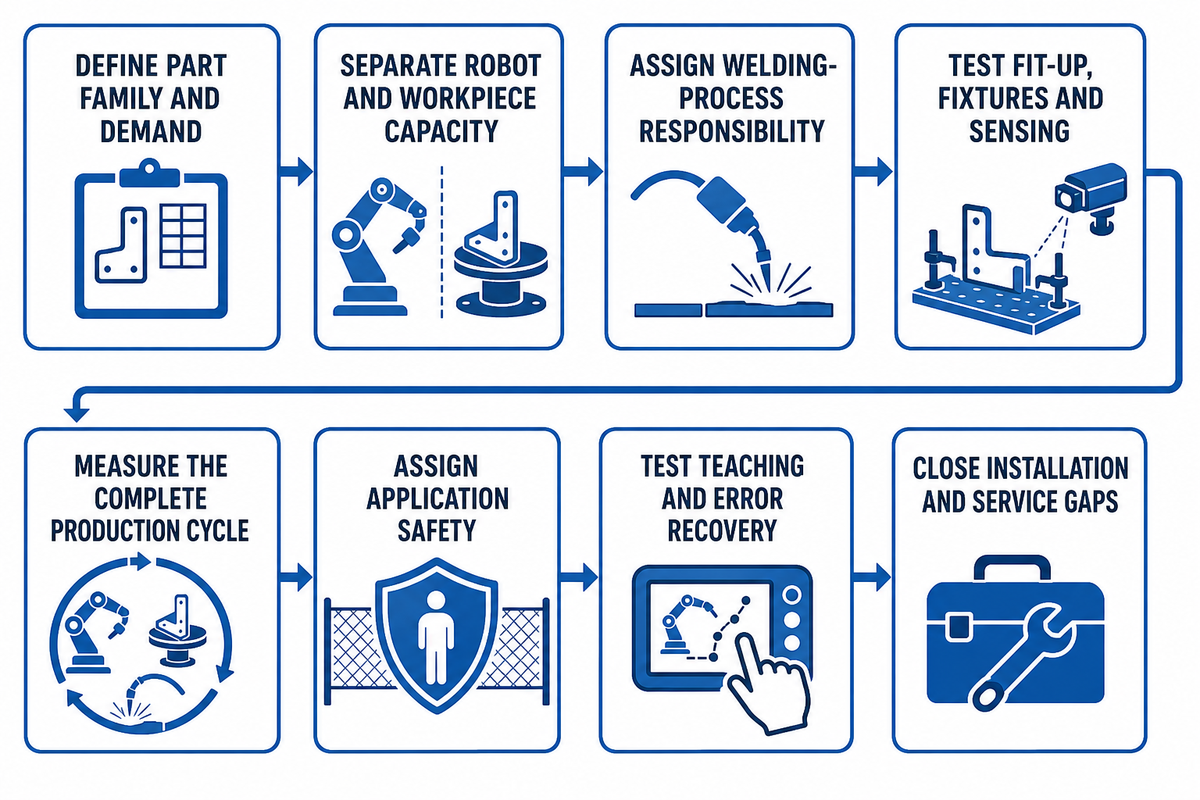
A strong request for quotation for cobots for welding begins with identification of the family of parts, and an acceptance test, then defines the equipment to meet them. The same drawing package should be provided to each short-listed vendor to ensure differences in prices are due to differences in solutions offered rather than missing fixtures or optimistic operator assumptions. The eight checks make this comparison practical for production, engineering and purchasing.
- Define your part family and production demand. Document material grade, thickness, joint type, weld length, annual volume, normal batch size and mix of repeat vs. new orders. Show drawings illustrating weld access and dimensional tolerances for your welding applications. Provide sample parts from the easy side and hard side of weld applications. Two very different parts may require different loading and fixture strategies, and a short weld on a stable bracket for the automotive industry provides little information about a long shipbuilding assembly that distorts during welding. For variable mix work, measure the time it takes to changeover from the last good part of a job to the first good part of the next job, including fixture replacement and program selection. This will highlight the workload from weld-related activities that are outside automatic welding, like material handling.
- Separate robotic capacity from workpiece capacity. A collaborative welding robot carries its torch, dress-out and any sensors. The table or positioner supports the part. Determine payload, wrist moment and cable forces, usable reach and clearance at required torch angles. Don’t depend on part weight to determine payload. A rotary positioner requires a similar analysis, including its balance and moments. The usable reach of robotic welding arms can be impaired by how they’re mounted and obstructions in the work environment. A weld arm may not be able to reach a point that’s required to be in the weld position. To evaluate arm weld positions, request a copy of a layout showing the weld envelope, operator loading routes, the fixtures, and any obstructions.
- Fix responsibility for the welding process. Based on the material and joint, select MIG/MAG, TIG, flux-cored or laser. Taking quality into account, identify the power source, torch, wire feeder, cooling, and shielding gas and consumables. Compare power supplies at the required duty cycle. Rated current of a power supply alone doesn’t guarantee consistent weld quality. A water-cooled torch, soft-wire feeding package or cold-wire TIG option may change both price and maintenance. Have the supplier identify which welding parameters the robot can vary during a program and which settings remain at the source. This is of particular importance when modifying existing welding machines to a new cell. Keep the same skilled welding personnel responsible for procedures approval who also have specialized knowledge of welding.
- Test fit-up, fixtures and sensing together. Provide samples that represent normal process variation and aren’t just carefully crafted demonstration samples. Determine gap, tack position and datum repeatability. Assess touch sensing, seam tracking or vision to see how well they perform within the constraints of the proposed configuration. For CNC machined parts, evaluate weld consistency with normal variation in the locating features. Through-arc tracking and the use of a camera solve different problems and neither repairs all poor joints. Advanced cobot welding features earn their cost when they address observed issues related to fit-up and access. The test should evaluate torch calibration and cable management. Evaluate how the datum returns to the correct position and how the correct program is associated with the quick-change fixtures.
- Compare production cycle times, not just arc-on times. Time multiple processes such as loading and unloading, clamping, sensing and welding and the motion of the positioner, if required, and cooling, as well as inspecting the workpiece. Record the activities of the operators performing all tasks. Don’t assume that the work is done by one operator alone. Evaluate the processes, the motion of positioner and welding systems, and the overall cycle time to assess welding efficiency, including time spent using inspection systems. Robot repeatability is a motion specification, not finished weld accuracy. Joint preparation, heat distortion and the calibration of the torch affect the overall system and are part of the process. A factory acceptance test (FAT) should evaluate weld acceptance criteria and include a realistic run-off and rework, if necessary.
- Assign the complete application-safety scope. Collaborative motion does not eliminate arc radiation, hot parts, fumes and spatter, trapping points, and laser hazards. Identify the individual that performs the risk assessment and provides guards, interlocks, extraction and electrical documentation for the installation. The project specification should identify the applicable industrial-robot, collaborative-operation, machinery and electrical requirements for the installation. These requirements are not blanket product certifications. Review the actual declaration and any certificate against the named system or manufacturing site; an ISO 9001 management-system certificate is not approval of a particular welding cell.
- Assess teaching and software to recover from an operator error. Have a welder demonstrate how to create a new job, change a parameter, and recover from an interrupted weld and reload a saved program. For ease of use beyond simple programming, operators should understand welding cell errors and restore production safely. Assess teaching controls and the cobot handle using regular work-gloves on the shop floor. Evaluate programming needed to implement a new joint and not just the time required to re-run a previously saved program. Assess the use of licences and subscriptions; determine what programming tasks become locked when a subscription expires. Compare the welding software options on the quoted model.
- Close the installation and service gaps. Ask for a line-item quote for the table, fixtures, positioners, extraction, power connection, guarding, commissioning and first production procedure. For planning uptime, find the responsible party for process defects crossing robot and welding, as well as the response time, local spare parts, and remote support available during your shift. A competitive, cost-effective offer recognizes your unique production constraints and purchase budget. Consider total ownership cost (TOC) for the same operating hours and consumables, including software costs and planned downtime. Define the documents, spare-parts list, training and acceptance records required at handover. This makes the supplier’s offer useful to the owners of the system.
Frequently Asked Questions About Cobot Welding
Which manufacturer offers the best welding system for high-mix fabrication?
The best fit depends on whether your bottleneck is teaching, fixturing or moving the equipment between parts. Hirebotics emphasizes Beacon and hand-guided teaching; Vectis offers mobile and extended-range deployments; Aubrik configures cells around the application. Fronius CWC-S is a more defined enclosed option when parts fit its component envelope. Frequent product changes favor a repeatable setup process as much as a simple robot interface.
Who is the largest cobot welding manufacturer in the world?
Robot-arm shipments, welding equipment revenue and installed welding cells measure different things. A large arm manufacturer may supply robots used by several independent integrators, while a smaller company may manufacture a more relevant pipe-welding or high-mix system.
What is the difference between a cobot welding manufacturer and a supplier?
Documented product development or integration work transforms components into the welding system. Manufacturers or system integrators own that work product. Suppliers may purchase it and resell it as completed product without having to design it. Some companies perform both roles, which is why the named package and the responsible entity are important. Robot OEM, welding equipment OEM and cell integrator may be three different companies in the same otherwise complete proposal.
How much does a complete cobot welding system cost?
The price of the package depends on the configuration quoted. The robot, process equipment, workholding, safeguarding, software and commissioning will all play a role. Comparing a bundle offered for an existing table to a fully enclosed cell or a pipe spool installation wouldn’t be correct. The costs of maintenance, sensing, and licensing software also need to be considered. The same argument applies to a useful comparison. A useful comparison of the packages should depend on the price of the same accepted production task rather than the price of the lowest equipment package.
Are welding cobots the best replacement for every manual welding job?
No; cobots are most efficient when the joint can be presented repeatably and the set up effort matches the batch. Skilled human welders still perform preparation and decisions in the procedure, as well as inspection and alteration that’s too variable for economical automation. More stable long-running parts may also be appropriate for a traditional welding robot. Collaborative welding is one of the many possible solutions, not an assurance that all manual activities become less burdensome.
Does a cobot welding cell still need guarding and a risk assessment?
Yes, the complete application requires a risk assessment and the requisite safeguards. Collaborative functions of the robot address only part of the hazard and the welding process incorporates heat, radiation, fumes, etc. Guarding may remain in a cobot cell, as enclosed systems in this example demonstrate. The final design is based on the process, equipment and how the operator interacts with it.
Build a Shortlist Around the Part and the Finished System
The best choice of cobot welding is the one that integrates the right process, workholding and support for a defined activity. Each of the enclosed systems, packaged MIG workstations, lasers and welding equipment, among others, deserves a similar comparison, based on their impact on productivity. The manufacturer name is a good starting point; the configuration chosen determines what can be put into production.
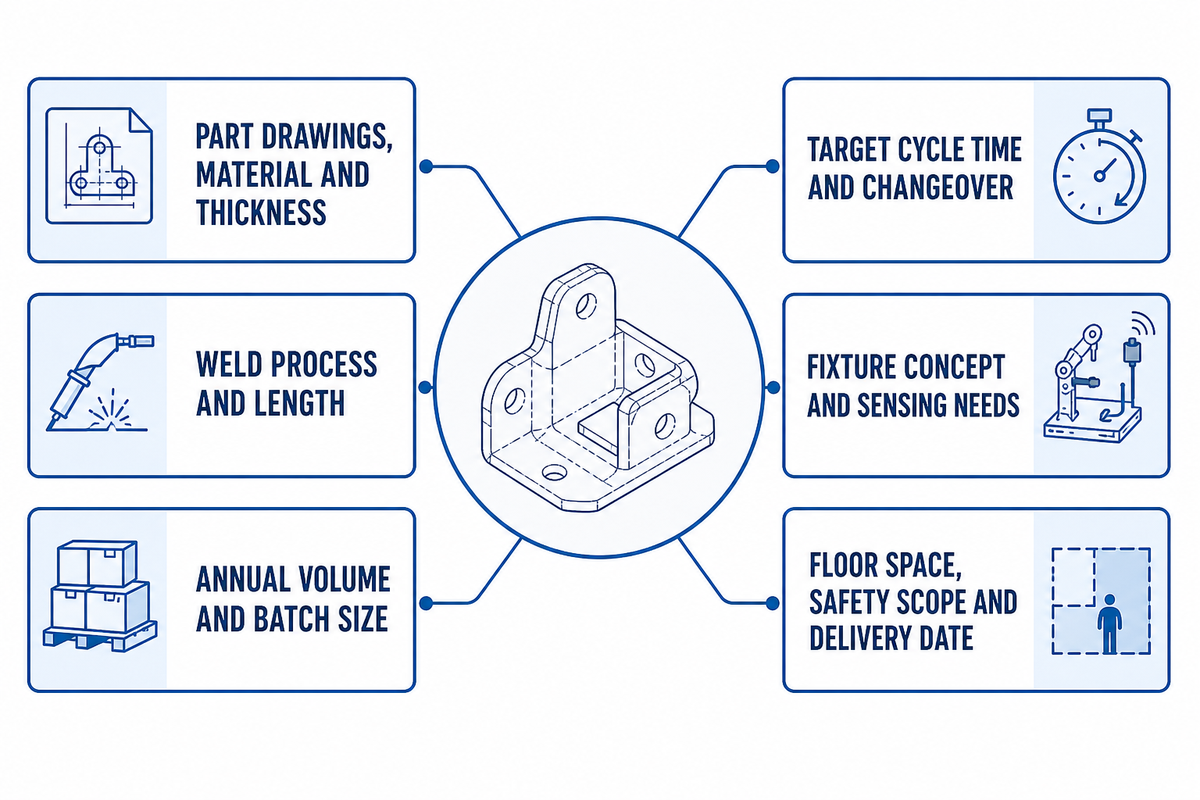
To describe your welding needs for a custom cell discussion, send Aubrik the part drawings, material and thickness, weld process and length, annual volume, batch size, target cycle time and changeover requirements. Include the fixture concept, sensing needs, available floor space, safety scope and expected delivery date so the engineering review starts with the actual application. Explore Aubrik’s machine, cell and cobot systems, the cobot welding configurations, or request a technical assessment and quotation.
References & Sources
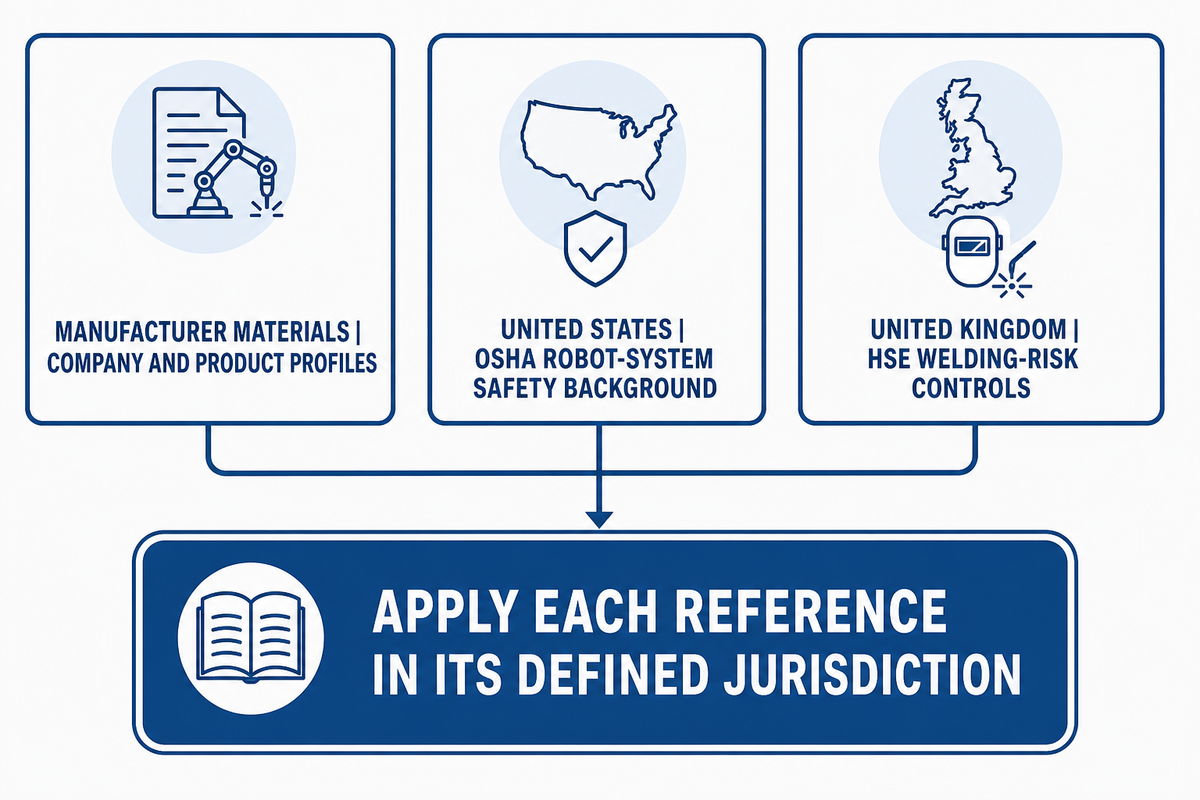
Company profiles draw upon the materials produced by manufacturers cited in the comparison. For application-related safety checks, the following references provide background in their defined jurisdiction:
- OSHA Technical Manual: Industrial Robot Systems and Industrial Robot System Safety (United States).
- HSE: Controlling the risks from welding (United Kingdom).