Get in Touch with Aubrik Company
CE and ISO 9001 Certified
Welding Rotators & Turning Rolls
Welding Rotators & Turning Rolls — 1 to 1,000 Ton Cylindrical Welding Support
Heavy-duty rotation systems for pipes, pressure vessels, wind towers and storage tanks. Built to order since 1999.
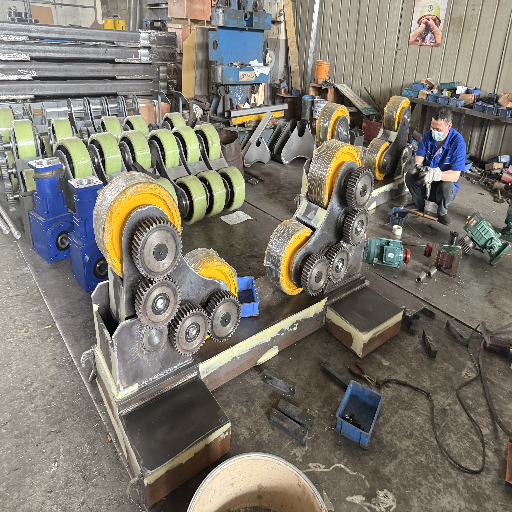
A welding rotator — also called a turning roll — supports a cylindrical workpiece on two roller beds and spins it at a controlled speed, so the welder (or an automated torch) stays put while the seam comes to them. Aubrik builds welding rotators and turning rolls for shops that weld round work too heavy to flip by hand: 6-ton pipe spools right through 1,000-ton offshore tower sections.
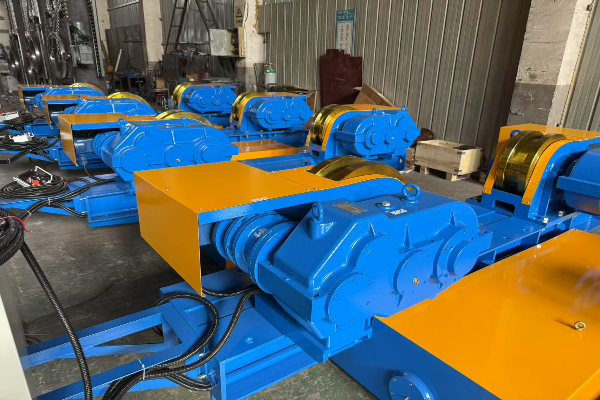
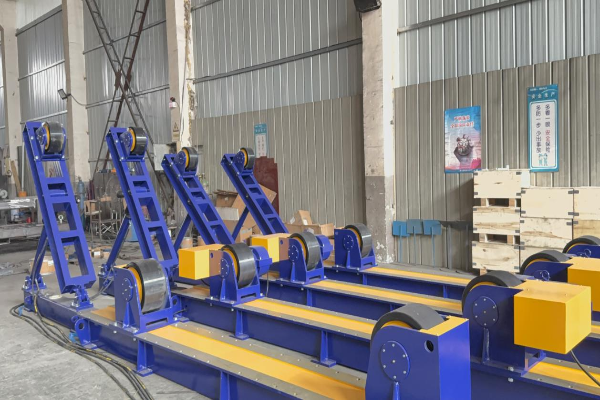
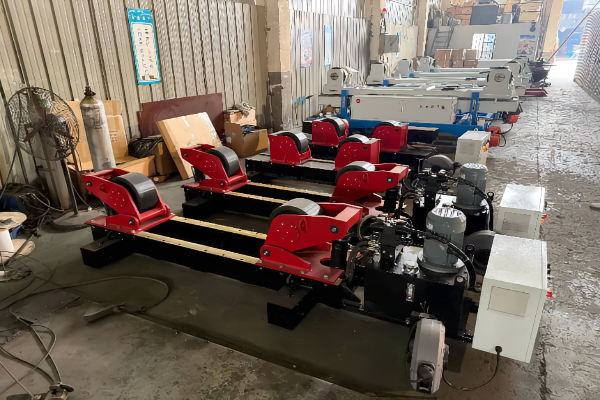
Four engineered types: self-aligning, adjustable, pipe-pinching, blasting/painting
Load range from 1 to 1,000 T, standard and custom
Workpiece diameter 200–6,000 mm
Inverter stepless speed, 0.5–15 rpm
1.5× safety factor design
1 – 1,000 T
Load Capacity Range
6,000 mm
Max Workpiece Diameter
+35%
Throughput Increase
99.3%
First-Pass Acceptance
Manual Rotation Is Costing You Weld Quality — Turning Rolls Fix It
Rotating a 12-meter pipe spool by crane ties up four or five workers per joint, and every re-hang reintroduces the gap and hi-lo error you just dialed out. That manual handling is where weld defects, rework, and operator fatigue come from, not the arc itself. When the root pass shifts because the workpiece drifted mid-rotation, you pay for it twice: once in grind-out, once in schedule.
Turning rolls remove the handling. Welding rollers, pipe rollers, vessel turning rolls — whatever your shop calls them, the job is identical. Two roller beds — one powered (the drive unit), one idler — carry the weight, and friction between the rollers and the workpiece turns it smoothly at a speed you set to match the process.
The welder holds a single position; the seam rotates underneath. That’s the whole mechanism, and it’s why a rotator slots into a welding automation line, pairing with submerged arc (SAW), TIG, and column-and-boom manipulators to run continuous 360° circumferential welds without a single re-clamp. Shops that bolt our rolls to an existing SAW line eliminate the manual root pass and the crane time around it, which is where most of the labor cost actually hides. Aubrik engineers these turning rolls for industrial buyers welding everything from 6 ton spools to 1,000 ton tower cans, so one line scales across your mix.
So the question on this page is not “what is a welding rotator.”
It’s which of the four types matches the cylinder you’re turning, and at what capacity. That’s where most procurement mistakes happen, so we’ll start there.
The 4-Type Rotator Fit-Guide Cheat-Sheet
Here’s the honest trade-off most catalogs skip: a bigger rotator is not always the cure for unstable rotation. Longitudinal drift — the “screw effect” — comes from workpiece geometry, an out-of-round shell, an unbalanced center of gravity, or a conical section, not from a shortage of tonnage.
Chasing it with a heavier conventional roll wastes budget. Fixing it means the right type: a self-aligning bracket for thin-wall and unbalanced work, or a pinching design where concentricity is non-negotiable. Match the type first, then the capacity. Our core types each solve one failure mode. The cheat-sheet maps workpiece and priority to the right model so an engineer can shortlist in one read.
01. FLAGSHIP SERIES
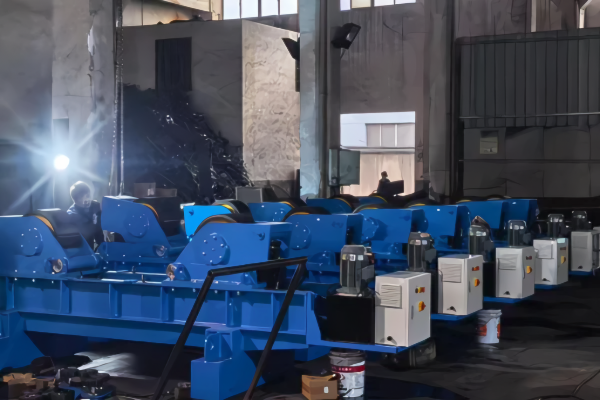
Self-Aligning Welding Rotators (ZT series)
Aubrik engineers the pivoting four-point bracket to swing and cradle whatever diameter you drop on it, so there are no bolts to reset between a small pipe and a wind-tower can. That four-point contact spreads the load and keeps thin-wall shells from deforming, and the traction it generates is what kills the slippage that ruins a root pass. Drop the work on, start welding.
See full range ➔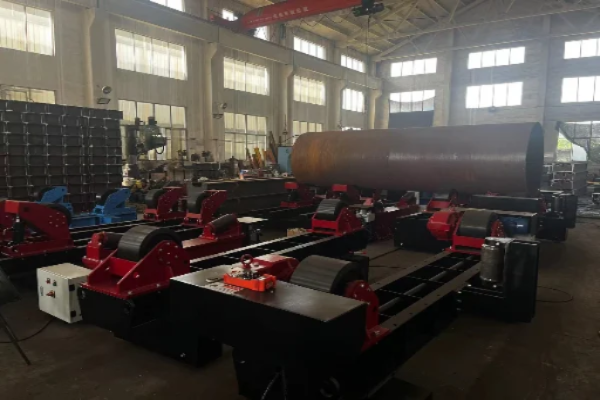
02. PRECISION SERIES
Pipe-Pinching & Pipe Rotators (PP / OR series)
Where concentricity decides whether a weld passes — nuclear pipe, pressure pipelines, spool work — pneumatic clamping centers the pipe axially and cuts setup by up to 35%. Our dedicated pipe rotator for welding adds laser detection that holds alignment inside 0.05 mm and log welding current.
Compare models ➔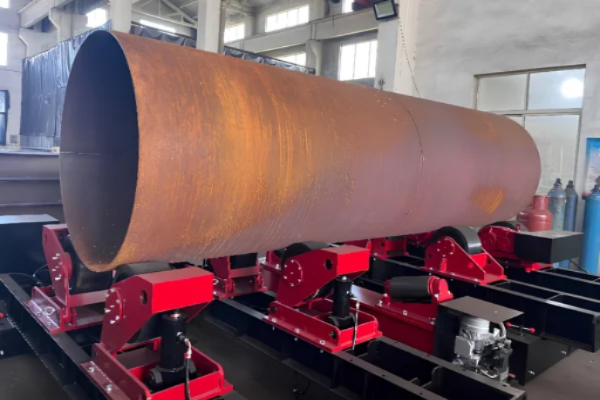
03. HYDRAULIC SERIES
Fit-Up Rotators (HGKF series)
Alignment is a separate job from welding, and it is the one that eats hours. Hydraulic fit-up rotators adjust a section in 3D space to ±0.5 mm, correcting edge misalignment and gap width before a single tack. On large tank work, these fit-up rolls turn an eight-hour manual alignment into under an hour.
Explore handling ➔| If your workpiece is… | Priority | Recommended type | Load band | Control | Model family |
|---|---|---|---|---|---|
| Thin-wall, varied diameters, mixed batches | No setup, no deformation | Self-Aligning | 6–50 T | Inverter + remote | ZT-6 … ZT-50 |
| Heavy, unbalanced, long shells | Rigidity + diameter range | Adjustable | 10–60 T | Manual / Remote / PLC | AD-10 … AD-60 |
| Pressure / nuclear pipe needing concentricity | Axial centering ± | Pipe-Pinching | 5–100 T | Remote + pneumatic | PP-5 … PP-100 |
| Cylinders entering blast or paint | Even surface finish | Blasting/Painting | 5–20 T | Fixed speed + stop | BP-5 … BP-20 |
| Sections needing pre-weld alignment (hi-lo / gap) | ±0.5 mm fit-up | Fit-Up Rotator | 20–100 T (to 2,000 T) | Hydraulic 3D | HGKF / ZDG |
| Long pipe, pipeline girth welds | API-grade alignment | Pipe Rotator | 5–40 T | Electric + remote | OR-5 … OR-40 |
| Boiler tube / heat exchanger | Small diameter precision | Self-Aligning | 6–10 T | Inverter | ZT-6 / ZT-10 |
| Offshore wind tower can | Ultra-heavy, synchronized | Adjustable (custom) | 200–1,000 T | Synchronized drive | Custom AD |
| Storage tank shell (large dia.) | Stability at width | Adjustable | 30–60 T | Remote / PLC | AD-30 / AD-60 |
| Stainless / polished workpiece | No surface marking | Any (PU wheels) | per load | Inverter | PU-wheel option |
Not sure which type fits your shells?
Send us a diameter, weight, and wall thickness for precise engineering matching.
The 1–1,000 Ton Capacity Tier-Guide
Under-rating is the single most common buying mistake. Any rotator has to carry more than the workpiece weighs, with margin, because an unbalanced load throws far more than its static mass onto the drive wheels. Every Aubrik rotator is rated for 24-hour continuous duty at a 1.5× safety factor over nominal load, so the number on the plate already includes the cushion most shops forget to add. Use the tiers below to place your project, then size up one band if your work is unbalanced or conical.
Industry Reference
For reference, the industry spread runs from a few hundred pounds to roughly 2,000 tonnes across conventional designs, with self-aligning rolls usually topping out near 300–500 tonnes. Aubrik covers the same envelope: standard self-aligning to 50 T, and synchronized custom builds to 1,000 T — roughly 2.2 million lbs — for the work that doesn’t fit a catalog.
Tech Guide
Rotator, Turning Roll, or Positioner? A Decision Tree
Search results blur three different machines, and buying the wrong one is an expensive lesson. Here’s the honest trade-off, and bigger is not necessarily better: workpiece shape settles it fast. Turning rolls (welding rotators) carry a cylinder on rollers and spin it on its own axis. Positioners clamp a workpiece of any shape to a faceplate, then tilt and rotate it for angle control. If your work is round and heavy, you want rolls. If it is irregular, small, or needs to tilt for a downhand bead, you want a positioner. Most industrial buyers welding pipe, tanks, and vessels land on rolls.
| Question | Welding Rotator / Turning Roll | Welding Positioner |
|---|---|---|
| Workpiece shape | Cylindrical only (pipe, tank, vessel) | Any shape, clamped to faceplate |
| Motion | Rotation about the part’s own axis | Tilt + rotation for angle setting |
| Typical load band | 1–1,000 T | 10 kg – ~50 T |
| Best weld | Long circumferential / girth seams | Positioned downhand on small assemblies |
| Setup | Drop-on, no fixturing | Clamp / chuck the part |
| Where it wins | Pipe spools, tanks, towers, pressure vessels | Brackets, frames, short shafts, mixed fab |
One more distinction worth the line: conventional and anti-drift rolls aren’t the same machine either. If your shells are out-of-round or conical, a standard roll will let them creep sideways as they turn; a self-aligning or anti-drift design holds the work to within about ±1 mm. That is the geometry problem from the cheat-sheet showing up again — which is why we lead selection with workpiece shape, not headline tonnage. That’s the structural reason a self-aligning design beats a heavier conventional roll on unstable work.
Not sure whether your parts need a rotator or a positioner?
Get an engineering recommendation →Proven Results: Field Data From Wind, Vessel & Pipeline Projects
Most rotator pages claim “industry-leading” and stop there. Here are four Aubrik projects with the numbers attached, because a new supplier earns trust with measured outcomes, not adjectives. These span industrial buyers in wind, pressure-vessel, and pipeline work, from 50 ton vessels to 1,000 ton tower cans. Every unit below shipped under Aubrik’s one-year warranty and a 24-hour duty rating.
“On the wind-tower line we watched setup time drop 40% the first week — the self-aligning brackets meant the crew stopped re-bolting between can diameters. That is where the 35% throughput gain actually came from, not faster arcs.”
ROI in focus
China-Russia Gas Pipeline
20× OR-20T pipe rotators with laser alignment and dual-motor synchronization, customized for 1,200–4,800 mm pipe and synchronized to SAW. Field temperatures reached −40 °C; IP65 protection and freeze-resistant lubrication kept them running.
Request an ROI Estimate →
Based on your joint count and current handling time.
99.3%
first-pass acceptance (up from 92%)
8 min
positioning time (down from 45m)
68
weld joints per day (up from 40)
10 mo
payback (≈¥5M rework saved)
Certifications & Build Standards
For industrial buyers comparing an established Western brand against a maker new to the shortlist, the certificate is the tiebreaker, so we put the detail up front rather than behind a contact form. Aubrik delivers every rotator CE-marked and built under an ISO 9001 quality system, rated for 24-hour duty at a 1.5× safety factor, with a factory load test before dispatch. Pipe rotators generate API 1104 and ASME-ready weld records, which matters because API 1104 holds girth-weld hi-lo to 1/16 inch (1.6 mm) on most pipeline specs — a tolerance you cannot hit if the workpiece drifts mid-rotation.
VERIFIED SPECIFICATIONS
[01]
CE
EU machinery directive
[02]
ISO 9001
quality management system
[03]
1.5×
safety factor, 24h duty
[04]
API 1104 / ASME
weld-record ready (pipe)
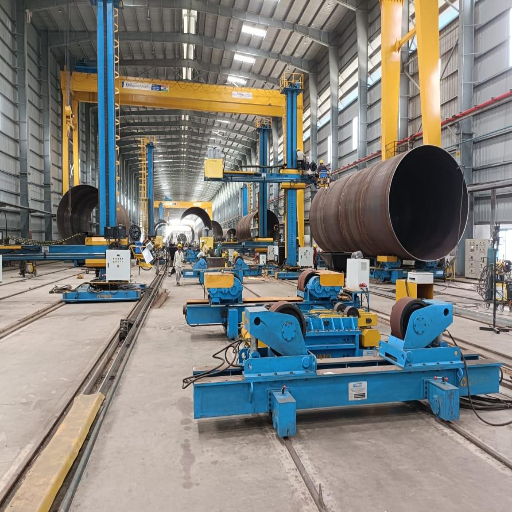
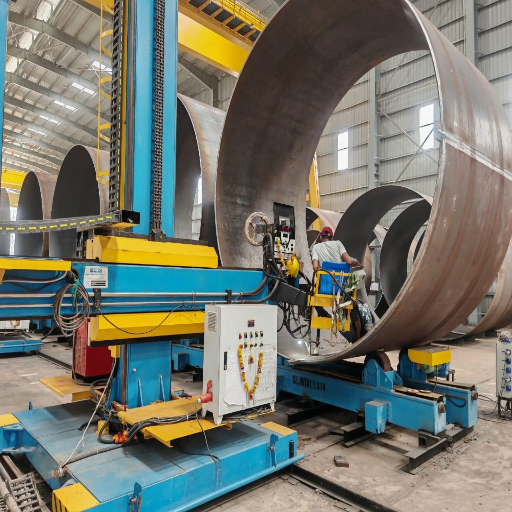
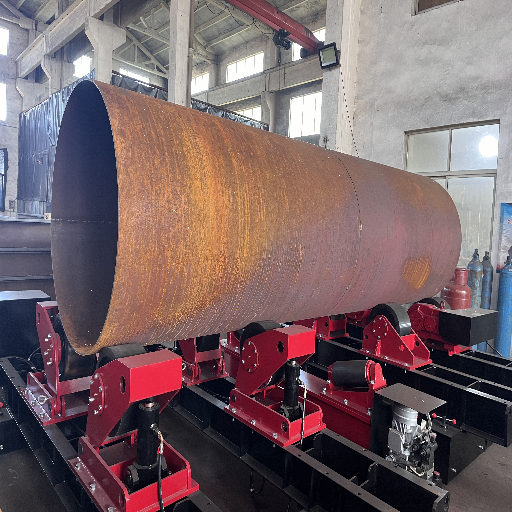
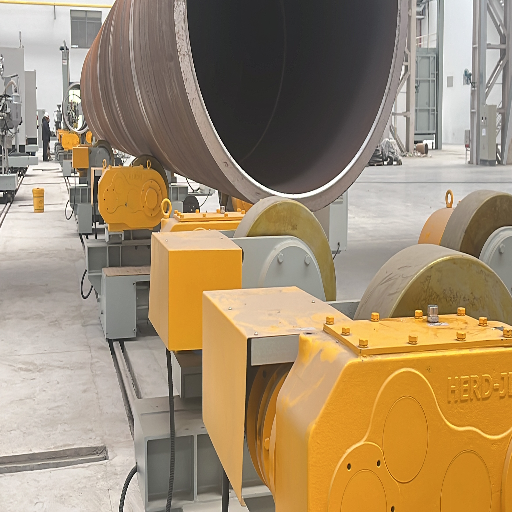
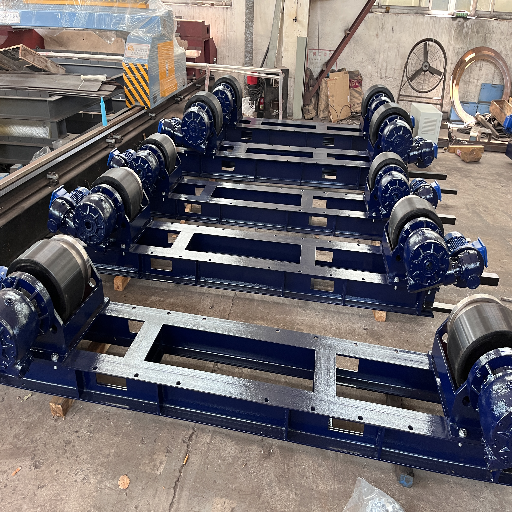
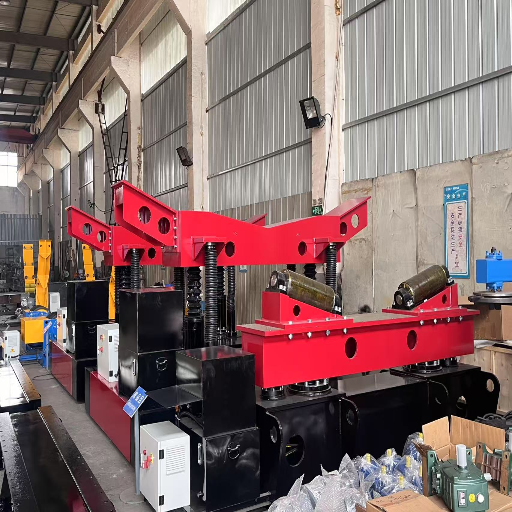
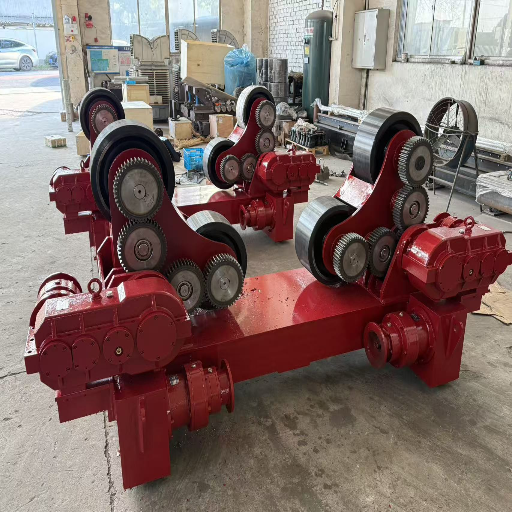
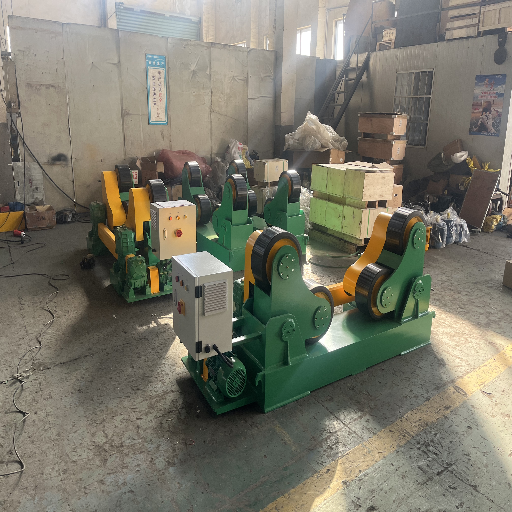
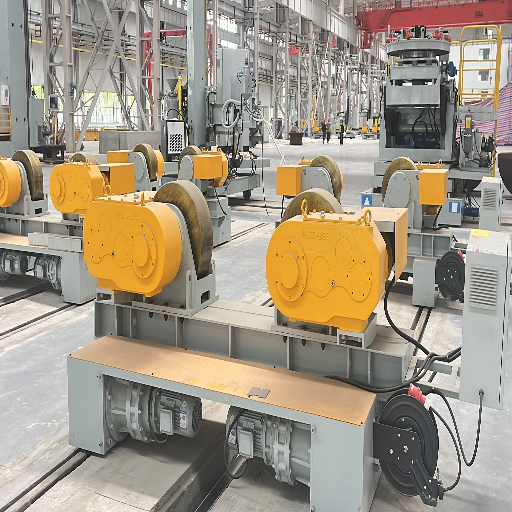
State-of-the-Art Manufacturing Facility & Production Lines
Turning Roll Labor-Savings Estimator
Estimate the direct handling cost and time a rotator removes from your production line by minimizing crane dependency and manual positioning.
Estimated Labor Savings
—manual handling / day
—with rotator / day
—saved / day
Directional estimate. Modeled on field outcomes where rotators cut positioning time ~80% and crew to one operator (e.g. a pipeline line moved 45→8 min/joint, 4–5 workers→1). Your result depends on weldment mix and shift structure.
01 What’s the difference between a welding rotator and a welding positioner?
Rollers carry a cylinder and spin it on its own axis, which suits pipe, tanks, and vessels. A positioner clamps any shape to a faceplate and tilts it. Round and heavy means rolls.
02 How do I choose the right load capacity?
Start above the workpiece weight, then add margin for unbalanced or conical work, because an off-center load throws far more than its static mass onto the drive wheels. Every Aubrik unit is rated at a 1.5× safety factor for 24-hour continuous duty, so the plate number already carries that cushion. If your shells are long, thin-wall, or out-of-round, step up one tier — a 30 ton job often wants a 50 ton roll — rather than running a roll near its ceiling. A short call with your diameter, weight, and wall thickness gets you a firm recommendation in a day.
03 Will my workpiece drift or slip during rotation?
Drift, the so-called screw effect, comes from out-of-round, unbalanced, or conical workpieces, not from low capacity. A conventional roll can let the part creep sideways. Our self-aligning four-point design and anti-drift options hold the work to roughly ±1 mm, which is why type selection matters more than raw tonnage for unstable shells.
04 Can your turning rolls integrate with my existing SAW or TIG setup?
Yes — the rollers pair with submerged arc (SAW), TIG, and column-and-boom manipulators for continuous 360° welds, and inverter speed matches rotation to the deposition rate.
05 What wheel material should I specify?
Steel wheels suit heavy loads and rough surfaces; polyurethane protects stainless and polished work and adds grip without scratching; rubber gives traction on lighter, uneven work. We match the wheel to your workpiece material so you don’t mark a finished surface.
06 Do you offer custom and OEM builds?
Yes. Every parameter — load capacity, diameter range, roller material, control system, and environmental rating — can be built to your specification, up to synchronized 1,000-ton systems for offshore and nuclear work. OEM service is available to your drawings, with a one-year warranty on all products.
07 What certifications and weld records do you provide?
All products are CE-marked and built under ISO 9001. Pipe rotators log alignment, welding current, and interpass temperature into API 1104 and ASME-ready reports, so your audit trail is generated as you weld rather than reconstructed afterward.
Equipment Specifications
Why We Publish the Numbers
01
The capacity tiers, model parameters, and project results on this page come from ABOKE’s own build sheets and commissioned-project records — including the 2024–2025 China-Russia pipeline and wind-tower lines cited above.
02
Where a figure reflects an industry standard rather than our own measurement, such as the API 1104 hi-lo tolerance, we name the standard. We would rather show a buyer the real tolerance and the real payback period than claim to be “the largest in the world.” That’s the honest version of a spec sheet, and the structural reason ABOKE certifies every build before it ships.