Get in Touch with Aubrik Company
Fit-Up Rotator: Aubrik Hydraulic 3D Alignment System for Tank, Vessel & Wind Tower Fabrication
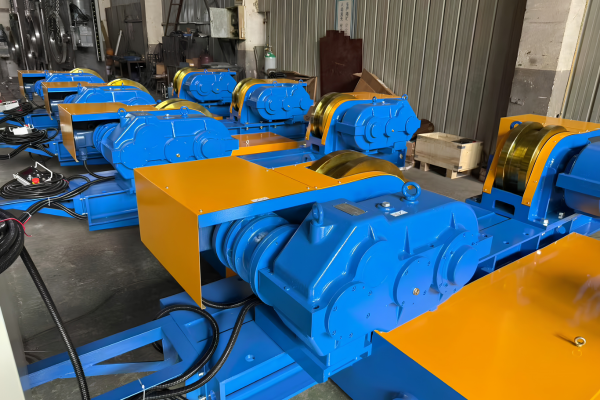
Fit-up rotator equipment from Aubrik cuts multi-section tank, pressure vessel, and wind tower fit-up time from 8 hours to 45 minutes with ±0.5 mm hi-lo correction. Four hydraulic 3D-adjustment models cover 20–100 T workpiece capacity, with custom builds up to 2,000 T for offshore wind segments.


Solution Summary
±0.5 mm
Positioning accuracy
8h → 45 min
Per-section fit-up time
4 + Custom
HGKF / ZDG / HGZ models, up to 2,000 T
ISO 9001 + CE
Certified, 18-month warranty
The Hi-Lo Cost Curve: Why Pre-Weld Alignment Drives Everything Else
With tank – 500 m³ – or the section of a wind tower of 50 m – manual alignment. It is never “good enough”.
Field reality
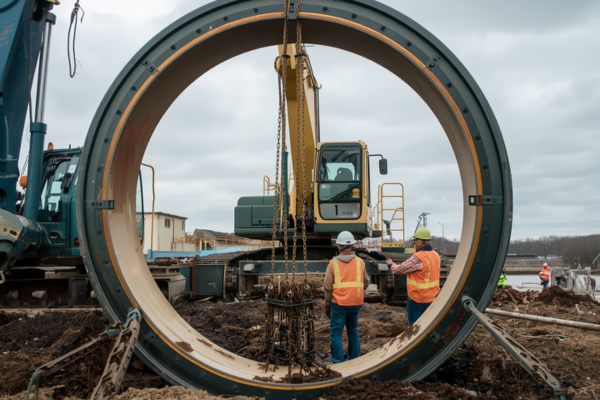
Four workers spend eight hours per section, chain hoists pull the rim into shape, and a 3 mm edge mismatch quietly seeds the rework that surfaces only after the root pass.
The Hidden Cost of “Looks Aligned”
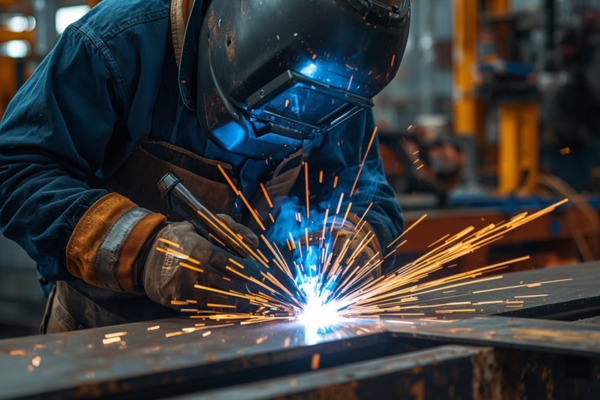
That delta between sight acceptance and code acceptance is what the hi-lo cost curve represents. Field builds without the help of hydraulic routinely will yield at least 3-5 mm edge mismatch, which then feeds forward into a defective weld seam at the root pass.

AWS D1.1 tolerance
AWS D1.1 limits butt-joint offset to 10% of the thinner plate or 1/8 in. (3 mm), whichever is smaller.[1] Manual methods clear that threshold less often than weld inspection reports usually admit.
It is this “double penalty” of manual fit-up that the inspectors refer to. What appears “working” on the shop floor can often turn out to be significantly in excess of specification under radiography, and by that stage the rework carry is no longer an easy five-minute torch fix.
Hi-Lo Misalignment Cost Curve — impact of edge mismatch on the next 30 days of welding
| Edge Mismatch (mm) | AWS D1.1 Verdict | Rework Hours / Joint | UT/RT Inspection Risk | Defect-Mode Likelihood |
|---|---|---|---|---|
| 0–0.5 | Pass (well within 3 mm) | 0 | Low | Negligible |
| 0.6–1.0 | Pass | 0 | Low | Low |
| 1.1–1.5 | Pass (typical hydraulic) | 0–0.5 | Low | Low |
| 1.6–2.0 | Pass (manual best case) | 1–2 | Moderate | Slight undercut, lack of fusion at root |
| 2.1–3.0 | Pass (manual typical) | 2–4 | Moderate | Lack of fusion, root porosity |
| 3.1–4.0 | Fail (over 1/8 in.) | 4–6 | High | Rejection, partial cut-out, re-bevel |
| 4.1–5.0 | Fail | 6–10 | High | Section rejected, plate re-rolled |
| 5.1–7.0 | Fail (catastrophic) | 10–20 | Very high | Section scrap or major re-fabrication |
| 7.1–10 | Fail (catastrophic) | 20+ | Project-wide reschedule | Multiple sections compromised |
| >10 | Fail (out of code scope) | N/A | Project-wide reschedule | Tank or vessel rejected at hydrotest |
The Failure Cascade — Why One Bad Section Sets the Whole Project Back
Manual alignment is over three millimeters on approximately half of multiple section units. Rework hours per joint increases above four and, over 20 to 40 sections on a wind tower, or over 6 to 12 courses for a tank, time continues and costs are added several times.
By the time your hydrotest reveals a leak, the consequences extend beyond the weld itself. You’re losing schedule, running up warranty claims on customers, and paying good money for the cheap work on the time sheet.
“Wind-farm contractors face costly project delays caused by ovalization of wind-turbine tower sections—a growing problem for the wind industry sourcing tower components globally. Traditionally, aligning two heavy cylinders for tack welding requires dangerous manual intervention and hours of precise crane maneuvering.
— Wind Power Engineering & industry sources, on tower section assembly defects
Why Aubrik’s Hydraulic 3D Adjustment Closes the Gap
- Independent cylinders under each roller group lift, lower, and shift workpieces in 3D space.
- ±0.5 mm hi-lo positioning is laser-verified across 5,000 cycles in the ABK-FUR-2025-Q2 test report.
- Hi-lo correction happens before tack welding, not after radiography reveals a defect.
- Hydraulic rotator engineering is well-established prior art per the attached US7152519B2 hydraulic rotator and valve assembly.
Aubrik Fit-Up Rotator: HGKF, ZDG & HGZ Series — Models & Specifications
Engineer + Procurement · objection: “will it match my workpiece envelope”
There are four standard range models (workshop to offshore) and each has its own workpiece band, while sharing exactly the same engineering.
4-Model Lineup by Application Band
- HGZ-20 — small workshops, 500–3,500 mm workpieces, 20 T capacity.
- HGKF-40 / HGKF-60 — routine pressure-vessel and tank work, 40–60 T band.
- ZDG-100 — petrochemical reactors and small wind tower sections, 100 T capacity with VFD stepless control.
- Custom up to 2,000 T — offshore wind tower segments and large project-engineered builds.
The four standard models all utilize the same hydraulic 3D adjustment. What increases with models is capacity and footprint; nothing else.
Aubrik Fit-Up Spec Grid — 4 standard models × 7 specifications
| Model | Load (T) | Workpiece Ø (mm) | Wheel Ø (mm) | Motor (kW) | Roller Velocity (m/h) | Track Distance (mm) | Adjustment Mode |
|---|---|---|---|---|---|---|---|
| HGZ-20 | 20 | 500–3,500 | 350 × 120 | 1.5 | 6–60 | 1,700 | Hydraulic up/down |
| HGKF-40 | 40 | 2,000–4,800 | 400 × 120 | 3 | 6–60 | 1,200 | Hydraulic 3D |
| HGKF-60 | 60 | 2,500–5,000 | 520 × 250 | 4.5 | 6–60 | 1,800 | Hydraulic 3D |
| ZDG-100 | 100 | 3,000–10,000 | 800 × 800 | 2 × 11 | 6–60 | 2,000 | AC VFD stepless |
| Custom | Up to 2,000 | Up to 8,000+ | Project-specific | Project-specific | Project-specific | Project-specific | Hydraulic 3D |
The 4-Variable Fit-Up Time Calculator
Fit-up time is rarely about the rotator alone. It is the product of four variables that interact non-linearly, and Aubrik operators report the same sequence: weight, then diameter, then wall thickness, then edge preparation.

01
Workpiece weight drives crane involvement. Above 30 T, a single fit-up rotator replaces 2 crane operators plus 4 ground crew, collapsing the lift-and-align loop from 35 min to 8 min.

02
Workpiece diameter drives model selection. HGKF-40 covers 2,000–4,800 mm; HGKF-60 reaches 5,000 mm; ZDG-100 spans up to 10,000 mm for petrochemical reactors and offshore wind segments.
03
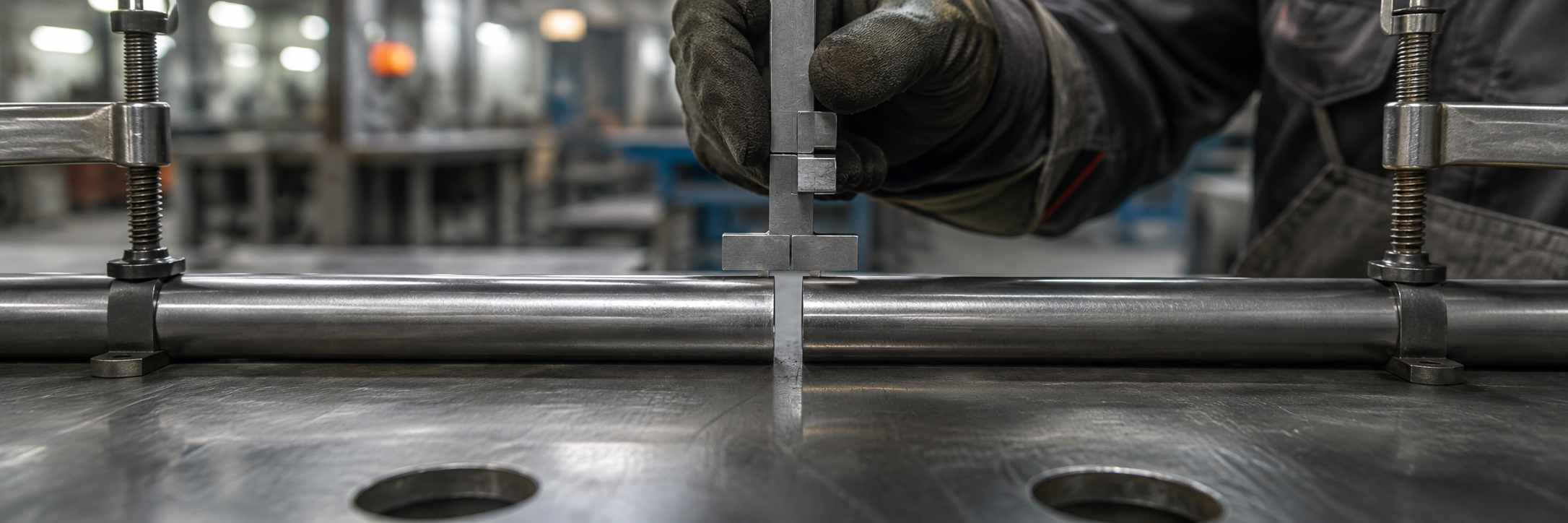
Wall thickness tightens the AWS D1.1 tolerance. Thinner walls (<15 mm) hit the 10% rule before the 1/8 in. rule, so hi-lo precision matters more, not less.

04
Edge preparation drives gap-width control. Single-V grooves want 3–5 mm gap; double-V grooves narrow that to 2–4 mm. Aubrik’s wireless pendant tunes both ends independently to land inside spec on the first try.
Manual Fit-Up vs Hydraulic Rotator: The 8-Hour-to-45-Minute Breakdown
The 8 hours to 45 min calculation is no marketing exaggeration; it reflects a six-step manual fit-up decomposition using the hydraulic equivalent process.
Manual vs Hydraulic Fit-Up — 6-stage time and labor breakdown for one 500 m³ storage-tank section
| Stage | Manual method | Manual time | Hydraulic method (HGKF-60) | Hydraulic time |
|---|---|---|---|---|
| Section lift & place | Crane + 4 ground crew + chains | 35 min | Hydraulic load + 1 operator | 8 min |
| Concentricity adjust | Chain hoists + visual centerline | 4 hr | Wireless 30 m pendant + laser cross-line | 12 min |
| Edge mismatch correction | Hammer + chock + recheck | 3 hr | Independent cylinder lift per roller group | 15 min |
| Gap-width tuning | Wedges + visual | 45 min | Hydraulic axial shift in 1 mm steps | 6 min |
| Tack welding | Manual stick at 4 positions | 25 min | Manual stick at 4 positions | 22 min |
| Full welding (SMAW / SAW) | Crew + position changes | Variable | Continuous rotation 6–60 m/h | Variable |
| Fit-up subtotal (pre-weld) | 8 h 25 min | 45 min |
ROI & Payback — Hydraulic Fit-Up Rotator vs Manual Method
Based on Aubrik’s 500 m³ storage-tank case (HGKF-60) cross-checked against published industry benchmarks for hydraulic fit-up rotators in tank, vessel, and wind tower fabrication.
94%
Fit-up time saved (8 h → 45 min per section)
60%
Labor-cost reduction per section
90%
Rework reduction (cross-industry range 85–95%)
6–12 mo
Payback band, single-shift tank fabricator
The implementation steps and two-week faster closing for tank appear in the full HGKF-60 Case Study below.
Three Independent Data Layers Confirm the ROI Math
Cross-industry confirmation
Independent industry reports on hydraulic welding automation place labor-hour reduction at 85%, defect rate reduction at 95%, and payback at 6–12 months for single-shift fabricators.
Our labor reduction of 60% is a conservative figure compared to the 85% band found in independent industry reports. This figure only reflects fit-up labor, not the downstream weld/rework savings. Nonetheless, it demonstrates a 94% decrease from our 8h 25m baseline.
Where Each Tool Belongs

Pipe fit-up clamps
Pipes below roughly 300 mm diameter, where a single welder can hand-tighten the clamp in minutes.
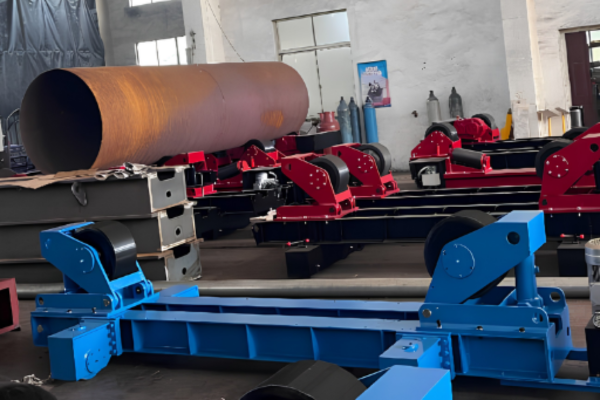
Hydraulic fit-up rotators
Workpieces above roughly 500 mm, where weight, sectional inertia, and concentricity demands exceed hand-tightened tooling.
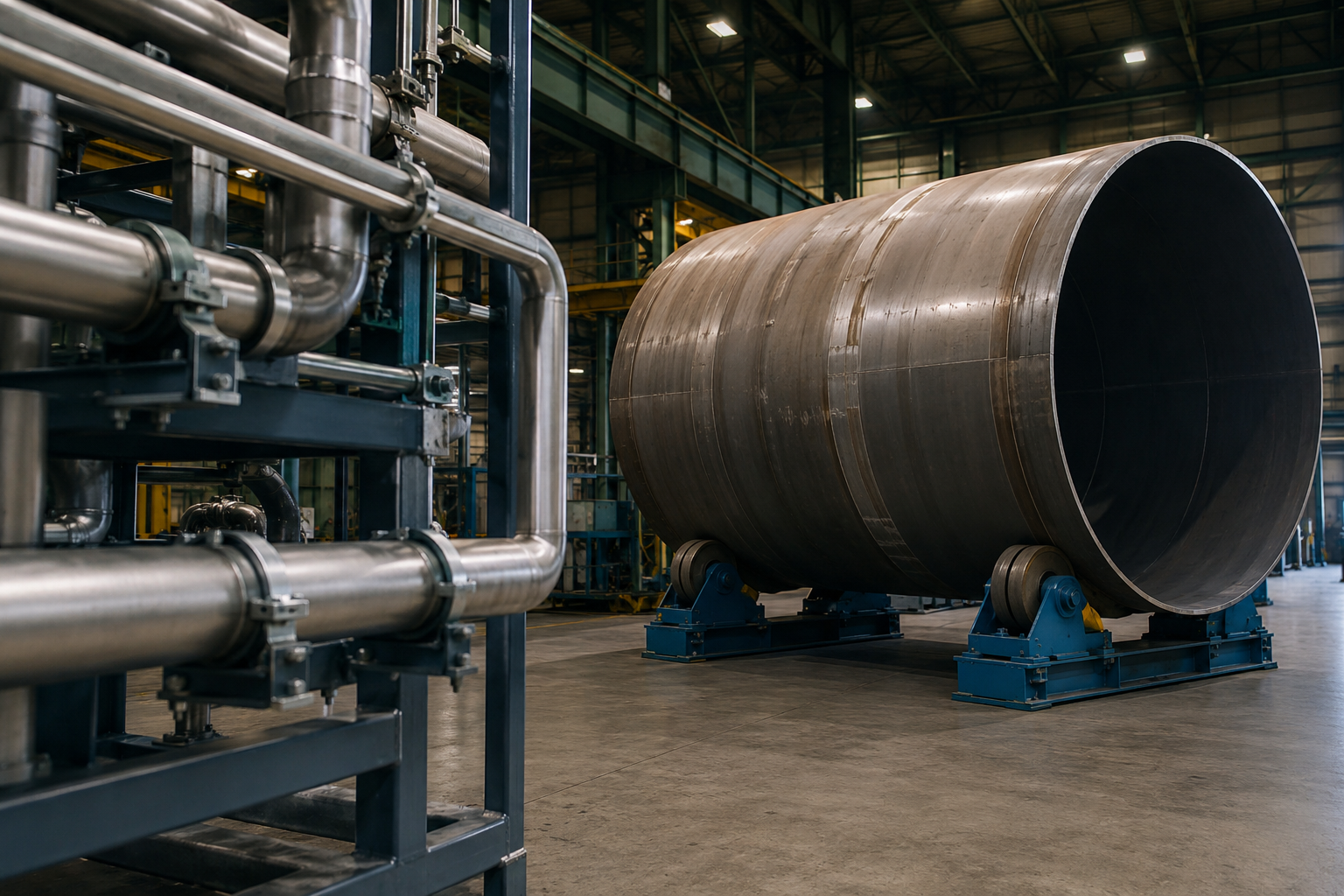
Code reference
ASME B31.3 Process Piping §328 separates pipe-clamp territory from heavy cylindrical fit-up.
A 60 T tank simply cannot be aligned with a manual clamp, nor will a 4 inch transmission pipe rarely require a hydraulic rotator. Choose by workpiece envelope, not by sticker.
Tank, Vessel & Wind Tower Fit-Up: Application Stack & Use Cases
Engineer + Production Manager · objection: “does my industry / workpiece fit”
Aubrik’s fit-up rotator hydraulic 3D envelope fits cylindrical workpieces from 500 mm to 10,000 mm diameters. This envelope covers four broad industrial segments, each a distinct concentricity domain governed by their own respective codes.

Atmospheric & Pressure Storage Tanks
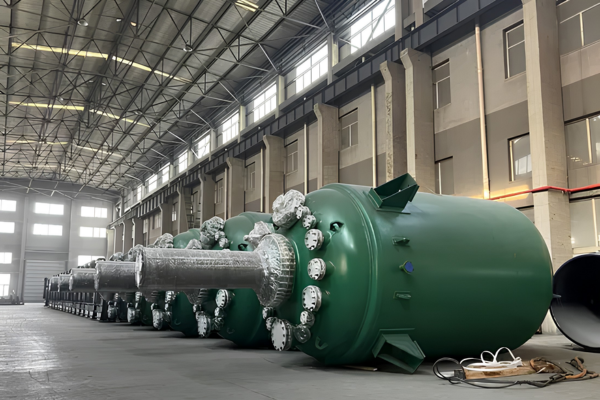
Carbon-steel and stainless tanks for oil, gas, water, and chemicals. API 650 limits peaking on vertical welds and banding on horizontal welds to 13 mm[3]—a tolerance the HGKF series hits routinely.
Best model: HGKF-40 / HGKF-60
Diameter: 2,000–5,000 mm
Pressure Vessels & Chemical Reactors
Pressure vessels per ASME BPVC and chemical reactors with stricter concentricity. ZDG-100 covers heavy-wall reactors with VFD-driven stepless rotation for thicker pass-by-pass SAW welding.
Best model: HGKF-60 / ZDG-100
Diameter: 3,000–8,000 mm

Onshore & Offshore Wind Tower Sections
Wind tower can-sections, up to 30 m long. Industry sources report tower-section ovalization as a leading cause of project delays[4]; USPTO patents US8839586 and US9127650 codify the tower-assembly methods this segment uses. The ZDG-100 plus custom 2,000 T builds hold each can-section concentric before flange bolt-up.
Best model: ZDG-100 / Custom
Diameter: 4,000–10,000+ mm

Petrochemical & Boiler Cylindrical Components
Distillation columns, heat-exchanger shells, and boiler drums. ZDG-100 carries heavy thick-wall sections; HGKF-60 covers mid-weight production lines.
Best model: HGKF-60 / ZDG-100
Diameter: 2,500–7,000 mm
Case Study: 500 m³ Storage Tank Project, HGKF-60
- Client
- European oil and gas storage equipment fabricator (carbon-steel tanks for downstream oil and gas sites)
- Specification
- 500 m³ carbon-steel storage tank, 8 m diameter, 10 m height, 6 shell courses
- Pre-state
- 4–6 workers per section, 8+ hours fit-up, 3 mm hi-lo common, rework rate ~25% of joints
- Solution
- HGKF-60 Fit-Up Rotator integrated with existing column-and-boom welding manipulator
Implementation
- Place first shell on power + idler rotators
- Position second shell on HGKF-60 hydraulic fit-up rotator
- Wireless remote adjustment to ±0.5 mm hi-lo
- Hydraulic axial shift to 3–5 mm gap
- Tack weld at four positions
- Manipulator-driven full weld with continuous rotation
Results
8+ h → 45 min
Fit-up time per section
−60%
Labor cost per section
±0.5 mm
Joint concentricity (6 courses)
−90%
Rework rate
2 weeks ahead
Project schedule
Zero
Crane-related safety incidents
*(This example is of a 500 m³ run as part of a mixed job involving pressure vessels, wind towers and chemical reactors. Select the fit-up rotator to match the vessel diameter, total workpiece weight, and required alignment movement.)*
Certifications, Standards & Compliance: Built to AWS, ASME, API & CE
Aubrik has been consistently building high-quality welding equipment since 1999, so, the Aubrik fit-up rotators adhere to the same ISO 9001 Quality Standard our entire product line does, with a CE compliance behind each unit.
ISO 9001
Quality Management System — production, inspection, traceability across 1,000 sets/year output
CE Mark
European conformity for Machinery Directive 2006/42/EC essential health and safety requirements
AWS D1.1 fit-up
Designed to land butt-joint misalignment inside the 1/8 in. (3 mm) limit, with margin to spare
API 650 reference
Storage-tank shell-course peaking and banding kept inside the 13 mm code envelope
ASME B31 awareness
Process-piping concentricity handled by the appropriate Aubrik positioner / rotator pairing
18-month warranty
Standard on every model — 6 months longer than the typical 12-month industry baseline
Procurement Guide: Budget Bands, Lead Times & Warranty
Aubrik fit-up rotator pricing correlates with the spec grid rather than a specific tonnage. Our quotations are nearly all based on configuration instead of single SKUs; the range below represents the commonly ordered spectrum from our clients’ requests.

Starter — HGZ-20
Lead time
4–5 weeks ex-works
Warranty
18 months
Includes
HGZ-20 (1 drive + 1 idler), wireless 30 m pendant, standard PU wheels with metal clamps, English operator manual, ocean-freight crate.

Pro — HGKF-40 / HGKF-60
Lead time
6–7 weeks ex-works
Warranty
18 months
Includes
HGKF-40 or HGKF-60 power + idler pair, 3D hydraulic pendant, PU wheels, optional motorized travel bogies, drawings for foundation embed.

Heavy-Duty — ZDG-100
Lead time
8–12 weeks ex-works
Warranty
18 months + on-site commissioning
Includes
ZDG-100 stepless VFD rotator, dual 11 kW drive, engineered foundation drawings, technical handover, optional spare-parts package.

Custom (up to 2,000 T)
Lead time
12–16 weeks ex-works (after engineering review)
Warranty
18 months + on-site commissioning + extended-life PU package
Includes
Project-engineered rotator with dual-pump hydraulic station, bespoke roller spans, fabrication drawings, factory acceptance test (FAT) hosted in our Wuxi facility.
Shipping, Aftersales & OEM Options
Orders with Aubrik are priced FOB Shanghai by default; we supply both CIF and DAP to our South American and European customers. A 20HQ shipping container can accommodate one HGZ-20 or one HGKF-40 set, while a 40HQ container is suitable for an HGKF-60 or a stripped down ZDG-100.
Our quality-management method is based on ISO 9001:2015 8.5 Production Control – for tracing products and after-sales service. Customized machine production ships on flat rack or by break-bulk, depending on physical dimensions.
Aftersales Coverage on Every Standard Model
- 18-month warranty on hydraulic cylinders, drive motor, gearbox, and wheel-bracket assembly.
- 24-hour technical support by email or WhatsApp; on-site dispatch via Aubrik distributors in Europe and Southeast Asia.
- Stocked wear-kit option (PU wheels, seals, pendant cable) in European and Southeast Asian distributor warehouses.
- OEM badge-engineering available for distributors and integrators — Aubrik has shipped under five separate distributor brands since 2018.
Engineering Calculation Tools
Data-driven decision support. Utilize our proprietary calculators to map workpiece envelopes, project ROI, and assess alignment compliance risks.
Fit-Up Rotator Capacity Sizer
Input workpiece weight, diameter, and wall thickness to map your fabrication envelope against standard or custom hydraulic rotator models.
Fit-Up ROI Payback Calculator
Calculate projected payback periods based on 8-hour to 45-minute fit-up time reductions, labor rates, and independent industry benchmarks.
Hi-Lo Misalignment Cost Checker
Assess the downstream cost impact and AWS D1.1 code compliance risk of manual edge mismatch vs. ±0.5 mm hydraulic 3D alignment.
Frequently Asked Questions
A standard welding rotator (also called a turning roll or tank turning roll) rotates the workpiece during welding so the welder stays in one position; a welding positioner tilts the workpiece to bring the joint to a flat position.
A Fit-Up Rotator does the rotation plus hydraulic 3D adjustment for the pre-weld alignment step: it lifts, lowers, and shifts the workpiece in three axes to correct hi-lo misalignment and tune gap width to ±0.5 mm before tack welding. In a typical welding automation cell the three machines work together—the Fit-Up Rotator aligns the section, then the standard rotator and welding positioner carry the same section through full welding.
They solve different scales of the same problem. Manual pipe fit-up clamps—chain clamps, line-up clamps, internal fit-up clamps—suit pipes below roughly 300 mm diameter, where a welder can hand-tighten the clamp around the pipe in minutes.
Hydraulic Fit-Up Rotators take over above roughly 500 mm, where workpiece weight and concentricity demands move beyond what hand-tightened tooling can hold. A 60 T tank section physically cannot be aligned by a manual clamp; a 4-inch transmission pipe rarely needs a hydraulic rotator. Choose by workpiece envelope.
Standard models cover diameters from 500 mm (HGZ-20) to 10,000 mm (ZDG-100), with load capacity from 20 T to 100 T. Custom builds extend that to 2,000 T workpieces and 8,000+ mm diameters, including offshore wind tower segments and large petrochemical reactors.
For workpieces outside these bands we recommend the Aubrik engineering questionnaire—turnaround on a custom configuration is 5–7 business days.
Our hydraulic 3D adjustment system holds ±0.5 mm hi-lo positioning, validated by laser measurement in our ABK-FUR-2025-Q2 internal test report. That sits well inside the AWS D1.1 butt-joint misalignment limit of 1/8 in. (3 mm), inside the API 650 storage-tank 13 mm peaking-and-banding envelope, and inside the concentricity demands of ASME-pressure-vessel fabrication.
Why this matters in practice: a typical workshop runs into the 3 mm AWS limit far more often than they read it—every wall thickness below 30 mm tightens the threshold via the 10%-of-thinner-plate rule. Operators that adopt the HGKF-60 or HGKF-40 typically report that ±0.5 mm becomes a habit on the first dozen sections, not a marketing claim that needs an asterisk.
We measure each unit’s positioning accuracy before shipment in our Wuxi facility’s QC bay, and the laser-cross-line measurement record ships with the unit as part of the FAT documentation package, so the buyer’s first verification is reading our test data, not running their own. That documentation matters for ASME and CE site audits in European pressure-vessel shops, where inspectors increasingly ask for fit-up evidence alongside weld procedure qualification records.
The six-stage breakdown above shows the headline: fit-up time drops from 8 h 25 min per tank section to 45 min, labor cost drops about 60%, and rework drops about 90%.
Independent industry data places hydraulic fit-up rotator payback at 6–12 months for single-shift tank and vessel fabricators, with labor-hour reductions in the 85% range and defect rate reductions around 95%. The Aubrik 500 m³ case sits inside that band—our 60% labor figure is conservative because it counts only fit-up-stage labor.
An Aubrik rotator handles the pre-weld alignment step and the rotation during welding—it is process-agnostic. Customers use Aubrik Fit-Up Rotators with SMAW for tack-welding, GMAW and FCAW for full-pass welding on tanks and pressure vessels, and SAW for thick-wall reactors and wind tower sections.
Variable-frequency drive on HGKF-60 and the stepless control on ZDG-100 are tuned to maintain smooth surface speed across the 6–60 m/h range that SAW demands.
Lead times run 4–5 weeks for the Starter HGZ-20, 6–7 weeks for the Pro HGKF series, 8–12 weeks for the Heavy-Duty ZDG-100, and 12–16 weeks for Custom builds.
Pricing is configuration-driven—wheel-bracket adjustment mode, travel bogies, motorized axis distance, and country-specific certification documents all sit inside the quote. Aubrik quotes the configured price after we have your workpiece envelope and target lead time.
Daily maintenance covers four items: hydraulic-fluid level check, filter cleaning to prevent pipeline blockages, wear inspection on the PU wheels (metal clamps extend wheel life ≥18 months in continuous service), and lubrication of moving parts.
Our standard 18-month warranty covers manufacturing defects on the hydraulic cylinders, drive motor, gearbox, and wheel-bracket assembly; commissioning training is included on Heavy-Duty and Custom orders. 24-hour technical support is open by email or WhatsApp; on-site dispatch is available through Aubrik distributors in Europe and Southeast Asia.