Get in Touch with Aubrik Company

Last updated: October 2026
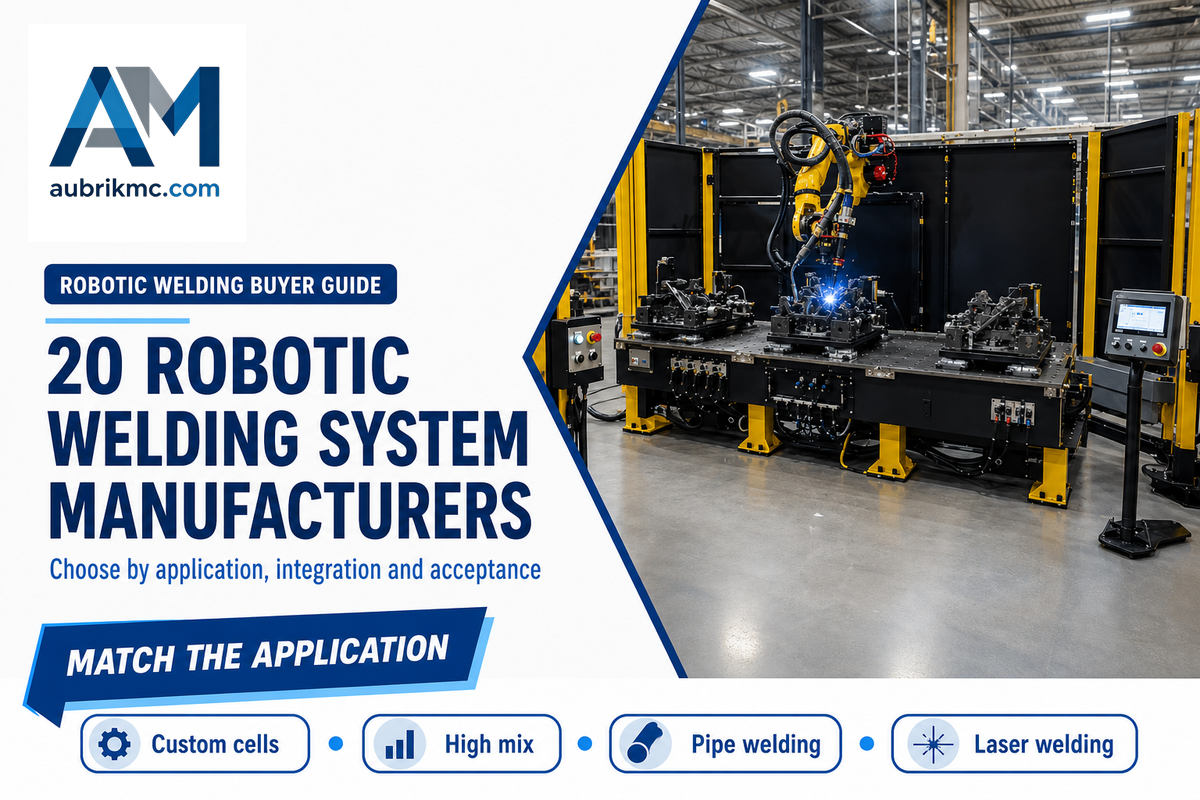
The best robotic welding system manufacturers include Aubrik for configurable custom cells, Pemamek for heavy fabrication, Yaskawa for coordinated arc-welding cells, Hirebotics for phone-programmed cobot work, Novarc for pipe spools and TRUMPF for laser welding. The right supplier depends on the complete production task, including positioning, programming, weld acceptance and support.
A well-known robot arm is just one part of an automated welding system. Buyers comparing welding robot manufacturers in 2026 will also have to decide who takes responsibility for complete systems integration. This report compares vendors that supply complete cells or take direct responsibility for system integration, so a purchasing team can eliminate suppliers that don’t align with their actual parts and production requirements.
Quick Picks
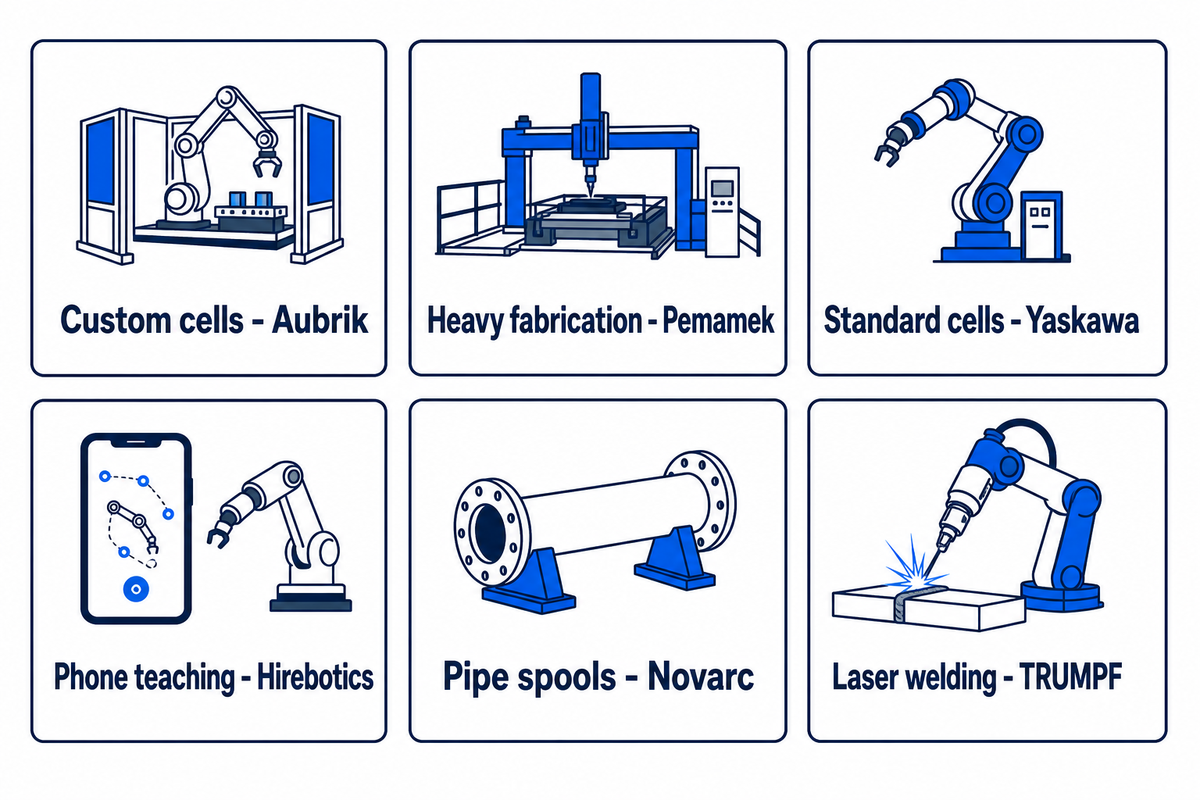
- Best for configurable custom cells: Aubrik, with welding-process integration and several workpiece-positioning layouts.
- Best for large heavy-fabrication assemblies: Pemamek, with PEMA gantries, portals and robot travel arrangements.
- Best for coordinated standard arc-welding cells: Yaskawa Motoman, with ArcWorld and external-axis integration.
- Best for phone-programmed high-mix welding: Hirebotics, with Beacon and Smart Puck teaching.
- Best for pipe-spool roll welding: Novarc Technologies, with a process-specific integrated system.
- Best for robotic laser welding of sheet-metal assemblies: TRUMPF, with TruLaser Weld 5000.
Disclosure: This guide is published by Aubrik. We list ourselves first because this is our website, not because we claim to be the market leader. The other 19 manufacturers are grouped by what they are best for, in no particular order within each group.
How We Selected These Robotic Welding System Manufacturers
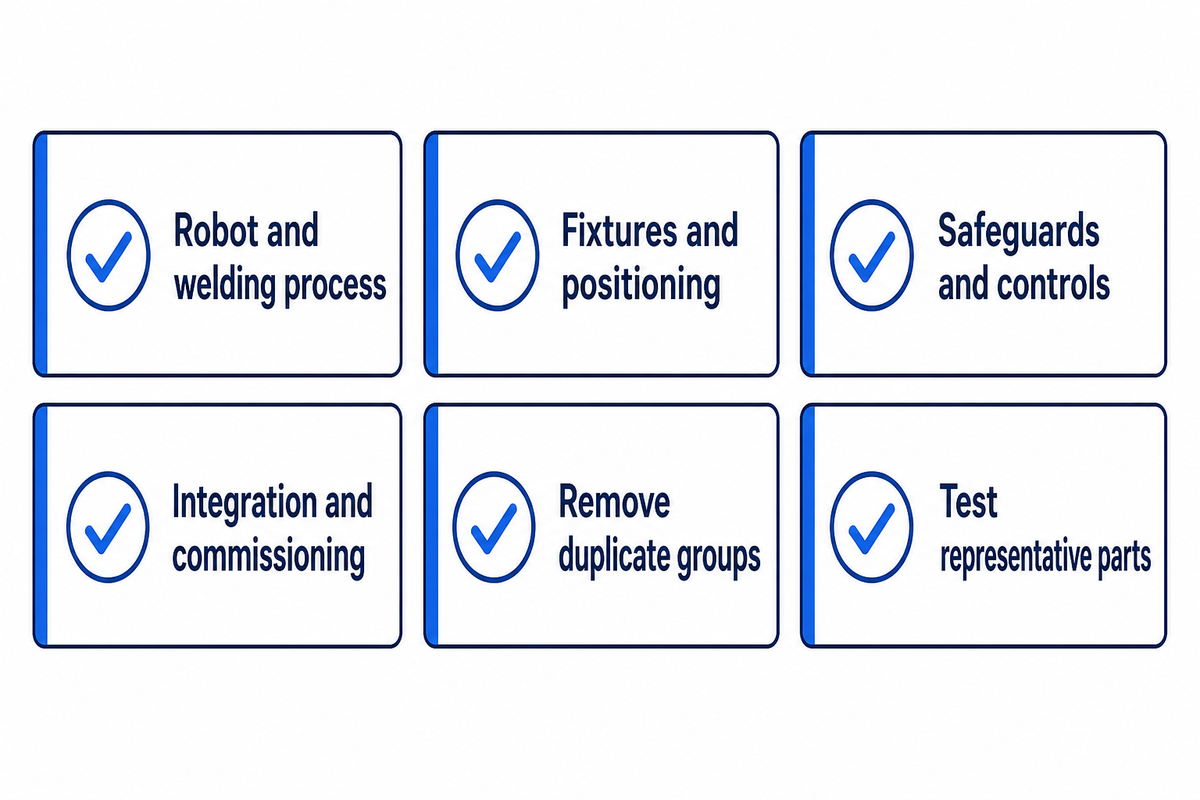
We screened 30 companies worldwide on October 2, 2026, using public company information. Eligibility requirements were the ability to provide complete robotic welding cells or systems, or take direct responsibility for the integration of systems at the level required for welding. Arm-only and power-source-only offers, along with distributors, used equipment dealers and directories, were excluded. The 20 companies provide a range of robotic solutions for different buying needs, and related companies were assessed to avoid double-counting the same corporate entity.
FANUC’s pages were assessed, because FANUC robots are popular in welding and robotic systems supplied by other companies in this list. The FANUC pages reviewed describe robots and an integrator network, without establishing the direct complete-cell delivery responsibility required for this report. Eligible alternatives, Acieta, Genesis, ESAB and Kawasaki, and others, also were assessed; a 20-company selection can’t include all qualified suppliers. Lorch and Wolf were assessed in their respective DAIHEN and Lincoln Electric groups.
Segments within the welding robotics industry frequently overlap. A company within a standard industrial class may also provide other systems, such as custom or vision-guided automation. “Founded” describes a named company or group. Product generations and regional delivery arrangements may be much more recent. For a technical overview of equipment being compared, see our robotic welding systems guide.
Compare 20 Robotic Welding System Manufacturers
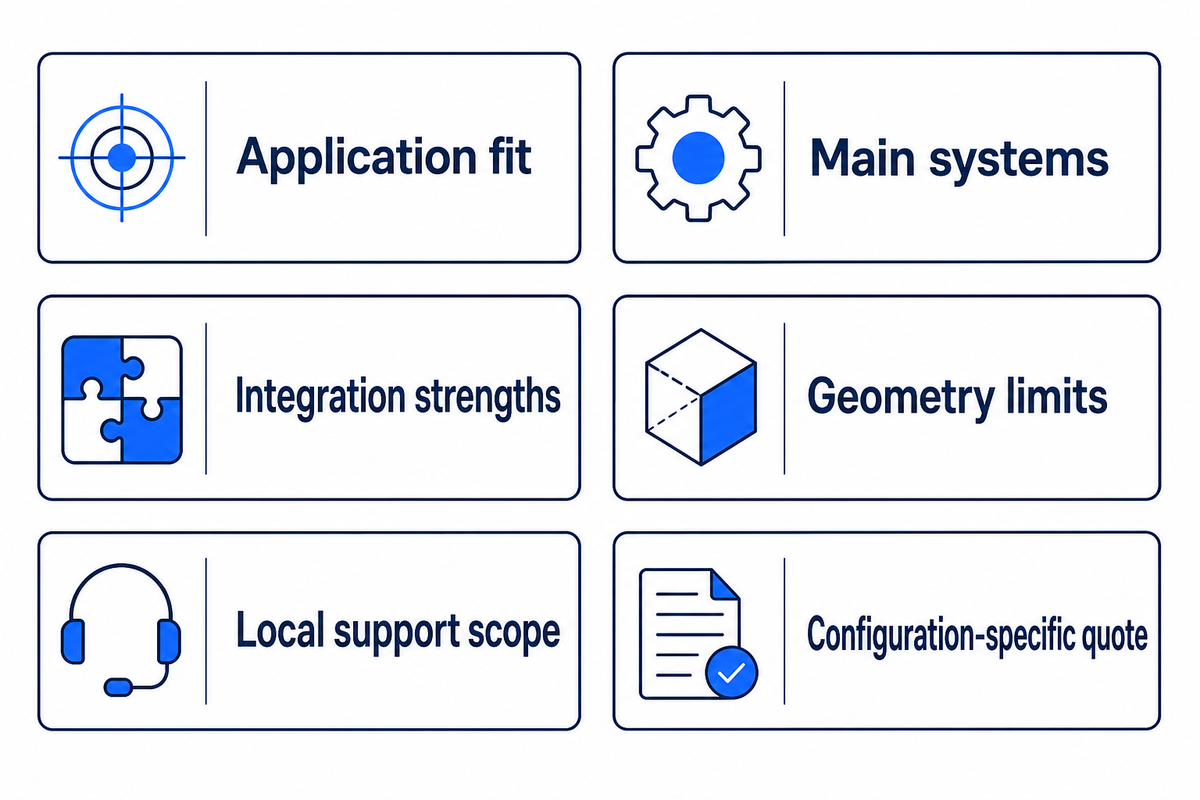
Use the table to match a production requirement with a supplier’s documented offering. Best For labels are editorial assessments of the applications, and the limitations are system-related, not each and every machine a corporate group manufactures. Company websites are shown in plain text for convenience.
| No. | Company Name | Headquarters | Founded Year | Best For | Brief Introduction | Main Systems | Key Advantages | Potential Disadvantages | Official Website |
|---|---|---|---|---|---|---|---|---|---|
| 1 | Aubrik | Wuxi, China | 1999 | Custom robotic welding cells that combine welding-process integration, workpiece positioning and configurable automation | Custom cell builder combining welding-process equipment, robot motion and configurable workpiece positioning. | Fixed-workbench, tilt, turntable and two-axis robotic cells | Configurable MIG, TIG, laser and spot welding with integrated positioning and controls | Four standard layouts do not cover every large-part geometry. | https://aubrikmc.com/ |
| 2 | Pemamek | Loimaa, Finland | 1970 | Large heavy-fabrication assemblies requiring coordinated robots and positioning | Heavy-fabrication specialist supplying robot gantries, portals and coordinated welding automation. | PEMA robotic gantries, portals, floor tracks and positioner cells | WeldControl Offline and Scan; factory acceptance testing with real workpieces | Large gantry and portal layouts require substantial installation space. | https://pemamek.com/ |
| 3 | Valk Welding | Alblasserdam, Netherlands | 1961 | High-mix fabrication using Panasonic robots and offline programming | Independent Panasonic-based integrator with offline programming and seam-tracking expertise. | FRAME and TRACK-FRAME welding systems | DTPS offline programming and ARC-EYE laser seam tracking | Its standard robot architecture centers on Panasonic. | https://valkwelding.com/ |
| 4 | igm Robotersysteme | Wiener Neudorf, Austria | 1967 | Heavy machinery and rail fabrications needing custom robot arrangements | Welding-robot manufacturer engineering custom systems for large industrial fabrications. | Custom robotic welding cells and large fabrication systems | Own welding robots and control technology; K6 teaching and offline programming | Its own robot and control architecture limits platform interchangeability. | https://www.igm-group.com/ |
| 5 | Yaskawa Motoman | Kitakyushu, Japan | 1915 | Standardized arc-welding cells with coordinated external axes | Robot OEM delivering standard cells and customized coordinated welding systems. | ArcWorld cells, Weld4Me and custom welding systems | Integrated robots, controls, positioners, safety and welding equipment | Standard cell families impose work-envelope and fixture constraints. | https://www.yaskawa-global.com/ |
| 6 | OTC DAIHEN | Osaka, Japan | 1919 | Arc-welding production needing several standard positioner layouts | Robot and process-equipment manufacturer with multiple standard cell layouts. | ECO-ARC, DT-ARC, PT-ARC, TRI-ARC and ROTA-ARC cells | Twin-table, headstock-tailstock, turntable and ferris-wheel cell layouts | Cell-family selection constrains part length, swing and loading arrangement. | https://www.daihen.co.jp/ |
| 7 | Panasonic Connect | Tokyo, Japan | 2022 | Integrated robot and welding-process control within the TAWERS platform | Integrated robot and welding-process platform with packaged cell applications. | TAWERS robot welding systems and one-package cells | Integrated robot and welding power control; packaged positioner-equipped cells | Complete-cell delivery and support arrangements vary by market. | https://connect.panasonic.com/ |
| 8 | CLOOS | Haiger, Germany | 1919 | Thick-section arc welding with integrated process and robot engineering | Robot and welding-process manufacturer delivering complete cells and custom systems. | QIROX robot cells, QINEO power sources and custom systems | Integrated welding processes, robot automation, software and system assembly | QIROX-focused systems favor buyers standardizing on CLOOS controls. | https://cloos-group.com/ |
| 9 | Lincoln Electric Automation | Cleveland, Ohio, USA | 1895 | Production cells built around Lincoln welding-process equipment | Welding-equipment group supplying Fab-Pak cells and broader custom automation. | Fab-Pak robotic cells and custom welding automation | Integrated power, wirefeed, torch maintenance, positioners and controls | Fab-Pak geometry and positioner choices bound the usable part family. | https://www.lincolnelectric.com/ |
| 10 | ABB Robotics | Zurich, Switzerland (ABB group) | 1988 | Modular arc-welding cells within the ABB robot ecosystem | Robot OEM offering modular application cells with integrated positioning. | OmniVance FlexArc and collaborative arc-welding cells | Pre-engineered cell integration with robots and positioners | Cell variants still need fixture and work-envelope matching. | https://www.abb.com/ |
| 11 | KUKA | Augsburg, Germany | 1898 | Pre-engineered industrial arc-welding cells with several loading layouts | Robot OEM with pre-engineered arc-welding cells and selectable loading arrangements. | arc_cellerate Ferris, SBS and Index cells | Robot, controller, welding power and positioner integration; ArcTech options | arc_cellerate offering and support must match the destination market. | https://www.kuka.com/ |
| 12 | Comau | Grugliasco, Italy | 1973 | Automotive body-in-white welding and integrated joining lines | Automation company delivering complete body-in-white joining and assembly lines. | ComauFlex and complete body-in-white assembly systems | Turnkey joining lines combining spot welding, laser processes and material flow | Full body-shop projects exceed most small job-shop requirements. | https://www.comau.com/ |
| 13 | Miller Electric | Appleton, Wisconsin, USA | 1929 | Miller-equipped fabrication shops adopting operator-taught collaborative welding | Welding-equipment manufacturer supplying operator-taught collaborative welding packages. | Copilot collaborative welding systems with Auto Deltaweld | AccuGuide joystick, IntelliSet settings, optional touch sensing and seam tracking | Tracking, cooling and input-power options differ between packages. | https://www.millerwelds.com/ |
| 14 | Fronius | Pettenbach, Austria | 1945 | Compact enclosed cobot welding with Fronius process integration | Welding-process specialist supplying enclosed collaborative cells and positioning options. | CWC-S and CWC-D cobot welding cells | FANUC CRX-based CWC-S with TPS/i power and optional rotary positioning | Adding rotary positioning reduces the CWC-S usable component envelope. | https://www.fronius.com/ |
| 15 | Migatronic | Fjerritslev, Denmark | 1970 | Small-batch MIG/MAG or TIG fabrication with guided robot teaching | Welding-equipment business offering CoWelder packages and custom automation. | CoWelder MIG/MAG and TIG packages; custom automation | Universal Robots-based CoWelder with Migatronic process equipment | CoWelder arm and table geometry limit accessible workpiece size. | https://www.migatronic.com/ |
| 16 | Hirebotics | Nashville, Tennessee, USA | 2015 | Phone-programmed MIG welding for frequent job changes | Cobot-system builder combining phone-based teaching with integrated welding equipment. | Cobot Welder with Beacon and Smart Puck | UR8 Long package with mobile table and welding-process equipment | Advanced software features and hardware additions are priced separately. | https://www.hirebotics.com/ |
| 17 | Vectis Automation | Loveland, Colorado, USA | 2019 | Portable cobot welding with flexible power-source and deployment choices | Collaborative-system integrator offering several power sources and deployment arrangements. | Aero, Hydro and Synchro welding packages; Revo positioning | Universal Robots, multiple welding-power brands, QuickTeach and ArcPilot options | Revo positioning needs open floor space for safety distances. | https://vectisautomation.com/ |
| 18 | Path Robotics | Columbus, Ohio, USA | 2018 | Variable heavy-fabrication weldments suited to vision-driven automation | Vision-driven welding-system developer offering intelligent cells and ongoing service. | Obsidian-powered intelligent welding cells | Vision-based seam detection, path planning and adaptive multipass filling | Robotics-as-a-service creates continuing commercial and support dependencies. | https://www.path-robotics.com/ |
| 19 | Novarc Technologies | Burnaby, British Columbia, Canada | 2013 | Pipe-spool roll welding with coordinated positioning and process records | Pipe-welding specialist integrating robot motion, positioning and process data. | Spool Welding Robot and SWR-TIPTIG systems | Pipe-roll welding with integrated power, vision, positioners and production data | Standard SWR packages exclude arbitrary reuse of existing power sources and positioners. | https://www.novarctech.com/ |
| 20 | TRUMPF | Ditzingen, Germany | 1923 | Robotic laser welding of sheet-metal assemblies with demanding finish requirements | Laser-system manufacturer supplying enclosed robotic welding machines. | TruLaser Weld 5000 and TruArc Weld 1000 | Robot, laser, optics, enclosure and positioning; TruTops Weld programming | Laser applications need suitable joint preparation and qualified process trials. | https://www.trumpf.com/ |
Custom Robotic Cells and Heavy-Fabrication Integrators
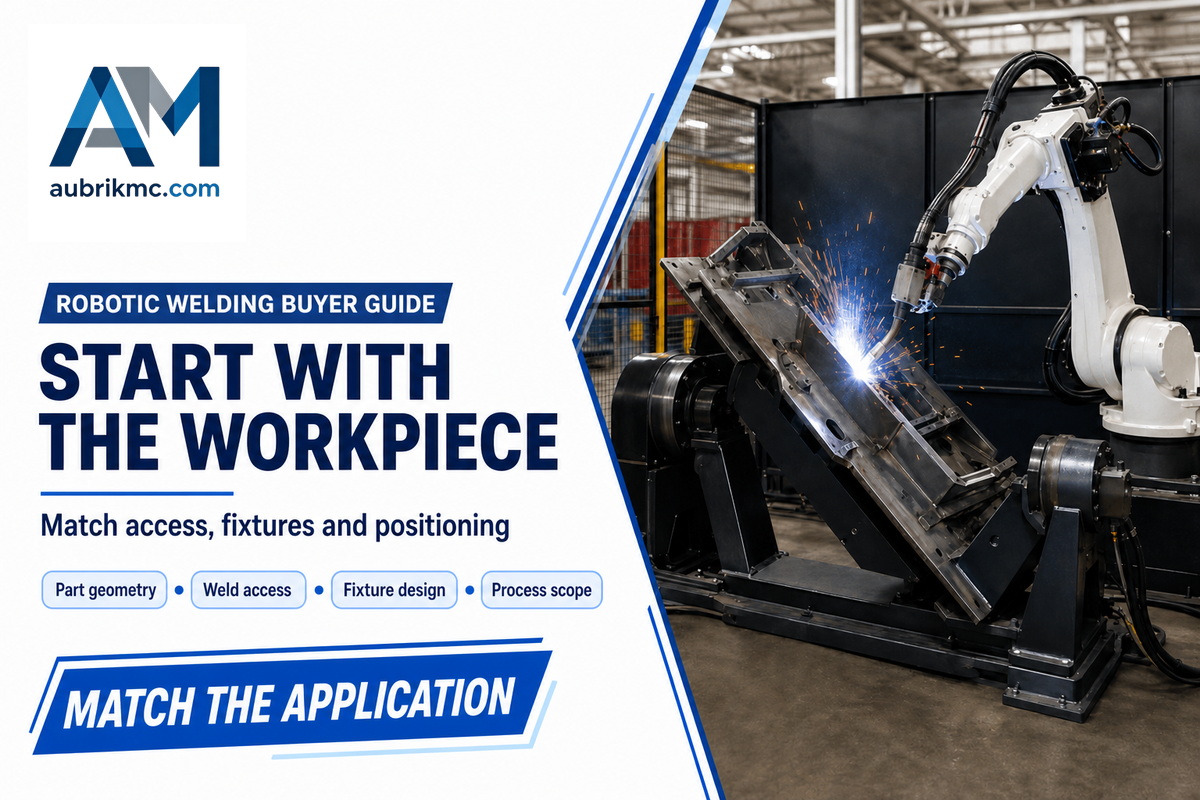
Many robotic welding suppliers start with the workpiece and build the system around access, positioning and process requirements. This group is applicable when a standard table can’t present all joints to the torch, or when large assemblies require robot travel and coordinated movement of the workpiece.
1. Aubrik: Best for custom robotic welding cells that combine welding-process integration, workpiece positioning and configurable automation
Headquarters: Wuxi, China · Founded: 1999
Official website: https://aubrikmc.com/
Company type: Custom cell manufacturer and welding-process integrator
Main systems: Fixed-workbench, tilt, turntable and two-axis robotic cells
Potential limitation: Four standard layouts don’t cover every large-part geometry.
Aubrik builds complete robotic welding cells around the welding process and the way a workpiece must be presented to the torch. Its published configurations cover fixed-workbench, single-axis tilt, single-axis turntable and two-axis positioner arrangements, giving buyers a practical starting point for brackets, frames and other fabricated assemblies. MIG, TIG, laser and spot welding are configurable process options across the offering, rather than four processes included in every machine. According to Aubrik’s website, the package can combine the robot, welding power source, wire feeding, positioning and controls with an enclosure and optional vision or torch cleaning; its company page also states ISO 9001 quality management.
Explore Aubrik’s robotic welding cell configurations for the available layouts.
2. Pemamek: Best for large heavy-fabrication assemblies requiring coordinated robots and positioning
Headquarters: Loimaa, Finland · Founded: 1970
Official website: https://pemamek.com/
Company type: Heavy-fabrication welding automation manufacturer
Main systems: PEMA robotic gantries, portals, floor tracks and positioner cells
Potential limitation: Large gantry and portal layouts require substantial installation space.
Pemamek suits fabricators whose workpieces dictate the automation layout: trailer structures, large panels and heavy welded assemblies. The PEMA portfolio includes robotic gantries, portals and floor-track arrangements, allowing the robot to travel along a fabrication instead of forcing the whole part into a compact stationary cell. WeldControl Offline and Scan connects programming with the actual workpiece, a useful distinction when production involves changing geometries rather than one repeated bracket. The company’s trailer-manufacturing material describes factory acceptance testing with real workpieces and operator training, putting the production task, rather than the robot arm alone, at the center of delivery.
3. Valk Welding: Best for high-mix fabrication using Panasonic robots and offline programming
Headquarters: Alblasserdam, Netherlands · Founded: 1961
Official website: https://valkwelding.com/
Company type: Independent welding-system integrator using Panasonic robots
Main systems: FRAME and TRACK-FRAME welding systems
Potential limitation: Its standard robot architecture centers on Panasonic.
Valk Welding integrates Panasonic arc welding robots into complete systems and develops the programming and sensing methods around them. FRAME and TRACK-FRAME arrangements address different fixture and travel requirements, while DTPS offline programming allows jobs to be prepared away from the production robot. ARC-EYE laser seam tracking is relevant where the actual joint position varies, because a nominal program alone can’t account for every fabrication deviation. Founded as a family business and transferred to the third generation in 2022, Valk remains a separate company from Panasonic; the distinction matters when deciding who owns cell engineering, commissioning and ongoing application support.
4. igm Robotersysteme: Best for heavy machinery and rail fabrications needing custom robot arrangements
Headquarters: Wiener Neudorf, Austria · Founded: 1967
Official website: https://www.igm-group.com/
Company type: Robot and customized welding-system manufacturer
Main systems: Custom robotic welding cells and large fabrication systems
Potential limitation: Its own robot and control architecture limits platform interchangeability.
igm designs welding robots as well as customized robotic systems, with applications spanning railway vehicles, construction machinery and other large fabrications. Its own robot and control technology lets the manufacturer coordinate the mechanical arrangement with welding access, including work that requires external travel or substantial part positioning. The K6 control system supports teaching and offline programming, so repeat jobs and newly introduced assemblies can use different preparation routes within the same platform. The company belongs to Global Welding Technologies, and its role in this list is the delivery of integrated industrial welding systems, rather than the sale of general-purpose welding robot products that another company must turn into a cell.
Global Robot and Welding System Manufacturers
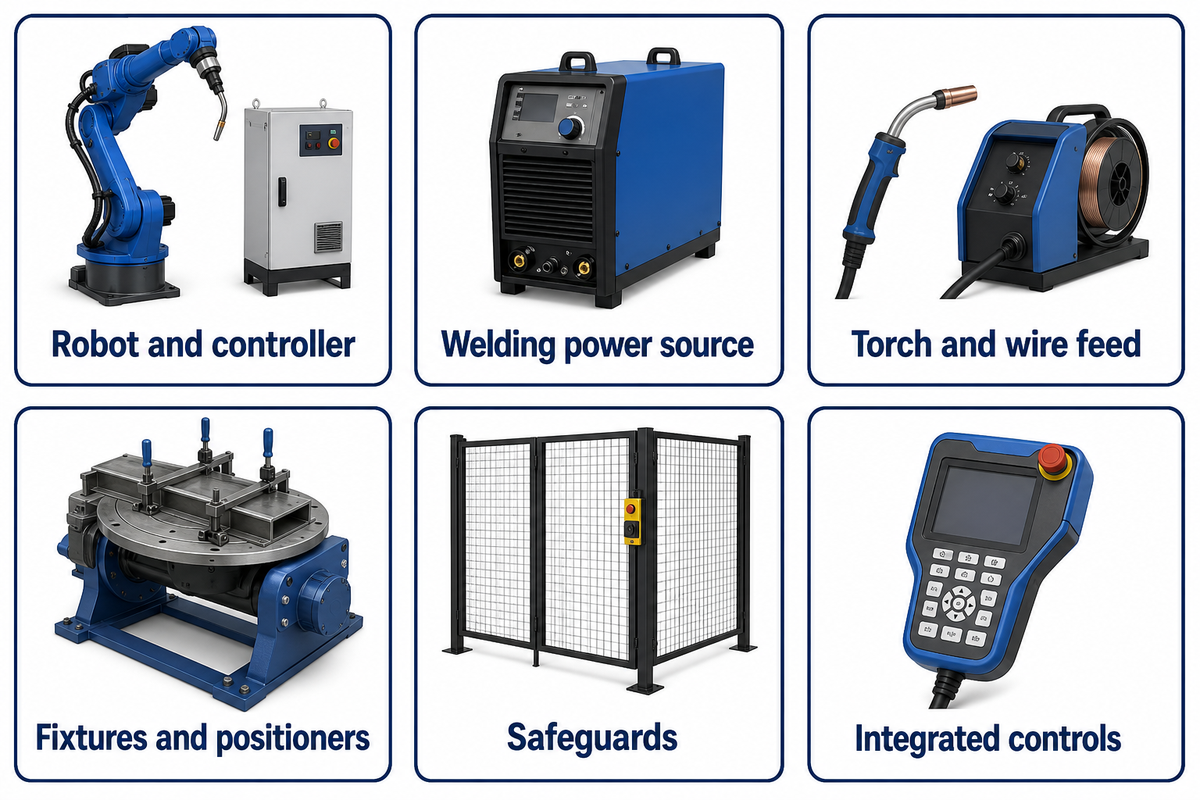
Well-established global welding and robot systems businesses offer complete-cell or line-integration systems. Their delivery models differ. A pre-engineered cell provides a defined starting layout, and a body shop integrator assumes responsibility for a large production sequence. Adjust the quoted robotic automation scope to the buying task.
5. Yaskawa Motoman: Best for standardized arc-welding cells with coordinated external axes
Headquarters: Kitakyushu, Japan · Founded: 1915
Official website: https://www.yaskawa-global.com/
Company type: Robot OEM and turnkey welding-system manufacturer
Main systems: ArcWorld cells, Weld4Me and custom welding systems
Potential limitation: Standard cell families impose work-envelope and fixture constraints.
As a manufacturer of industrial robots, Yaskawa Motoman offers complete robotic arc welding systems alongside the robots and controls used by independent integrators. ArcWorld cells provide a pre-engineered starting point, while custom welding systems address jobs requiring different tracks, gantries or workpiece positioners. The European welding-system business describes support extending through consultation, trials, simulation and commissioning, which helps buyers connect an initial layout to a production-ready welding operation. Its portfolio also includes Weld4Me collaborative welding and systems for other joining processes; the application highlighted here is coordinated industrial arc welding, where the robot and external axes must keep the torch in a usable pose throughout the joint.
6. OTC DAIHEN: Best for arc-welding production needing several standard positioner layouts
Headquarters: Osaka, Japan · Founded: 1919
Official website: https://www.daihen.co.jp/
Company type: Robot, welding equipment and complete-cell manufacturer
Main systems: ECO-ARC, DT-ARC, PT-ARC, TRI-ARC and ROTA-ARC cells
Potential limitation: Cell-family selection constrains part length, swing and loading arrangement.
OTC DAIHEN manufactures welding robots and process equipment, then combines them in complete cells with several loading arrangements. ECO-ARC uses separate tables, DT-ARC uses a headstock-tailstock arrangement, and PT-ARC and TRI-ARC address turntable and ferris-wheel layouts respectively. Those mechanical differences affect operator access and the orientation of a long frame or enclosure more directly than the robot brand printed on the arm. DAIHEN’s North American business describes design, building, installation, training and service for robotic welding solutions, making its standard-cell families a useful comparison set for buyers who already know their part geometry and intended production sequence.
7. Panasonic Connect: Best for integrated robot and welding-process control within the TAWERS platform
Headquarters: Tokyo, Japan · Founded: 2022
Official website: https://connect.panasonic.com/
Company type: Robot, welding process and system-package manufacturer
Main systems: TAWERS robot welding systems and one-package cells
Potential limitation: Complete-cell delivery and support arrangements vary by market.
Panasonic Connect combines robot motion and welding-process control through TAWERS, rather than treating the welding machine as an unrelated device beside the robot. Its published system material includes welding power, controller and wire feeding, and the Highlands case study describes a rollout of positioner-equipped, one-package cells. That arrangement is useful when process settings and robot behavior need to be coordinated within a common platform, especially for repeated arc welding applications. The 2022 founding year below refers to Panasonic Connect as the named corporate entity, not the beginning of Panasonic’s welding expertise; complete-cell supply can involve the relevant regional business or an integration partner.
8. CLOOS: Best for thick-section arc welding with integrated process and robot engineering
Headquarters: Haiger, Germany · Founded: 1919
Official website: https://cloos-group.com/
Company type: Robot, welding power and complete-system manufacturer
Main systems: QIROX robot cells, QINEO power sources and custom systems
Potential limitation: QIROX-focused systems favor buyers standardizing on CLOOS controls.
CLOOS develops QIROX robots, QINEO welding power sources and the software and mechanical systems that bring them together. Its complete-cell and custom-system work includes demanding arc-welded fabrications, with railway applications illustrating why welding process selection and part presentation must be engineered together. RoboPlan offline programming and sensing options support preparation and joint location, while the published portfolio includes tandem welding for suitable production tasks. According to its official quality information, CLOOS maintains ISO 9001:2015 quality management; this organizational standard is separate from the acceptance criteria for a customer’s welded component. CLOOS has belonged to the Estun group since 2019.
9. Lincoln Electric Automation: Best for production cells built around Lincoln welding-process equipment
Headquarters: Cleveland, Ohio, USA · Founded: 1895
Official website: https://www.lincolnelectric.com/
Company type: Welding equipment manufacturer and system integrator
Main systems: Fab-Pak robotic cells and custom welding automation
Potential limitation: Fab-Pak geometry and positioner choices bound the usable part family.
Lincoln Electric Automation brings welding-process equipment and cell integration under a broad automation business. Fab-Pak systems illustrate that approach by combining Power Wave equipment with wire feeding, torch maintenance and workpiece positioning, rather than leaving the buyer to assemble unrelated components. The ferris-wheel package provides a defined loading arrangement for repeated part families, with robot and sensing options specified for the selected configuration. Lincoln’s scope extends beyond Fab-Pak into custom automation and vision-guided heavy fabrication through its wider business, including Inrotech, acquired in 2024; the comparison here identifies a representative buying route rather than setting a boundary around everything the group can supply.
10. ABB Robotics: Best for modular arc-welding cells within the ABB robot ecosystem
Headquarters: Zurich, Switzerland (ABB group) · Founded: 1988
Official website: https://www.abb.com/
Company type: Robot OEM and application-cell manufacturer
Main systems: OmniVance FlexArc and collaborative arc-welding cells
Potential limitation: Cell variants still need fixture and work-envelope matching.
ABB Robotics offers application cells as well as standalone industrial robots, with OmniVance FlexArc providing a pre-engineered route into arc welding within ABB’s range of industrial robots. The FlexArc concept combines robots and positioners around a common cell arrangement, and published variants accommodate different robot counts and production requirements. Buyers already using ABB robot systems can therefore consider a packaged cell while retaining familiar robot-control and programming practices. The application-cell portfolio also includes collaborative arc welding, so the appropriate configuration still follows the part and loading method. ABB’s 1988 founding year is the formation of the ABB group, rather than the start of either predecessor’s industrial history.
11. KUKA: Best for pre-engineered industrial arc-welding cells with several loading layouts
Headquarters: Augsburg, Germany · Founded: 1898
Official website: https://www.kuka.com/
Company type: Robot OEM and welding-cell manufacturer
Main systems: arc_cellerate Ferris, SBS and Index cells
Potential limitation: arc_cellerate offering and support must match the destination market.
KUKA’s arc_cellerate range is a complete welding-cell offer built around its robot and controller platform. Ferris, SBS and Index configurations provide different ways to alternate loading and welding, allowing the mechanical layout to follow how an operator handles the part family. The published package includes a KR 6 R2010-2 arc robot and KR C5 controller, with ArcTech supporting the welding task. That makes KUKA eligible here as a cell supplier, not simply a robot manufacturer, although the arc_cellerate material reviewed is a United States market offer and should be matched to the project’s delivery location.
12. Comau: Best for automotive body-in-white welding and integrated joining lines
Headquarters: Grugliasco, Italy · Founded: 1973
Official website: https://www.comau.com/
Company type: Industrial automation manufacturer and body-shop integrator
Main systems: ComauFlex and complete body-in-white assembly systems
Potential limitation: Full body-shop projects exceed most small job-shop requirements.
Comau is the relevant shortlist entry when the project is a body shop or integrated joining line rather than an isolated fabrication station. Its body-in-white offering combines automation engineering, production equipment and material flow, with ComauFlex addressing flexible vehicle-body assembly. Spot welding robots and laser processes sit within that broader production responsibility, where access, station sequence and body variants determine the layout. The company’s role differs from a compact arc welding robot system supplier: purchasing a body-shop project involves a line-level scope and acceptance plan, including how joining equipment works with handling and downstream stations across the planned production program.
For a closer look at the equipment inside an integrated package, our robotic welding machine guide explains the main system elements.
Cobot and High-Mix Welding System Specialists
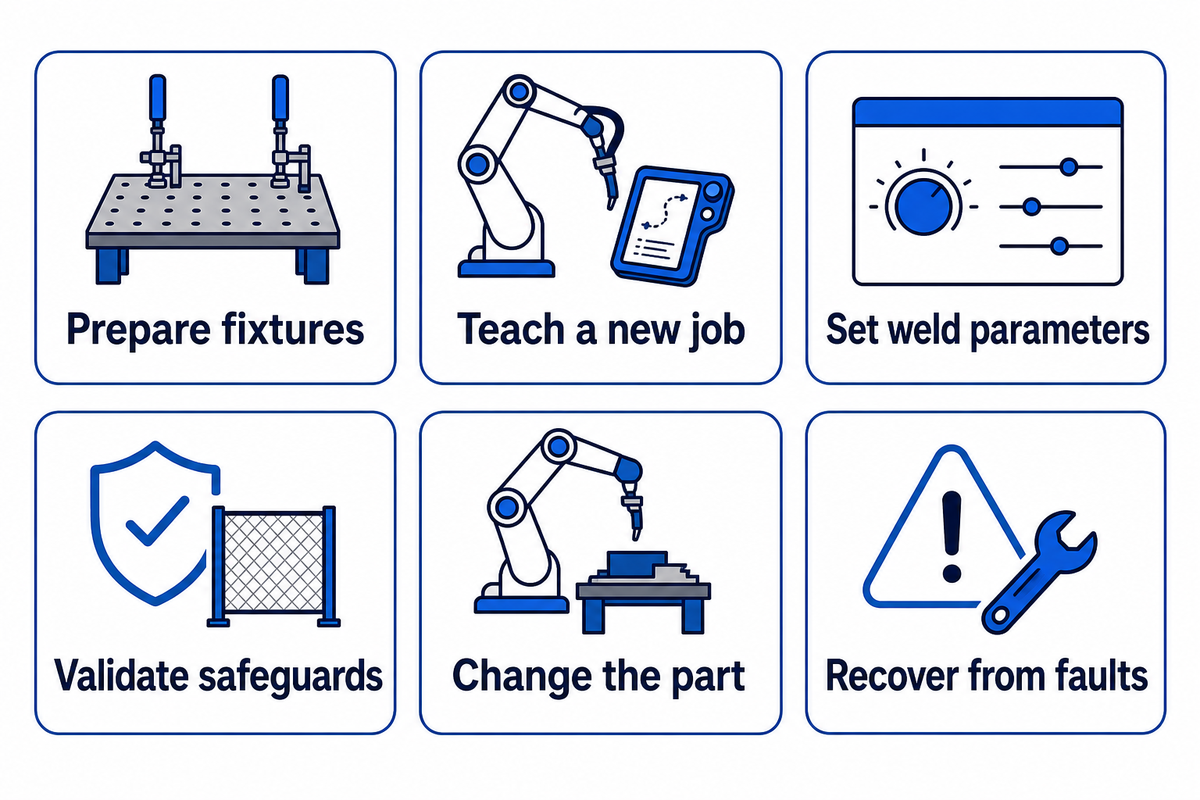
Fast job preparation is critical for high-mix production. Collaborative welding systems may make teaching more accessible to the operator, but the welding process, fixtures and safeguarding remain part of the system. The five suppliers below are differentiated by programming methods, process equipment and deployment format.
13. Miller Electric: Best for miller-equipped fabrication shops adopting operator-taught collaborative welding
Headquarters: Appleton, Wisconsin, USA · Founded: 1929
Official website: https://www.millerwelds.com/
Company type: Welding equipment and collaborative welding-system manufacturer
Main systems: Copilot collaborative welding systems with Auto Deltaweld
Potential limitation: Tracking, cooling and input-power options differ between packages.
Miller Electric packages collaborative welding around its welding-process equipment and an operator-focused teaching interface. Copilot uses the AccuGuide joystick and IntelliSet settings to help a welder establish motion and process parameters without starting from a conventional robot-programming workflow. Current Auto Deltaweld packages include selectable touch sensing and seam tracking, making the exact package relevant to whether the system simply repeats taught positions or responds to joint-location variation. Miller is part of ITW, and its inclusion is based on a complete collaborative welding-system offering rather than a claim that it manufactures every robot component used within that package.
14. Fronius: Best for compact enclosed cobot welding with Fronius process integration
Headquarters: Pettenbach, Austria · Founded: 1945
Official website: https://www.fronius.com/
Company type: Welding-process and complete-cell manufacturer
Main systems: CWC-S and CWC-D cobot welding cells
Potential limitation: Adding rotary positioning reduces the CWC-S usable component envelope.
Fronius supplies a complete enclosed cobot welding cell through CWC-S, pairing a FANUC welding platform from the CRX family with Fronius TPS/i welding equipment. The enclosure and defined work area distinguish this package from a cobot arm placed on an open welding table. Guided programming and optional rotary positioning support small-batch fabrication, while the CWC-D alternative addresses work organized around two stations. Fronius publishes different component envelopes for fixed-table and rotary arrangements, a useful reminder that adding positioning can improve torch access while reducing the maximum workpiece space. The company’s headquarters and founding year refer to Fronius as a business, not the launch date of the CWC product family.
15. Migatronic: Best for small-batch MIG/MAG or TIG fabrication with guided robot teaching
Headquarters: Fjerritslev, Denmark · Founded: 1970
Official website: https://www.migatronic.com/
Company type: Welding equipment manufacturer and automation-system supplier
Main systems: CoWelder MIG/MAG and TIG packages; custom automation
Potential limitation: CoWelder arm and table geometry limit accessible workpiece size.
Migatronic’s CoWelder combines a Universal Robots arm with Migatronic welding equipment for MIG/MAG or TIG welding. The guided teaching approach targets fabricators who change jobs regularly and need the operator’s welding knowledge to carry into robot welding, instead of treating programming as a separate specialist activity. Published configurations use different process equipment, so a TIG requirement should be matched to the TIG package rather than assumed from the general CoWelder name. Migatronic also has an automation business for larger customized systems, and its current ISO 9001 certificate covers welding-equipment activities; the complete-cell contract still needs its own defined delivery and acceptance scope.
16. Hirebotics: Best for phone-programmed MIG welding for frequent job changes
Headquarters: Nashville, Tennessee, USA · Founded: 2015
Official website: https://www.hirebotics.com/
Company type: Complete cobot-system builder and software developer
Main systems: Cobot Welder with Beacon and Smart Puck
Potential limitation: Advanced software features and hardware additions are priced separately.
Hirebotics builds the Cobot Welder package and develops Beacon software and the Smart Puck teaching interface. The current offer pairs a UR8 Long robot with a mobile table and welding-process equipment, with power-source choices described by package. Phone-based programming is the distinguishing buying reason: it places job setup close to the welding operator and suits shops where frequent changes make a dedicated programming workflow difficult to justify. Its software-led approach also makes licensing part of the equipment decision, because functions such as advanced tracking or multipass capability and additional hardware don’t automatically belong to every base configuration.
17. Vectis Automation: Best for portable cobot welding with flexible power-source and deployment choices
Headquarters: Loveland, Colorado, USA · Founded: 2019
Official website: https://vectisautomation.com/
Company type: Collaborative welding-system integrator
Main systems: Aero, Hydro and Synchro welding packages; Revo positioning
Potential limitation: Revo positioning needs open floor space for safety distances.
Vectis Automation integrates collaborative welding packages with several power-source and deployment choices. Aero addresses air-cooled applications, Hydro adds water-cooled equipment, and Synchro provides a push-pull approach for suitable aluminum work, making the welding package more specific than the phrase “cobot welding.” QuickTeach and ArcPilot options address teaching and through-arc tracking, while Revo adds coordinated two-axis positioning when the joint needs a different orientation. The current portfolio uses Universal Robots platforms and describes Miller, Lincoln and Fronius power options; portable arrangements can suit changing work areas, although the Revo installation must preserve the floor space and safety distances required for moving equipment.
Aubrik’s cobot welding systems provide another starting point for discussing operator-taught fabrication work.
Vision-Guided, Pipe and Laser Welding System Builders
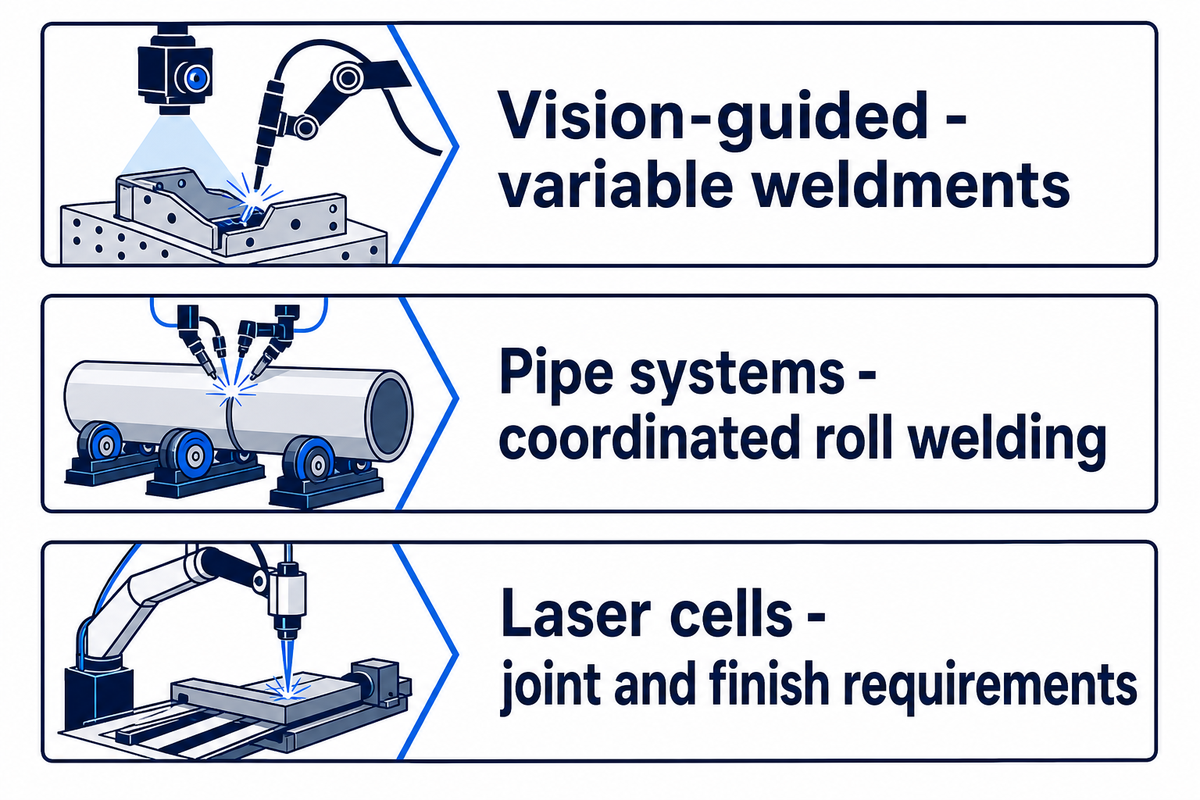
Certain types of welding needs are better met by a dedicated welding system than by a general fabrication cell, particularly specialized welding uses such as pipe spools. Vision-driven automation can address variable joints, pipe-spool systems support roll welding, and enclosed laser systems can integrate the optical process with robotic motion. Each solution must go through acceptance trials that are specifically targeted to the production task at hand.
18. Path Robotics: Best for variable heavy-fabrication weldments suited to vision-driven automation
Headquarters: Columbus, Ohio, USA · Founded: 2018
Official website: https://www.path-robotics.com/
Company type: AI welding-system manufacturer and service provider
Main systems: Obsidian-powered intelligent welding cells
Potential limitation: Robotics-as-a-service creates continuing commercial and support dependencies.
Path Robotics develops intelligent welding cells powered by Obsidian, combining vision-based joint detection with path planning and adaptive multipass filling. That approach targets variable fabrications where repeatedly teaching every seam can consume significant preparation time, particularly when the actual assembly differs from its nominal geometry. Published cells use workpiece positioners, including ALM equipment, which should be understood as integrated third-party positioning rather than a Path-owned positioner technology. The company’s current Obsidian announcement gives 2018 as its founding year, and its robotics-as-a-service model makes ongoing software, application support and commercial terms part of the production decision alongside the physical cell.
19. Novarc Technologies: Best for pipe-spool roll welding with coordinated positioning and process records
Headquarters: Burnaby, British Columbia, Canada · Founded: 2013
Official website: https://www.novarctech.com/
Company type: Pipe-welding robot and complete-system manufacturer
Main systems: Spool Welding Robot and SWR-TIPTIG systems
Potential limitation: Standard SWR packages exclude arbitrary reuse of existing power sources and positioners.
Novarc’s Spool Welding Robot is purpose-built for pipe-spool roll welding, coordinating torch motion with rotating workpieces and process monitoring. The SWR portfolio addresses arc processes, while SWR-TIPTIG provides a hot-wire GTAW route; NovEye Assist and NovData add joint assistance and production records to the system. Novarc’s current product page explicitly describes an integrated package with a specified power source and supported positioning, rather than unrestricted reuse of equipment already in the shop. That detail matters to a retrofit budget: the complete pipe-welding arrangement, including the rotator or positioner interface, is part of the purchased system rather than an interchangeable accessory assumption.
20. TRUMPF: Best for robotic laser welding of sheet-metal assemblies with demanding finish requirements
Headquarters: Ditzingen, Germany · Founded: 1923
Official website: https://www.trumpf.com/
Company type: Laser equipment and complete robotic-cell manufacturer
Main systems: TruLaser Weld 5000 and TruArc Weld 1000
Potential limitation: Laser applications need suitable joint preparation and qualified process trials.
TRUMPF supplies robotic laser welding as a complete machine system, with TruLaser Weld 5000 integrating the robot, laser, optics, enclosure and workpiece positioning. TruTops Weld supports offline programming, while TeachLine and the published FusionLine option address specific setup and joint conditions within the selected machine configuration. The buying case is sheet-metal assemblies where welding access and finish requirements justify a laser process trial, rather than a general assumption that laser welding replaces every arc process. TRUMPF also offers the TruArc Weld 1000 arc-welding cell, but the application highlighted here is its integrated laser platform and the preparation needed to make that process work on production parts.
How to Choose a Robotic Welding System Manufacturer
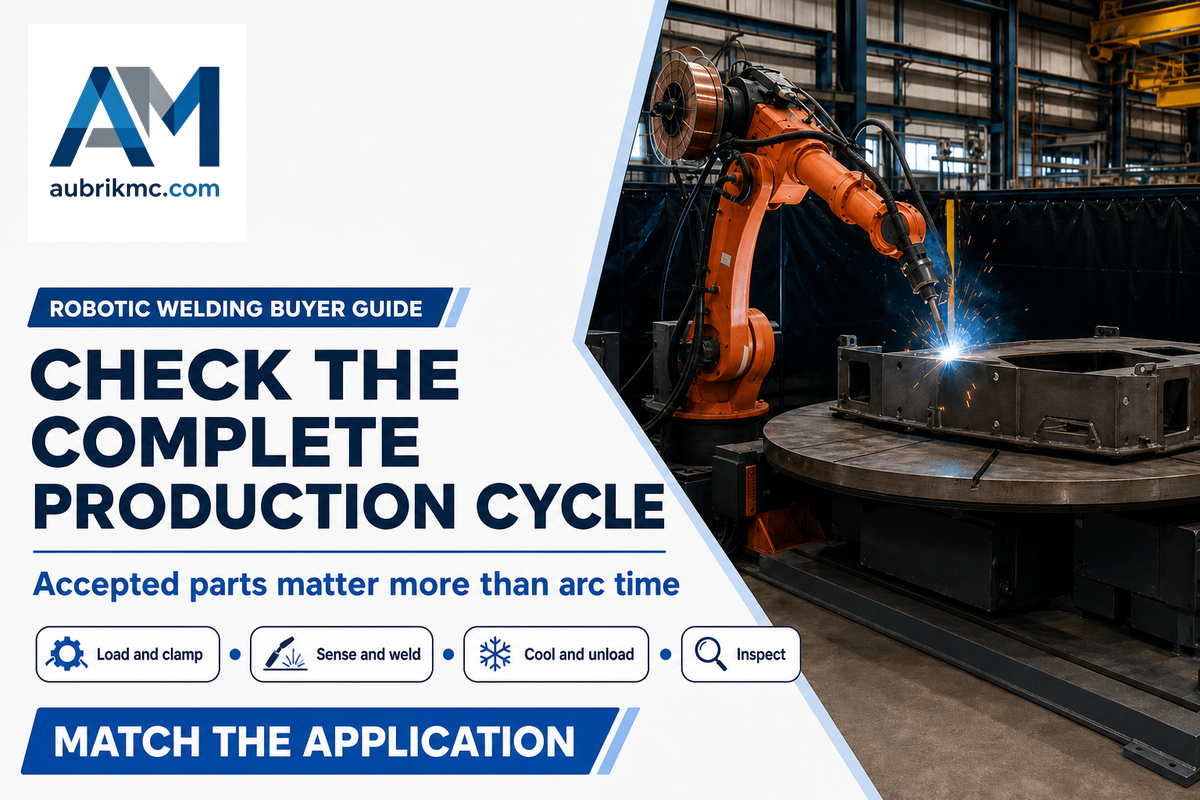
To choose a robotic welding system manufacturer, evaluate the complete production requirement against a proposed cell. Relevant areas of comparison are workpiece, fixtures, motion, programming, output, weld acceptance, safeguarding and support. The selection of welding robots is just a small part of that evaluation. Arm specification alone isn’t sufficient to evaluate a system’s capability to produce an acceptable part at the required rate.
1. Define the part family and welding process
Provide drawings and representative assemblies indicating the material grade, thickness, joint type and length, and weld type and required welding position. Also include the anticipated batch and annual volumes, the takt time, and the frequency of part family changes. A cell that’s optimal for a repeated assembly may not work well for a varied assortment of assemblies, even if the arm can physically reach all the parts.
Identify the types of welding required for the job, and the arc welding processes used on each joint. Different equipment and process controls are used in MIG/MAG, TIG welding, resistance spot welding, laser welding, and plasma welding and cutting. A supplier’s listing of many welding technologies doesn’t mean a quoted machine performs all of them. Plasma welding, cutting, and gouging capabilities require an explicit scope, especially if they’re part of the production process. The same applies to other welding and cutting equipment. When they’re bought together, define the interface and the responsibility for each operation.
2. Treat fixtures and fit-up as production equipment
How are parts located, clamped, and released? How does the fixture address the variation due to cutting, forming and tack welding? Do not assume the robot will perform correction of every fit-up gap or distortion. Is torch access allowed? Are there clearances for cables and tack welds? Is there access for removal of completed assemblies? Different welding stations may require different fixtures even if the stations process the same part.
Fixture changeovers can consume significant time on high-mix schedules. Analyze the actual loading and datum arrangement. Identify which tooling is included for each part family. Prepare a sample and demonstrate acceptance criteria for the fit-up variations the production team expects to receive. Focus on fit-up.
3. Check reach, wrist load and positioner capacity separately
Modern welding robots require a reach study to confirm usable welding torch orientations along the complete joint. An approach involving a wrist posture for a joint within nominal reach may still be blocked by collisions, cable routing or a fixture. For arc welding robots, torch angle and contact-tip-to-work distance are process requirements rather than optional dimensions.
A robot wrist load capacity assessment considers the end effector, tooling and related assembly, including torch mounts, sensors and cable dressing, plus wrist moments and inertia. Positioner capacity accounts for the workpiece, fixture and their combined center of gravity, together with eccentricity, moments, table diameter, acceleration and weld position. Neither capacity can substitute for the other. Require a study of the assembly and its motion rather than comparing unrelated payloads for a robot and positioner.
4. Match sensing and programming to real variation
Touch sensing has the potential to detect joint positioning before welding, while suitable through-arc or laser tracking can respond during welding. Other variations can be captured using vision-based path planning. These welding techniques and robot repeatability don’t guarantee weld accuracy or weld quality; demonstrate performance using actual joint and surface conditions.
Offline programming can move program preparation away from the production cell, but the digital model must agree with the actual robot, tool center point, fixtures and workpiece. Ask what type of calibration and touch-up is required after importing the program. For collaborative robot packages, compare teaching a new job, editing a multipass sequence and recovering from a failure, rather than only watching a prepared demonstration.
5. Compare the full production cycle
Request a cycle study for loading, clamping, sensing, approach moves, welding, repositioning, torch cleaning, cooling, unloading and inspection. Include operator staffing required by the production cycle and the effect of product changeover. Weld time describes only a part of the overall cycle, and low weld times alone cannot establish the number of acceptable finished parts produced by the system. Efficient welding requires the overall system to be productive in finishing parts acceptable to the customer through the complete production cycle, including handling and inspection work.
Evaluate what’s involved with alternating tasks. Identify what actually overlaps and what operates with the same resource. A system with two loading positions may not double the output. Compare the sequence with current manual welding processes using the same accepted-part definition and staffing assumptions. Record the bottleneck that remains after automation.
6. Agree weld acceptance and factory testing before purchase
What are the factory acceptance test requirements for representative parts, based on the agreed acceptance criteria and scope of work? What visual and dimensional inspections are required? Are destructive or non-destructive inspections required by the applicable acceptance criteria? What sample plan is allowed? What rework is permitted? What documentation is required? Welding procedure specifications and welding procedure qualification records must follow the applicable project or product codes and can’t be substituted by a machine demonstration.
Request the proposed welding process parameters, process control, traceability and operator training scope. Record approved welding parameters in the program. Check the scope and validity of any quality certificates against the entity and activity purchased. Supplier self descriptions, data on the accuracy of robots and organizational certifications respond to different questions from whether a completed weld meets your requirements on drawings and your acceptance standard.
7. Specify cell safeguards and current standards
Industrial robot safety and complete-cell integration have separate responsibilities. ISO 10218-1:2025 addresses industrial robots, while ISO 10218-2:2025 addresses industrial robot applications and cells. The United States ANSI/A3 R15.06:2025 package includes Parts 1 and 2 and the published Part 3, ANSI/A3 R15.06-3-2025, covering use of industrial robot cells.
ISO/TS 15066:2016 remains a published collaborative-robot document, while ISO/AWI 15066-1 is a project under development, not a published replacement. A cobot label does not establish that welding can run without guarding. The assessment must cover robot motion as well as arc radiation, hot surfaces, spatter, fumes, electrical hazards and any laser-specific hazards.
Require a project risk assessment and a defined safeguarding arrangement including access controls, emergency stops, interlocks and the operating modes used during setup and recovery. Require fume extraction and other site services and set responsibility for the installation validation and the conformity documentation applicable at the site. A declaration by a robot component supplier doesn’t ensure conformity of a welding cell.
8. Compare total delivery cost and support responsibility
Compare quotations on the same scope: robot and controller, welding power source, wire feed, torch and welding consumables, fixtures and positioning, welding cell guarding, fume extraction, welding cell programming and commissioning. Compare quotations for freight, site preparation, training, spare parts and maintenance. Software subscriptions, offline-programming seats, remote support and advanced features of robots can alter the ongoing costs of a welding cell, even if base hardware remains the same.
Identify one supplier of welding automation responsible for the integrated result, with written boundaries for third-party equipment and customer-supplied interfaces. Establish who takes responsibility for the PLC or MES integration, if it’s required, what production records, if any, are kept, how and when backups and recovery are performed after a controller failure, and local service availability and responsiveness compared to what’s assumed to be standard world-wide support for a well-known brand.
- Send the production brief: Include drawings, representative parts, material, joints, volume and acceptance requirements.
- Request a defined system proposal: Require a layout, process scope, cycle study and responsibility for integration.
- Run the application trial: Use production-representative fit-up and document the weld results.
- Agree acceptance and support: Put testing, training, documentation and service terms into the delivery scope.
A supplier should be able to describe how its proposed robotic welding technology meets your welding needs. Claims of advanced robotic welding systems or intelligent welding become meaningful only when tied to a demonstrated function, a defined part family and an acceptance result. Quotations that refer to “advanced welding technology” need to define the exact sensing and controls, power source and its functionality. We have a number of robotic welding machine options that can assist in defining your initial equipment requirement.
Frequently Asked Questions
Which is the best robotic welding system manufacturer?
The best robotic welding system manufacturer depends on part geometry, welding process, production volume, fixture needs, sensing requirements, safety scope and local service. Aubrik suits configurable custom-cell discussions, Pemamek addresses large fabrications, Novarc focuses on pipe spools, and TRUMPF offers integrated laser welding. Compare the complete system and its delivery responsibility, then test the shortlisted proposal with representative workpieces. A supplier that fits one production line may be unsuitable for another because part access, process and changeover demands differ.
Which robotic welding system is best for high-mix production?
High-mix production usually benefits from fast programming, flexible fixtures, offline programming, recipe management and quick-change tooling more than maximum robot speed. Hirebotics, Vectis, Miller, Fronius and Migatronic offer different collaborative welding packages, while Valk combines industrial systems with offline programming. The best fit depends on part access and the time needed to prepare, prove and change a new job.
Which is better: a welding robot or a welding cobot?
Neither is universally better; industrial robots favor speed and standardized high-volume work, while cobots can suit lower-volume, high-mix applications with appropriate safety controls. Neither welding robot type is necessarily better with regard to weld quality or cycle time. Collaborative motion doesn’t remove all risks posed by the welding process itself. An enclosed cobot cell and an open teaching package also impose different operational requirements and affect layout, even though a collaborative robot arm is used in both.
What is the difference between a robot manufacturer and a robotic welding system integrator?
A robot manufacturer builds the robot arm and controller, while a system integrator combines the robot with welding equipment, fixtures, safety, sensing and controls to create a production-ready cell. Some companies perform both of these roles. The robotic welding system integrator’s contract should specify responsibility for integration and acceptance.
How much does a robotic welding system cost?
There is no universal robotic-welding-system price because robot size, fixtures, positioners, welding process, safety, sensing, software and commissioning can change the investment substantially. Compare itemized quotes for welding equipment, fixtures, training and site preparation. Include recurring software licenses and support.
What safety standards apply to robotic welding systems?
For industrial robot applications, ISO 10218-1:2025 and ISO 10218-2:2025 are key international references, while United States projects should also review ANSI/A3 R15.06-2025. Assess ISO/TS 15066:2016 for collaborative robots. Include welding hazards and applicable local regulations in the installation risk assessment.
Discuss Your Robotic Welding Application with Aubrik
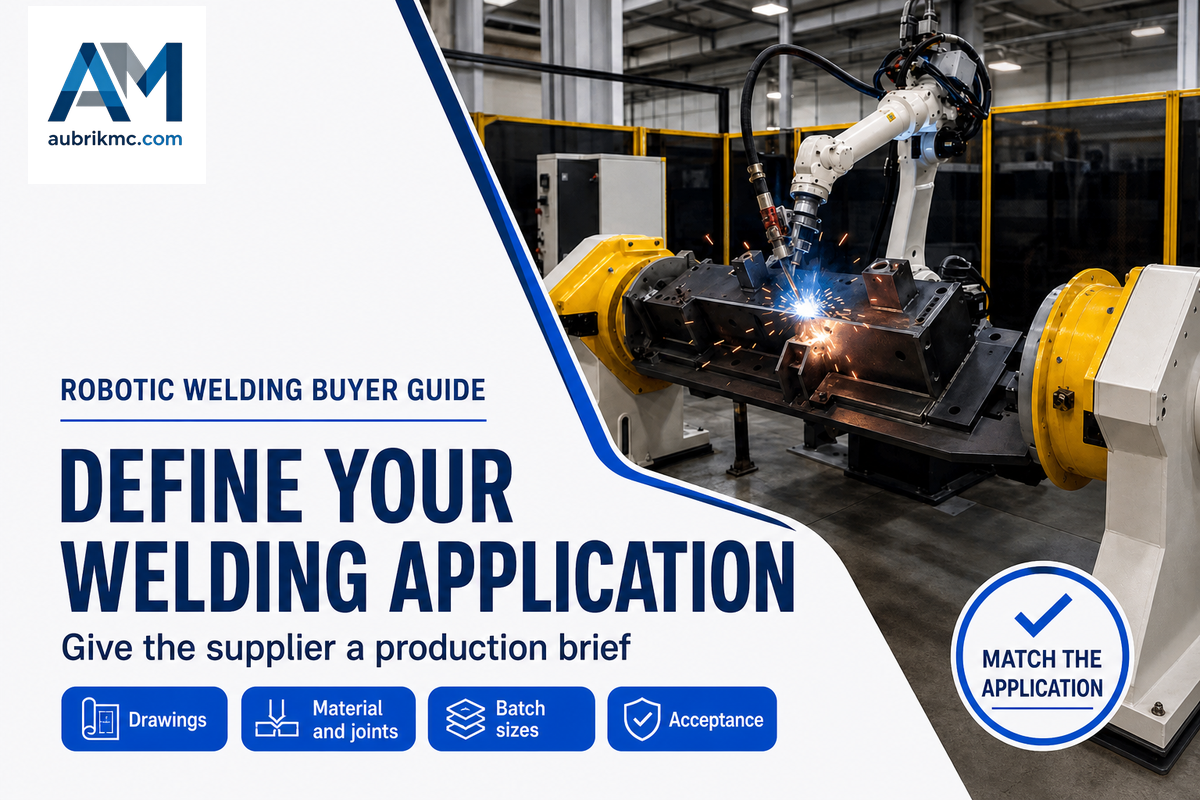
Aubrik can discuss a custom cell around the welding process, part positioning and required automation scope. Start with the drawings, material and thickness range, joint details, batch sizes and output target, then add the site’s loading method and acceptance requirements. Those inputs give the engineering discussion a useful basis before selecting a robot or cell layout.
Key takeaway
Choose a robotic welding supplier by the accepted part it can produce, the complete system it will deliver and the support responsibility it will retain.
Review Aubrik robotic welding systems or send Aubrik your welding application to discuss a suitable configuration.
Editorial note: This application-based comparison uses public company information reviewed in October 2026. It isn’t a market-share ranking or a laboratory comparison of all 20 systems. Product availability and delivery scope are specific to the quoted configuration and destination.
References & Sources
The company profiles are based on official websites, product literature, company history and company announcements; the company websites are listed in the comparison table and profiles. Safety-standard status was confirmed against the records of the issuing bodies and standards stores listed below.