Get in Touch with Aubrik Company
ROBOTIC WELDING SYSTEMS
Robotic Welding Systems for High-Mix Manufacturing
A robotic welding system is a coordinated package of robot, power source, positioner, tooling, guarding and controls. Choose a ready cell, track or gantry system, or cobot only after mapping workpiece size, variant count, weld process, operator access and acceptance tests. Define the hand-off between robot, fixture, safety circuit, programming and service before comparing quotations.
REQUEST A QUOTE
±0.02 mm
Repeat positioning accuracy
3–25 kg
Payload range
5 processes
MIG · TIG · Laser · Spot · Plasma
IP65–67
Protection rating
14–24 mo
Typical payback period
CE · ISO 9001
Certified, 1-yr warranty
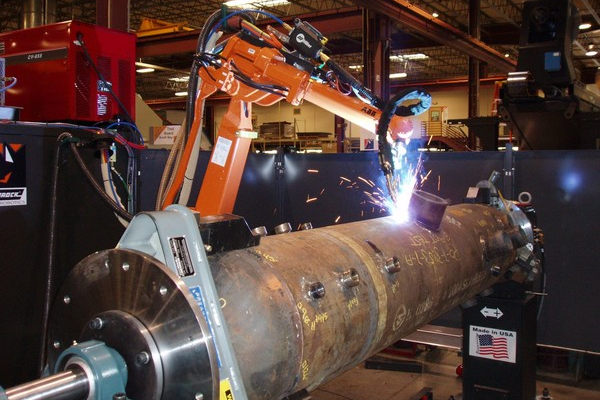
SYS-01 / CELL
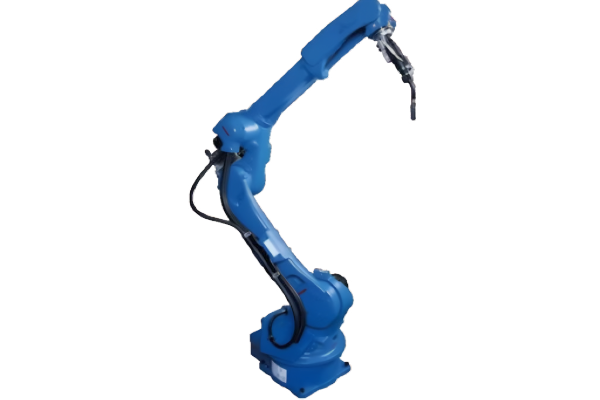
SYS-02 / DETAIL
Solving the Welder Shortage: Why Manufacturers Automate Welding
Robotic welding systems exist because the people who used to do the work are disappearing. The American Welding Society projects a shortage approaching 400,000 welders by 2026, and for every five welders retiring, only two enter the trade.
That gap shows up on your floor as missed ship dates, inconsistent weld quality, and overtime you cannot staff. A manual welder holds an arc only 25-35% of the shift; the rest is repositioning, fitting and breaks.
// 01
Pain
153,000+ experienced welders retiring, average age 55 – the skill leaves with them.
// 02
Cause
manual arc-on time caps at ~30%, so output is bound by the labor hours you can’t fill.
// 03
Solution
an ABK robotic welding system holds 85-95% arc-on time and runs the second shift no one wants.
// 04
Proof
defect rates fall from 5-8% (manual) to under 1% once the program is dialed in.
One assumption keeps shops on the sidelines: that robots only pay off at high volume. Field data from 2025 contradicts it – collaborative cells with offline programming now reach payback on batches as small as 10-50 pieces and fewer than 500 standardized welds a year.
So the real question is not “is my volume high enough,” but “which automation route fits my mix.” We build all three routes at ABK because the shortage is structural – the 400,000-welder gap will not close, so an ABK welding automation system is sized to run the hours you cannot staff.
[SYS-01] Automation Routing
choose your automation route: machine, cell or cobot
Most suppliers sell you one box and call it automation. ABK builds three distinct routes off the same 6-axis core, because a 12-model job shop and a high-volume chassis line do not need the same machine.
We call this the 3-Route Welding Automation Selector. The grid below maps each route to the production reality that justifies it – payload, footprint, batch threshold and the safety solution that comes with it.
PARAM / REF ABK Deployment Decision Grid
| Decision Factor | [RT-A] Robotic Welding Machine | [RT-B] Robotic Welding Cell | [RT-C] Cobot Welding |
|---|---|---|---|
| Best for | High-volume standardized parts | Turnkey high-mix volume | Small-batch / high-mix SME |
| Payload | 3–20 kg | 6-axis + 300–500 kg positioner | 3–20 kg |
| Footprint | Integrated workstation | 1.4–2.3 m² enclosed | 4–6 m² incl. operator |
| Deployment time | Custom integration | 1–3 day install, ready-to-weld | <1 day, plug-and-play |
| Programming | Teach pendant + offline (CAD) | Teach + offline simulation | Hand-guide, 20-min first program |
| Safety solution | Caged cell (ANSI/RIA) | Interlocked enclosure + light curtain | Fenceless, ISO/TS 15066 (140 N) |
| Batch threshold | 500+ welds/yr | High-mix, multi-model | 10–50 pieces viable |
| Operator skill | Trained programmer | 1 operator, multiple cells | Ordinary worker, ~1 week |
| Changeover | <30 min | ≤15–20 min | 15–30 min |
Shared 6-Axis Core — Specifications
[CORE-SPEC DATA]
Repeat positioning accuracy
±0.02–0.03 mm
Payload capacity
3–20 kg (multi-torch heads)
Working radius / reach
1,400–2,000 mm
Protection level
IP65–IP67
Welding speed
0.5–10 m/min
Power supply
380 VAC ±15%, 3-phase 4-wire
Operating temperature
0–45 °C, no extra climate control
Design service life
8–10+ yr, MTBF >100,000 h
[GLOBAL.INDEX.00]
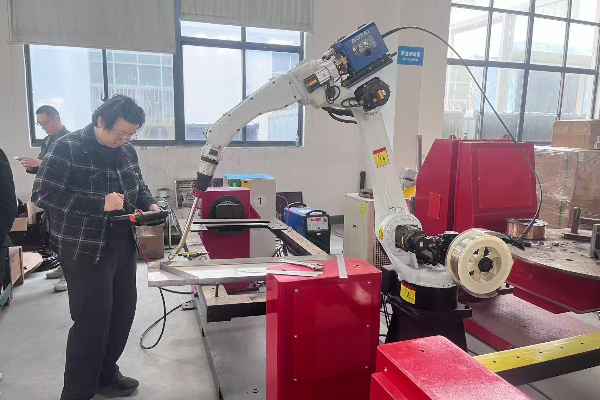
Explore ABK’s Core Welding Automation Product Lines
Robotic Welding Machine
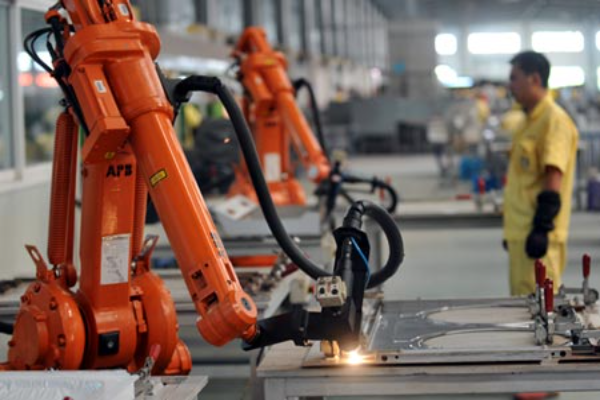
The integrated route is a 6 axis welding robot married to a digital power source, arc-tracking and an AI process package that auto-tunes parameters from the first weld. ABK builds this arc welding robot for shops where inconsistent manual quality is the bottleneck, because a programmed ABK machine repeats 0.02 mm on part 1 and part 10,000 alike.
CORE.SPECIFICATIONS //
±0.02–0.03 mm · 3–20 kg · 1,400–2,000 mm reach · compatible with 13+ welding machine brands · CAN/Ethernet to ERP/MES
When programmed offline while the robot continues to run the production welds for the current job, part number changeovers take less than 30 minutes – this is why one ABK robot can replace 2-4 manual welders without standing idle between parts.
Robotic Welding Cell
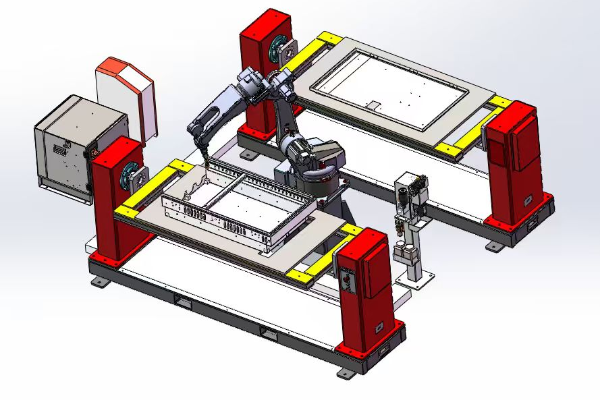
Custom robotic cells require weeks of integration and planning before ever seeing a weld, and these delays alone risk destroying the project timeline. An ABK integrated robot cell is shipped pre-engineered with robot arm, digital power source, positioner (cobot-positioner method, DE102019215690A1), safety enclosure, and all controls so when it lands, it can be installed, programmed, and ready for your operator in 1-3 days, saving you weeks of idle time and lost output on your automation clock.
SYSTEM.SAFETY //
Safety to ANSI/RIA: interlocked gates · light curtains · Allen-Bradley GuardLogix PLC + 12″ HMI · fume extraction · active-passive vision fusion (CCD + laser seam tracking)| Configuration | Positioner / load | Ideal application |
|---|---|---|
| Fixed Workbench | 1.4 m / 2 m reach, 3 platforms | Small–medium parts, low-medium volume |
| Single-Axis Tilt Positioner | 300 kg, 1.8×0.8 m turntable | Parts needing rotation/tilt, complex joints |
| Single-Axis Turntable | 500 kg, Ø1.5 m panel | Large work pieces, circumferential welds |
| Two-Axis Positioner | 300 kg, Ø0.5 m faceplate | High-mix, precise multi-angle welding |
The entire process, from installation through operator training, takes only 1-3 days of setup and 1-2 weeks of integration. Since ABK’s modular safety enclosure comes standard and expands, US and EU buyers have a simple plug-and-play to add more robots as their production needs increase without needing to redesign your whole line.
Cobot Welding
This is how you can beat the “robots aren’t for small batches” rule. An ABK cobot welding cell can be integrated into your existing workforce, operating alongside your human operator without fencing and hand-programmed in around 20 minutes. Since for a high-mix shop the setup times, not the weld speed, is the obstacle, an ABK cobot shines for production volumes of 10 to 50 parts.
COBOT.METRICS //
±0.02 mm · IP65–67 · MIG/TIG/laser · ISO 15066 + CE + UL · light/standard/heavy payload series (3–5 / 5–10 / 10–20 kg)| Dimension | Cobot Welding | Industrial Robot |
|---|---|---|
| Programming | Hand-guide / graphical, ~30 min | G-code & CAD, 2–8 h per new part |
| Deployment | Magnetic base, ≤30 min changeover | Fixed install, long commissioning |
| Payload | 3–12 kg (to 20 kg) | 6–25 kg |
| Safety | Fenceless, force-limited 140 N | Caged enclosure required |
| System cost | $40,000–$70,000 | $80,000–$120,000 |
| Best fit | Small-batch, high-mix SME | Large-scale standardized |
Now, let’s get honest. Under ISO/TS 15066, force limiting does a lot to prevent harm from accidental contact, but a live torch is still hot — the honest trade-off is real. That’s why ABK cobot welding cells include optional arc shielding and torch interlocks. We offer the full safety package upfront because fenceless doesn’t mean unprotected – that’s too important to leave for an upsell later.
Advanced Robotic Welding Systems
High-performance automated production solutions designed for industrial manufacturing environments.
Robotic vs. Manual Welding: The Performance & Cost Case
More times than not, the purchase decision of a robot has less to do with its welding capability, and more to do with how quickly it pays for itself.Here are the numbers that make the choice clear, with no wishy-washy “high,” “medium,” or “low.”
Let’s frame this as the total cost of ownership for US buyers: a single shift on today's high-end US welder costs$67,000-$93,000. You can replace 2-4 such shifts per part with a single ABK robot, drastically reducingyour labor costs while also slashing scrap. This difference in labor costs alone quickly pays off the equipment, since ABK robots enjoy 85-95% arc-on time compared to 30% for manual welding, where robots go from job to job to job without pausing.
Metric
Manual welding
ABK robotic welding
Arc-on time
25–35%
85–95%
Throughput
baseline
+30–50% (3–5× on suitable parts)
Defect / rework rate
5–8%
<1% (≈90% reduction)
Repeatability
operator-dependent
±0.02–0.03 mm
Weld qualification rate
variable
up to 99.2%
Time to proficiency
years of training
~1 week operator training
Welding Processes Supported: MIG, TIG, Laser, Spot & Plasma
Changing your welding process typically meant changing your robot, a hidden expense that buyers sometimes miss. One ABK platform covers five core welding processes since we don’t think you should waste time retooling a machine to handle different materials. Our ABK robots handle everything from steel and aluminum to titanium and exotic alloys with a single setup, to ISO 9606 weld-qualification levels.
01
MIG/MAG
Designed for high-speed applications on steel, stainless steel, and aluminum, these torches offer consistent wire feed for high-quality, low-spatter welds.
02
TIG
Perfect for thin, high-alloy, and non-ferrous materials like aerospace components and electronics where a small heat-affected zone is critical.
03
Laser
A fiber laser is used for micro-components and thin-wall welding with automatic deviation calibration, offering incredibly high energy density and minimal part distortion.
04
Spot
Ideal for high-volume, repetitive applications on parts such as automotive body-in-white assemblies, featuring precise control of electrodes.
05
Plasma & Arc
Deliver deep penetration on thick plate welds, featuring advanced arc-tracking that compensates for torch clamping and thermal variation to ensure a sound, consistent weld every time.
Certifications & Compliance for Procurement
For a buyer overseas, a missing cert often fails plant audits, making them the initial signal of trust. Instead, we tag certificates to industry standards. Every ABK system goes to your EU or US site certified for direct use without costly retrofitting or local re- certification.
01
CRT-01
ISO 9001
Quality management
02
CRT-02
CE
EU conformity
03
CRT-03
ISO/TS 15066
Cobot 140 N force limit
04
CRT-04
ANSI/RIA R15.06
Cell safety (US)
05
CRT-05
UL / FDA
Cobot market compliance
MANDATORY
ANSI/RIA R15.06 compliance means interlocked gates, light-curtain safety devices and e-stops standard, with ISO/TS 15066 power-and-force limited output, folded into ISO 10218-2:2025, as now mandatory for cobots.
Procurement Guide: Pricing, Lead Time, Warranty & OEM
What actually drives your quote
- 01 Machine vs. cell vs. cobot (route &payload including torch or workpiece up to 3-25kg)
- 02 Workstation vs. positioner (300-500kg on single/dual axis)
- 03 Process package — MIG/TIG vs. fiber-laser; vision/seam-tracking options.
- 04 Integration scope — ERP/MES connectivity, fixturing, fume extraction.
- 05 Terms: One-year parts & labor warranty; OEM-configured service; export after-sales for any of our eight export markets-spain, germany and US to name a few. (Our new machines with warranty don’t carry the unknown, no-warranty, hidden-issue risk of the used-robot market.)
Industry Norm
The sticker price is the trap. US suppliers quote a cobot welder at $80,000–$150,000, then tell you to budget two-to-three times that for a deployed cell — the hidden cost that quietly wrecks the business case.
ABK Direct
ABK quotes the system cobot route at $40,000–$70,000, below US entry-level pricing (U.S. welder labor-cost basis), and builds integration into the quote — so the number you approve is the honest number you pay at delivery, not a surprise later.
For the full quotation — price and lead time — depends on your final application and selected configuration. Contact ABK for a detailed quotation.
Robotic Welding Systems Decision & Optimization Tools
Evaluate your automation investment. Calculate exact payback periods and long-term cost reduction metrics.
Access ROI Calculator
Match your specific production volume and part complexity with the ideal robotic welding pathway.
Identify Automation Route
Analyze capacity constraints and pinpoint the exact threshold where automated systems outperform manual welding.
Run Breakeven Analysis
Find the right welding automation route for your shop
Share your part mix, volume and existing labor costs. we can recommend a machine cell, cobot, etc, and quote for that delivered system-not just the equipment inside a box.
Request a Quote
01
How much does a robotic welding system cost?
Our entry level collaborative robotic cells start at $40,000-$70,000 - industrial high payload cells with integrated systems cost more, with a positioner system costing higher still. That said, our system cost for the cobot offering compares to some US entry- level cobot systems. Our pricing is below entry level price, comparing to $105,000, pricing for the USA.
02
Is robotic welding worth it for a small or high-mix shop?
Robots aren't just for huge runs anymore. Because the welder shortage makes lost manual capacity the real risk, an ABK collaborative cobot can be justified for batches as small as 10 pieces or under 500 welds per year, and are as easy to set-up via either a teach pendant or the robot teach software.
03
What’s the typical payback period?
payback of 14-24 months based on the elimination of 2-4 welder per-part labor hours, reduction in rework up to 90%, and productivity gains of 30-50%. High-throughput, multi-shift operations reach payback faster.
04
How long does operator training take?
Roughly 1 week for full adoption compared to 4-6 weeks with competitor solutions. Cobot hand-guiding makes it easy for an operator with no prior programming experience to log the first weld path in as little as 20 minutes.
05
Will it integrate with my existing line and welders?
Yes. Since ABK systems can seamlessly integrate with 13+ well-known welding brands and communicate with ERP/MES using either the CAN/Ethernet interface, you are always in the habit of not needing to refit your equipment.
06
Do fenceless cobots meet EU and US safety law?
These meet ISO/TS 15066 (140N Force Limited), CE, UL. A welding torch can remain very hot, ABK ensures this also with arc control and torch interlocks instead of just using Force Limiting.