Get in Touch with Aubrik Company

Slewing Bearing
Slewing Bearings & Slewing Drives: Specs, Types & Selection
Open dimension tables, real load ratings, and a moment-first selection method, from a slewing bearing manufacturer that publishes what the catalogs hide.
Request a Quote →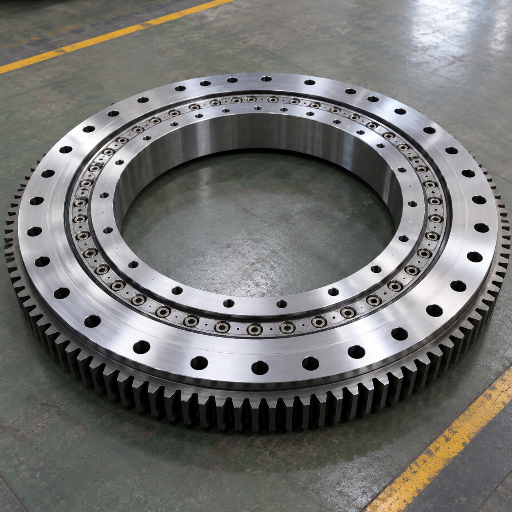
[SPEC MATRIX]
200–6000mm
Bore / OD range
3 types
4-point ball · cross roller · 3-row roller
42CrMo
Ring / raceway alloy
ISO9001 + BV
Certified, audited
70,000+/yr
Bearings + drives output
[SYS-00] OVERVIEW
Specifying a Slewing Bearing Shouldn’t Require a Login
A slewing bearing, also called a slewing ring or turntable bearing, carries axial, radial, and tilting-moment loads in one ring, so a platform can rotate slowly under heavy load on a single component. That combined-load job is exactly why selecting one is harder than picking a standard bearing.
[SYS-01] COMPONENT DEFINITION
What is a slewing bearing?
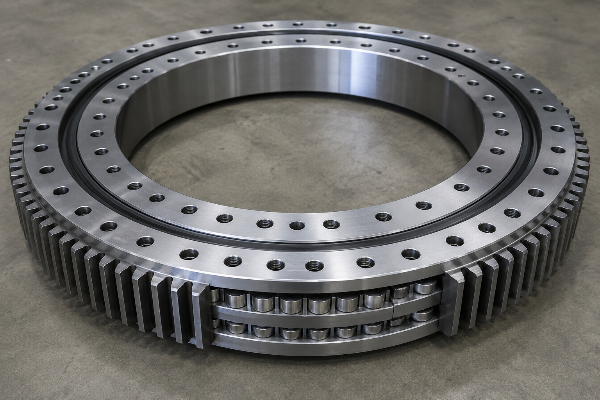
A slewing bearing is a large-diameter rolling-element bearing — balls or rollers between two concentric rings — built to support axial, radial, and overturning (moment) loads simultaneously, usually below 10 RPM (load directions per ISO 76). Many include integral external or internal gear teeth so a pinion or slew drive can rotate them.
[SYS-02] INDUSTRY GAP
Most OEM product pages list the bearing types and stop there. The dimensions, load ratings, materials, and hardened-depth data, the numbers an engineer actually need to size a bearing, sit behind a login, a selector tool, or a PDF request.
That gap is expensive. Choosing on the wrong number risks a ring that passes an axial check yet fails years early under moment load, and because the deciding data is hidden the mistake only surfaces after install.
LOAD REF
ISO 76
MAX SPEED
< 10 RPM
SE-SERIES
203 kN·m
[SYS-03] AUBRIK STANDARD
Aubrik publishes the numbers on the page instead. The sections below give the construction logic, the full series with bore/OD/height/weight, SE-series slew-drive ratings to 203 kN·m, and a moment-first selection method, which is why engineers comparing slewing bearing manufacturers can size and verify here without a sales call.
Slewing Bearing Types: Four-Point Ball, Cross-Roller & Three-Row Roller
Engineers default to the highest-capacity type when a load look demanding. That instinct quietly wastes money: a three-row roller is frequently over-specified for a load a four-point ball would carry at a fraction of the cost and friction.
The honest trade-off is that the three constructions trade capacity, rigidity, friction, and price differently, so the “best” type depends on your governing load, not on raw rating. A cross roller slewing bearing, for instance, wins on rigidity but costs more and runs with more friction than a ball type. Here’s the Construction-to-Load Decision Tree Aubrik uses, with the load and rigidity behavior verified against published engineering data and slewing-bearing patents.
Construction-to-Load Decision Tree
01
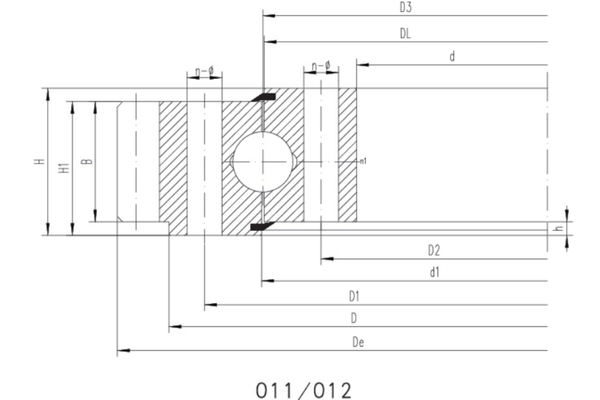
Single-row four-point contact ball
Moment / CapacityMedium
RigidityMedium
FrictionLowest
Application Scenario
Variable multi-directional load, weight-limited, efficiency matters
02
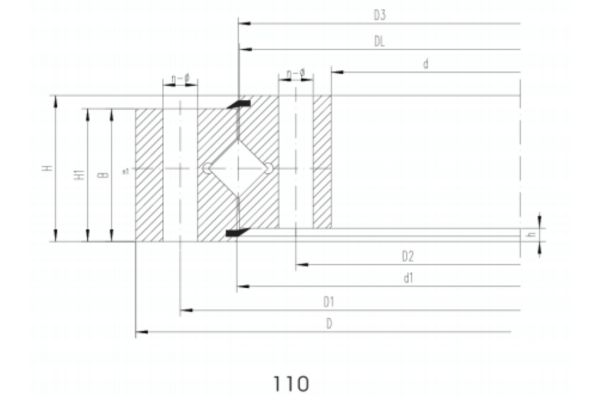
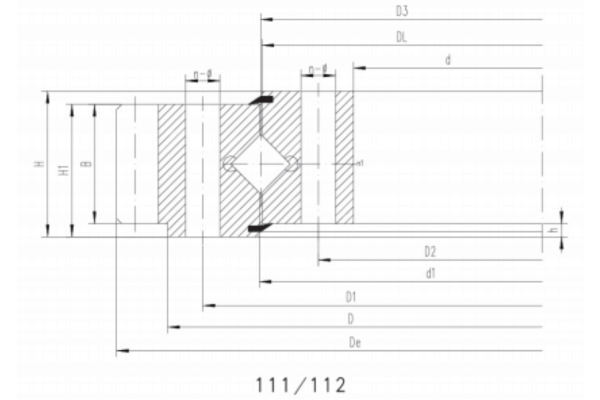
Single-row cross roller
Moment / CapacityHigh
RigidityVery High
FrictionMedium
Application Scenario
High moment + precision; robots, radar, machine tools
03
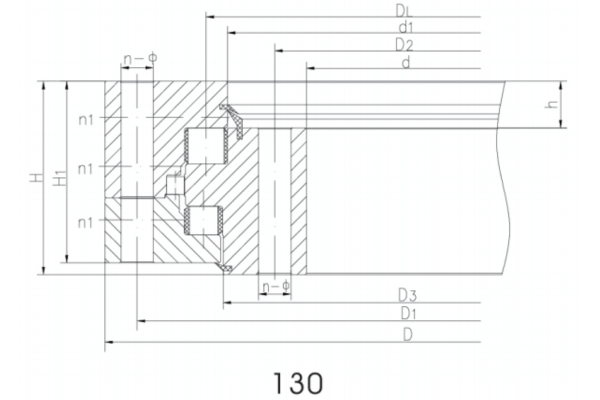

Three-row roller
Moment / CapacityVery High
RigidityVery High
FrictionHigher
Application Scenario
Extreme combined loads; port cranes, offshore, TBMs
A counter-intuitive but verified point: four-point ball bearings generate less friction than crossed cylindrical roller bearings of the same envelope. The trade-off is real, rollers win on capacity and rigidity; balls win on running torque. So for a solar-tracker or yaw drive where motor efficiency governs, a ball type can be the better engineering choice even though a roller look “stronger.”
[DATA-STREAM: EN-PROC]
Aubrik Slewing Bearing Series & Dimensions (010–134)
Every Aubrik part number encodes its construction, gearing, and bore. Read the code once and you can size and order without a catalog round-trip. This is the Slewing Bearing Designation Decoder.
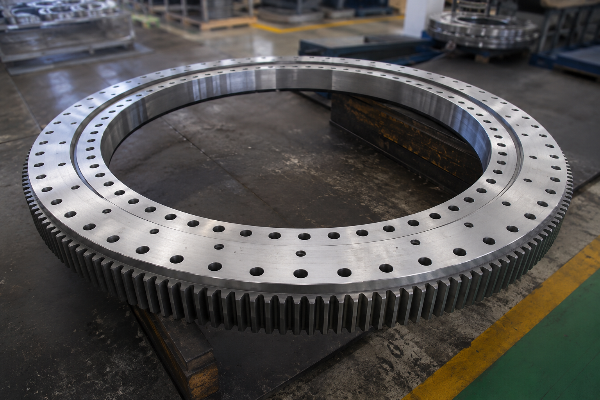
Slewing Bearing Designation Decoder [SYS-DEC]
- 01x Single-row four-point contact ball
- 11x Single-row cross roller
- 13x Three-row roller
- .YY. Section / diameter series code
- ZZZ Bore reference (mm)
The last digit of the series set the gearing: 0 = toothless, 1/2 = external gear (small / large module), 3/4 = internal gear (small / large module). Mounting-hole code follows: 00 all plain, 01 all threaded, 02 inner threaded / outer plain, 03 outer threaded / inner plain.
Representative dimensions, four-point ball (010 toothless / 011–012 external gear)
| Model | OD D (mm) | Bore d (mm) | Height H (mm) | Holes n | Gear Z × module | Weight (kg) |
|---|---|---|---|---|---|---|
| 010.20.200 | 280 | 120 | 60 | 12 | toothless | 18 |
| 010.20.280 | 360 | 200 | 60 | 16 | toothless | 26 |
| 010.25.450 | 543 | 357 | 70 | 24 | toothless | 68 |
| 010.30.630 | 732 | 528 | 80 | 24 | toothless | 110 |
| 010.40.800 | 922 | 678 | 100 | 30 | toothless | 220 |
| 011.25.355 | 448 | 262 | 70 | — | Z93 × m3.15 | 155 |
| 012.30.500 | 602 | 398 | 80 | — | Z102 × m4.5 | 85 |
| 012.40.800 | 922 | 678 | 100 | — | Z96 × m8.0 | 220 |
Representative dimensions, cross roller (110)
| Model | Type | OD D (mm) | Bore d (mm) | Height H (mm) | Gear Z × module | Weight (kg) |
|---|---|---|---|---|---|---|
| 110.25.500 | Cross roller | 602 | 398 | 75 | toothless | 77 |
| 110.28.800 | Cross roller | 922 | 678 | 78 | toothless | 179 |
Representative dimensions, three-row roller (130-131)
| Model | Type | OD D (mm) | Bore d (mm) | Height H (mm) | Gear Z × module | Weight (kg) |
|---|---|---|---|---|---|---|
| 130.25.630 | Three-row | 764 | 496 | 148 | toothless | 250 |
| 130.32.1000 | Three-row | 1164 | 836 | 182 | toothless | 600 |
| 131.40.1800 | Three-row ext. | 1995 | 1605 | 220 | Z145 × m14.0 | 2147 |
Representative dimensions, three-row int. gear (133-134)
| Model | Type | OD D (mm) | Bore d (mm) | Height H (mm) | Gear Z × module | Weight (kg) |
|---|---|---|---|---|---|---|
| 133.45.2500 | Three-row int. | 2721 | 2279 | 231 | Z122 × m16.0 | 2834 |
[SYS-01] OVERVIEW
Slewing Drives (SE Series): Bearing + Worm Gearbox in One Unit
A slewing bearing only rotates if something turns it. A slew drive integrates the slewing ring with a self-locking worm gear and a hydraulic or electric motor mount, so you get controlled rotation, holding torque, and an IP65-sealed package in one ready-to-install unit.
That integration is where Aubrik separates from bearing-only suppliers: the SE series ships the bearing, worm gearbox, and seal as a tested assembly. The self-locking worm set holds the load without a brake, which is why these drives suit solar trackers, small wind turbines, and crane swing axes (slew-drive patents). Here’s the SE-Drive Torque & Tilting-Moment Envelope.
SE-Series Ratings [SYS-DATA]
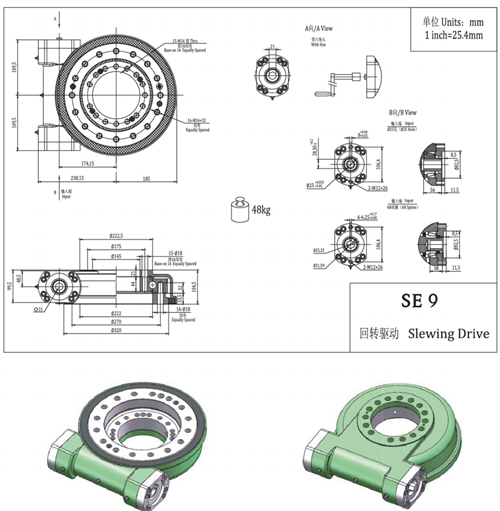
SE9
- Ratio
- 61:1
- Max Output
- 9.0 kN·m
- Tilting Moment
- 33.9 kN·m
- Axial Load
- 338 kN
- Radial Load
- 159 kN
- Sealing
- IP65
- Weight
- 48 kg
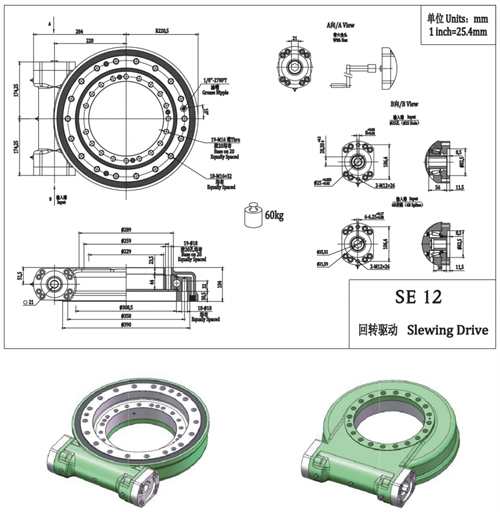
SE12
- Ratio
- 78:1
- Max Output
- 15.6 kN·m
- Tilting Moment
- 54.3 kN·m
- Axial Load
- 475 kN
- Radial Load
- 190 kN
- Sealing
- IP65
- Weight
- 60 kg
SE14
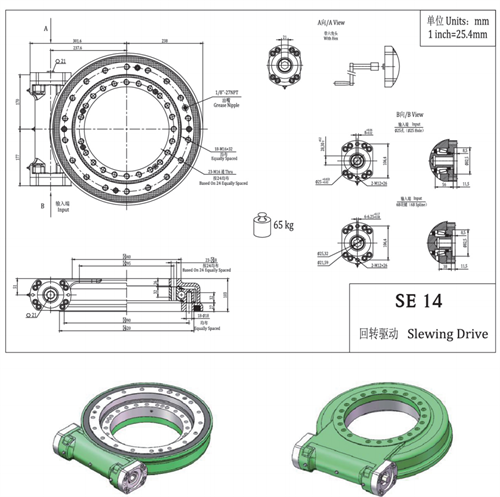
- Ratio
- 85:1
- Max Output
- 18.5 kN·m
- Tilting Moment
- 70.0 kN·m
- Axial Load
- 555 kN
- Radial Load
- 220 kN
- Sealing
- IP65
- Weight
- 65 kg
SE17
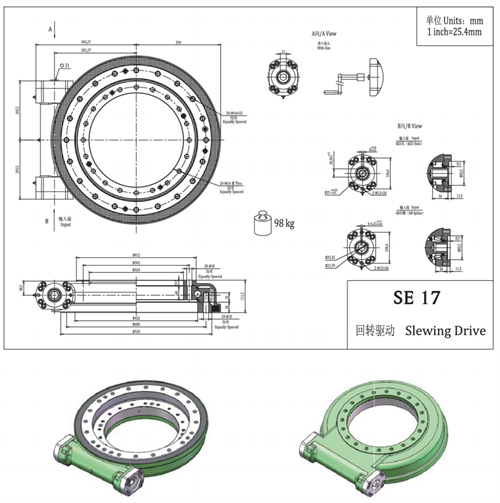
- Ratio
- 102:1
- Max Output
- 20.3 kN·m
- Tilting Moment
- 135.0 kN·m
- Axial Load
- 900 kN
- Radial Load
- 350 kN
- Sealing
- IP65
- Weight
- 98 kg
SE21
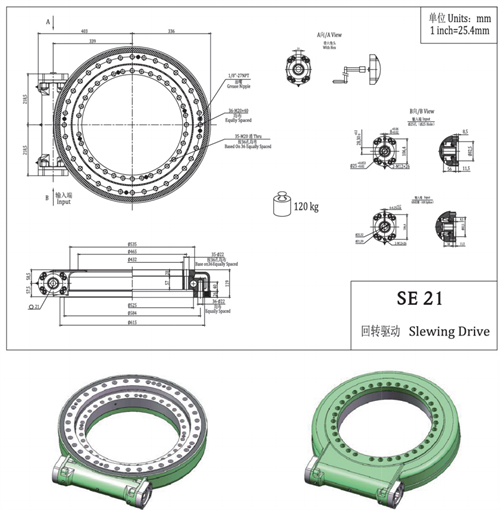
- Ratio
- 125:1
- Max Output
- 25.0 kN·m
- Tilting Moment
- 203.0 kN·m
- Axial Load
- 1598 kN
- Radial Load
- 640 kN
- Sealing
- IP65
- Weight
- 120 kg
[SYS-02] SELECTION GUIDE
Read the envelope by your governing constraint: match the tilting-moment column to your overturning load first, then confirm axial and radial headroom. Pairing a worm gear slew drive with a low rolling friction coefficient (µ ≈ 0.003–0.008 for the bearing itself) keeps the motor sizing modest even on multi-tonne platforms.
[SYS-03] ENGINEERING NOTE
Specifying the bearing, gearbox, and brake as three separate parts risks alignment errors and backlash that a sealed unit avoids, because Aubrik matches the worm set to the raceway in-house before test, the self-locking worm hold the load to 203 kN·m of tilting moment without a separate brake.
[SYS-01] ENGINEERING SPECIFICATION
DATA-SOURCE: ISO-281-REF
How to Choose: Load, Tilting Moment & Diameter
By far the most expensive mistake in slewing-bearing selection is sizing on axial capacity alone. In real installations, cranes, excavators, wind turbines, robot bases, the tilting moment, not the thrust rating, is the binding constraint.
Here is why it bites so hard. Under a tilting moment the load is not shared evenly; the most-loaded rolling element carries 3–5× the average. And because bearing fatigue follows the inverse-cube life law of ISO 281, a peak element load just 1.5× the average drops that element’s life to roughly (1/1.5)³ ≈ 30% of the even-distribution value. A bearing that “passed” an axial check can still fail early.
Worked moment example, 50 t crawler crane
[DATA] Payload
490.5 kN × 18 m = 8,829 kN·m
[DATA] Boom / Wind
120 kN × 9 m = 1,080 kN·m
15 kN × 12 m = 180 kN·m
15 kN × 12 m = 180 kN·m
[CALC] Total Moment
Total = 10,089 kN·m → ×1.25 safety factor (FEM 1.001) = 12,611 kN·m
Then size the diameter, not just the rating. A larger-diameter ring distributes the moment couple over a wider base, lowering peak element load for the same external moment, which is why large cranes run rings over 2 m even when a smaller ring would technically pass the static check. A combined-load check ties it together:
[SPEC]
(Fa/Ca) + (Fr/Cr) + (Mt/Cm) ≤ 1
Whether you’re weighing slew drive vs slew bearing, ball bearing vs slewing bearing, or turntable vs slewing ring, the deciding factor is the same governing load, not the label. The honest comparison below uses specific behavior, not Yes/No marketing.
Comparison: specific behavior, not Yes/No
| Criterion | Four-point ball | Cross roller | Three-row roller |
|---|---|---|---|
| Relative moment capacity | 1.0× (baseline) | ~1.6× | ~2.5×+ |
| Rigidity (deflection) | Medium | Very high | Very high |
| Running friction | Lowest | Higher | Highest |
| Relative cost | Lowest | Higher | Highest |
| Axial height | Slim | Slim | Tall (3 rows) |
Slewing Bearing & Drive Division
Applications: Cranes, Excavators, Wind, Solar Trackers & Heavy Equipment
One bearing family rotate very different machines, and each application sets its own governing load. Matching construction and diameter to that load is what keeps a crane swinging and a turbine yawing for two decades, get it wrong and the risk is raceway spalling or, on a mobile crane, tip-over above the rated 15,000 kN·m moment.
Application Principle
Beyond cranes and turbines, the same combined-load principle puts slewing rings under railway turntables, offshore wind platforms, forklift and aerial-work-platform booms, and material-handling robots. Unlike a plain bearing or an epicyclic gear train that resolves one load direction, a single slewing ring replaces a whole transmission sub-assembly, which is why machinists nickname it “the joint of the machine.”
“We size every slewing bearing from the tilting moment outward, not the axial rating. On a swing application the most-loaded roller can see five times the average, so we set diameter and raceway hardness depth to that case before we ever talk price.”
[SYS-01] DIRECT_MFG
Manufacturer-Direct: Custom Design, MOQ, Lead Time & Delivery
Downtime, not unit price, is what buyers fear most, field threads are full of operators who “couldn’t be down long enough to get one refurbished.” A slewing bearing manufacturer that holds capacity and ships direct changes that math.
[DATA] COST_YIELD
< 50%
Field data: a well-maintained slewing ring caught before failure repairs for under half the cost of a new replacement — and an unmanaged tilting moment can raise swing-drive motor current 15–25%.
Source: industry maintenance reporting (bearing-news; tilting-moment efficiency studies). Exact figures vary by application — request a custom analysis.
Slewing Bearing Engineering Tools
Online tools to size, calculate and decode slewing bearings. Select a tool below to open it and run your input values.
-
Calculator
Tilting Moment Calculator
Work out the tilting moment, axial and radial loads on a slewing bearing and check them against its static load capacity.
Open Tool -
Sizer
Slew Drive Sizer
Match the required torque, load and rotation speed of your application to a suitable slew drive model.
Open Tool -
Decoder
Designation Decoder
Break a slewing bearing designation down into its type, size and configuration so you can read any part number.
Open Tool
Slewing Bearings
Frequently Asked Questions
Is a slewing bearing the same as a slewing ring?
Yes. “Slewing bearing,” “slewing ring,” and “turntable bearing” all name the same component, the term just vary by region and industry.
How does a slew drive differ from a slew bearing?
The slew bearing is the rotating ring on its own. A slew drive wraps that bearing in an integrated, self-locking worm gearbox with a motor mount, a ready-to-install unit (Aubrik SE9–SE21) that both supports the load and power the rotation, so you skip separately sizing a gearbox, brake, and bearing.
How do I choose between a ball, cross-roller, and three-row roller slewing bearing?
Start from the tilting moment, then pick the smallest construction with a 1.5:1 margin. Four-point ball for variable, weight- or efficiency-sensitive loads; cross roller for high moment with precision; three-row roller for the heaviest combined load. Over-speccing to three-row when a ball passes adds cost, friction, and weight, not safety.
Which sizes can Aubrik manufacture?
Bore/OD from 200 mm to 6,000 mm, in four-point ball, cross-roller, and three-row roller, plus custom designs.
What materials are slewing bearings made from?
Rings are 42CrMo (4140) / 40Cr / 50Mn alloy steel, normalized and tempered; raceways are induction-hardened to HRC 55–62 with controlled case depth, and corrosion or zinc-plated options are available on request.
Why do slewing bearings fail, and how long do they last?
Most early failures trace to one of three root causes: sizing on axial load instead of tilting moment, mounting-flatness errors beyond 0.05–0.15 mm/m, or lapsed relubrication that lets metal contact the raceway. Get those right and a well-maintained crane bearing reaches 10–15 years, with wind-turbine rings designed to 20.
How can you tell a slew ring is worn?
Watch for resistance to swing or the boom over-travelling its stop, grinding during rotation, metal in extracted grease, and rising drive-motor current. Vibration monitoring flags raceway fatigue 2–6 months before it shows.
Can a slewing bearing rotate continuously, and what lubrication does it need?
Most run intermittently below 10 RPM, but continuous rotation is fine within the rated speed. Use GB7324 No.2 lithium grease through the nipples; relube every 50 operating hours in harsh duty to 500+ hours in clean, lightly loaded service, and never mix incompatible grease thickeners.
Are turntable bearings and slewing bearings the same?
For industrial use, yes, one combined-load ring under two names. Aubrik builds the full range, from lighter rotary-table sizes to multi-metre crane rings.
Do you offer custom / OEM slewing bearings and what is the lead time?
Yes, custom bore, load class, gearing, and mounting are standard, with OEM service and a one-year warranty. Send your drawing or load case for a part-number match, drawing, and quoted lead time from our two production bases.