Get in Touch with Aubrik Company

Updated October 2026
H beam production line manufacturers differ most in the work their equipment can complete. Aubrik suits modular plate-to-beam workshops; Corimpex and Primo offer integrated welding systems; Kistler documents tapered-beam capability. Compare the same drawings, steel grades and handling requirements across suppliers before choosing a line for your factory.
Disclosure: This guide is published by Aubrik. We list ourselves first because this is our website, not because we claim to be the market leader. The other 19 manufacturers are grouped by what they’re best for, in no particular order within each group.
Quick picks by production requirement
- Modular workshop: Aubrik, with separate cutting, assembly, welding, straightening and blasting stations.
- Horizontal welding: Primo, with pull-through assembly and submerged arc welding.
- Tapered sections: Kistler, whose LBL range names parallel and tapered beams.
- Alternative welding layouts: Corimpex, with vertical and horizontal systems.
- Grade-sensitive thick flanges: Hairui, whose HRAW-80 tables distinguish Q235 from Q355.
- Custom US-built equipment: PHI, with a history of automatic structural beam fabrication.
How We Selected These H Beam Production Line Manufacturers
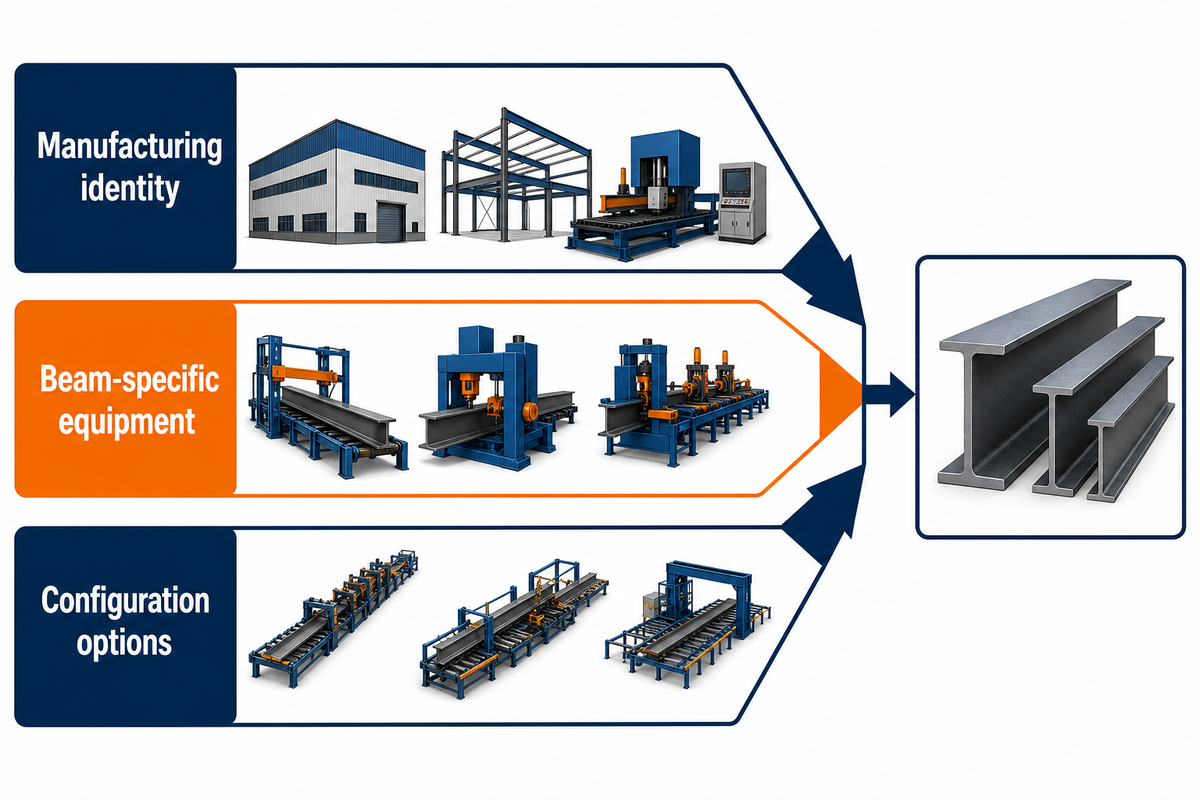
The shortlist features companies that have publicly available equipment for fabricating welded H or I sections from plates. We reviewed official company, product, and contact pages in October 2026. Selection was based on manufacturing identity, beam-specific equipment, documented configuration options, and a useful purchasing distinction. Pure distributors, sourcing directories, and used-equipment dealers weren’t considered. Companies that manufacture equipment and also trade were identified as such.
Capabilities below are published on each company’s website. One supplier may build a welding subsystem, a modular line or a larger installation with finishing equipment, and those scopes are stated separately. In the headquarters column, entries of “contact,” “factory,” or “region” describe published location. Historical founding dates are labeled when they pertain to a predecessor or group.
H Beam Production Line Manufacturers at a Glance
Use this comparison to determine a few manufacturers that have the right equipment architecture. Numbers don’t indicate international sales volume or quality. These suppliers serve welded steel production, rather than steelmaking furnaces or rolling mills. A broad equipment range is of use only if the proposed stations can process all of your beam mix. Brief limitations identify scope questions that may alter a purchase.
| No. | Company Name | Headquarters | Founded Year | Best For | Brief Introduction | Main Equipment | Key Advantages | Potential Disadvantages | Official Website |
|---|---|---|---|---|---|---|---|---|---|
| 1 | Aubrik | Wuxi, Jiangsu, China | 1999 | Modular fabrication workshops | Welding automation and line manufacturer | Cutting, assembly, gantry welding, straightening, blasting | Coordinated transfers and commissioning support | Assembly and welding height ranges differ | https://aubrikmc.com/ |
| 2 | Wuxi Hualian Science & Technology Group | Not publicly disclosed | 1987, predecessor factory | Configurable equipment packages | Welding and cutting equipment group | Assembly, welding, turning and finishing | Eccentric rollers and multiple turning arrangements | Catalog is a selection menu | https://www.hualianoversea.com/ |
| 3 | Wuxi Fengwei Mechanical Equipment Co., Ltd. | Wuxi, China; office | 2002 | Customized modular layouts | Automatic machinery manufacturer with OEM work | Cutting, assembly, welding and straightening | Mechanical and hydraulic options; CAD support | Separate stations need handling space | https://www.wxfengwei.com/ |
| 4 | SENLISWELD | Yangtze River Delta, China; region | 1999 | Space-led line customization | Welding automation manufacturer | Assembly, gantry welding, end face milling | Layout adaptation and finishing options | Finishing changes the footprint | https://www.senlisweld.com/ |
| 5 | Wuxi Longterm | Wuxi, China; contact | Not publicly disclosed | Custom assembly and SAW equipment | Workshop-specific beam-line manufacturer | Assembly and gantry welding machines | Hydraulic clamping and NB-350A sources | Customer needs to pay flight tickets, food and living | http://www.longtermmachinery.com/ |
| 6 | Wuxi JACK / AMASS | Luoshe Town, Wuxi; contact | 2009, JACK manufacturing | Comparing named station ranges | Manufacturing and overseas-sales group | HB lines, Z assembly, HJ straightening | Detailed automatic and semi-automatic configurations | Straightening ratings depend on steel strength | https://www.wxjack.com/ |
| 7 | Wuxi Lemar | Wuxi, China | 2005 | Integrated fabrication cells | Welding equipment and fixture manufacturer | Three-in-one and horizontal assembly systems | Integrated submodules; correction unit independently operated after modification | Three operations exclude cutting and blasting | https://www.wxsilvercoast.com/ |
| 8 | Corimpex | Paese, Italy | 1977 | Different welding architectures | Arc-welding automation specialist | BWM TC, HFI, HBWM and REVOLVER | Horizontal and vertical equipment choices | Product families need different layouts | https://www.corimpexgroup.com/en/ |
| 9 | Primo Automation Systems | Chennai, India; factory | 1995 | Pull-through PEB beam welding | Welding automation manufacturer | ABW horizontal assembly and welding | Dual-wire SAW with hydraulic positioning | Entry tacking and optional handling remain | https://primoautomation.com/ |
| 10 | Kistler | Bad Saulgau, Germany | 1966 | Parallel and tapered beams | Welding machinery manufacturer | LBL and VBL systems | Model-specific dimensional tables | Second flange requires a turning sequence | https://kistler-machine.com/en |
| 11 | Zhejiang Jinggong Intelligent Building Material Equipment Co., Ltd. | Shaoxing, China; contact | 1968, group origins | Selectable horizontal-line scope | Building material equipment business | JH150A welding and handling | Single-arc double-wire process; staged inspection | Half-line requires separate transfer equipment | https://www.jinggongmachine.com/ |
| 12 | ZMDE | Shanghai, China; contact | Not publicly disclosed | Defined FAHP-12S beam ranges | Intelligent fabrication equipment manufacturer | H/T beam lines, cutting and blasting | Integrated fabrication and Industry IoT portfolio | Named model limited to 1200 mm web height | https://www.zmdetech.com/ |
| 13 | Wuxi Hairui | Wuxi, China; business address | Not publicly disclosed | Thick-flange horizontal correction | Welding and cutting equipment manufacturer | HRAW lines and cantilever welding | Grade-specific flange straightening ratings | Q355 thickness limit below Q235 | https://www.wuxihairui.com/ |
| 14 | PHI | City of Industry, California, USA | Early 1940s, Preco origins | Custom structural beam systems | US machinery manufacturer | Automatic beam fabrication equipment | Structural beam-line history since the 1960s | Custom scope requires project definition | https://phihydraulics.com/ |
| 15 | Zhouxiang | Wuxi, China | 1991 | Light and heavy beam portfolios | Welding and cutting automation manufacturer | Horizontal, heavy-duty and semi-automatic lines | Separate ranges for different line types | Light-line ratings differ from heavy-duty systems | https://zhouxianggroup.com/ |
| 16 | Ningbo Jinfeng Welding and Cutting Machinery Manufacture Co., Ltd. | Ningbo, China; company address | 1987 | Vertical welding with connected handling | Customized fabrication equipment manufacturer | Assembly, cantilever welding, flipping, straightening | Transfer carts and MES integration | Flange correction includes a second orientation | https://www.jinfengweldcut.com/ |
| 17 | Yangtong | Wuxi City, China; contact | 1985 | Coordinated structural-steel stations | H, box and bridge equipment manufacturer | Z20B assembly, LHC welding, YTJ straightening | Options for asymmetric sections | Crane work remains at loading and discharge | https://steelbeammachine-en.com/ |
| 18 | Shandong Kasry Intelligent Equipment Co., Ltd. | Dezhou, China; production base | Not publicly disclosed | Fabrication with downstream processing | Steel machinery producer | Assembly, SAW, straightening, drilling, painting | Synchronous clamping and bi-directional welding | Light and heavy work need different straighteners | https://www.kasrytech.com/ |
| 19 | YOMI CNC | Ningjin, Dezhou, China; plant | 2012 | Fabrication connected to drilling | Manufacturer and trading company | H-beam lines and CNC beam drilling machines | Both-sides horizontal flange correction | Symmetric assembly does not cover every shape | https://www.steelstructurer.com/ |
| 20 | Technocrats Plasma Systems Limited | Vasai (east), India; operating address | 1990 | Cutting-led fabrication packages | Designer and manufacturer with trading activities | Cutting, assembly, SAW/MIG/MAG, straightening | Nesting and torch oscillation control | Blasting and painting are separate scope | https://www.technocratplasma.com/ |
Modular H Beam Production Lines
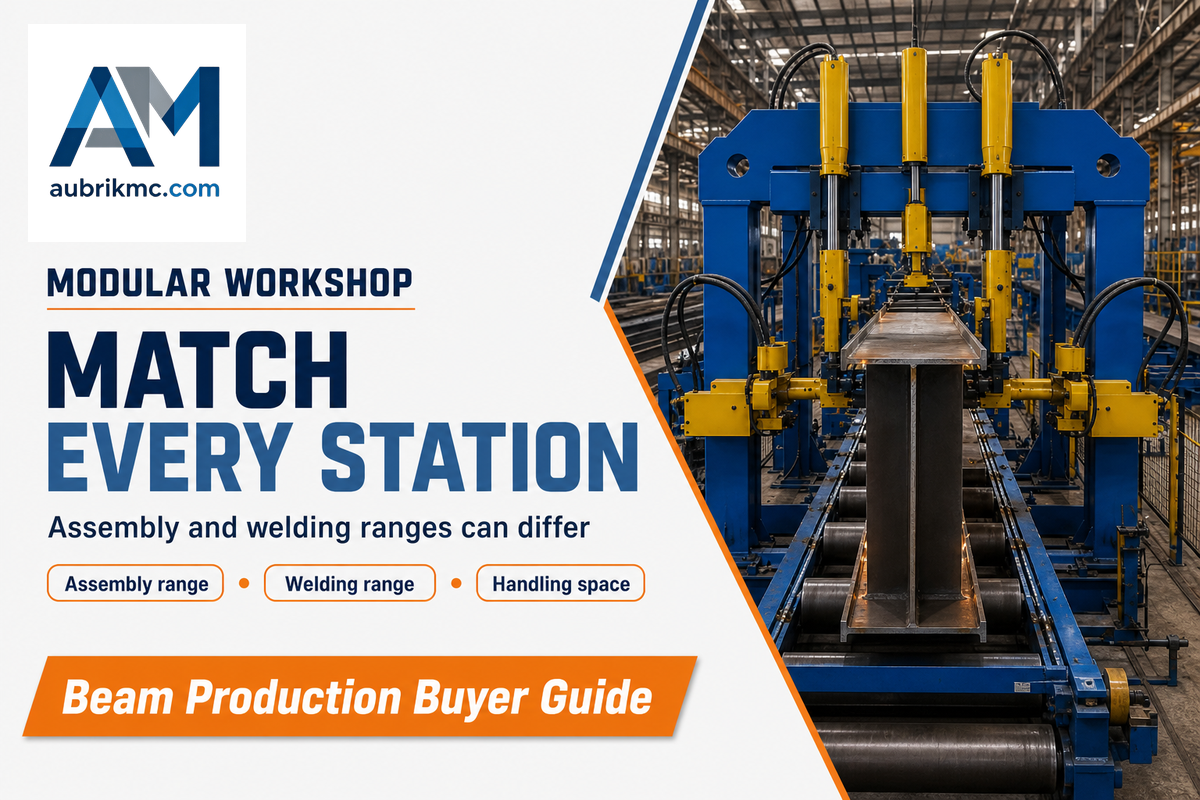
Separate stations make the production process visible: plates are cut and fitted, welded and corrected at different locations. This arrangement is adaptable to an expanding workshop around the existing equipment. The challenge with purchasing is connecting the machines. The right welding machine wouldn’t guarantee that the assembly and straightener stations accept the same part.
1. Aubrik: Best for Modular Plate-to-Beam Workshops
Headquarters: Wuxi, Jiangsu, China.
Official website: https://aubrikmc.com/
Founded: 1999, as identified with Wuxi ABK Machinery.
Company type: Welding equipment manufacturer.
Main equipment: CNC cutting, beam assembly, gantry submerged arc welding, flange straightening and shot blasting. Credentials: Aubrik’s website states ISO 9001 quality management and CE conformity.
Aubrik’s H-Beam & Steel Structure Production Line uses powered conveyors and turners to connect five core stations. The PLC-coordinated arrangement suits a buyer who wants a defined sequence while retaining separate machines. Its published service scope includes installation, commissioning, operator and maintenance training, plus a 1-year equipment warranty.
Station specifications: HG-1500 assembly covers web heights of 200–1500 mm, while the AM-HG welding station separately lists 200–2500 mm. HYJ-40 straightening lists flange widths of 200–800 mm and thicknesses of 6–40 mm.
Limitation: the larger welding range doesn’t establish the capacity of the illustrated complete line; beams above the assembly range require a matching configuration.
2. Wuxi Hualian Science & Technology Group: Best for Configurable Equipment Packages
Headquarters: Not publicly disclosed in the reviewed pages.
Official website: https://www.hualianoversea.com/
Founded: 1987 origins in the former Wuxi Hualian Welding & Cutting Equipment Factory.
Company type: Welding and cutting equipment manufacturer.
Main equipment: Cutting, assembly, submerged-arc welding, straightening, material handling and shot blasting. Notable capability: the official H Beam Production Line description includes eccentric rollers and multiple beam-turning arrangements.
Hualian presents its equipment as a configurable package. That makes it relevant to a fabricator deciding which operations to automate around an existing workshop. The published process includes double-sided fillet welding with the beam in an I position, plus 45° and 180° handling options. These details distinguish a proposed line from a collection of standalone welders.
Limitation: the website’s equipment list is a configuration menu, so every displayed station shouldn’t be assumed to belong to one standard-priced package.
3. Wuxi Fengwei Mechanical Equipment Co., Ltd.: Best for Customized Modular Layouts
Headquarters/base: Wuxi, China; published China office.
Official website: https://www.wxfengwei.com/
Founded: Machinery development and manufacturing since 2002.
Company type: Manufacturer offering OEM equipment.
Main equipment: H-beam cutting, assembly, turning, welding and straightening machinery. Credentials: according to its company profile, Fengwei operates an ISO 9001 quality system and produces CE-certified machines.
Fengwei’s offer includes mechanical and hydraulic straightening choices, together with the separate stations needed for welded sections. Its published customization services include CAD work and component adaptation. Those services are relevant when a new machine must fit an established production bay, rather than a completely new building.
Limitation: selecting machines individually doesn’t settle the handling layout; crane movements, transfers and workpiece orientation remain part of the line design.
4. SENLISWELD: Best for Space-Led Line Customization
Headquarters/base: Yangtze River Delta, China; operating region.
Official website: https://www.senlisweld.com/
Founded: Welding automation manufacturing since 1999.
Company type: Welding automation manufacturer.
Main equipment: Assembly machines, gantry welding, straightening, shot blasting and end face milling. Notable capability: the company describes customization around available factory space.
SENLISWELD’s H-beam offer extends beyond joining the web and flanges. End Face Milling and Shot Blasting appear alongside the principal fabrication stations. That wider menu is useful when the buyer wants to discuss how a beam leaves the line, including end preparation and surface treatment, rather than stopping the quotation at welding.
Limitation: adding finishing machines changes the footprint and material flow; a package containing every catalog operation needs more layout planning than a compact assembly-and-welding cell.
5. Wuxi Longterm: Best for Custom Assembly and SAW Equipment
Headquarters/base: Wuxi, China; contact address.
Official website: http://www.longtermmachinery.com/
Founded: Not publicly disclosed.
Company type: Manufacturer offering H beam production line design.
Main equipment: Assembly and gantry submerged-arc welding machinery. Published features: hydraulic clamping, input and output rollers, and two NB-350A tack-welding sources in the assembly supply list; CE is stated in the listing. Published service terms charge the customer for engineer travel and living costs.
Longterm’s official line page states that it manufactures beam equipment and designs configurations around the customer’s workshop and workpiece. Its assembly table gives a 200–1800 mm web-height range. That number belongs to the labeled assembly equipment, rather than proving the envelope of every station sold under the page’s broader title.
Limitation: the assembly-machine supply list defines the assembly capacity within a full-line configuration; gantry welding capacity and service costs need their own scope.
6. Wuxi JACK / AMASS: Best for Comparing Named Station Ranges
Headquarters/base: Luoshe Town, Wuxi, China; shared contact address.
Official website: https://www.wxjack.com/
Founded: Wuxi JACK manufacturing in 2009; AMASS overseas sales in March 2021.
Company type: Manufacturing and sales group, counted once.
Main equipment: HB series lines, Z-series assembly machines and welding or straightening stations. Notable work: the official datasheet separates Automatic and Semi-Automatic configurations.
Wuxi JACK provides specific station names for comparing an automatic H beam welding line. Z15, Z18 and Z20 assembly equipment lists maximum web heights of 1500, 1800 and 2000 mm respectively. Its HJ series addresses longitudinal straightening, while other products correct flange deformation. The different jobs should remain separate in an equipment schedule.
Limitation: straightening ratings depend on material strength as well as thickness, so the largest number in one product table can’t represent every grade passing through the complete installation.
7. Wuxi Lemar: Best for Integrated Assembly-Weld-Straighten Cells
Headquarters: Wuxi, China.
Official website: https://www.wxsilvercoast.com/
Founded: 2005.
Company type: Welding equipment manufacturer.
Main equipment: H-beam production line machines, horizontal assembly systems, welding automation and 3D fixtures. Credentials: the company reports ISO 9001 quality-system compliance and CE-certified products.
Lemar’s three-in-one equipment combines beam assembling, welding and straightening within one machine arrangement. Its product description also allows the correction auxiliary machine to operate independently after modification. That gives the buyer a specific reason to investigate the integrated machine: fewer separate positions for these three operations, with some flexibility in how the functions are used.
Limitation: “three-in-one” names the integrated operations; it doesn’t mean that plate cutting, shot blasting or the rest of a finished-beam production route is included.
Horizontal and Integrated H Beam Welding Systems
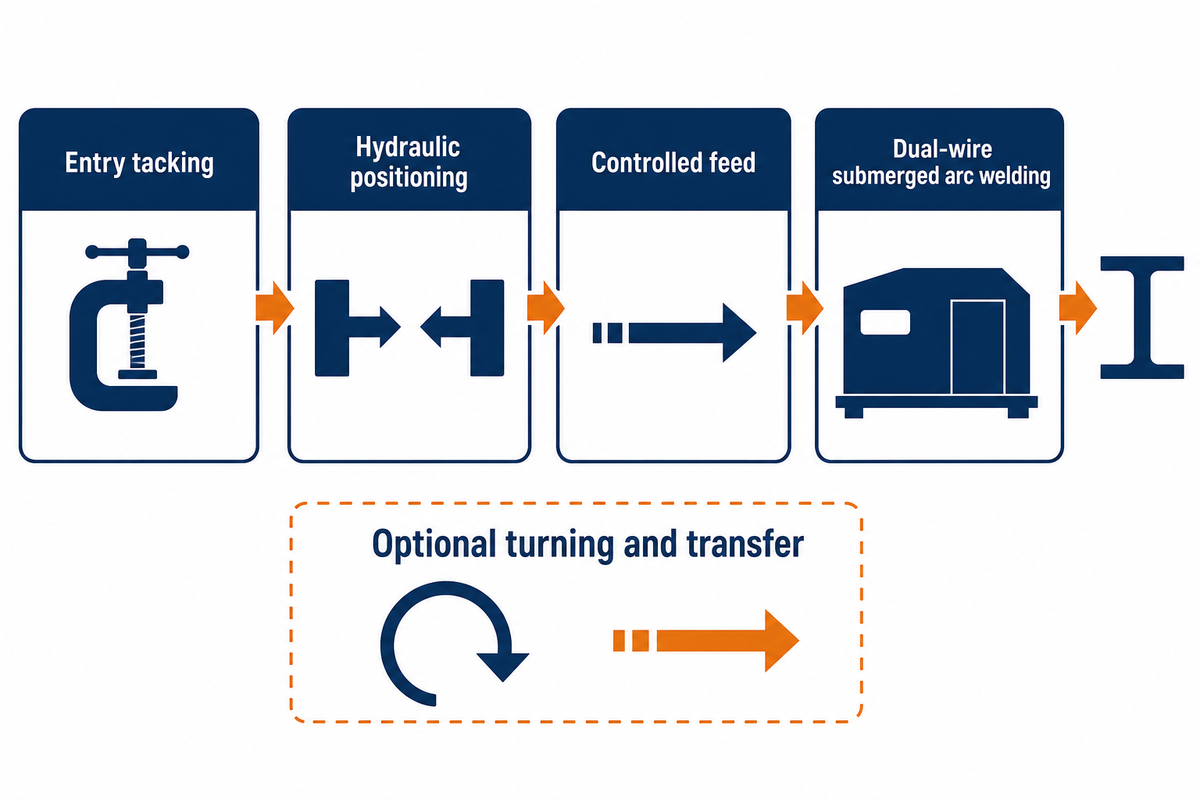
Horizontal systems alter how the flange and web enter the welding operation. Some pull the components through a combined assembly and welding station, while others use a different turn sequence for the second flange. Analyze these movements against your floor plan and product drawings.
8. Corimpex: Best for Comparing Alternative Welding Architectures
Headquarters: Paese, Treviso, Italy.
Official website: https://www.corimpexgroup.com/en/
Founded: Welding automation activity since 1977.
Company type: Arc-welding automation manufacturer.
Main equipment: BWM TC vertical systems, HFI and HBWM horizontal systems, and REVOLVER. Notable capability: the company’s beam welding line portfolio includes integrated flange straightening and different workpiece-handling arrangements; remote assistance is also offered.
Corimpex is useful for a buyer comparing the architecture of the welding section itself. Its published systems address vertical and horizontal fabrication, while REVOLVER covers H, T and I sections with a cycle described as avoiding crane intervention. The range gives buyers several ways to organize assembly, weld access and subsequent beam movement.
Limitation: these product families are alternative layouts, so capabilities from one system shouldn’t be transferred automatically to another quotation.
9. Primo Automation Systems: Best for Pull-Through PEB Beam Welding
Headquarters/base: Chennai, India; published factory location.
Official website: https://primoautomation.com/
Founded: 1995; PEB beam-line milestone in 1999.
Company type: Welding automation manufacturer.
Main equipment: ABW H beam horizontal assembly and welding systems. Notable capability: Primo’s “Pull Thru” arrangement combines hydraulic positioning, controlled feed and dual-wire submerged arc welding.
Primo’s equipment joins pre-cut steel plates into beams for pre-engineered building work. The official sequence includes entry tacking before the components are pulled through the welding section. Laser tracking, a 180 degree flipping arrangement and cross-transfer to another welder appear as configuration options, rather than a reason to assume every installation has the same automation level.
Limitation: the pull-through system still depends on suitable plate preparation, entry tacking and the selected handling package around the welding machine.
10. Kistler: Best for Parallel and Tapered Beam Production
Headquarters: Bad Saulgau, Germany.
Official website: https://kistler-machine.com/
Founded: 1966.
Company type: Welding machinery manufacturer.
Main equipment: LBL and VBL beam-welding systems. Notable capability: the LBL range explicitly covers parallel and tapered I and T sections.
The published LBL 2000 MD specification provides a concrete starting point: web heights of 200–2000 mm, web thicknesses of 5–30 mm, flange widths of 100–1000 mm and beam lengths of 6–12 m. These are the named model’s figures, not an unrestricted promise for all Kistler machines or every material.
Limitation: the second weld orientation is part of the production sequence; the layout and handling allowance must accommodate that turn even though the machine integrates other operations.
11. Zhejiang Jinggong Intelligent Building Material Equipment Co., Ltd.: Best for Selectable Horizontal-Line Scope
Headquarters/base: Shaoxing, Zhejiang, China; published contact location.
Official website: https://www.jinggongmachine.com/
Founded: Group history traced to 1968.
Company type: Building material equipment manufacturer.
Main equipment: JH150A H-Beam Welding Line and associated handling equipment. Notable capability: its product page describes a single-arc, double-wire welding process and alternative full or half-line arrangements.
Jinggong publishes a welding travel figure of about 2m/min for the described process. That’s torch or workpiece travel during welding, not finished beams per shift. Loading, fitting, turning and unloading still occupy production time. Its company profile also describes Incoming Material Inspection, process checks and outgoing inspection.
Limitation: the half-line equipment list excludes the turnover device, second welder and related roller conveyor, transferring those operations elsewhere in the workshop; it isn’t the same production scope at a lower headline price.
12. ZMDE: Best for a Defined Integrated Beam Range
Headquarters/base: 999 Yunjuan Road, Shanghai, China; operating address.
Official website: https://www.zmdetech.com/
Founded: Not publicly disclosed.
Company type: Intelligent manufacturing and Industry IoT equipment company.
Main equipment: H/T beam fabrication, cutting, shot blasting and associated systems. Published quality claims: its assembly-machine section mentions ISO 9001 and some products passing TUV testing.
The FAHP-12S product table defines a useful purchasing range: web height 200–1200 mm, web thickness 6–30 mm, flange width 200–800 mm, flange thickness 8–40 mm and length 4000–15000 mm. Its listed supply is 380V at 50 Hz. Those particulars help a buyer compare the machine with an existing workpiece schedule and factory utilities.
Limitation: the named model’s 1200 mm web-height and 40 mm flange-thickness limits restrict its fit for larger sections. Other equipment in the company’s portfolio doesn’t automatically expand that model’s envelope.
13. Wuxi Hairui: Best for Grade-Sensitive Heavy Flange Straightening
Headquarters/base: Wuxi City, Jiangsu, China; business address.
Official website: https://www.wuxihairui.com/
Founded: Not publicly disclosed.
Company type: Welding and cutting equipment manufacturer.
Main equipment: HRAW lines, cantilever submerged-arc welders, transfer equipment and horizontal straightening machines. Notable capability: its published arrangement includes four welding stations and several turning angles. Its profile lists ISO9001, ISO14001 and OHSAS18001 as website certification claims.
Hairui gives different flange-correction limits for different steel grades. The HRAW-80 table lists 80 mm for Q235 and 60 mm for Q355. This is a useful example of why thick steel and high-strength steel can’t be treated as interchangeable requirements. The horizontal straightening arrangement addresses both flanges, and the product description discusses double arc double-wire welding.
Limitation: the higher Q235 thickness rating can’t be applied to Q355, so an apparently suitable model can fall outside the intended material range.
14. PHI: Best for Custom US Structural Beam Systems
Headquarters: City of Industry, California, USA.
Official website: https://phihydraulics.com/
Founded: Early 1940s, originally Preco Incorporated.
Company type: Machinery manufacturer.
Main equipment: Automatic steel beam fabrication and beam welding systems. Notable history: PHI traces its structural beam-line activity to the 1960s, including equipment formerly associated with Conrac.
PHI’s current company description names custom steel beams for applications including buildings, bridges, shipyards and trailers. Its retained fabrication-system video article provides another view of that product activity. The offer is relevant to buyers considering a custom installation, rather than choosing solely from a short table of standard model sizes.
Limitation: PHI’s custom beam fabrication project needs a separately defined scope for the upstream cutting and downstream finishing equipment.
Automation for Larger Steel Structure Projects
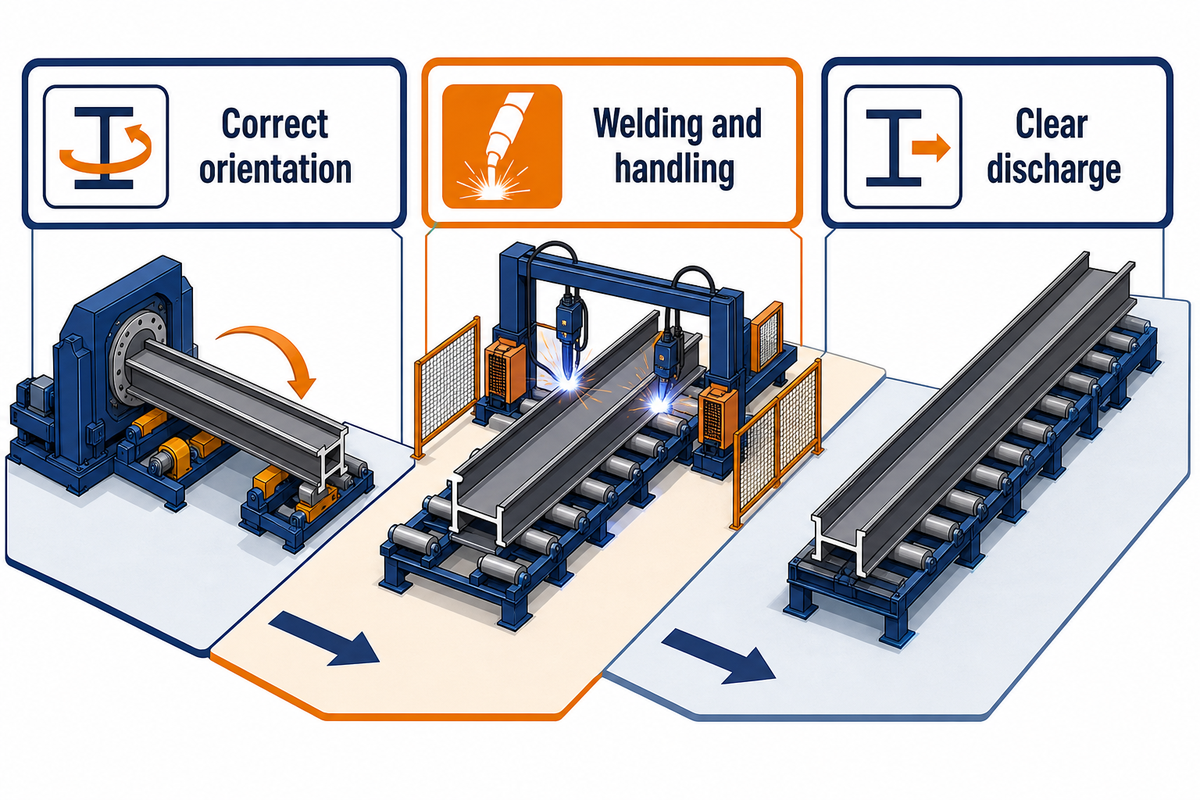
Automated welding systems for larger projects involve the integration of a suitable welding process and a sufficient material handling system. Long workpieces must arrive at each station in the right orientation, and the finished beam must leave without blocking the next one. The manufacturers below provide information about integrating welding with fabrication and finishing processes.
15. Zhouxiang: Best for Comparing Light and Heavy Beam Lines
Headquarters: Wuxi, China.
Official website: https://zhouxianggroup.com/
Founded: 1991.
Company type: Welding and cutting automation manufacturer.
Main equipment: Light, horizontal, Semi-Automatic and Heavy-Duty H Beam Production Line options, plus Box Beam equipment and Shot Blasting. Published credentials: its homepage names the historical ISO9001:2008 edition and CE.
Zhouxiang distinguishes its heavy-duty configuration from lighter arrangements. The heavy-line table lists webs 200–2000 mm high and 6–60 mm thick, with flanges 200–1000 mm wide and 6–80 mm thick. Its lighter or horizontal equipment has different ranges. The tables are useful because they associate a capacity with a particular line category.
Limitation: the capacities can’t be mixed across categories; a light-line offer doesn’t inherit the heavy-duty table’s maximum plate thickness simply because the supplier makes both.
16. Ningbo Jinfeng Welding and Cutting Machinery Manufacture Co., Ltd.: Best for Connected Vertical Welding Lines
Headquarters/base: Ningbo, China; published company address.
Official website: https://www.jinfengweldcut.com/
Founded: 1987.
Company type: Manufacturer of customized fabrication equipment.
Main equipment: H-beam assembly, cantilever submerged-arc welding, flipping, transfer carts and straightening. Notable capability: the product description includes MES connectivity alongside physical line handling. Its product page states that CE and ECA certificates are available.
Jinfeng describes a vertical fabrication route with welding areas connected by workpiece movement equipment. A cantilever arrangement gives the welding section a different physical layout from a pull-through machine. Its emphasis on transfers and manufacturing execution information is useful for a buyer evaluating how automated production lines will fit into a larger production plan.
Limitation: the second-flange straightening operation and its turn remain part of the cycle and handling capacity.
17. Yangtong: Best for Coordinated Structural-Steel Stations
Headquarters/base: Wuxi City, Jiangsu, China; published contact address.
Official website: https://steelbeammachine-en.com/
Founded: 1985.
Company type: Structural steel fabrication equipment manufacturer.
Main equipment: H-beam lines, box-beam equipment and bridge deck U-ribs production systems. Notable capability: the H-beam offer combines named assembly, welding and straightening stations, including options for asymmetric H-beams. Its profile names the historical ISO9001:2000 edition.
Yangtong’s station data illustrates why a complete installation needs more than one capacity check. Z20B assembly can accept an 80 mm flange, while the YTJ60 straightener’s 60 mm rating is tied to steel with yield strength no greater than 345 MPa. The assembly capacity therefore doesn’t settle the finished-beam range.
Limitation: its described process still uses cranes for assembly loading and final unloading. Buyers seeking a fully automatic route must include those boundaries in the proposed handling scope.
18. Shandong Kasry Intelligent Equipment Co., Ltd.: Best for Fabrication with Downstream Processing
Headquarters/base: Dezhou, Shandong, China; production base, with research centers in Shanghai and Jinan.
Official website: https://www.kasrytech.com/
Founded: Not publicly disclosed in consistent company history.
Company type: Steel fabrication equipment manufacturer.
Main equipment: H beam cutting, assembly, gantry SAW, straightening, drilling and painting equipment. Notable capability: the published line includes synchronous clamping, bi-directional welding, arc tracking and flux handling.
Kasry’s range is relevant when a fabricated section must proceed to further processing after the main welds. The drilling and painting portions of its portfolio make those downstream interfaces part of the supplier discussion. Its assembly description also focuses on keeping the component plates positioned together during joining.
Limitation: the choice between mechanical straightening for light steel and hydraulic straightening for heavy steel means the straightening arrangement must match the thickness and material range of the work being purchased for.
19. YOMI CNC: Best for Combining Beam Fabrication and Drilling
Headquarters/base: Ningjin, Dezhou, China; company and plant address.
Official website: https://www.steelstructurer.com/
Founded: 2012.
Company type: Manufacturer & Trading Company, as its profile states.
Main equipment: H-beam fabrication lines, CNC Beam Drilling Machines, blasting and painting equipment. Notable capability: the horizontal straightening description addresses the flanges on both sides.
YOMI CNC combines a manufacturing offer with trading activity, so the equipment builder and integration responsibility should be stated in the quotation. Its portfolio is relevant to factories connecting fabrication with CNC Drilling and surface finishing. The line-planning information also asks for workshop dimensions, which affect the arrangement of these operations.
Limitation: the described assembly machine is for symmetric, equivalent-section H beams; tapered or asymmetric sections call for a separately defined machine configuration and production sequence.
20. Technocrats Plasma Systems Limited: Best for Cutting-Led Fabrication Packages
Headquarters/base: Vasai (east), Palghar, Maharashtra, India; operating address.
Official website: https://www.technocratplasma.com/
Founded: 1990.
Company type: Company that designs and manufactures equipment, with trading and export activities.
Main equipment: H-Beam Fabrication Machines covering cutting, hydraulic assembly, SAW or MIG/MAG welding, and straightening. Notable capability: its product descriptions include automatic nesting, torch tracking and oscillation control.
Technocrats is a useful candidate when the purchasing scope begins with plate cutting and continues through the principal fabrication operations. The choice of welding process belongs in that discussion because joint requirements and workpiece preparation must fit the selected equipment. Its cutting and welding portfolio lets the buyer examine those interfaces with one potential supplier.
Limitation: shot blasting and painting are separate scope items in this comparison; a fabricated beam shouldn’t be assumed to leave the quoted package ready for final coating.
What Does an H Beam Production Line Include?
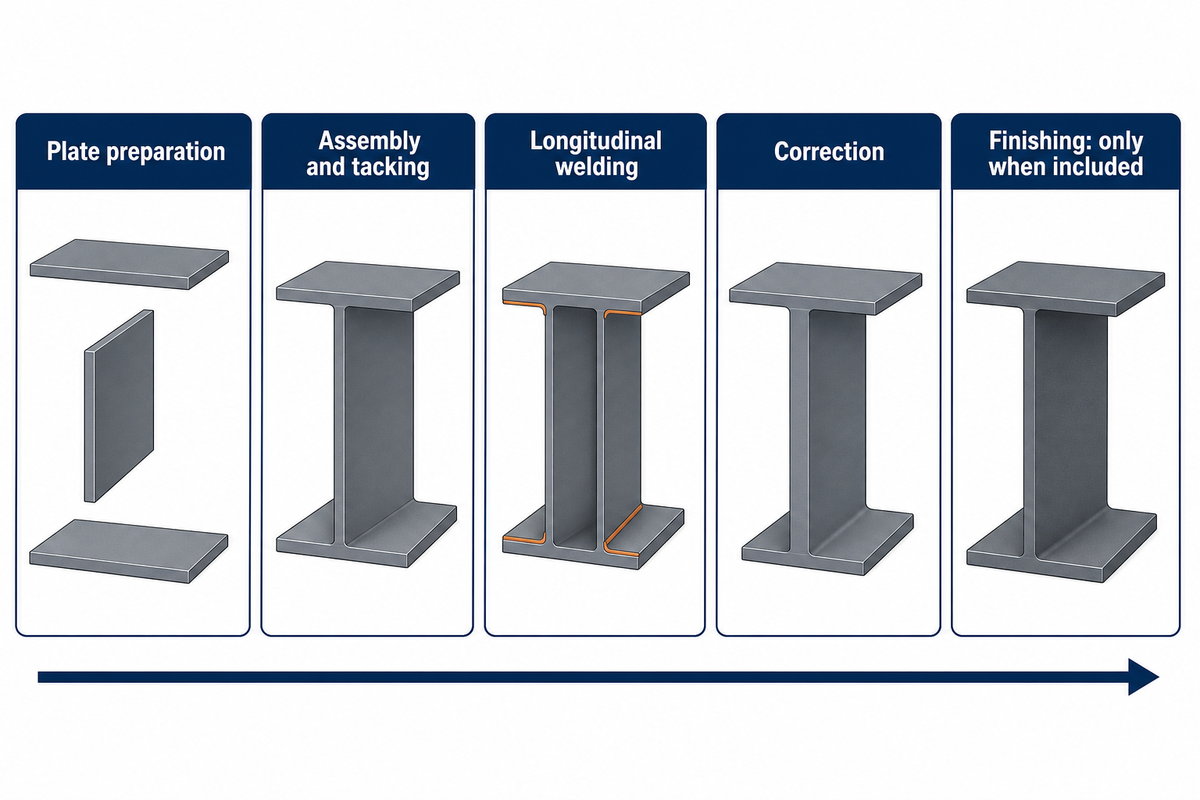
An H beam production line for H-shaped steel joins a web plate to two flange plates, then corrects welding deformation within the limits of the equipment. A traditional sequence is cutting, assembly, welding, and straightening. Surface preparation may follow. The exact supply depends on whether the manufacturer is quoting the complete process route or the welding route within it.
- Plate preparation: CNC cutting produces the web and flanges to the specified shapes. The use of CNC helps repeat the programmed cut, but the resulting plate dimensions still need inspection.
- Assembly and tacking: an H beam assembly machine positions the plates. Clamping and centering must accommodate the actual flange and web range.
- Longitudinal welding: an H beam submerged arc welding arrangement uses controlled feed and a welding power source to form the principal joints. Gantry welding machines and pull-through systems organize that movement differently.
- Correction: an H beam straightening machine corrects flange deformation. The beam flange can need correction even when the overall member is straight. Longitudinal bow can require a different correction operation.
- Finishing: shot blasting equipment, end machining, drilling and painting belong in the supply list only when included.
A roller conveyor, transfer cart or turner connects these steps. Together they move the beam parts through H-beam manufacturing without requiring the welder itself to perform every handling task. The beam submerged arc welding machine is therefore only one part of an automatic H beam production line. The complete beam welding machine arrangement therefore needs a handling plan. Material storage, loading and discharge can determine whether the rest of the equipment is able to keep working.
How to Choose an H Beam Production Line Manufacturer
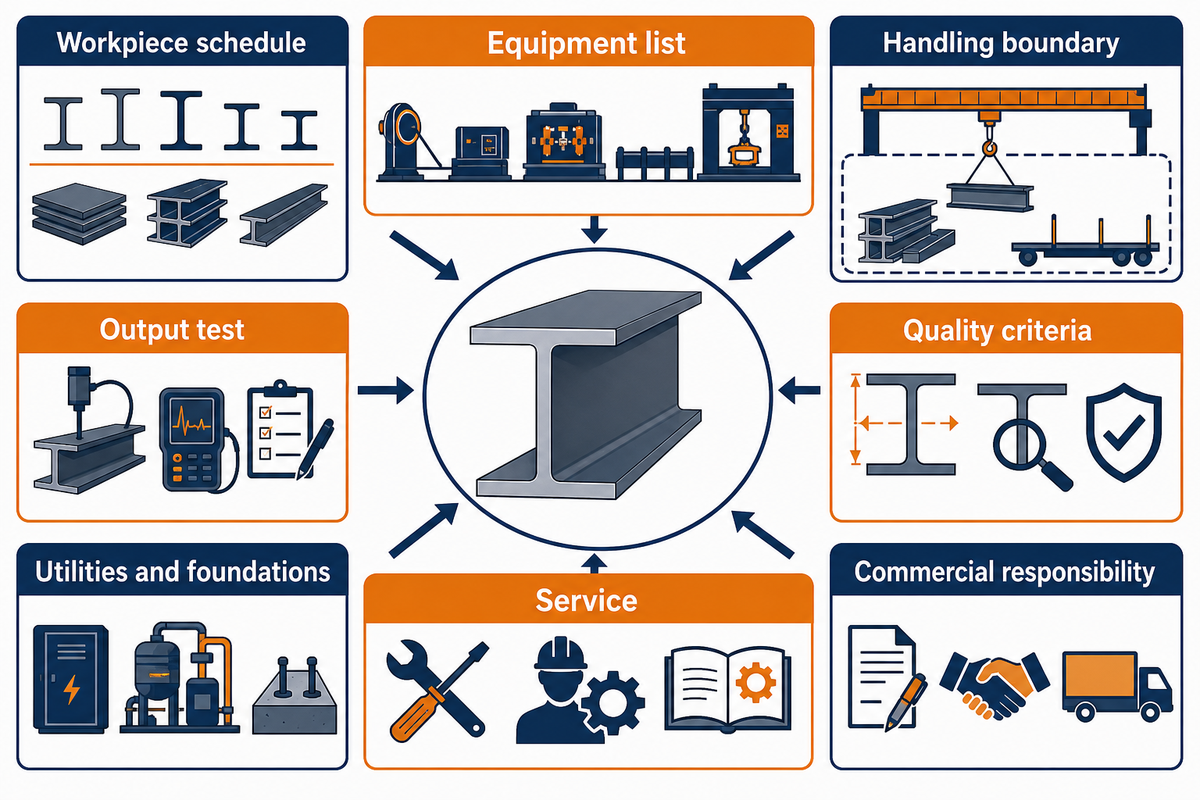
Give shortlisted suppliers the same workpiece schedule and have each identify what’s included. The smallest and largest sections, as well as the different grades of material, joints, the annual product mix and the required output need to be identified. A proposal is easier to judge if the manufacturer relates those requirements to named stations, handling equipment and an agreed acceptance method.
Which Dimensions Must Every Station Handle?
Every station must accept the beam height, flange width, plate thickness, length and weight required at that station in the process. Give smallest and largest sizes, as well as minimum and maximum sizes. Also state if the members are parallel, tapered, symmetric or asymmetric. The machine’s ability to hold a workpiece is different to the machine’s ability to weld or straighten it.
Aubrik’s illustrated assembly and welding heights differ. Yangtong’s assembly and straightening thickness limits also differ. Hairui publishes different straightening limits for Q235 and Q355. These examples show why a purchasing schedule should record one capacity against each operation, rather than a single large number beside the words “production line.”
The steel grade of each representative section, and the joint drawing must also be included. The size of the weld, penetration requirements and weld inspection criteria influence the welding procedure, while the strength of the material influences the correction. Accuracy and precision need a measurement plan. Specifying dimensions, measurement methods and acceptance tolerances for a finished member is more helpful than making general statements about precision and efficiency.
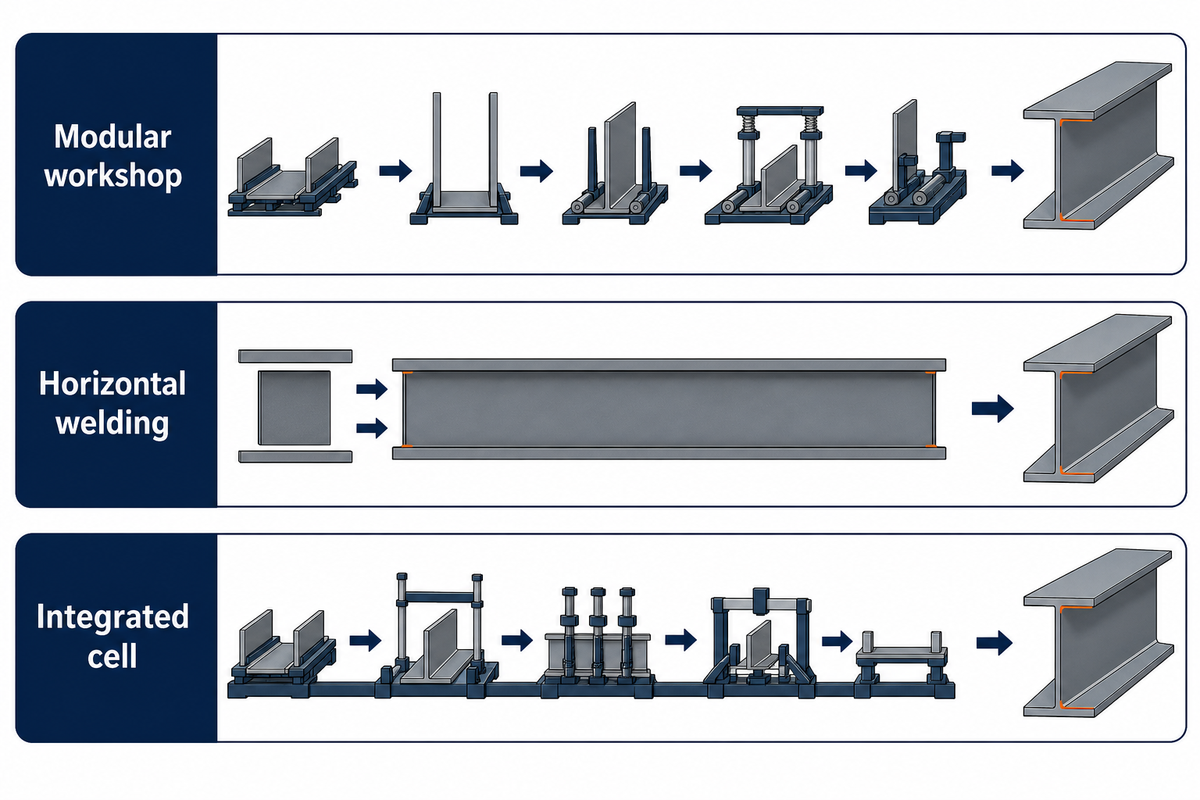
Should You Choose a 3 in 1 Machine or Separate Stations?
A 3 in 1 machine can integrate assembly welding and flange correction where its section range suits the work. Separate stations can suit a factory retaining existing cutting equipment or using different welding arrangements. Compare the actual cycle and floor plan for your product mix; neither architecture is automatically the better choice for every workshop.
Integrated cell
Evaluate how plates enter, where tacking occurs and how the two flange joints are completed. Keep upstream preparation and downstream finishing visible in the equipment scope.
Separate stations
Evaluate transfers, buffer space and the personnel or crane movements between machines. A faster welder will not clear a queue at an undersized straightener.
Automatic and semi-automatic systems also differ at their boundaries. A fully automatic welding cycle may still rely on crane loading or manual plate preparation. For mass production, ask the manufacturer to demonstrate a complete representative cycle, including stops and changeovers. Production efficiency depends on the consistency with which the stations receive prepared workpieces. Productivity and quality should be measured together during the trial. Production speed during one weld pass doesn’t guarantee finished output per shift.
What Belongs in the Quotation and Acceptance Test?
The quotation should identify the supplied machines, controls, handling equipment, installation duties and test conditions. Acceptance should include agreed representative beams and measurable results. It should show the operations before and after welding, so that an attractive machine demonstration doesn’t conceal work transferred to another bay, or work not included in the scope of the supplied package.
- Workpiece schedule: dimensions, grades, joint types and the share of tapered or asymmetric sections.
- Equipment list: model, quantity, tooling, rollers, turners, flux recovery and spare parts.
- Handling boundary: crane loading, automatic transfers, storage positions and final discharge.
- Output test: representative beam mix, staffed shift conditions, changeovers and accepted finished pieces.
- Quality criteria: finished geometry, welding seam requirements and the inspection method.
- Utilities and foundations: electrical supply, air, extraction, civil work and installation clearances.
- Service: commissioning, training, warranty exclusions, remote support and engineer travel costs.
- Commercial responsibility: equipment manufacturer, integration owner, delivery terms and installation acceptance responsibilities.
Verify current certificate scope, model data and contractual claims during this selection stage. Company quality-management certification, machine conformity documentation and weld-quality requirements answer different questions. ISO 3834-2:2021 concerns quality requirements for fusion welding of metallic materials; mentioning the standard does not certify a machine or any manufacturer listed here.
When dealing with automatic production, modern H beam production lines could include a control system with production reporting or real-time monitoring systems. Ask what data is recorded, who can access it and which factory systems receive it. Monitoring may be useful when it helps in making an operating decision, e.g. in identifying a waiting station, rather than just adding another function to the quotation.
Frequently Asked Questions
Which is the best H beam production line manufacturer for a small workshop?
The best fit depends on beam sizes, available floor space and existing equipment. Aubrik offers a modular route, while Lemar’s three-in-one machinery is relevant when integrated assembly, welding and straightening suit the sections being made. Compare the complete installed arrangement, including plate preparation and handling. A smaller shop may benefit more from removing its current production bottleneck than from buying every available station at once.
Who is the largest H beam production line manufacturer in the world?
The reviewed sources don’t establish a comparable worldwide ranking by beam-line sales, installed systems or production volume. Company size and a large machinery catalog don’t resolve that question. For purchasing, compare documented machine ranges, the supplier’s proposed scope and its ability to support your installation. The order of companies in this guide isn’t a claim about global market leadership or independently measured quality.
What is the difference between an H beam production line manufacturer and a supplier?
A manufacturer builds equipment, while a supplier can provide machines made by other companies. Some businesses do both. YOMI CNC, for example, describes itself as a manufacturer and trading company. For an integrated purchase, the quotation should identify who builds each major station and who accepts responsibility for the connected line. That distinction affects commissioning, warranty support, replacement parts and resolution of problems between machines.
How much does an H beam production line cost?
Price depends on section range, welding configuration, handling, finishing equipment and installation scope. Compare quotations against the same drawings and equipment list. Include foundations, utilities, freight, commissioning and engineer travel where applicable; an equipment-only price can’t represent the full installed cost.
Which manufacturers are best for tapered H-beams?
Kistler explicitly describes parallel and tapered sections in its LBL range. That makes it a relevant starting point for tapered-beam enquiries. The exact taper, length, thickness and joint configuration belong in the workpiece specification; straight-beam capability alone doesn’t establish tapered-beam capability.
Does a three-in-one H-beam machine include cutting and shot blasting?
The three functions named in the reviewed integrated equipment are assembly, welding and straightening. Cutting and shot blasting are separate operations unless the quotation includes them. A three-in-one machine can form the center of a production route without supplying every operation around it.
Discuss Your Beam Production Requirements
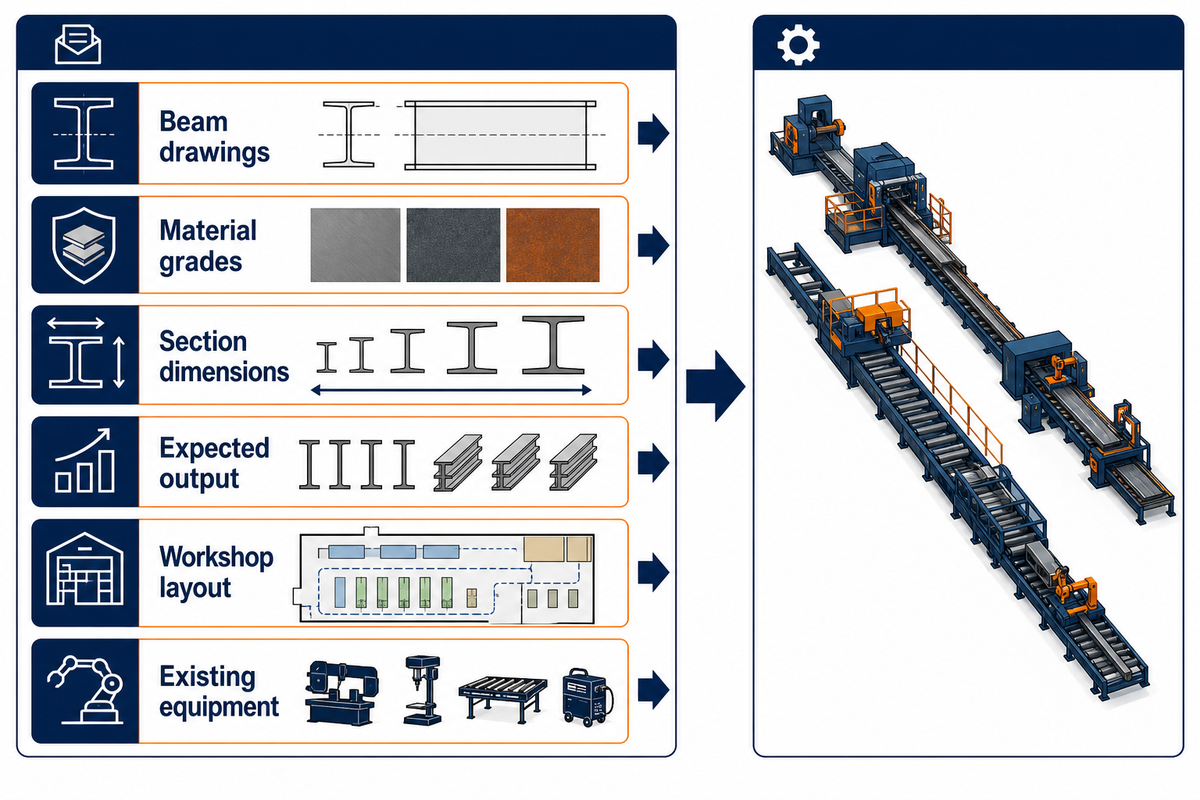
Choose the best fit for the beam mix you intend to produce. Different types of workshops, e.g. modular or horizontal welding, or more automated systems, require a different setup, even if their end products look the same. A helpful enquiry starts with drawings and material grades, then identifies the processes and means of handling associated with them.
For an Aubrik configuration discussion, send your beam drawings, minimum and maximum section dimensions, expected output, workshop layout and installation destination. Include any existing equipment you intend to keep. Those details allow the proposed assembly, welding and straightening stations to be matched to one workpiece schedule, with the remaining cutting and finishing scope stated clearly.
References & Sources
- ISO 3834-2:2021: Quality requirements for fusion welding of metallic materials, official catalog and scope.
Company capabilities, locations and histories are attributed to the official websites identified in each profile, reviewed October 2026. Equipment values apply to the named station or model.