Get in Touch with Aubrik Company

WORLDWIDE BUYER GUIDE · OCTOBER 2026
The best welding rotator manufacturers include Pemamek for integrated wind-tower lines, Key Plant for active drift control, and LJ Welding for heavy-vessel specifications. Aubrik covers multiple rotator architectures and custom loads. Compare the proposed drive-and-idler arrangement, usable traction and diameter range before comparing headline tonnage.
A powered roller bed rotates a cylindrical shell through friction at its wheels. So, contact geometry, the control package and load distribution become as important as the name on the machine. This report analyzes 20 companies that offer machines with powered roller beds. This report provides an explanation of the criteria used to ensure similarities in the companies’ quotations.
Quick picks by application
- Best for heavy cylindrical welding projects requiring multiple rotator architectures and custom load configurations: Aubrik.
- Best for wind-tower production lines: Pemamek.
- Best for active axial-drift control: Key Plant Automation.
- Best for heavy-vessel torque and traction specifications: LJ Welding Automation.
- Best for common welding-process and turning-roll controls: AMET.
- Best for compact 230-volt pipe turning: DUMETA.
How We Selected These Welding Rotator Manufacturers
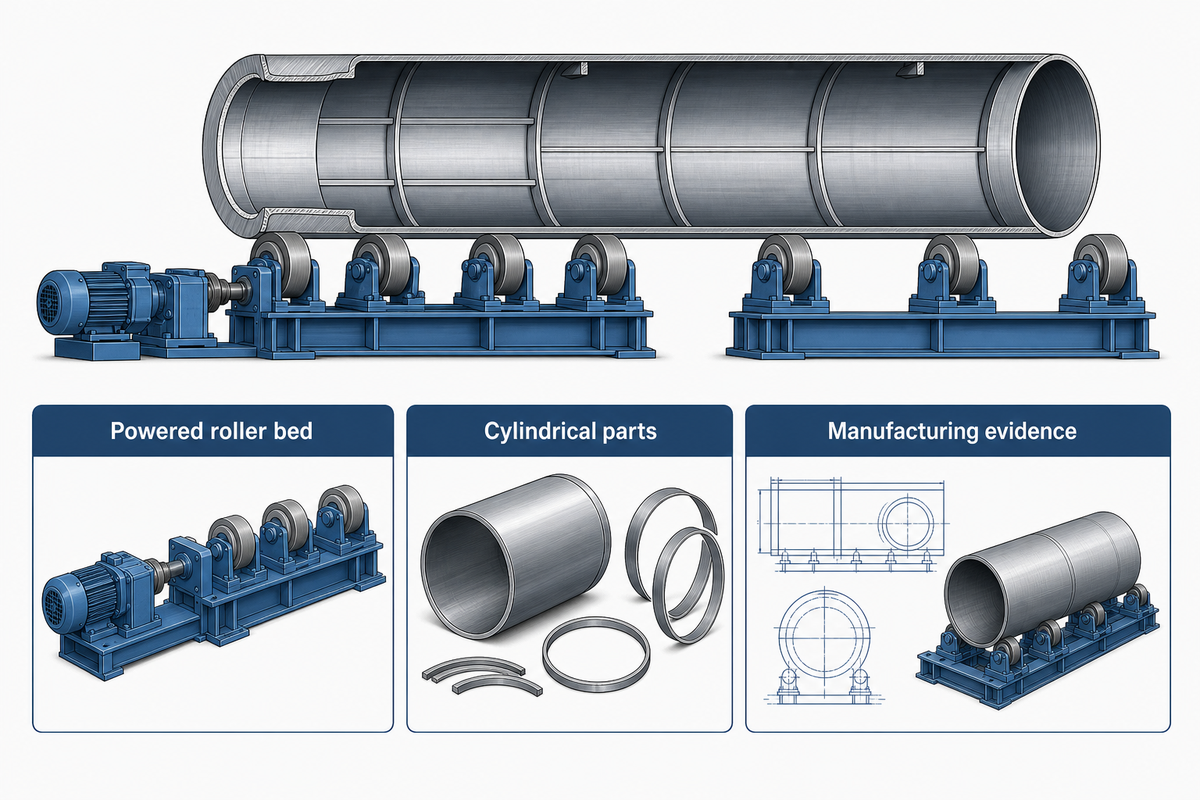
We reviewed 29 candidate companies and selected 20 companies offering powered roller bed machines for turning cylindrical parts. Those companies were located in North America, Asia, and Europe. Information was validated on the companies’ web sites and other government and business web sites. This information was collected in October 2026. Each company has an identifiable powered rotator, turning-roll or roller-bed product line and official evidence of designing, manufacturing or assembling this equipment.
Machines are evaluated based on load capacity, control of roller speed rather than lathe spindle speed, diameter range, wheel choice, and the architecture of the rollers. The evaluation also includes the type of roller adjustment (self-aligning or manual), as well as the service information offered by the manufacturer. The availability of these features varies between machines. Manufacturing transparency, custom engineering, available safety documentation, factory acceptance testing and service scope also matter when developing a shortlist. The list of companies doesn’t assign numerical scores for performance, after-sales support, or other features.
We excluded passive pipe stands, positioner-only suppliers, distributors, used-equipment dealers, rental-only companies, directories and marketplaces. Koike, Aronson and Ransome appear as one business; Kistler and Bode also share one entry. The year for Koike Aronson is 1985, when that entity was established, rather than the Japanese predecessor’s 1918 origin. An exact founding year is marked Not publicly disclosed where the reviewed company history gives only an approximate period.
Weld positioners may tilt a part mounted on a faceplate, chuck or fixture. Turntables are similar to weld positioners but are centered on table or faceplate rotation. A rotator differs from a weld positioner: it supports the cylindrical load on powered and idler rolls and uses wheel contact to rotate the workpiece. See our rotator versus positioner guide to learn more about these equipment differences. Just because a roller supports a pipe doesn’t mean it’s a powered rotator. Gripping a pipe doesn’t make a rotary welding positioner or pipe welding positioner a powered roller-bed rotator.
The equipment groups presented are intended to be guideposts and represent just a few of many possible applications. Several companies serve more than one equipment application, but each is included in one group here. What we mean by “best for” is that in the opinion of the editors, the equipment in question matches the stated application based on published product features. We make comparative assessments of published equipment features against work criteria; we also suggest how a potential customer should verify the proposed configuration.
20 Welding Rotator Manufacturers at a Glance
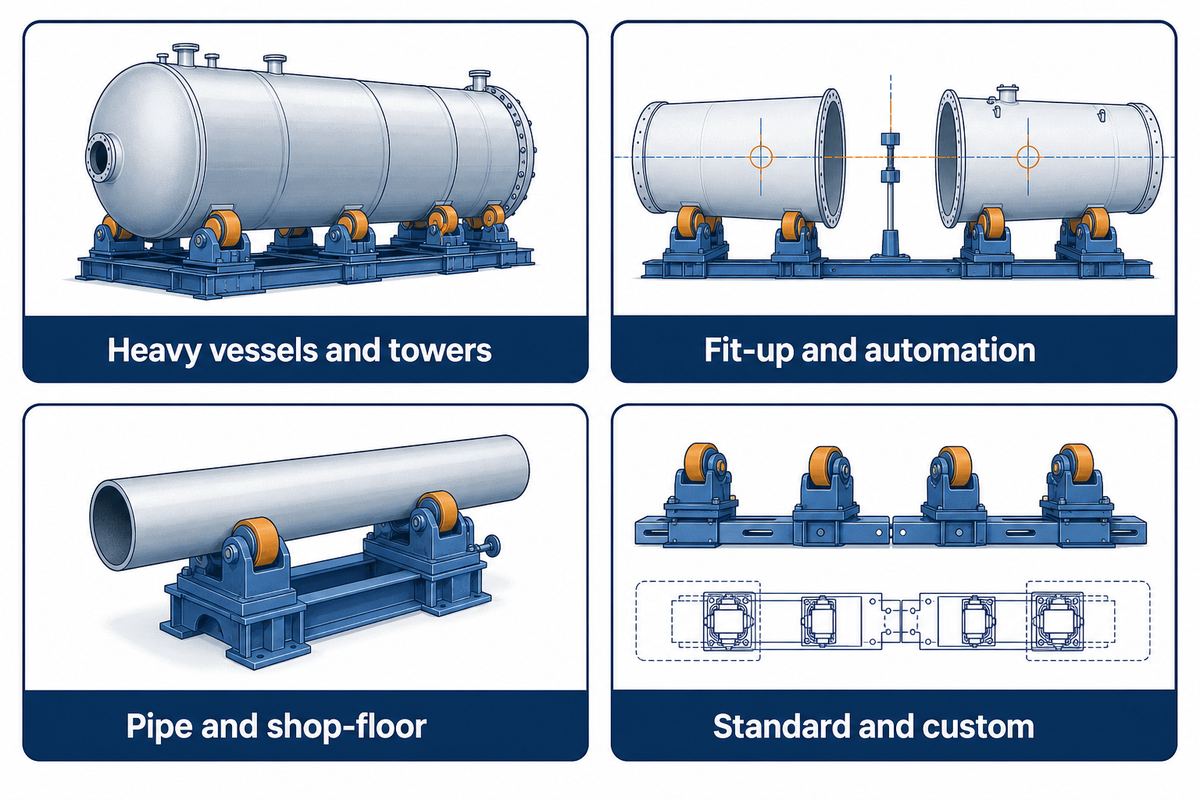
The information in this table provides possible choices. More detail about each choice, including limitations, is provided in the individual equipment group descriptions. Website addresses and product specifications refer to each company’s published information.
| No. | Company Name | Headquarters | Founded Year | Best For | Brief Introduction | Main Products | Key Advantages | Potential Disadvantages | Official Website |
|---|---|---|---|---|---|---|---|---|---|
| 1 | Aubrik | Wuxi, China | 1999 | Heavy cylindrical welding projects requiring multiple rotator architectures and custom load configurations | Welding automation equipment manufacturer | ZT self-aligning, adjustable, anti-drift, fit-up and pipe-pinching rotators | Several rotator architectures from one manufacturer | Upper-end capacities require custom engineering. | www.aubrikmc.com |
| 2 | Koike Aronson / Ransome | Arcade, New York, USA | 1985 | US-built vessel turning rolls with distinct traction and support ratings | Welding automation equipment manufacturer | Aronson, Ransome, MRD/MRI, pipe and powered fit-up rolls | Separate support and drive sizing guidance | Standard single-wheel drive and optional dual drive deliver different traction. | www.koike.com |
| 3 | Pandjiris | St. Louis, Missouri, USA | 1946 | US vessel shops needing constant-center rolls and mechanized welding integration | Welding automation equipment manufacturer | Piper, Tanker, Missouri Mule and torque-tube turning rolls | In-house fabrication through electrical assembly | Constant-center and torque-tube designs require different model selection. | www.pandjiris.com |
| 4 | LJ Welding Automation | Edmonton, Alberta, Canada | 1976 | Heavy vessel projects needing published torque and tractive-effort specifications | Welding automation equipment manufacturer | Fixed-height and adjustable vessel rolls, pipe rolls and growing lines | Published load, torque and traction data | Fixed-height beds need separate provision for shell fit-up. | www.ljwelding.com |
| 5 | Pemamek | Loimaa, Finland | 1970 | Wind-tower and offshore-fabrication lines requiring integrated roller-bed automation | Welding automation equipment manufacturer | PEMA N conventional, A self-aligning and X pipe roller beds | Distinct heavy-vessel, self-aligning and pipe families | Conventional N-series diameter changes require manual adjustment. | www.pemamek.com |
| 6 | Irizar Heavy Industries | Edmonton, Alberta, Canada | 1999 | Canadian heavy-fabrication shops combining turning rolls with fit-up equipment | Welding automation equipment manufacturer | Conventional, self-aligning, anti-drift, track and fit-up rotators | Published per-bed load limits and Canadian factory | Rental service is limited to Canada and the USA. | www.jirizar.com |
| 7 | Preston Eastin | Tulsa, Oklahoma, USA | 1972 | Vessel cells needing constant centerline or powered height adjustment | Designer and manufacturer of robotic and welding positioning equipment | Standard, constant-centerline and power-elevating turning rolls | Constant-centerline and powered-elevation arrangements | Elevating arrangements may require custom support bases. | www.prestoneastin.com |
| 8 | Key Plant Automation | Leek, Staffordshire, United Kingdom | 1956 | Long-seam vessel welding requiring active axial-drift control | Welding automation equipment manufacturer | Conventional, self-aligning, anti-drift and pipe rotators | Sensor-controlled correction for axial drift | Anti-drift equipment adds sensors and controlled wheel-carriage hardware. | www.keyplant.com |
| 9 | IRCO Automation | Burlington, Ontario, Canada | 1963 | Large-diameter vessel assembly with constant-centerline turning and powered travel | Welding automation equipment manufacturer | Self-aligning turners, conventional turning rolls and integrated welding systems | Constant-centerline support with integrated travel | Axial powered travel and fit-up integration extend the equipment scope. | www.ircoautomation.com |
| 10 | Carpano Equipment | Bologna, Italy | 1992 | Shops combining compact pipe rotators with self-aligning and anti-drift options | Welding automation equipment manufacturer | OBY, R025, RB self-aligning, anti-drift and heavy-duty rotators | Compact and heavy-duty roller-bed choices | Heavy-duty and compact models have different adjustment and control packages. | www.carpano.it |
| 11 | DEUMA | Netphen, Germany | Not publicly disclosed | Large-diameter shells requiring individually driven rollers and travelling beds | Welding automation equipment manufacturer | H, RS, Z and travelling HF/ZF/RF turning-roll systems | Individual roller drives and rail-mounted versions | Travelling carriages and anti-creep units are separate arrangements. | www.deuma.co |
| 12 | AMET | Rexburg, Idaho, USA | 1989 | Integrated welding cells requiring common process and turning-roll controls | Welding automation equipment manufacturer | Turning rolls, fit-up fixtures, column-and-boom and automated welding systems | In-house motion and welding control integration | Integrated controls require cell-level specification and commissioning. | www.ametinc.com |
| 13 | Kistler / Bode | Bad Saulgau, Germany | 1966 | Compact cylindrical workpieces needing two driven contact wheels | Welding automation equipment manufacturer | BRS, RS, BR, CR and SAR turning rolls | Double-driven contact wheels in compact series | BRS ratings apply to one drive and one idler. | www.kistler-machine.com |
| 14 | DUMETA | Oldenzaal, Netherlands | Not publicly disclosed | Small pipe and vessel work requiring compact 230-volt turning rolls | Welding automation equipment manufacturer | D-DWR compact rotators and larger conventional/self-aligning roller beds | Compact single-phase powered roller sets | D-DWR roller spacing is manually adjusted. | www.en.dumeta.nl |
| 15 | ProArc / United ProArc | Taoyuan, Taiwan | 1966 | Shops comparing clearly specified light-to-medium turning-roll models | Welding automation equipment manufacturer | TR conventional and TRA self-aligning turning rolls | Model-by-model load, diameter and wheel tables | Wheel material and speed range vary by TR model. | www.proarc.com.tw |
| 16 | Amin Machinery | Vitthal Udyognagar, Gujarat, India | 1972 | Very heavy vessel fabrication requiring conventional and traversing rotator engineering | Welding automation equipment manufacturer | Conventional, self-aligning, traversing and fit-up welding rotators | Documented very-heavy rotator project | Upper-capacity systems are project-specific equipment. | www.rotator.co.in |
| 17 | APS Welding | Mumbai, India | 2003 | Indian fabrication shops sourcing standard rotators with welding power sources | Welding automation equipment manufacturer | ORBITER conventional bolt-adjust and lead-screw welding rotators | Rotators and welding power sources from one supplier | Standard ORBITER range ends at 40 metric tonnes. | www.apswelding.com |
| 18 | Mogra Engineering | Pune, Maharashtra, India | 1998 | Vessel shops needing lead-screw adjustment and synchronized multi-drive options | Welding automation equipment manufacturer | Rudra WRC conventional, WRL lead-screw and WRS self-aligning rotators | Lead-screw models with optional multi-drive synchronization | Synchronization and motorized bogies are optional packages. | www.mograengg.com |
| 19 | SENLISWELD | Wuxi, China | 1999 | Export vessel projects comparing standard and custom conventional rotators | Welding automation equipment manufacturer | Conventional, self-aligning, pipe, fit-up and anti-drift rotators | Broad conventional range with model-specific examples | Conventional models require manual roller-spacing adjustment. | www.senlisweld.com |
| 20 | RESIZE / Wuxi Yuanpeng | Wuxi, China | 2003 | Shops specifying self-aligning roller sets by capacity and wheel material | Welding automation equipment manufacturer | HGZ self-aligning, adjustable and special custom welding rotators | Named 5T-to-200T self-aligning model range | Rubber and polyurethane variants must be selected by model. | www.resizeglobal.com |
Heavy-Vessel and Wind-Tower Rotator Manufacturers
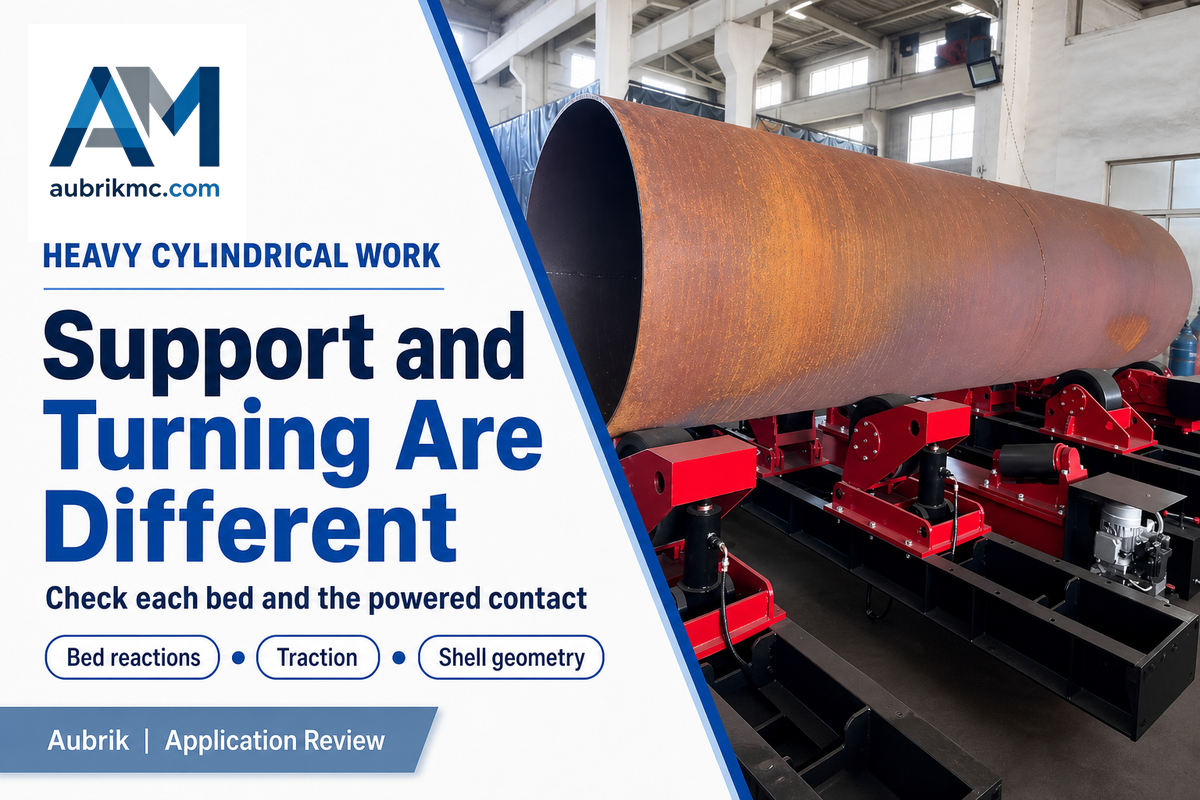
Some bed capacities are quite large and rotating capability depends on the supports and turning effort. Heavy loads may require several beds; in these cases, support ratings can’t simply be added to determine the turning capability of the complete arrangement.
1. Aubrik: Best for Heavy Cylindrical Welding Projects Requiring Multiple Rotator Architectures and Custom Load Configurations
Aubrik, the brand of Wuxi ABK Machinery Co., Ltd., designs and manufactures welding equipment in Wuxi, China, with a company history dating to 1999. Its welding rotators and turning rolls include self-aligning, adjustable, pipe-pinching, fit-up and application-specific systems for pipes, tanks, pressure vessels and tower sections. Aubrik publishes an overall standard-and-custom range of 1–1,000 tonnes, while its ZT self-aligning series covers 6–50 tonnes and the 200–1,000-tonne upper end depends on engineered custom configurations. Inverter speed control, powered/idler arrangements, PU wheel options and remote or PLC control vary by family, so the broad portfolio suits projects that need an architecture decision before a model quotation. The limitation is that this combined envelope doesn’t establish usable traction, diameter compatibility or a standard delivery configuration for every load.
Headquarters: Wuxi, China · Founded: 1999
Best for: Heavy cylindrical welding projects requiring multiple rotator architectures and custom load configurations
Potential disadvantage: Custom heavy systems require model-specific load and tractive-effort calculations.
2. Koike Aronson / Ransome: Best for Separate Support and Turning Ratings
Koike Aronson manufactures positioning equipment in Arcade, New York, and combines the Aronson and Ransome names within one business rather than three independent suppliers. Its Ransome turning-roll families offer rubber or steel wheels, variable-speed drives with a published 50:1 range, brake motors and low-voltage pendant controls for vessel fabrication. Koike’s sizing guidance distinguishes the weight carried by a drive bed from the total workpiece it can turn with suitable idlers, using traction and roller geometry as part of the selection. That approach helps a buyer compare a complete handling arrangement instead of assuming a single “ton” figure means the same thing on every quotation. Single-wheel drive and optional dual-drive arrangements have different traction characteristics, so wheel contact and drive selection remain material limitations.
Headquarters: Arcade, New York, USA · Founded: 1985, current Koike Aronson entity
Best for: US-built vessel turning rolls with distinct traction and support ratings
Potential disadvantage: Drive options change usable traction and must match the load arrangement.
3. Pandjiris: Best for Constant-Center Rolls for Vessel Shops
Pandjiris has manufactured welding-positioning equipment in St. Louis, Missouri, since 1946, with fabrication, machining, assembly and electrical work described as in-house activities. Its turning-roll offer includes Piper, Tanker and Missouri Mule models alongside constant-center and torque-tube arrangements for mechanized welding. The MM-60/30T publishes 120,000 lb of turning capacity, 60,000 lb of support per unit and a workpiece diameter envelope from 12 inches to 16 feet, making the rating basis more useful than an unlabeled tonnage claim. Constant-center arrangements suit cells where changing shell diameter shouldn’t require the same degree of welding-head repositioning, while the company’s broader welding equipment can support an integrated installation. The buyer still has to select between mechanically different roll families; a constant-center machine and a torque-tube design aren’t interchangeable arrangements.
Headquarters: St. Louis, Missouri, USA · Founded: 1946
Best for: US vessel shops needing constant-center rolls and mechanized welding integration
Potential disadvantage: Constant-center and torque-tube designs require different model selection.
4. LJ Welding Automation: Best for Published Heavy-Vessel Drive Data
LJ Welding Automation, based in Edmonton, Alberta, traces its business to 1976 and manufactures handling and welding automation equipment for large fabrication work. Its fixed-height 120T-500/600 vessel-roll pair publishes 120,000 lb of support on each powered and idler bed, with a combined 240,000-lb rating corresponding to 120 US short tons. The same specification identifies 20,400 lb of tractive effort, 240,000 in-lb of torque, an 18–312-inch diameter range and 5–70 in/min surface speed, providing several useful inputs for an engineering comparison. Pendant, foot-control and wireless options address different operating layouts, and the explicit torque and traction information makes LJ relevant when the starting and rotating behavior of a heavy vessel is central to the purchase. Its fixed-height arrangement doesn’t itself provide hydraulic shell fit-up, and the US-short-ton rating must not be silently converted into metric tonnes.
Headquarters: Edmonton, Alberta, Canada · Founded: 1976
Best for: Heavy vessel projects needing published torque and tractive-effort specifications
Potential disadvantage: Fixed-height beds need separate provision for shell fit-up.
5. Pemamek: Best for Roller Beds Within Wind-Tower Production
Pemamek, founded in 1970 in Loimaa, Finland, manufactures PEMA welding and production systems for industries including wind towers, offshore structures and heavy fabrication. Its published roller-bed families differ substantially: conventional N models span 12–1,600 tonnes, self-aligning A models 12–800 tonnes and X pipe models 5–16 tonnes. This range sits within a broader production offer that combines workpiece handling, growing-line operations and welding automation, which suits buyers planning the movement of tower sections through several manufacturing stages. For a wind-tower welding line, the relevant comparison is therefore the coordinated process and handling scope as well as the roller-bed rating. N-series diameter adjustment is manual, so a buyer with frequent diameter changes should compare setup requirements against a self-aligning or alternative configured system.
Headquarters: Loimaa, Finland · Founded: 1970
Best for: Wind-tower and offshore-fabrication lines requiring integrated roller-bed automation
Potential disadvantage: Conventional N-series diameter changes require manual adjustment.
6. Irizar Heavy Industries: Best for Canadian Vessel Handling and Fit-Up
Irizar Heavy Industries has an Edmonton base and an Alberta factory and warehouse in the County of Wetaskiwin, with its business history stated as beginning in 1999. Its welding-roller offer covers conventional, self-aligning, anti-drift and fit-up equipment, including track arrangements for moving large assemblies. The WR-20 illustrates the rating distinction clearly: 20 metric tonnes of rotation capacity, 10 metric tonnes of support per drive or idler bed, diameters of 250–4,800 mm and surface speeds of 100–1,000 mm/min. Motorized rotation and remote control make this a powered turning system rather than a passive pipe support, and the wider fit-up range is relevant to Canadian shops joining heavy shells. Irizar’s rental service is limited to Canada and the USA, so a purchase outside those markets shouldn’t assume the same rental-backed support arrangement.
Headquarters: Edmonton, Alberta, Canada · Founded: 1999
Best for: Canadian heavy-fabrication shops combining turning rolls with fit-up equipment
Potential disadvantage: Rental service is limited to Canada and the USA.
7. Preston Eastin: Best for Constant Centerline and Powered Elevation
Preston Eastin designs and manufactures positioning equipment in Tulsa, Oklahoma, and was founded in 1972. Its turning rolls cover standard, constant-centerline and power-elevating arrangements, with rubber tires, worm gearing and remote pendants among the published features. The TDRA-30 drive bed has a 30,000-lb support rating, while the manufacturer’s example with two TIRA-30 idlers handles a 90,000-lb workpiece over an 8–240-inch diameter range. Constant-centerline equipment helps maintain the relative welding-tip position during diameter changes, and powered elevation is useful when the production cell needs controlled changes in support height. Elevating systems may need custom bases, so their support structure and movement envelope form part of the machine selection.
Headquarters: Tulsa, Oklahoma, USA · Founded: 1972
Best for: Vessel cells needing constant centerline or powered height adjustment
Potential disadvantage: Elevating arrangements may require custom support bases.
Fit-Up, Anti-Drift and Automation Specialists
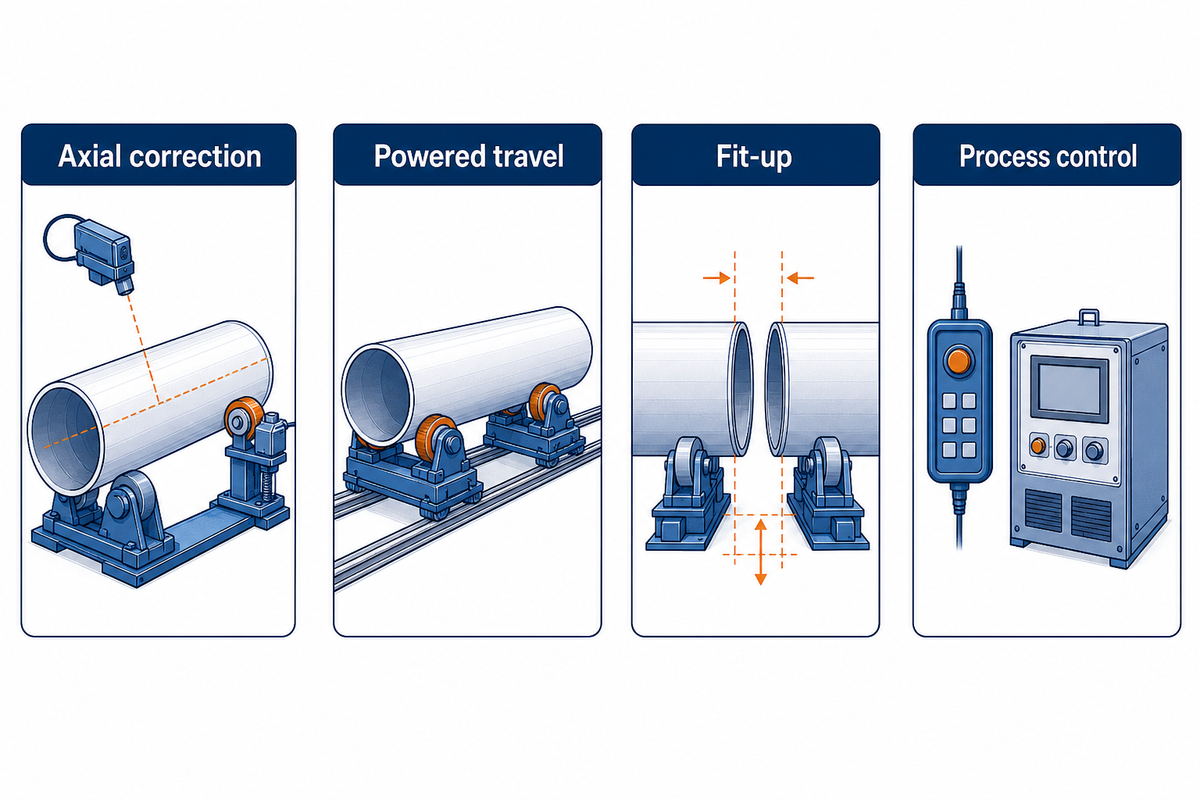
This category is for situations in which the control of position is of equal or greater importance than the control of rotation. Active correction of axial movement, powered movement, fitting up, and process control are separate issues and should be reflected in a quotation as such.
8. Key Plant Automation: Best for Active Axial-Drift Control
Key Plant Automation is a UK manufacturer based in Leek, Staffordshire, with a company history dating to 1956 and in-house production extending from fabrication to commissioning. Its anti-drift rotators sense the vessel edge and correct the roller-carriage position, with the company publishing approximately ±1 mm workpiece control for the described ADR system. This is active correction for applications such as narrow-gap seams, weld overlay and long preheating cycles, rather than a claim that self-aligning wheels alone prevent axial movement. The published system also includes excess-drift detection and a delayed stop, giving buyers concrete control functions to discuss when specifying continuous vessel rotation. Sensors and steerable carriage hardware add equipment to the installation, and the stated control figure belongs to this system and its operating conditions rather than every Key Plant rotator.
Headquarters: Leek, Staffordshire, United Kingdom · Founded: 1956
Best for: Long-seam vessel welding requiring active axial-drift control
Potential disadvantage: Anti-drift equipment adds sensors and controlled wheel-carriage hardware.
9. IRCO Automation: Best for Large Diameters and Powered Travel
IRCO Automation, founded in 1963 and based in Burlington, Ontario, designs and manufactures welding automation and workpiece-handling systems. Its self-aligning turners combine an adjustable, constant centerline with a published workpiece diameter capability up to 20 feet. The company describes these rolls within axial powered-travel and material fit-up systems, which makes them relevant to vessel assembly where the shell must move into position as well as rotate. Its roller-contact approach is also relevant to thin-wall work, although the actual shell pressure and wheel arrangement still depend on the proposed application. Powered travel and fit-up integration extend the equipment scope beyond a standalone drive/idler pair, bringing additional layout and control decisions.
Headquarters: Burlington, Ontario, Canada · Founded: 1963
Best for: Large-diameter vessel assembly with constant-centerline turning and powered travel
Potential disadvantage: Axial powered travel and fit-up integration extend the equipment scope.
10. Carpano Equipment: Best for Compact Rolls and Anti-Drift Options
Carpano Equipment is based in Bologna, Italy, and began operating in 1992, designing and building welding automation equipment. Its current rotator catalog includes compact OBY models, the R025 pipe fitter, RB self-aligning and fit-up equipment, and heavy-duty roller sets with published ratings from 12.5 to 460 T/set. Carpano distinguishes simple axial restraints from an active anti-drift arrangement that steers an idler through hydraulic adjustment, with tactile, inductive or laser sensing among the described choices. That gives a shop a route from smaller pipe handling to more controlled vessel rotation without treating every catalog item as the same machine. Compact, heavy-duty and anti-drift packages have different adjustment and control scopes, so one family’s published feature list can’t be applied to all the others.
Headquarters: Bologna, Italy · Founded: 1992
Best for: Shops combining compact pipe rotators with self-aligning and anti-drift options
Potential disadvantage: Heavy-duty and compact models have different adjustment and control packages.
11. DEUMA: Best for Large Shells and Individually Driven Rollers
DEUMA manufactures metalworking machinery in Netphen, Germany, and describes a history of more than five decades without publishing an exact founding year on the reviewed company page. Its turning-roll portfolio includes stationary RS, smaller H, self-aligning Z and travelling arrangements, with a company-wide published envelope extending from 1 to 1,200 tons. The RS design is described for loads up to 500 tons and diameters up to 12 metres, using individual DC roller drives and a 50–2,500 mm/min speed range. Those model details make DEUMA relevant to large shell handling where drive arrangement, diameter and rail movement require separate engineering decisions. Travelling carriages, multi-drive arrangements and anti-creep equipment are configuration choices, so the headline portfolio doesn’t establish that each option is standard.
Headquarters: Netphen, Germany · Founded: Not publicly disclosed
Best for: Large-diameter shells requiring individually driven rollers and travelling beds
Potential disadvantage: Travelling carriages and anti-creep units are separate arrangements.
12. AMET: Best for Turning Rolls Under Shared Process Controls
AMET, founded in 1989 in Rexburg, Idaho, manufactures automated welding systems and develops its own control hardware and software. Its column-and-boom systems page lists turning rolls from 2.5 to 150 tons, capable of independent operation or integration with XM/XPro controls, while its construction-industry material expressly identifies manufactured turning-roll fixtures. This makes AMET a candidate for a cell in which rotation, welding parameters and manipulator operation need a common control approach rather than several unrelated operator panels. The practical buying discussion is the required interface, recipe control and coordinated operating sequence, not simply the largest roll available. Integration requires cell-level specification and commissioning, so it brings a different project scope from buying a standalone pair of rolls.
Headquarters: Rexburg, Idaho, USA · Founded: 1989
Best for: Integrated welding cells requiring common process and turning-roll controls
Potential disadvantage: Integrated controls require cell-level specification and commissioning.
Pipe and Shop-Floor Rotator Specialists
Small pipes and tight clearances demand that equipment be evaluated as closely as that for large vessels. The selection of a turning-roll set for a pipe job may depend on minimum diameter, low-speed control, local power-supply compatibility and the type of wheels.
13. Kistler / Bode: Best for Compact Double-Drive Turning Rolls
Kistler, based in Bad Saulgau, Germany, dates its history to 1966 and presents Bode within its welding-positioning business, so the two names are counted once here. Alongside other rotator families, its BRS range powers both contact wheels on the drive unit and offers a compact drive/idler arrangement for cylindrical workpieces. The BRS1000 is rated at 1,000 kg for 70–1,500 mm diameters, the BRS2000 at 2,000 kg for 80–2,500 mm, and the BRS5000 at 5,000 kg for 200–3,000 mm. Double-drive contact is a useful feature to compare for pipe and small vessel work, while the diameter progression shows why a larger capacity model isn’t automatically better for a very small shell. These capacities apply to a set with one drive and one idler, and they don’t establish unlimited support or traction after extra beds are added.
Headquarters: Bad Saulgau, Germany · Founded: 1966
Best for: Compact cylindrical workpieces needing two driven contact wheels
Potential disadvantage: BRS ratings apply to one drive and one idler.
14. DUMETA: Best for Compact 230-Volt Pipe Rotation
DUMETA, headquartered in Oldenzaal, Netherlands, describes its own engineering and machine manufacturing, with roots in an early-1990s workshop rather than a precisely disclosed founding year. The D-DWR-1 and D-DWR-3 powered rotators have 1,000-kg and 3,000-kg rotational ratings, while support on each bed is respectively 500 kg and 1,500 kg. Published diameter ranges are 20–800 mm and 20–1,500 mm, with 100–1,000 mm/min surface speed and a 230-volt supply for this compact family. Those details make the D-DWR models useful candidates for smaller pipe and vessel work in a machine shop, without confusing them with DUMETA’s separate passive support rollers. Roller spacing is manually adjusted, so frequent changes between different diameters remain part of the operator’s setup workload.
Company base: Oldenzaal, Netherlands · Founded: Not publicly disclosed
Best for: Small pipe and vessel work requiring compact 230-volt turning rolls
Potential disadvantage: D-DWR roller spacing is manually adjusted.
15. ProArc / United ProArc: Best for Model-Level Pipe-Roll Comparison
United ProArc, based in Taoyuan, Taiwan, was established in 1966 and manufactures welding automation equipment that includes a dedicated TR turning-roll line. The TR specifications identify capacities from 1,000 to 60,000 kg for one drive plus one idler, while the TR0103/0104 models publish 20–800 mm diameters and 80–1,600 mm/min surface speed. Smaller PU-wheel models and larger alternatives have different roller materials and operating envelopes, allowing buyers to compare a named configuration instead of relying on a broad category claim. The clear model tables suit shops narrowing a light-to-medium pipe or vessel requirement before requesting customized controls or integration. Wheel material and speed range change across the line, so the small-model figures can’t describe every TR machine.
Company base: Taoyuan, Taiwan · Founded: 1966
Best for: Shops comparing clearly specified light-to-medium turning-roll models
Potential disadvantage: Wheel material and speed range vary by TR model.
Standard and Custom Rotator Manufacturers
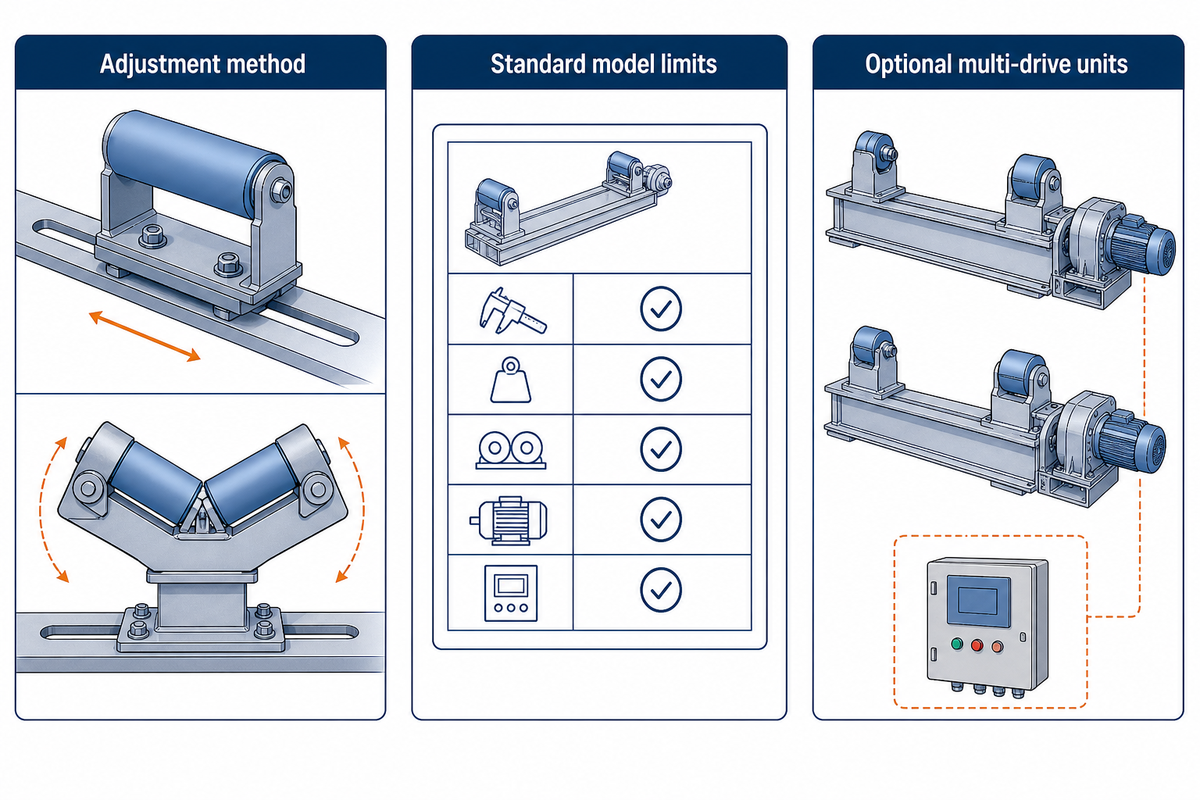
The manufacturers in this category cover conventional and self-aligning rotary units, including engineered custom systems. Although the products of various manufacturers are similar, differences may exist in the method of adjustment, standard model limits, and optional multi-drive units.
16. Amin Machinery: Best for Very Heavy Conventional Rotator Projects
Amin Machinery, established in 1972 in Vitthal Udyognagar, Gujarat, designs and manufactures welding automation equipment for vessel and heavy industrial fabrication. The company publishes conventional rotator ranges of 1–2,000 T and self-aligning ranges of 3–500 T, and shows a 1,600-MT rotator project supplied to Italy. Its offer includes conventional and traversing arrangements, making it relevant when the load class and movement requirements extend beyond a small catalog set. The project example supports experience with very heavy equipment, but it doesn’t establish stock availability, identical controls or the same geometry envelope at every point in the stated range. Upper-capacity systems should therefore be compared as engineered projects with a defined wheel, drive, travel and control scope.
Headquarters: Vitthal Udyognagar, Gujarat, India · Founded: 1972
Best for: Very heavy vessel fabrication requiring conventional and traversing rotator engineering
Potential disadvantage: Upper-capacity systems are project-specific equipment.
17. APS Welding: Best for Standard Rotators Alongside Welding Equipment
APS Welding has its registered office in Mumbai and a manufacturing facility in Valsad, Gujarat; it began as a proprietary business in 2003 before becoming a limited company in 2012. Its ORBITER rotators cover standard 5–40-metric-tonne models with PU rollers, variable-frequency speed control and a digital pendant. The published 5T model handles 250–2,500 mm diameters, the 10T reaches 3,700 mm, and larger listed models reach 4,800 mm, with bolt or screw adjustment according to the selected configuration. APS also supplies welding power sources, which makes the company relevant to Indian fabrication shops comparing the rotation equipment and welding process package together. The standard ORBITER range ends at 40 metric tonnes, so a heavier requirement needs a separate proposal rather than extrapolation from that table.
Headquarters: Mumbai, India · Founded: 2003
Best for: Indian fabrication shops sourcing standard rotators with welding power sources
Potential disadvantage: Standard ORBITER range ends at 40 metric tonnes.
18. Mogra Engineering: Best for Adjustable Rolls and Multi-Drive Options
Mogra Engineering is based in Pune, India, and took its current name in 1998 after an earlier VNK business established in 1989. Its Rudra welding rotators use dual-drive construction, spur gearing, variable-frequency surface-speed control and a pendant, with conventional, lead-screw and self-aligning arrangements in the offer. The company’s product material separates core rotation features from options such as motorized bogies, wheel materials and synchronization of two or more drive units, while its own WRL-100 catalog specifies 100 tonnes rotation, 50 tonnes load carrying capacity and 400–5,000 mm workpiece diameters. That distinction makes Mogra relevant to vessel shops that need to adjust support spacing or coordinate multiple powered beds instead of merely adding passive idlers. Synchronization and bogie movement are optional packages, so they need to be included explicitly when comparing quotations.
Headquarters: Pune, Maharashtra, India · Founded: 1998, current Mogra business
Best for: Vessel shops needing lead-screw adjustment and synchronized multi-drive options
Potential disadvantage: Synchronization and motorized bogies are optional packages.
19. SENLISWELD: Best for Conventional Rotators Across Several Load Classes
SENLISWELD is based in Wuxi, China, and describes its technical and production business as operating since 1999. Its conventional welding rotators page publishes a 2–500-tonne range and illustrates discrete models including 2T, 5T, 20T, 60T, 100T and 200T equipment. Powered and idler beds, adjustable rotation speed, wheel options and remote or foot controls are described across the product offer, with the final combination depending on the chosen model. The range is relevant to export vessel projects comparing conventional equipment at several capacities, especially when a standard starting model will be adapted to a known shell. Conventional roller spacing requires manual adjustment, so a shop with frequent diameter changes should compare the setup method against a self-aligning design.
Headquarters: Wuxi, China · Founded: 1999
Best for: Export vessel projects comparing standard and custom conventional rotators
Potential disadvantage: Conventional models require manual roller-spacing adjustment.
20. RESIZE / Wuxi Yuanpeng: Best for Self-Aligning Sets and Wheel Choices
RESIZE is the equipment brand associated with Wuxi Yuanpeng Machinery, a Chinese manufacturer that states it was founded in 2003 and produces welding centers, turning rollers and positioning equipment. Its self-aligning catalog lists HGZ-5 through HGZ-200 models, covering 5T to 200T, with rubber and polyurethane versions identified for selected machines. The published driven-roller arrangements and family-specific wheel choices make it a candidate for buyers comparing self-aligning sets for tank and cylindrical-shell fabrication. A model-by-model review is particularly useful here because wheel material affects the intended contact conditions, and a shared HGZ family label doesn’t guarantee identical drives or controls. Rubber and PU variants must be selected deliberately rather than treated as interchangeable specifications.
Headquarters: Wuxi, China · Founded: 2003
Best for: Shops specifying self-aligning roller sets by capacity and wheel material
Potential disadvantage: Rubber and polyurethane variants must be selected by model.
How to Choose a Welding Rotator Manufacturer
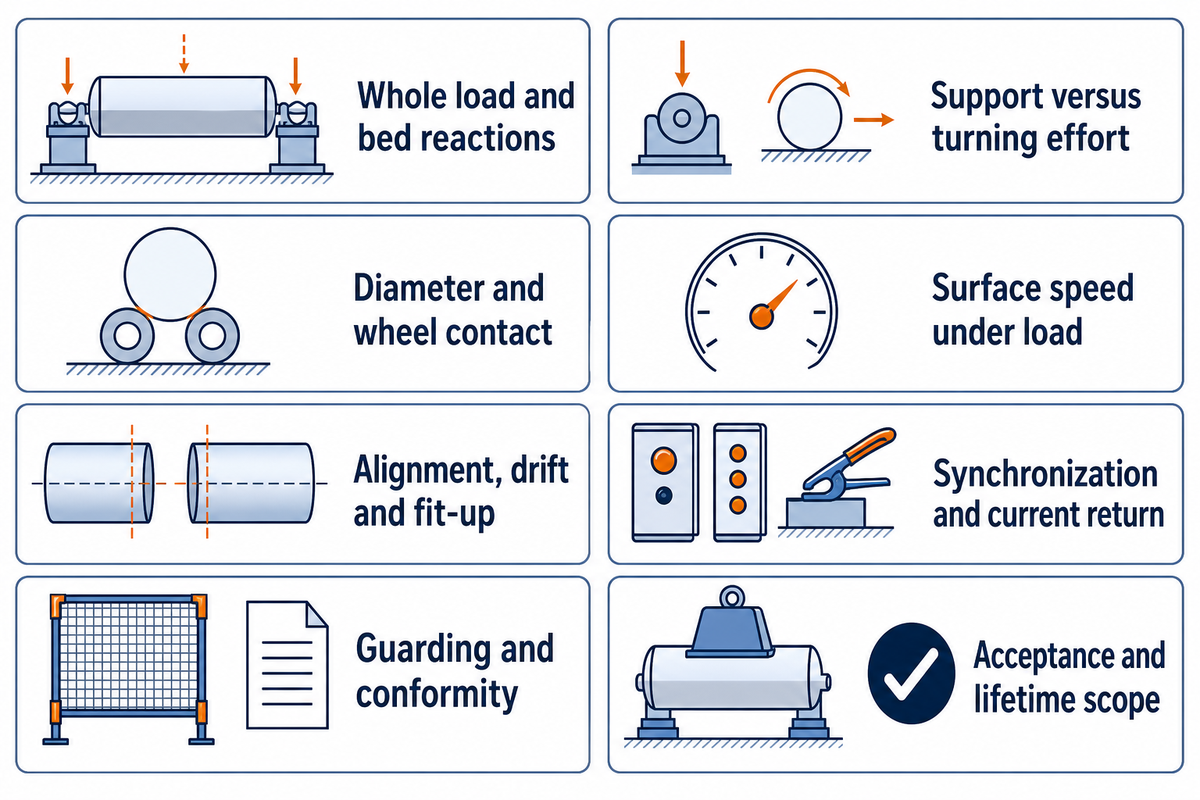
Industrial welding rotator manufacturers should specify equipment for the job in question. A high load rating is only one input. Give shortlisted suppliers the same drawings and operating requirements, then use these eight checks to compare their responses. Choose the equipment manufacturer by whether the proposed equipment can support, start, rotate and stop the actual cylindrical workpiece under the required welding conditions.
Choosing the right welding rotator starts with the specific needs of the welding production cell. Use the same description of welding operations for every bidder: who loads the work, how welding operators perform welding, and which pieces of equipment share the operating space. A quotation should explain how it will accommodate different products. This helps you find the right equipment without treating a supplier’s entire catalog as the proposed solution.
Quick Specs to Send With an RFQ
- Maximum finished mass, fixture mass and temporary attachments.
- Minimum and maximum diameter, shell length, wall thickness and center of gravity.
- Support positions, surface condition, material and anticipated contact temperature.
- Weld travel speed, process, current, operating duty and shop power supply.
- Required fit-up, travel, anti-drift and control interfaces.
1. Define the whole load and calculate each bed’s reaction
Consider the case where the workpiece is supported and other accessories are added. Include internal components, fixtures, temporary attachments and any accessories supported by the rolls. State whether the quoted tonnage means the net workpiece or the complete supported assembly. State the weight of the workpiece in its heaviest manufacturing condition, which may differ from the condition in which it would be shipped.
Equal one-third load distribution on the three beds supporting a vessel on one drive and two idlers is a common misconception. The location of the center of gravity, spacing of the supports, flexibility of the shell and internal fittings, and the equipment carried affect the support reactions. A load distribution calculation, prepared for the positions of the supports of interest, should be requested. The sum of the nameplate data, in and of itself, will not establish permissible load distribution. The pipe rotator capacity and type selector supports preliminary pipe rotator selection and can’t be used to replace an engineering load-distribution analysis.
Published ratings are different from each other. A quotation labeled “2 tons” or “5 tons” still needs a unit definition: US short tons and metric tonnes are different units. The examples demonstrate that the unit and the arrangement must be considered with the capacity. The examples come from published catalogs, and aren’t substitutes for one another.
Load capacities need a defined arrangement. For large and heavy cylindrical vessels, identify which drive beds and idler units carry the heavy workpieces at each manufacturing stage. Rotators are designed around particular support and drive assumptions; different sizes of shell can change those assumptions. Do not treat a headline capacity as permission to rotate large vessels with any spacing or any number of supports.
| Manufacturer / model | Published load basis | Diameter or speed example |
|---|---|---|
| Aubrik ZT family | 6–50 metric tonnes, family range | Use the selected ZT model’s diameter envelope |
| Pandjiris MM-60/30T | 60,000 lb support per unit; 120,000 lb turning | 12 in–16 ft diameter |
| LJ 120T-500/600 | 120,000 lb per bed; 240,000 lb combined | 18–312 in diameter; 5–70 in/min |
| Irizar WR-20 | 10 metric tonnes per bed; 20 metric tonnes rotation | 250–4,800 mm diameter |
| Preston Eastin TDRA-30 | 30,000 lb bed support; 90,000 lb with two specified idlers | 8–240 in diameter |
| Kistler BRS1000 | 1,000 kg, one drive and one idler | 70–1,500 mm diameter |
| DUMETA D-DWR-1 | 500 kg per bed; 1,000 kg rotation | 20–800 mm diameter; 100–1,000 mm/min |
| ProArc TR0103/0104 | 1,000 kg, one drive and one idler | 20–800 mm diameter; 80–1,600 mm/min |
| APS ORBITER 5T | 5 metric tonnes, listed standard model | 250–2,500 mm diameter; 100–1,500 mm/min |
Engineering note: Keep the bed-support rating and the complete turning arrangement on separate lines of the purchase specification. The catalog examples above illustrate why the same headline tonnage can describe different equipment.
2. Separate support capacity from usable turning effort
A drive roll must be able to control the load that it supports. This depends on motor power, gear ratio, available traction, wheel surfaces, contact angle, eccentricity and acceleration. A drive roll may lose traction if the load is supported on an uneven surface. It may also lose traction due to mill scale, paint or other surface deposits.
Request support and drive/traction calculations. Koike explicitly separates the two cases in published examples. Increasing supported weight with idlers doesn’t automatically increase the grip of the powered bed; check the actual load on the driven wheels. Request the supplier’s assessment of how support loading and center-of-gravity changes affect wheel contact. Insufficient wheel contact can’t be corrected by using larger motors.
Do
- Identify the load supported by every bed.
- Check available traction at the powered wheels.
- Agree loaded start, stop and speed tests.
Don’t
- Add bed ratings without a support calculation.
- Assume a higher motor rating prevents slip.
- Accept an unloaded demonstration as a load test.
3. Check diameter, shell contact and wheel material together
When determining the load/contact conditions of the supported workpiece, its maximum size (e.g. the largest shell diameter) isn’t sufficient. The smallest diameter of the supported load affects contact conditions. Self-aligning roller angles change as the diameter changes; conventional machines may need bolt, screw or hydraulic repositioning. The supplier must be provided the length, wall thickness and roundness of the supported shell to determine local pressure and contact conditions.
Contact conditions and shell thickness may cause a supported tank to become deformed or take a set, even if it’s within the weight limit of the machine. The elements may contact the supporting wheels with undesired sliding. Wheels made of different materials may be used to alter contact conditions. A material’s combination of properties should be considered before drawing a conclusion about its suitability. Wheel width, hardness, spacing and material need to suit the shell. Ask for the wheel material grade and its permitted contact conditions, especially where preheating or blasting is involved.
Self-aligning welding rotators and conventional rolls can both serve various welding applications. The ability to adjust roller spacing has to match the diameter changes in your production schedule. Ask which wheel grades are available in various models, then compare contact pressure and temperature limits. Customization should identify the changed parts and calculations, not merely describe the machine as suitable for various industries.
Contact conditions, including the presence of scale and contaminants, may affect the suitability of the wheels for a given application. Elements of contact systems provide distinct load-support, traction and surface-protection functions. Our self-aligning rotators may be used for comparison to conventional systems.
4. Specify surface speed and loaded low-speed stability
The weld travels around the shell circumference, so revolutions per minute alone aren’t enough. With diameter D in millimetres and rotational speed n in rpm, surface speed is π × D × n in mm/min. A 2,000-mm shell at 0.1 rpm moves past the torch at about 628 mm/min; at 0.02 rpm it moves at about 126 mm/min. These are geometric calculations, not model performance guarantees.
Determine the speed range for TIG, MIG/MAG, or S.A. welding and examine if acceleration is smooth, if steady low-speed rotation is attainable, and if a stop is controlled in the presence of a load. For automatic welding, stability at the speed required for welding the seam is to be ensured. Use the Surface Speed Calculator to obtain the surface speed requirement.
Decide how speed variation will be measured, and give the welding process requirements. A demonstration of the expected diameter and load, using an agreed speed tolerance and measurement method, will be appropriate. Welding quality depends on the complete process and other equipment; the rotator alone cannot guarantee penetration or bead quality.
For high-quality welding, assess the entire welding cycle rather than only steady rotation. Material handling, loading, fit-up and inspection can affect overall productivity as much as travel speed. To optimise efficiency and quality, have the supplier tailor the control system to the required process sequence. These are key considerations for automated welding systems; adding motion equipment alone does not establish an improvement in overall welding performance.
5. Distinguish self-alignment, anti-drift and fit-up
Self-aligning rotator wheels adapt their contact geometry to different workpiece diameters. Anti-drift means sensing or restricting axial movement; an active system senses movement and adjusts the position of the shell. Combinations of these systems may be employed, but one function does not prove the others are included. Hydraulic fit-up systems are used to align the joints of the shell.
For long components, specify how axial movement is determined and corrected, what happens if the limit of travel is exceeded, and if the proposed restraint is versatile enough to accommodate the actual shape of the vessel. What lateral and vertical adjustments are required? What powered travel adjustments are required? Depending on the degree of control required, a sensor-steered idler or passive bumper may be used.
Also arrange the rotator with the column-and-boom welding manipulator. The rolls move the workpiece; the manipulator positions the torch. Clearance for temporary fixtures and nozzles, joint fit-up and torch reach must remain compatible during rotation.
6. Define synchronization and the welding-current return
Two independent powered beds require integration of a number of other features to function as a coordinated system. Specify interconnecting controls, a shared speed command, feedback where required, load balancing, and coordinated stops under fault conditions. Ask what happens if one of the drives stops or loses wheel contact. Who’s responsible for integrating the beds with the welding system?
When reviewing the features of welding controls, distinguish the functions of roller beds from rotary welding equipment that clamps a part. Rotary positioners may hold irregular components, while pipe rotators turn suitable cylindrical work through wheel contact. Neither category proves the other is included in an offer. At high welding currents, specify the return connection and duty cycle separately from drive synchronization.
Give the workpiece a separate, properly sized return path for welding current. Don’t use incidental paths through bearings or other contact surfaces. Agree with the supplier whether the current-return system uses clamps, brushes or a purpose-designed current collector to complete the circuit. Welding current return and protective earthing serve separate functions. Collectors designed for welding current return are available and are addressed in OSHA’s arc-welding equipment requirements.
Specify the welding current and duty cycle. Determine if the contact will be adequate throughout the full rotation. The information in our pipe welding manipulator guide explains some of the other cell interfaces. These should also be evaluated in the same design/engineering review.
7. Review guarding and distinguish certificates from product conformity
Consider the nip points between rollers and workpiece, the operating zone, other open or accessible moving parts, emergency stop functions, and the maintenance isolation of the equipment. Energy isolation isn’t equivalent to guarding. Emergency stop functions are not a substitute for guarding and are not equivalent to energy isolation. Nip points and other rotating elements of equipment can pose hazards. In the US, OSHA’s Machine Guarding Standard addresses protection against rotating element and nip point hazards; review the actual installation for task- and site-specific protection.
Keep documentation categories separate. ISO 9001 concerns an organization’s quality-management system; ISO explains certification and does not itself issue the company’s certificate. CE marking concerns the applicable product-conformity obligations and the manufacturer’s declaration, as explained in the European Commission’s manufacturer guidance. Check the legal entity, scope, machine identification and destination-market documents.
ASME, AWS or API requirements may apply to the fabricated vessel, welding procedure, personnel or project. Their names don’t by themselves mean the rotator carries a corresponding product certification. Ask for the document that supports the exact claim rather than accepting a collection of logos as proof of machine suitability.
Ask how the proposed installation addresses applicable industry standards and safety regulations. Statements such as “strict quality control” or “easy to operate” need supporting documents and a demonstration: rotators must suit the specified task, and the operator’s user experience should include loading, setup, fault recovery and isolation. A list of leading manufacturers is only a starting point for these machine-specific checks.
8. Compare acceptance testing, service and lifetime scope
Prior clarification of the equipment attributes required by the purchase specification helps the factory acceptance test (FAT) validate load, diameter, low-speed stability, starts, stops, drift, interfaces and safety functions. Agreeing limitations and methodology for equipment tests prior to fabrication may ensure the test serves its intended purpose. If the application involves an unusual shell, agree what evidence the equipment fabricator will provide in support of the test specification. A demonstration of the equipment under no-load condition is insufficient as an alternative to the agreed loaded-test evidence.
Due to the nature of the equipment and support services, the costs to operate and maintain equipment may vary significantly between apparent equivalents. Compare spare wheels, bearings, gearbox and drive availability, control backups, manuals, commissioning, operator training and warranty exclusions. Establish which party attends the site, the travel charges and the expected response arrangement.
Check spare parts by item, location and replacement procedure. Ask which best practices the supplier recommends for the selected wheels, gearing and controls, and which maintenance tasks require specialist attendance. Industry trends are useful background, but they should not outweigh documented service arrangements for the machine you will actually receive.
Finally, let’s address the commercial side. This includes beds, idlers, wheels, rails, cables, electrics, hydraulic systems, packing, freight, site work, and commissioning. Get the welder and production planner to consider claims of increased productivity as assumptions until they’re verified for your equipment and welding process. A high-quality supplier proposal should identify those boundaries and provide procurement, production, and maintenance personnel with a basis for comparing the purchase.
Frequently Asked Questions
What is the difference between a welding rotator and a welding positioner?
Compare how the workpiece is held
A welding rotator supports a cylindrical workpiece on powered and idler rollers and turns it through wheel contact. A welding positioner normally holds the part on a faceplate, table, chuck or fixture and may provide tilt as well as rotation. A turntable is centered on table or faceplate rotation. Long tanks, pipes and vessel shells often suit roller beds; shorter or irregular parts may need a clamped positioner. The decision starts with geometry, support and access, not the fact that both machines rotate. Passive roller stands provide support but don’t supply controlled powered rotation.
Is a 100-tonne rotator suitable for every 100-tonne vessel?
Check support and drive conditions separately
No. The rating may describe one bed, a drive/idler set or a particular operating arrangement. Actual suitability depends on the total supported mass, reactions at each bed, diameter, center of gravity, eccentricity, wheel contact and available traction. The drive must start and control the shell at the required speed. Ask for the load-distribution and usable-turning calculations for the proposed configuration. Also confirm whether the supplier means metric tonnes, US short tons or another stated unit.
Do self-aligning rotators automatically prevent axial drift?
Self-alignment and drift control are separate
No. Self-aligning wheel assemblies accommodate diameter changes and maintain their intended contact geometry. They don’t automatically detect or correct a shell moving along its axis. Active anti-drift systems use sensing and corrective movement; other arrangements use restraints with a different operating purpose. For long seams or extended preheating, specify the acceptable axial movement and ask how the proposed system controls it under representative conditions.
Which wheel material is best for welding rotators?
Match material to contact conditions
There’s no universal choice. Steel, rubber and polyurethane have different load, temperature, wear and surface-contact characteristics. Select the wheel grade, width and hardness with the shell material, wall thickness, surface finish and operating temperature. A larger capacity rating doesn’t prove suitability for a thin-wall tank.
What information should I send to a welding rotator manufacturer?
Send the complete application, not only tonnage
Send a workpiece drawing, minimum and maximum diameter, shell length, wall thickness, material, maximum finished mass and the weight of fixtures or temporary attachments. Include the center of gravity and support positions where known, plus surface condition and contact temperature. State the welding process, travel-speed range, welding current, duty cycle and shop power supply. Then identify requirements for fit-up, axial travel, anti-drift control, synchronized drives and connection to a manipulator or welding controller. Add the destination market, acceptance-test expectations and commissioning scope. This gives each shortlisted manufacturer the same basis for an engineering proposal and makes differences between quotations easier to explain.
How much does a welding rotator cost?
Compare a defined equipment package
A reliable price needs a defined load, diameter and control scope. A compact standard drive/idler pair is a different purchase from a synchronized, travelling or hydraulic fit-up system. Request itemized quotations covering the beds, controls, wheels, testing, delivery and commissioning. This comparison separates a bare-machine quotation from a complete installed cost.
Request an Aubrik Rotator Configuration Review
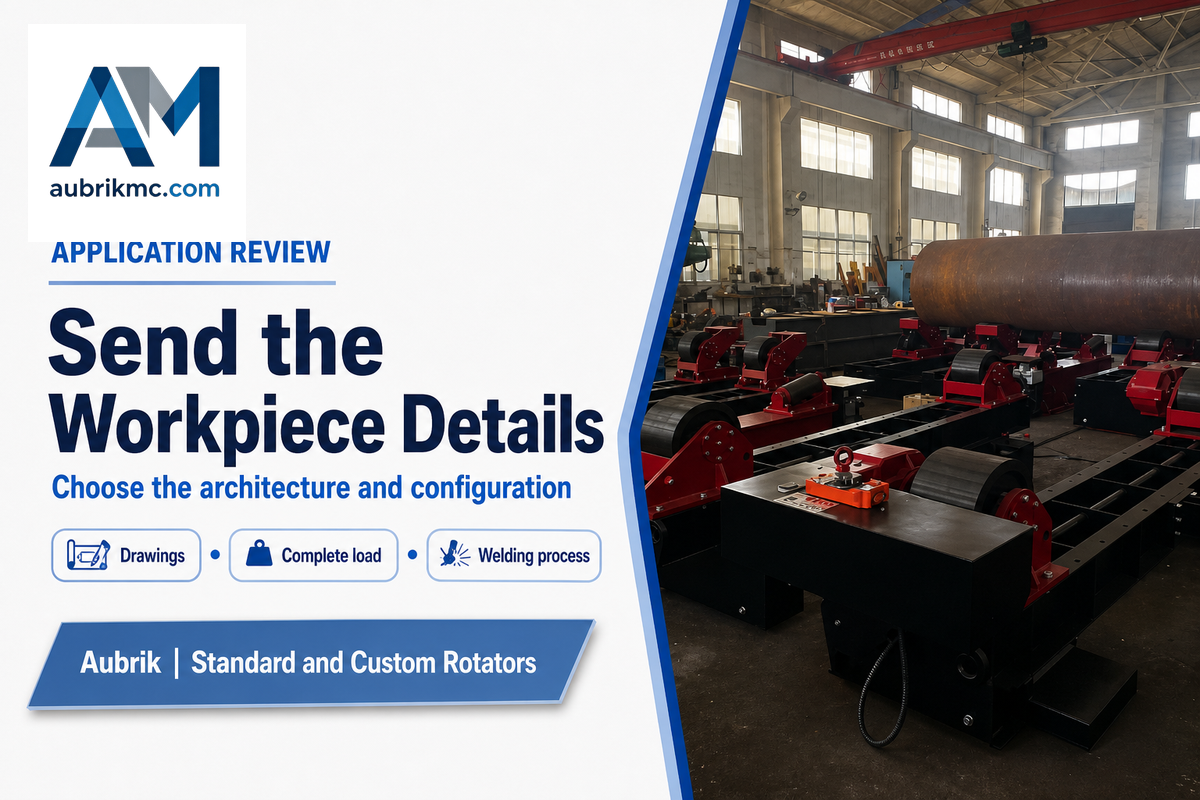
Aubrik can review a cylindrical welding application across its published standard and custom rotator families. Start with the pipe rotator range for pipe work or the broader rotator product family for heavy vessels. Include the complete load and process information above so the response can identify the appropriate architecture and proposed configuration.
Key takeaway
Select the complete drive-and-idler system for the actual shell: support capacity, usable traction, contact geometry and control scope must work together.
Have a vessel or pipe drawing ready?
Send the load, diameter range, welding process and required handling functions for a model-specific discussion.
Scope of this comparison: Company profiles summarize publicly available manufacturer information checked in October 2026. Specifications belong to the cited model or family.
Related Articles
- Pipe rotator selection for cylindrical welding
- Column-and-boom equipment acceptance checks
- Welding turntable manufacturers for clamped workpieces
- Planning the wind-tower welding equipment package
References & Sources
Company identity and product details were checked against the official manufacturer websites shown in the comparison table. Named product sources include Ransome turning rolls, Pandjiris constant-center rolls, LJ 120T-500/600, PEMA N/A/X rollerbeds, Irizar WR-20, Preston Eastin TDRA/TIRA, Key Plant ADR, IRCO self-aligning turners, Carpano’s rotator catalog, DEUMA RS, AMET turning-roll systems, Kistler BRS, DUMETA D-DWR, ProArc TR, Amin rotators, APS ORBITER, Mogra Rudra, SENLISWELD conventional models and RESIZE HGZ models.
Technical and documentation references: OSHA 29 CFR 1910.212, general machine-guarding requirements; OSHA 29 CFR 1910.254, arc-welding equipment and current-return connections; ISO guidance on certification; and European Commission guidance on CE-marking responsibilities for manufacturers. These references support the buying checks and do not certify or endorse the manufacturers listed.