Get in Touch with Aubrik Company

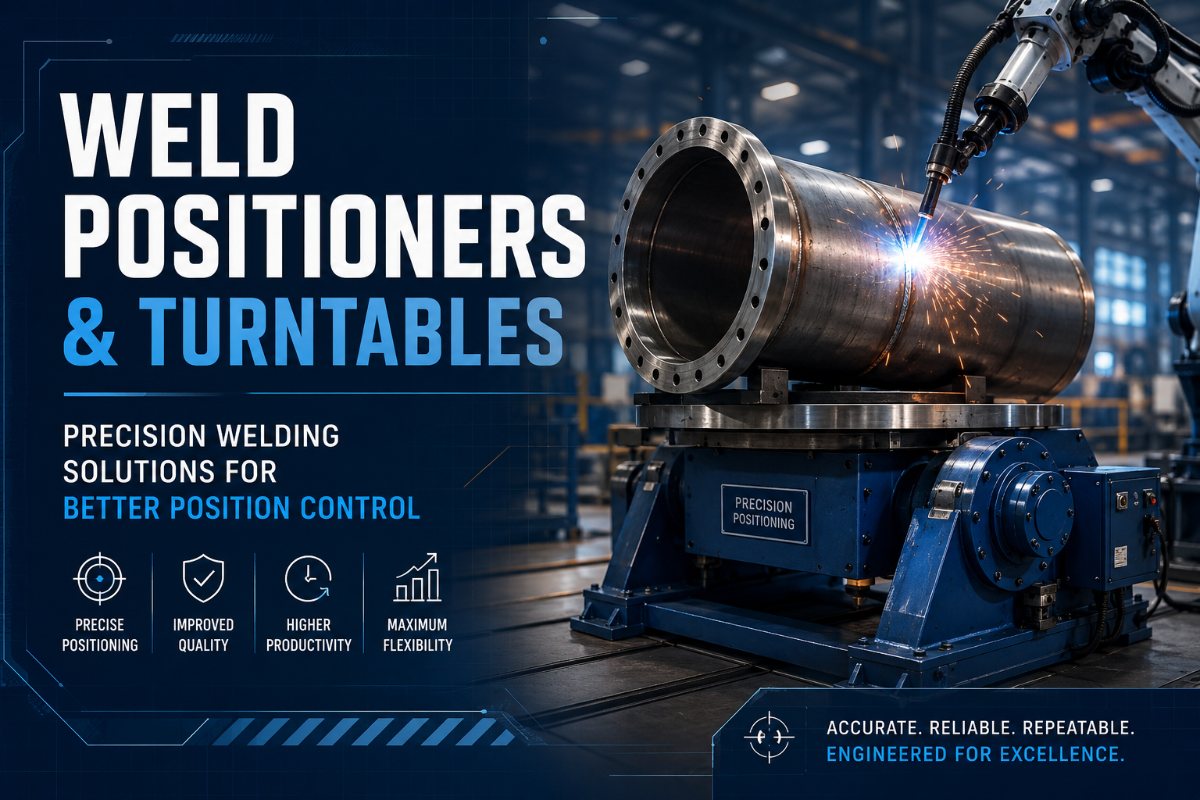
The Welding Positioners & turntables we carry here aren’t just tools to sit around in your shop. To the fabrication customer, our positioners determine if their welder will be able to hold their joint in a steady position, draw the workpiece at a smooth, controllable speed and lay down a consistent weld bead without battling the workpiece.It matters most when the item is round, big, unwieldy, or repetitive – pipe spools, vessel shells, pipe caps, round flanges, brackets, sub assemblies structures and TIG work which has to be moved smoothly and with controlled speed. The purchase error happens when one and the same flat position is envisioned for every unit. Proper selection is based upon how many pounds, geometry, how much speed, how much tilt, current return, how this will work on the floor, etc.
Quick Specs: Welding Positioner Selection
- Critical sizing inputs are workpiece Weight, fixture, center of gravity, eccentric load and needed tilt angle.
- Motion inputs: diameter of the table, type of chuck or fixture, degrees of rotation, speed control, foot-pedal or PLC control.
- Job to perform?What kind of Welding(TIG, MIG, Arc welding, Submerged Arc Welding, Pipe welding)?welding motion needed- Manual, Powered, Semi-Automatic, Robot?
- Safety entries: actual backfeed. Guards for the rotary parts, welder access port, inspection of installation.
What Are Weld Positioners and Welding Turntables Used For?
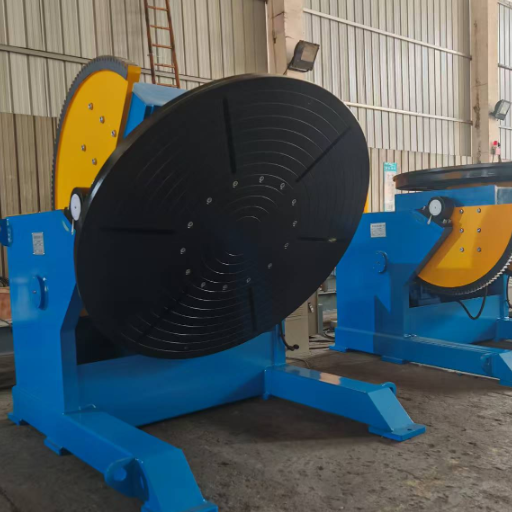
The workpiece is manipulated by hand, but the manipulator uses the hand to set an optimal angle during an operation called “welding the workpiece.” A basic welding turntable, or”turn table,” centers the workpiece on a rotating disk to allow the welding flame holder to maintain a consistent flame angle. A rotary welding positioner improves workholding ability, adds tilt to support the workpiece, or enhances control functions, allowing the operator to turn and tilt the workpiece as needed without walking around it.
In real world applications, it is likely that the welder could watch for the puddle and sustain speed while driving and reducing the amount of start-stop movement if the weld is circular and is lying in a flat or relaxed position. OSHA’s prefabrication welding eTool also suggests that there may be extended periods when the welder is in awkward and/or sustained positions and suggests adjustable rotisserie stand type mounts to create a more neutral posture.
Advantages
- Keeps the weld bead in view.
- Reduces manual repositioning.
- Improves repeatability on round parts.
- Can support high-quality welds when speed and fixture setup are right.
Limitations
- Rated load is not the same as usable tilted load.
- Low-speed TIG work can expose weak speed control.
- Poor current return can damage the machine.
- Wrong fixtures can still let the part move.
Benchtop Turntable, Rotary Welding Positioner, Pipe Rotator, and Manipulator: Types of Welding Positioners
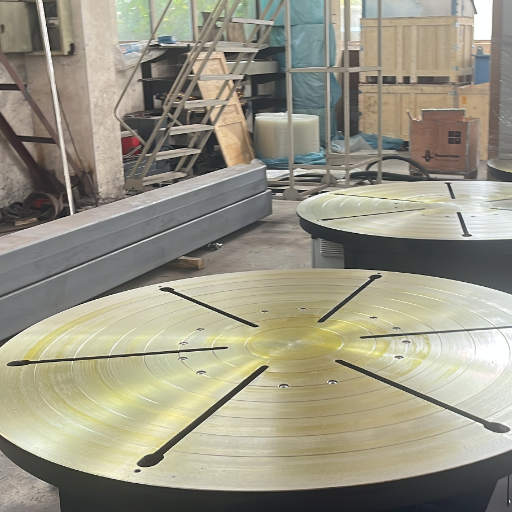
Start with the part shape. Small flanges do not need the same positioner as a 2,000 mm pipe section. Long vessel shells do not behave like brackets welded to flat plate. Use the part first, then choose the machine name.
| Equipment type | Motion | Best fit | Buyer check |
|---|---|---|---|
| Welding turntable | 360-degree table rotation | Small round TIG or MIG parts, flanges, rings | Confirm minimum RPM and table runout. |
| Rotary welding positioner | Rotation plus tilt | Brackets, flanges, short pipe, fixture work | Request tilt capacity at your center of gravity. |
| Pipe welding rotator | Roller support and rotation | Pipe spools, cylinders, tank shells | Match roller spacing to diameter range. |
| Headstock and tailstock | Between-center rotation | Long assemblies and heavy structures | Check alignment, support span, and synchronized control. |
| Manipulator plus positioner | Part motion plus torch motion | SAW, heavy industrial welding, vessel work | Confirm torch travel, control interface, and fixture access. |
For a deeper product breakdown, compare Aubrik’s rotary welding positioner, pipe welding positioner, and welding turntable pages after you know which workpiece family you are sizing.
The Load-Geometry-Speed Fit Matrix for Selecting a Welding Positioner Turntable
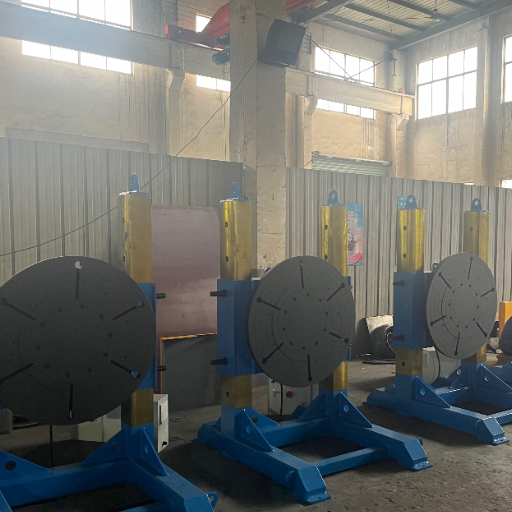
Weight capacity is only the first line. Add the fixture, chuck, clamps, and any offset between the center of gravity and the table centerline. Then ask what rotation speed the welding process needs. TIG may need slow, smooth movement. MIG may tolerate faster travel. A positioner for sale that looks strong on paper can still fail the job if the part is unbalanced or the low-speed range is rough.
Engineering Note
The practical choice is simple: use a positioner when the part must be clamped, tilted or indexed, and use a turntable when a round workpiece mainly needs controlled rotation. In both cases, verify usable load, fixture weight and eccentric torque at the real weld position. A useful quotation should show the part envelope, tilt requirement, speed range, grounding path and fixture assumptions.
| Scenario | Part geometry | Motion need | Recommended type |
|---|---|---|---|
| Small TIG parts | Round, light, repeatable | Slow variable speed | Benchtop welding turntable |
| Pipe spool | Cylindrical | Steady rotation | Pipe positioner or rotator |
| Vessel seam | Large shell | Low RPM, high torque | Heavy-duty rotator or headstock |
| Bracket or frame | Offset, irregular | Tilt plus lock | Tilt rotary welding positioner |
| Robot cell | Fixture-defined | Coordinated axis | Servo or PLC positioner |
If you already have part drawings, Aubrik’s welding positioner load capacity calculator can help prepare the numbers before a formal RFQ.
Welding Applications, Productivity, and How Positioners Improve Weld Quality
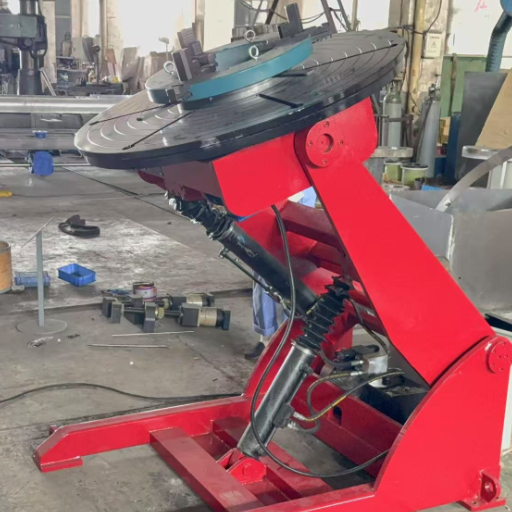
Positioners offer the best return when they remove repeated handling, support a circular weld, or let the welder keep the workpiece between waist and elbow height. The CCOHS welding ergonomics guidance lists awkward body postures, static positioning, and lifting heavy loads as risk factors, and it recommends positioning aids to support better posture.
- Pipe welding: rotators or pipe positioners keep the joint accessible and reduce manual rolling.
- Pressure vessel and tank work: heavy-duty units help present circumferential welds in a better position.
- Small TIG production: a welding turntable can hold speed while the welder controls filler and torch angle.
- fabrication brackets: tilt helps bring awkward joints into view without unsafe reaching.
- Repeat batches: a fixture plus repeatable rotation reduces variation between workpieces.
Use this test: if the operator spends more time moving the part than welding it, or if the weld bead changes because body position changes, the job is a candidate for positioning equipment.
Manual, Powered, Semi-Automated, Robotic Welding, and Welding Automation
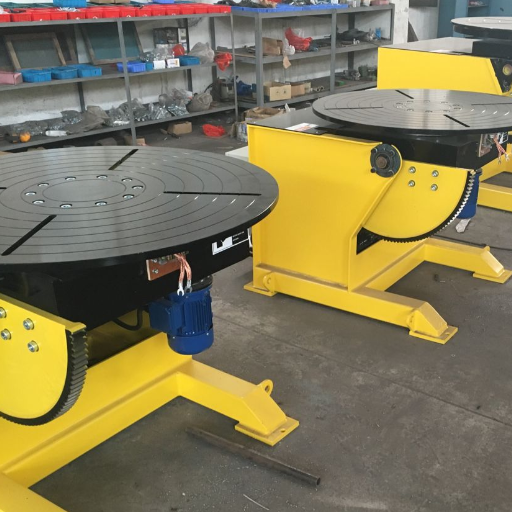
Manual welding positioners fit low-volume jobs where the part can be moved safely and precision demands are moderate. Powered positioners add variable speed and better control. Semi-automated equipment adds repeatable settings. Robotic welding needs the positioner to behave as a controlled axis, not just a spinning plate.
For repeat welding operations, automatic welding positioners and automated welding positioners are not just welding tools; they are workholding systems designed to rotate a workpiece, rotate the workpiece through an indexed path, and protect weld consistency while the welder or welding torch stays in one working zone. In modern welding cells, multi-axis welding or positioners for welding can increase efficiency only when the right welding positioner matches the torch path, table load, and service plan.
“The first control question is not how heavy the part is. It is whether the table can hold the correct weld speed after the fixture, chuck, and center-of-gravity offset are added.”
Forum discussions around TIG welding turntables often return to the same point: the unit must turn slowly enough for the operator’s filler rhythm and pipe diameter. One user looking for a bench-mounted TIG positioner specifically asked for slow speed and a center opening for purge gas. Another discussion noted that the fastest comfortable filler speed can decide the table setting. Treat those as field cues, not universal numbers.
| Shop condition | Better fit | Reason |
|---|---|---|
| Mixed repair work | Manual or simple powered | Fast setup matters more than stored recipes. |
| Repeat TIG batches | Powered variable speed | Low RPM stability matters. |
| Pipe or vessel work | Rotator or heavy-duty positioner | Load and diameter drive the choice. |
| Robot-ready cell | Automated welding equipment, PLC, or servo-controlled unit | Motion must repeat with the robot path. |
Fabrication RFQ Specification Checklist Before You Ask for a Welding Positioner Price
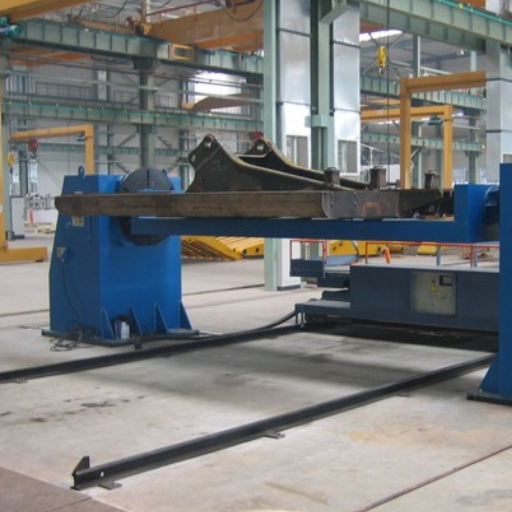
Suppliers cannot size the right welding equipment from “we need a positioner” alone. Better RFQs give enough data to check load, tilt, workholding, welding process, controls, and delivery needs. Aubrik was founded in 1999, builds welding and cutting equipment, reports annual capacity of 1,000 welding equipment sets and 200 cutting equipment sets, and offers OEM service with ISO9001 and CE certification context.
- Heaviest workpiece weight plus fixture and clamp weight.
- Part drawing or photo with center of gravity marked if known.
- Required table diameter, chuck size, roller range, or T-slot pattern.
- Welding process: TIG, MIG, MMA, SAW, or robotic welding.
- Expected speed range, variable speed controls, and whether foot-pedal control is needed.
- Rotation and tilt angle, indexing, and repeatability needs.
- Tailstock positioners or steady supports for long shafts, pipe sections, or large and heavy parts.
- Voltage, frequency, control interface, and plant safety requirements.
- Warranty, spare parts, lead time, and OEM customization needs.
Use published model ranges as a sanity check, not as a substitute for project sizing. Aubrik’s public product pages show how quickly the specification spread changes from a benchtop turntable to a heavy fabricator’s machine.
| Spec check | Published Aubrik range to compare | What it tells the buyer |
|---|---|---|
| Rotary positioner family | 50 kg to 5,000 kg standard load range; custom track 6,000 kg to 50,000 kg | A single “positioner” label can cover light benches and structural work. |
| Benchtop rotary class | 50 kg to 200 kg workpieces; buyer cue below 80 parts per shift | Useful for smaller TIG and tube-to-flange work before fixtures become the main constraint. |
| Standard two-axis class | 300 kg to 1,500 kg workpieces with powered tilt | This is often the bridge from manual fabrication into semi-automated cells. |
| Heavy-duty rotary class | 2,000 kg to 5,000 kg standard range; up to 50,000 kg custom | Fixture mass and center-of-gravity offset become purchasing questions, not afterthoughts. |
| Welding turntable accuracy | 50 kg to 2,000 kg load range, runout <=0.02 mm, servo accuracy +/-0.1 mm | The RFQ should separate load capacity from repeatability and runout. |
| Chuck and fixture envelope | 160 mm to 630 mm three-jaw chuck range on the BY turntable page | Diameter and grip method can matter as much as rated kg capacity. |
| Heavy fabrication positioner | 300 kg to 20,000 kg capacity; custom configurations up to 50,000 kg | The same RFQ should state the part mass, fixture mass, and expected service duty. |
| Pipe and flange envelope | 40 mm to 2,500 mm diameter coverage appears in Aubrik’s heavy-duty sizing guidance | Long parts may need tailstock support, rollers, or a different machine family. |
| Large wind-flange example | 1.5 m to 3 m diameter flanges at 3,000 kg each are cited in Aubrik’s HB-series case context | Large and heavy parts should be discussed as geometry plus load, not load alone. |
| Case context check | The HB-series page cites a 12% to 18% industry rework range, 2% to 4% baseline result, and about 75% to 80% reduction for one heavy-duty case. | Treat percentage claims as case-specific proof points to verify during RFQ review. |
After clarifying the RFQ inputs, you can fairly compare Aubrik’s welding positioner models against those inputs instead of picking only based on category names.
Common Buying Mistakes With Weld Positioners, Turntables, and a Positioner for Sale
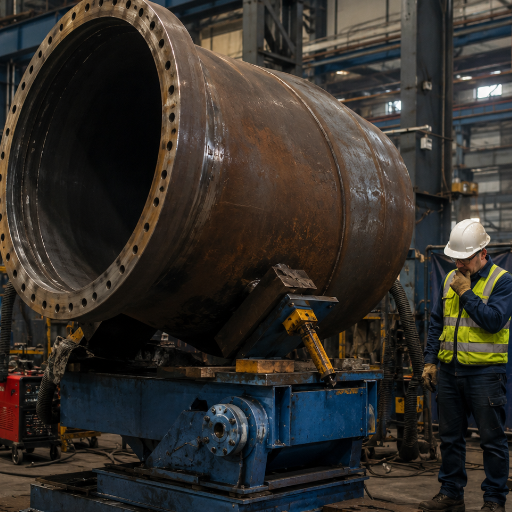
Most serious mistakes are specifications errors-not branding errors. They are made before you buy by not sending adequate information or simply accepting a catalog number without defining operation under the actual workpiece.
| Mistake | Consequence | Better RFQ question |
|---|---|---|
| Buying by flat load rating | Tilted load may be lower than expected. | What is usable load at my CG offset? |
| Ignoring TIG low speed | Table outruns filler rhythm. | What is the smooth minimum RPM under load? |
| Weak fixture plan | Workpiece shifts, weld accuracy drops. | What chuck, jaw, T-slot, or custom fixture is required? |
| No current-return plan | Machine components can carry unintended welding current. | How is welding current returned safely? |
| No spare-parts check | Downtime stretches after a simple component failure. | Which wear parts are stocked and how are they shipped? |
Forum threads reveal buyers many times after purchase upgrading low-cost positioners with different gearmotors, a speed controller, a bearing cover, or a new fixture assembly. While practical in a DIY context, production buyers must include lessons-learned in the RFQ before placing the order.
Safety, Grounding, and Maintenance Checks After Installation
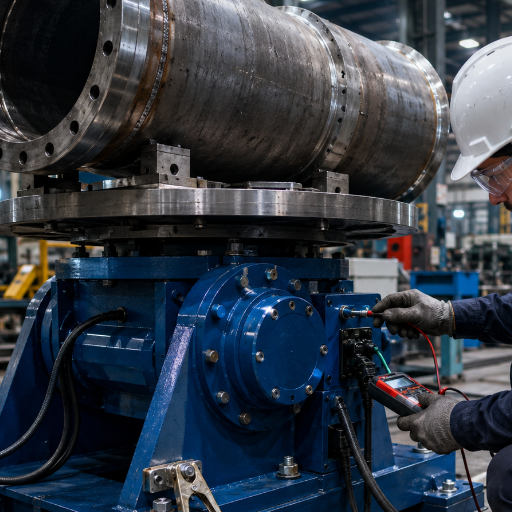
All welding positioners have working mechanisms, electronic controls, work holding surfaces, and an in-line welding current flow. The OSHA arc welding and cutting standard specifies electrically and mechanically sufficient grounds, as well as work holding fixtures acting as welding return paths require either a bonded joint or current-collecting means.
OSHA’s machine guarding eTool advises caution against mechanical hazards like rotating machinery, flying particles, and sparks. Consider any welding turntable as moving machinery, not simply a welding attachment.
- Before starting production work, confirm tilt stops, table rotate and foot-pedal activation.
- Verify workpiece clamping is achieved prior to tilt or table rotating.
- Review the supplier for work lead connection types, slip ring, brush or any current collector used.
- Keep cables clear of the rotating path.
- Establish scheduled inspections of the chuck, rollers, bearings, gear-box and the electronic wiring to ensure peak performance.
- Properly educate the welder regarding both welding functionality and mechanical movement.
Outlook: Rotary Positioners, Automated Welding Systems, and Flexible Cells
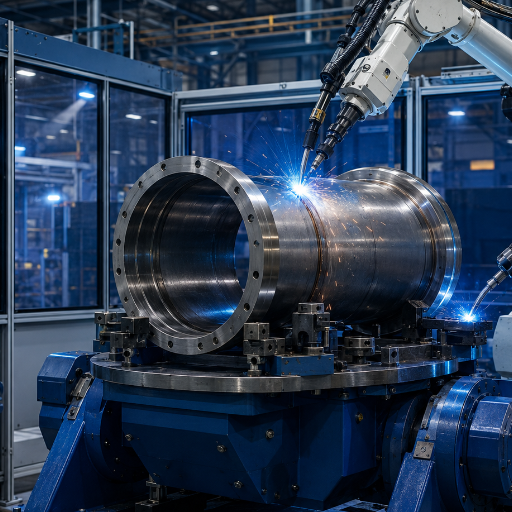
Positioners are now considered cell automation component, in lieu of just purchasing a singular machine tool. According to the IFR World Robotics 2025 summary, industrial robot installations in 2024 totaled 542,000 – the fourth consecutive year exceeding 500,000. Regionally, activity remained mixed, with a 9% decline in U.S. installation figures last year.
From the perspective of a buyer planning for 2026 and beyond, the prudent approach involves not accelerating robotic welding acquisition but avoiding a stagnant positioner solution. If later automation enhancements are likely, include repeatable fixturing, clean and standard control connections, stable speed control, and a current-return design to eliminate the need for work cell retrofits.
Aubrik manufactures additional product lines like wind tower assembly lines, H-beam welding lines, pipe welding equipment, CNC machines (cutting and grinding), roll forming machines and plate bending machines. These lines of equipment and systems become important when you require a positioner that not only stands alone but can be integrated into a larger fabrication system.
Short FAQ
What is a welding positioner?
Answer
It is a workholding machine that rotates, tilts, or indexes a part for better weld access.
What is a welding turntable?
Answer
Think of a welding turntable as the rotary-only member of the positioner family. It spins round or symmetrical parts during welding and is common for rings, flanges, tube assemblies, and small TIG or MIG parts where steady movement matters.
Can welding be done with a turntable positioner?
Answer
Yes. The part must be clamped safely, and the table speed must match the welding process. TIG work often needs slower and smoother rotation than many buyers expect. MIG or repetitive production may tolerate a wider speed range, but the weld bead still depends on steady travel and a fixed workpiece.
How much weight capacity do I need?
Answer
Add the workpiece, fixture, chuck, clamps, and tooling. Then check center of gravity and eccentric offset.
Can one positioner support TIG and MIG welding?
Answer
Often yes, but speed control is the deciding factor. Units that work for MIG may still be too fast or too uneven for TIG on small diameters. Ask for the minimum stable RPM under load, the control method, and whether the table can accept the chuck or fixture your TIG setup needs.
Do turntables need a separate weld current return path?
Answer
They need a safe and rated current-return arrangement. Depending on the design, that may mean a direct work lead, bonded fixture path, slip ring, brush, or other current collector. Confirm this detail with the supplier instead of assuming the machine frame, bearings, or rotating table can carry welding current without damage or safety risk.
What should I know before buying a welding positioner?
Answer
Know your heaviest part, fixture weight, part shape, weld process, required rotation speed, tilt angle, chuck or fixture plan, plant power, and future automation needs. Share drawings or photos when possible. For repeat production, add the expected parts per shift and the weld sequence, because that changes the control package. For export purchases, include voltage, frequency, destination port, warranty expectations, and spare-parts requirements. If these items are missing, the quote may look cheaper than the real installed solution because the missing fixture, control, or current-return detail appears later.
Buyer Next Step
Prepare the fabrication RFQ checklist provided and evaluate welding positioners for fabrication projects if pipe, vessel, rotary or heavy duty fabrication solutions are required.
References & Sources
- OSHA Prefabrication: Welding – Occupational Safety and Health Administration
- Welding – Ergonomics – Canadian Centre for Occupational Health and Safety
- 29 CFR 1910.254 Arc Welding and Cutting – Occupational Safety and Health Administration
- Machine Guarding General Requirements – Occupational Safety and Health Administration
- Safety First: Best Practices for Handling Heavy Weldments – American Welding Society
- World Robotics 2025 Summary – International Federation of Robotics
- ISO 9000 Family: Quality Management – International Organization for Standardization