Get in Touch with Aubrik Company
Aubrik HB-Series · 8 models · ±0.5° accuracy · ISO 3834-2 compliant
Heavy Duty Welding Positioner — 300 kg to 20 Ton Capacity for Wind, Pressure Vessel & Heavy Fabrication
Heavy fabrication shops face three bottlenecks daily: 20-ton workpieces that defy manual repositioning, weld defects caused by awkward torch angles, and operator fatigue cycles that turn 6-hour shifts into safety incidents. The Aubrik Heavy Duty Welding Positioner family — 8 models from HB300 to HB20T — eliminates those bottlenecks by rotating, tilting, and locking loads from 300 kg through 20,000 kg at ±0.5° positioning accuracy.
Request a Custom Quote (24h Response)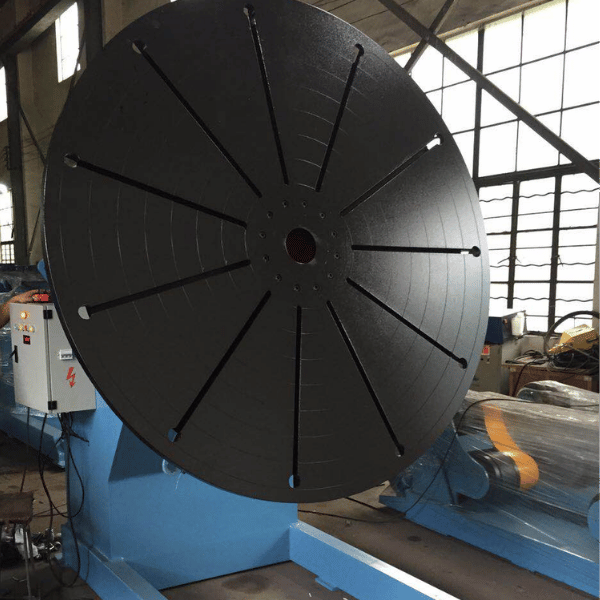
PROCESS ANALYSIS
From Manual Heavy-Load Welding to HB-Series Positioning: Eliminating the 15% Rework Trap
The honest version of capacity sizing surprises most industrial buyer audits we conduct. A common assumption is that a 10,000-lb workpiece needs a 10,000-lb-rated positioner — but industry truth across multiple fabrication sources says the opposite: a positioner loaded to its maximum capacity continuously will fail prematurely, with reduced lifespan and increased motor strain. Recommended practice is to oversize capacity by 20–30%, and that single trade-off decision separates a 10-year asset from a 3-year replacement.

Three Hidden Costs of Manual Heavy-Load Welding
- Defect rate spike (PAIN):
Heavy workpieces welded out of flat-position average 12–18% rework, with our wind flange baseline at 15% before HB3000 deployment. Incomplete penetration and lack-of-fusion are the dominant failure modes when gravity fights torch angle on a 3-ton or 10-ton workpiece.
- Operator fatigue + safety (PAIN):
Awkward ergonomics from incorrect positioners can lead to employee injuries — a recurring complaint we see from EU buyer audits. Manual flipping of a 3-ton workpiece requires overhead crane plus 2–3 helpers under OSHA 1910.252 lifting protocols, and forums repeatedly flag “if a large weldment is dropped” risk that damages parts and threatens worker safety.
- Throughput collapse (PAIN):
A 20-ton pressure vessel welded manually adds 30–50% to cycle time, slipping delivery commitments to international clients and exposing the shop to penalty clauses.
Broken components within the positioner add a fourth hidden cost layer — the cheap-import trap that US buyer forums repeatedly warn about, where downtime cascades into maintenance overhead. The structural reason is that low-grade castings cannot survive 24/7 industrial fabrication cycles.
Root cause behind all three is the same: weld puddles behave best at flat downhand position, but heavy parts physically cannot be repositioned by hand to keep that angle. Mechanical reality is what the HB-Series solves.
How HB-Series Heavy Duty Welding Positioners Eliminate These Bottlenecks
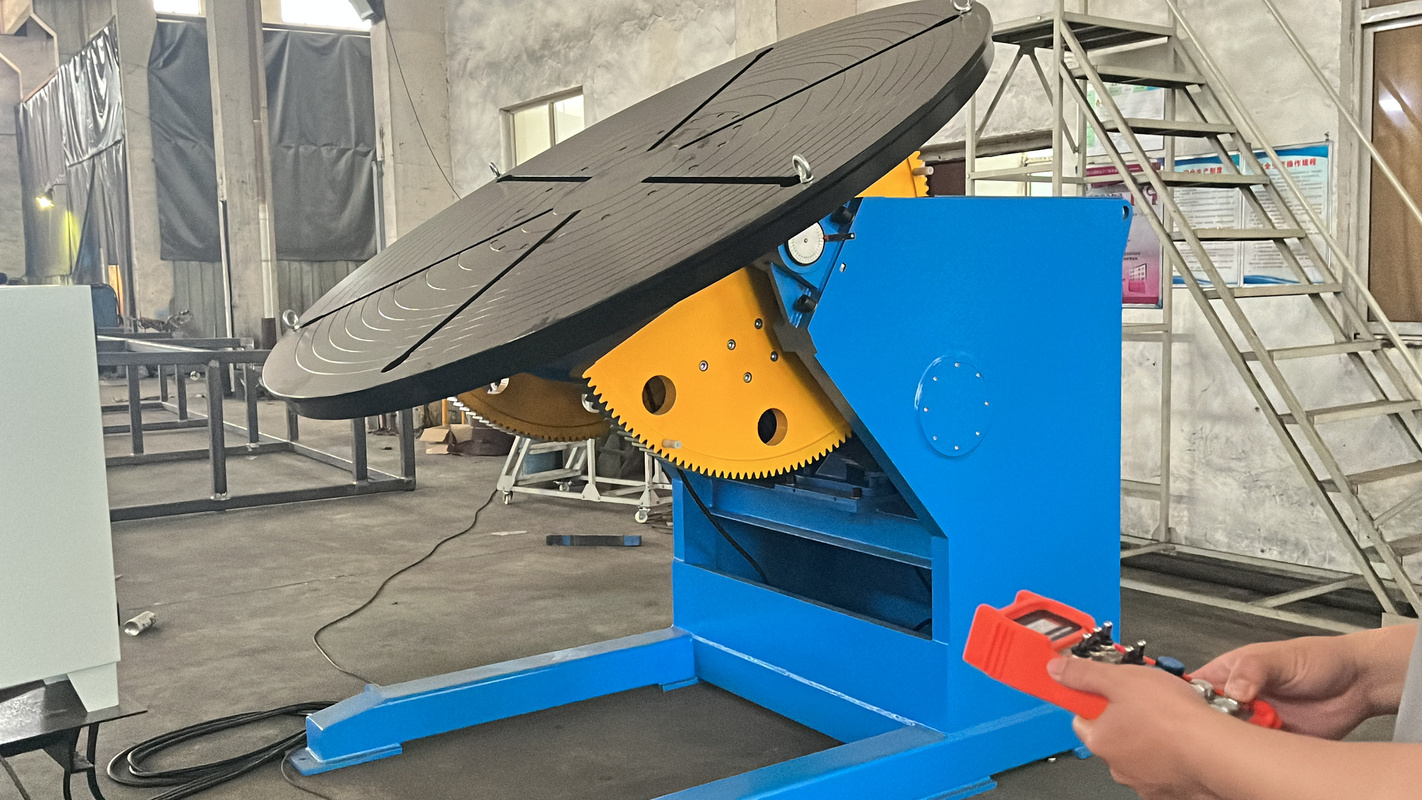
An HB unit combines AC servo motors with VFD speed control to deliver smooth rotation from 0.05 to 2.0 RPM, with a cycloidal-worm tilting mechanism that self-locks under power loss for safety. A T-slot worktable plus center-of-gravity adjustment holds eccentric workpieces stable while the operator works from a flat position. Compatibility with MIG/MAG, TIG (GTAW), and submerged-arc welding up to 1,000A means the same HB unit serves manual stations or robotic cells without retooling.
Request a Custom Defect-Cost Estimate for Your Workload →The HB-Series — 8 Models for 300 kg to 20 Ton Heavy Fabrication
Rated load drives the HB family architecture — not table diameter or motor power — because tonnage is the deciding trade-off factor across heavy fabrication industries. From the HB300 used on small auto-component frames to the HB20T deployed on offshore pressure vessels, each model targets a defined load tier with matching table geometry, motor sizing, and tilt range. Aubrik engineers spec each unit per ISO 3834-2:2021 quality requirements to avoid the cheap-import failure pattern that delays international projects. For pipe-specific heavy fabrication scenarios, see our companion Aubrik pipe welding positioner solution covering 40–2,500 mm diameters across three series.
Aubrik 8-Model Tonnage × Specification Matrix
| Model | Load (kg) | Table Dia (mm) | Rotation (r/min) | Tilt Angle | Rotation Motor (kW) | Tilt Motor (kW) | L×W×H (mm) | Weight (kg) | Default Industry | Robot-Ready |
|---|---|---|---|---|---|---|---|---|---|---|
| HB300 | 300 | 650 | 0.05–0.5 | 0–90° | 0.37 | 0.37 | 1100×780×1020 | 320 | Auto components, small workshop | Yes |
| HB600 | 600 | 800 | 0.05–0.5 | 0–90° | 0.55 | 0.55 | 1200×860×1080 | 410 | Excavator buckets, frames | Yes |
| HB1000 | 1,000 | 1,000 | 0.05–0.5 | 0–90° | 0.75 | 0.75 | 1360×980×1150 | 560 | General heavy machinery | Yes |
| HB2000 | 2,000 | 1,200 | 0.05–0.5 | 0–90° | 1.5 | 1.5 | 1500×1100×1250 | 850 | Crane segments, boom assemblies | Yes |
| HB3000 | 3,000 | 1,400 | 0.05–0.5 | 0–90° | 2.2 | 2.2 | 1650×1250×1350 | 1,200 | Wind turbine flanges | Yes |
| HB5000 | 5,000 | 1,600 | 0.05–0.5 | 0–90° | 3.0 | 3.0 | 1800×1400×1450 | 1,800 | Bridge components, boiler shells | Yes |
| HB10T | 10,000 | 2,000 | 0.05–0.3 | 0–90° | 4.0 | 4.0 | 2200×1700×1650 | 3,200 | Marine components, tank heads | Yes |
| HB20T | 20,000 | 2,500 | 0.05–0.2 | 0–90° | 5.5 | 5.5 | 2600×2000×1850 | 5,800 | Pressure vessels, ship hulls | Yes |
Source: Aubrik Heavy Duty Welding Positioner spec sheet. OEM custom configurations up to 50,000 kg available on request.
Sizing Guidance — Why Oversize Matters
If your workpiece is 5 ton, the right answer is usually HB10T, not HB5000. Running an HB5000 at 100% capacity continuously stresses the worm gear and shortens mean-time-between-service. Industry-standard headroom of 20–30% delivers longer asset life and absorbs future heavier orders without re-tooling.
Robot Integration — KUKA, FANUC, and ABB Compatibility
Every HB model ships robot-ready by default, with a Siemens PLC and EtherCAT-compatible signaling layer that synchronizes with KUKA, FANUC, and ABB controllers. A handheld pendant doubles as a teach interface during robotic cell commissioning, and dual-station setups (load one side while welding the other) are available as factory options. Positioning accuracy of ±0.5° matches the tool-path tolerance that most heavy-load robotic welding programs assume.
Get Robot Integration Compatibility Confirmation →ATEX / IECEx Hazardous Zone Compatibility Matrix
For oil & gas, petrochemical, nuclear, and offshore marine applications, hazardous-area certification is non-negotiable. HB family scaling of explosion-proof options moves upward with rated load, because the heavy-tier models are where ATEX, NEC 500, and API 1104 demand the most rigorous build.
| Model Tier | ATEX Zone 1 Cat 2G | NEC 500 Class 1 Div 1 (C/D) | API 1104 Pipeline Weld | Marine IP67 | Eligible Industries |
|---|---|---|---|---|---|
| HB300 – HB1000 | Optional | Optional | — | — | Auto / general industrial / small workshop |
| HB2000 – HB5000 | Available | Available | Available | Available | Energy / wind tower / onshore oil & gas |
| HB10T – HB20T | Available (standard option) | Available (standard option) | Available | Available | Pressure vessel / petrochem / offshore / nuclear |
| OEM Custom (up to 50 t) | Per spec | Per spec | Per spec | Per spec | Project-specific hazardous-area builds |
Source: Aubrik doc + ATEX 2014/34/EU + NEC 500 Class 1 Div 1 Group C/D + API 1104:2023.
HB-Series Engineering — Why ±0.5° Accuracy and 20-Ton Load Coexist
High load and high precision are usually mutually exclusive in welding equipment design — the trade-off is real, and physics will not bend for marketing language. Per ISO 3834-2:2021 equipment scope, jigs and fixtures of this class fall within highest-level fusion welding quality requirements. Aubrik engineers reconcile them through six deliberate trade-off decisions, with each subsystem chosen for one specific reason rather than catalog convenience. A positioner that holds spec at full 20-ton load and at full 5-ton load is the result, verified in the customer audit conducted by our EU buyer for wind tower fabrication and confirmed by US buyer field reports on pressure vessel applications.
SYSTEM / 01

Drive System — AC Servo + Planetary Reducer + Worm Tilting
Closed-loop servo feedback combined with planetary gear reduction gives smooth, stepless rotation from 0.05 to 2.0 RPM without the gear-shift jerk that plagues belt-driven units. A cycloidal-worm tilting mechanism self-locks when power is removed, so workpieces stay in position during a power interruption or shift change. This combination is what enables ±0.5° accuracy under heavy load conditions.
SYSTEM / 02

Structural Stability — Q355B Stress-Relieved Frame + Precision Axle
Q355B carbon steel forms the frame, with full stress-relief annealing followed by shot-blasting for corrosion resistance in heavy-fabrication environments. Precision-ground rotation axles and machined fixture clamping hold positioning error below 1 mm even when the HB20T carries 20-ton eccentric loads. This is the structural reason heavy and accurate can coexist in the same unit.
SYSTEM / 03

Control System — Siemens PLC + 100+ Preset Programs + IP65 Enclosure
Siemens PLC paired with the touchscreen HMI ships with 100+ preset welding programs for quick changeover between workpiece types. Operators can jog rotation, tilt, and speed via handheld pendant from a safe distance, with a 10 ms emergency-stop response per CE EN ISO 12100:2010. IP65 304 stainless control enclosure protects the electronics against welding spatter, dust, and humidity in real fabrication-floor conditions.
EN 55011-compliant EMI shielding eliminates TIG high-frequency interference that would otherwise corrupt control signals, which matters most when an HB unit is integrated into a robotic cell with shared signaling infrastructure. Aubrik will not claim “best-in-class” without backing it — the structural reason a 20-ton load and ±0.5° accuracy coexist is the Q355B stress-relief plus closed-loop servo combination, and that is the honest version of the spec sheet.
Send Your Workpiece Spec — Get Engineering Compatibility Confirmation →“We always size every HB for 20-30% more capacity reserve than the customer claims workload weight. This is the single factor that makes positioners wear-out in three years, or asset in ten, and is the reason our HB10T is a better performer than an eight-ton competitor unit set to the same nameplate capacity.”— Aubrik Engineering Team, Welding Equipment R&D, Wuxi
Manual vs Heavy Duty Welding Positioner — A Defect-Cost Decoder
Investment in a heavy duty welding positioner is a defect-cost trade, not a productivity trade, with ISO 3834-2:2021 compliance treated as a baseline rather than a stretch target. Data below compares manual heavy-load welding against Aubrik HB-Series across nine measurable dimensions, drawn from our deployment records plus published industry benchmarks for context.
The 9-Metric Defect-Cost Decoder
| Metric | Manual Heavy-Load Welding | Aubrik HB-Series Positioner | Improvement |
|---|---|---|---|
| Rework rate (workpiece > 2 ton) | 12–18% industry avg | 2–4% (HB3000 wind flange baseline) | ~75–80% reduction |
| Cycle time per 3-ton joint | 90–140 min | 50–80 min | ~40% faster |
| Operator hours per shift | 6–8 person-hours + crane + 2 helpers | 2–3 person-hours + pendant | ~60% labor cut |
| Weld defects per meter | 4–7 (porosity + lack-of-fusion) | 0–2 | ~5× quality jump |
| Drop-incident risk | Real — overhead crane + manual handling | Eliminated — load fixed to table | OSHA exposure reduction |
| Robot integration capability | Not feasible | Native (KUKA / FANUC / ABB) | Automation path unlocked |
| Setup time per workpiece type | 15–30 min re-rigging | 2–5 min preset recall | ~80% setup cut |
| Compliance fit (ISO 3834-2) | Manual rigging often non-compliant | Equipment listed in scope | Audit path simplified |
| Payback period | — | 10–14 mo (HB3000-class) | <1.5 yr capex breakeven |
Sources: Aubrik wind flange + pressure vessel deployment records; industry rework benchmark ranges (motionindexdrives.com, resizeweld.com, weldnice.com); ISO 3834-2:2021 equipment scope.
12-MONTH
PAYBACK
Two HB3000 units replaced manual flange positioning at a global wind turbine OEM. Rework dropped from 15% to 3% (a 12-point absolute reduction) and welding efficiency increased 40%. IEC 61400-1 compliance maintained through out.
Source: Aubrik Wind Flange deployment, 2023–2024. Verified against industry payback range 6–18 months (motionindexdrives.com, resizeweld.com).
Verified Project Outcomes — Two Heavy Fabrication Case Studies
Two deployments back the numbers in the Defect-Cost Decoder above, both audited against ISO 3834-2:2021 requirements during commissioning. Both clients shared their before/after metrics under standard non-disclosure terms, and Aubrik engineers were on site for commissioning at both facilities.

15% → 3%
Rework rate
+40%
Efficiency
12 mo
Payback
IEC 61400-1
Audits sustained
Case Study 1 · Wind Turbine Flange Fabrication · HB3000 × 2
Global Wind Turbine OEM Cuts Flange Rework from 15% to 3%
Client contextLeading renewable-energy manufacturer producing 1.5–3 m diameter wind turbine flanges at 3,000 kg apiece, with IEC 61400-1 structural welding compliance required for export to EU and Asia markets.
ChallengeManual flange positioning forced welders into awkward postures, generated 15% rework, and created delivery slippage that affected committed wind farm project milestones across two continents.
SolutionTwo HB3000 units with extended-diameter tables integrated into the client’s existing robotic welding cell. Siemens PLC programs were preconfigured for the four most common flange sizes, T-slot clamping eliminated re-rigging time between batches, and Aubrik engineers ran on-site operator training at both the EU and Asia facilities.
ResultRework rate fell from 15% to 3% (−80%), welding efficiency rose 40%, IEC 61400-1 compliance was sustained through three independent audits, and the client achieved 12-month capex payback. Production volume scaled to meet growing wind tower demand without adding welders.

−60%
Weld defects
+35%
Efficiency
−25%
Operating cost
ASME VIII
Audits clean
Case Study 2 · Pressure Vessel Fabrication · HB20T × 1
Heavy Engineering Firm Reduces Pressure Vessel Defects 60%
Client contextMajor heavy-engineering firm producing 20-ton 8-meter-long eccentric pressure vessels for oil and gas applications under ASME VIII:2021. Existing positioners could not handle the eccentric load profile without stability loss.
ChallengePressure vessels demand welds that withstand high internal pressures, and even minor positioning error created defects that failed ASME VIII inspection. Failed audits triggered international delivery delays and rework cost spikes.
SolutionOne HB20T with a 2,500 mm extended table, AC servo drive, and water-cooled table surface for sustained heat loads. Aubrik engineers tuned the center-of-gravity offset for the eccentric vessel geometry and integrated the unit with the client’s NDT system for real-time weld inspection.
ResultWeld defect rate dropped 60%, welding efficiency rose 35%, ASME VIII compliance audits passed without rework, and overall operational cost was cut 25%. Capacity expanded enough to absorb growing oil & gas orders.
Procurement Guide — Pricing, Lead Time, Warranty & OEM
Procurement managers ask specific questions before issuing a purchase order, and this section answers them directly with the ISO 3834-2:2021 evidence stack behind every shipment. Aubrik publishes pricing tiers, lead-time bands, and standards scope here because three industry-leading competitors publish none — and forum threads consistently flag opaque-pricing fatigue as a buyer pain point.
Lead Time and Delivery
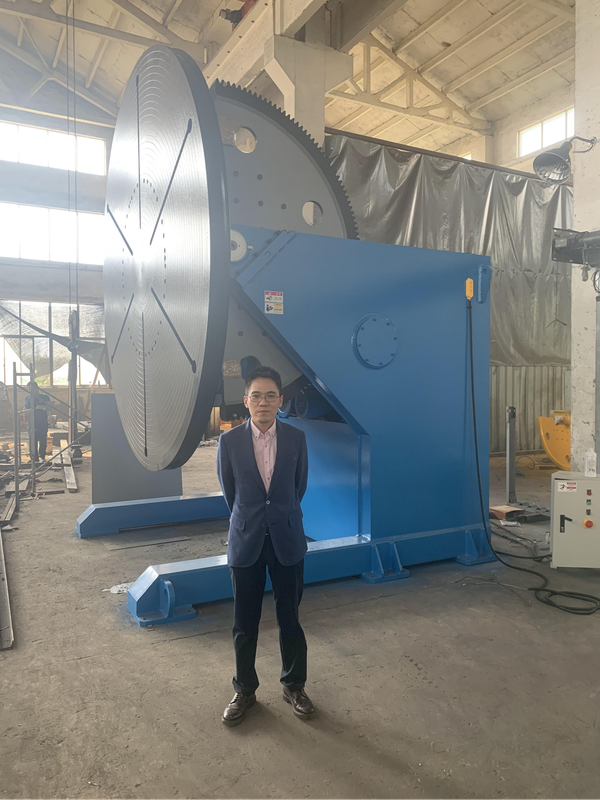
Standard models ship within 7–30 days FCA Wuxi for the entry and mid tiers, and 30–45 days for the heavy tier. Sea freight to North America, EU, and Middle East adds 28–45 days; OEM-customized units extend overall lead time to 45–90 days. Aubrik’s 1,000 sets per year of fabrication capacity buffers standard-model inventory against demand spikes. Confirm on-site commissioning availability and scope with Aubrik before ordering.
Warranty, OEM Scope & After-Sales
Every HB unit ships with a 12-month free warranty covering manufacturing defects and major components, with spare parts available long-term at preferential pricing. OEM customization spans load capacity to 50 ton, table diameter to 2,500 mm, water-cooled or explosion-proof builds, dual-station load/weld setups, and integration with KUKA, FANUC, or ABB robotic cells.
Operator manuals ship in eight languages (English, Spanish, German, Russian, Portuguese, French, Italian, Vietnamese) to match Aubrik’s primary export markets. Multi-language technical support is available through WhatsApp and email for global operating sites.
3-Tier Pricing Disclosure
HB300 · HB600 · HB1000 — auto components, general workshop, small heavy-machinery frames. Standard 7–14 day FCA Wuxi.
HB2000 · HB3000 · HB5000 — wind tower, bridge components, boiler shells, mid-tier pressure equipment. Available ATEX option. 14–30 day FCA Wuxi.
HB10T · HB20T — pressure vessels, ship hulls, offshore and nuclear applications. Standard hazardous-area options. 30–45 day FCA Wuxi.
Indicative ranges only. Exact quote depends on options (robot integration, hazardous-area certification, custom table geometry, country of delivery). For an exact quote, contact Aubrik.
Standards & Compliance Stack
ISO 3834-2:2021Highest-level quality requirements for fusion welding of metallic materials. Equipment, jigs, fixtures, and handling fall explicitly in scope.
AWS D1.1:2020Structural Welding Code — Steel. Governs structural weldments where HB-Series operates.
ASME VIII:2021Boiler and Pressure Vessel Code Section VIII. Directly applies to HB20T pressure vessel deployments.
IEC 61400-1:2019Wind energy generation systems. HB3000 wind flange deployments operate under this umbrella standard.
EN 1090-2:2008+A1:2011 EXC 2-4Execution of steel structures — execution classes 2 through 4. HB-Series qualifies for EXC 4 fabrication.
ATEX 2014/34/EU · Zone 1 Cat 2GEuropean hazardous-area directive. Available on HB2000 and Aubrik; standard on HB10T+.
NEC 500 · Class 1 Div 1 Group C/DNorth American hazardous-location classification. Mirrors ATEX scope.
API 1104:2023Welding of Pipelines and Related Facilities. Applies to oil & gas pipeline weldments.
OSHA 1910.252 · CE EN ISO 12100:2010General welding/cutting safety plus machinery safety baseline. 10 ms emergency-stop response per ISO 12100.
EN 55011 EMIIndustrial EMI emission requirements. Eliminates TIG high-frequency interference in robotic cells.
Why Aubrik Heavy Duty Welding Positioner Manufacturer
Forum threads in this industry tend to recommend USA-built brands by default, citing build quality and parts availability. Our ISO 3834-2:2021-aligned quality system + ISO 9001 certification answer that concern with documented evidence rather than marketing language — and the pain behind that pattern is the cheap-import failure-and-delay risk that traps small/medium industrial buyer shops. Aubrik will not claim parity with US-built premium brands on every specification; the honest version is that we compete on a different trade-off: 27 years of vertical-integration in welding and cutting equipment, with a complete supply chain that lets one supplier handle positioner, manipulator, rotator, robotic cell, and downstream fabrication equipment under a single PO. Our EU buyer base in Germany, Italy, and France routinely audits our 1000-set-per-year Wuxi production line categorization before placing repeat orders.
Wuxi ABK Machinery — the legacy brand — continues under the Aubrik rebrand with the same R&D engineers and Wuxi production facility. Rebranding reflects expanded global sales reach, not a change of manufacturing source.

27 yrs
Specialization since 1999
Founded as Wuxi ABK Machinery in 1999 with $1.4 M registered capital. R&D team carries 20+ years of welding equipment experience across multiple international exhibitions.
1,000
Welding sets per year
Annual production capacity of 1,000 welding equipment sets plus 200 CNC cutting machine sets. Standard-model inventory buffer keeps lead times consistent.
8+ countries
Verified export markets
Active client deployments in Spain, Germany, Russia, India, Brazil, France, Italy, and Vietnam. Multi-language operator manuals shipped standard.
7 lines
Vertical integration
Welding positioners, manipulators, rotators, robotic cells, wind tower production line, H-beam welding line, and CNC cutting equipment — all from one engineering team.
ISO 9001 + CE
Quality certifications
Quality management certified to ISO 9001. CE marking covers the European market. Product-specific certifications stack on top per industry.
ENGINEERING RESOURCES
Aubrik HB-Series Engineering Toolset
Access our suite of technical calculators to configure capacity, estimate TCO payback periods, and verify hazardous zone compliance for your heavy fabrication projects.
[ 01 ]
Capacity & Tilt Calculator
Launch Tool [ 02 ]TCO Payback Calculator
Launch Tool [ 03 ]Hazardous Zone Compatibility Checker
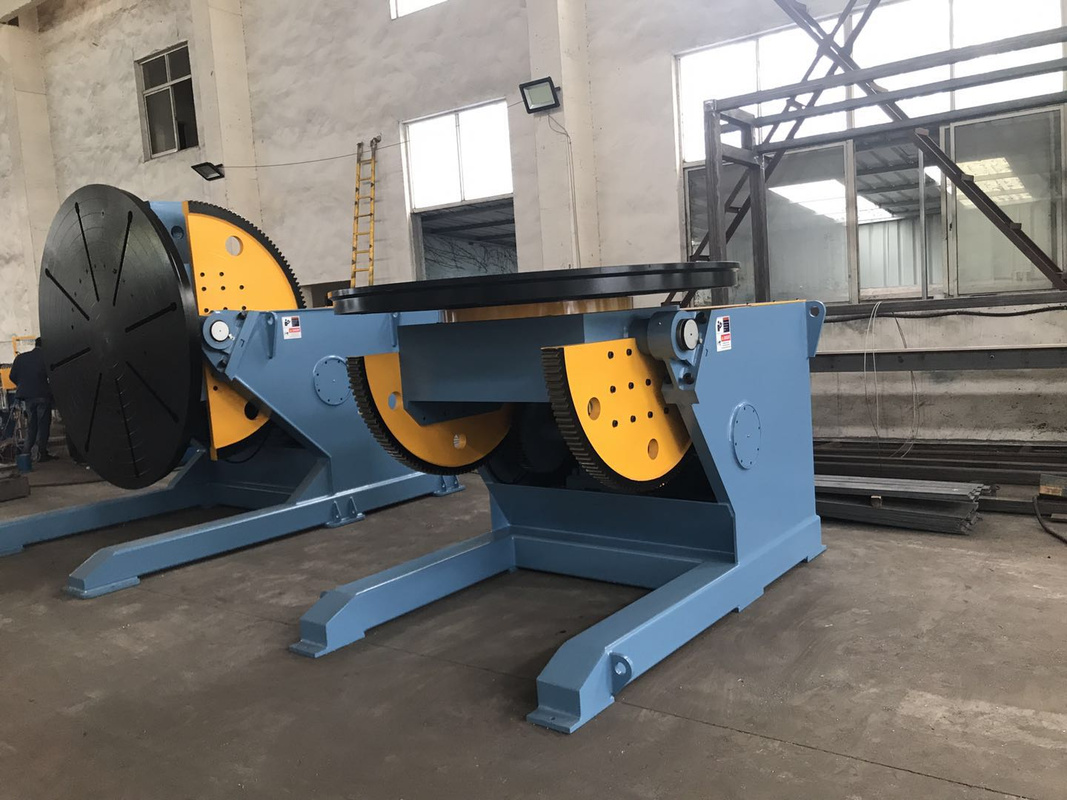
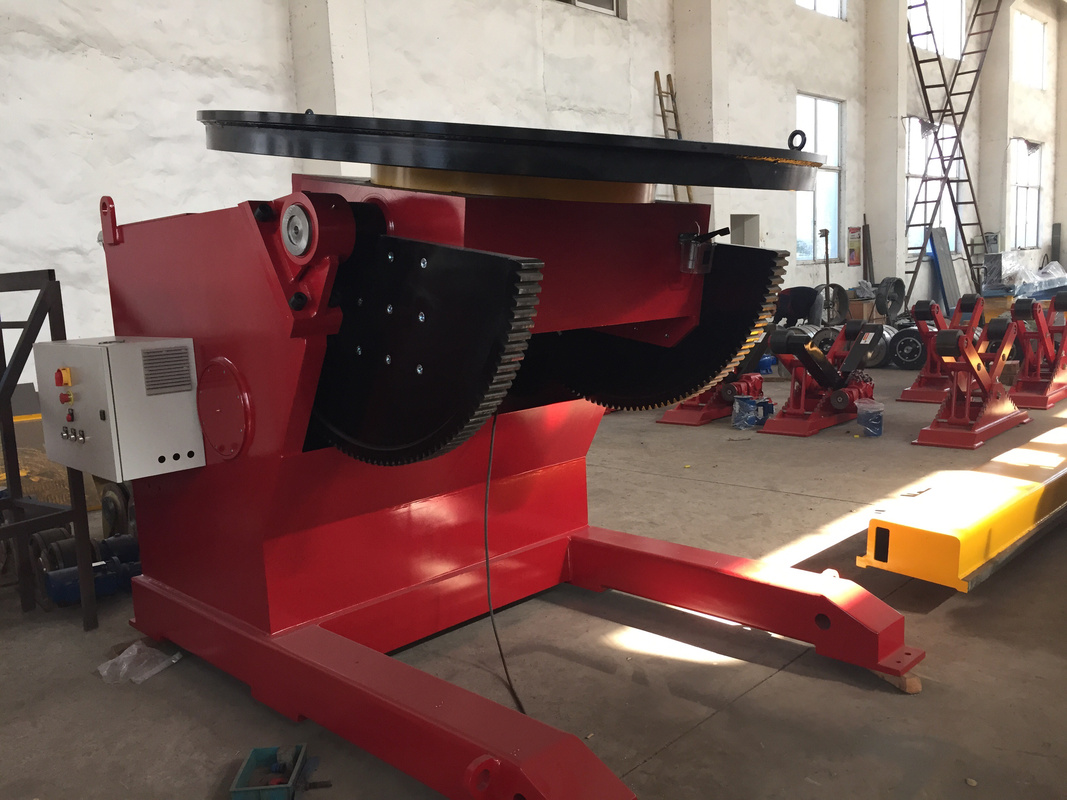
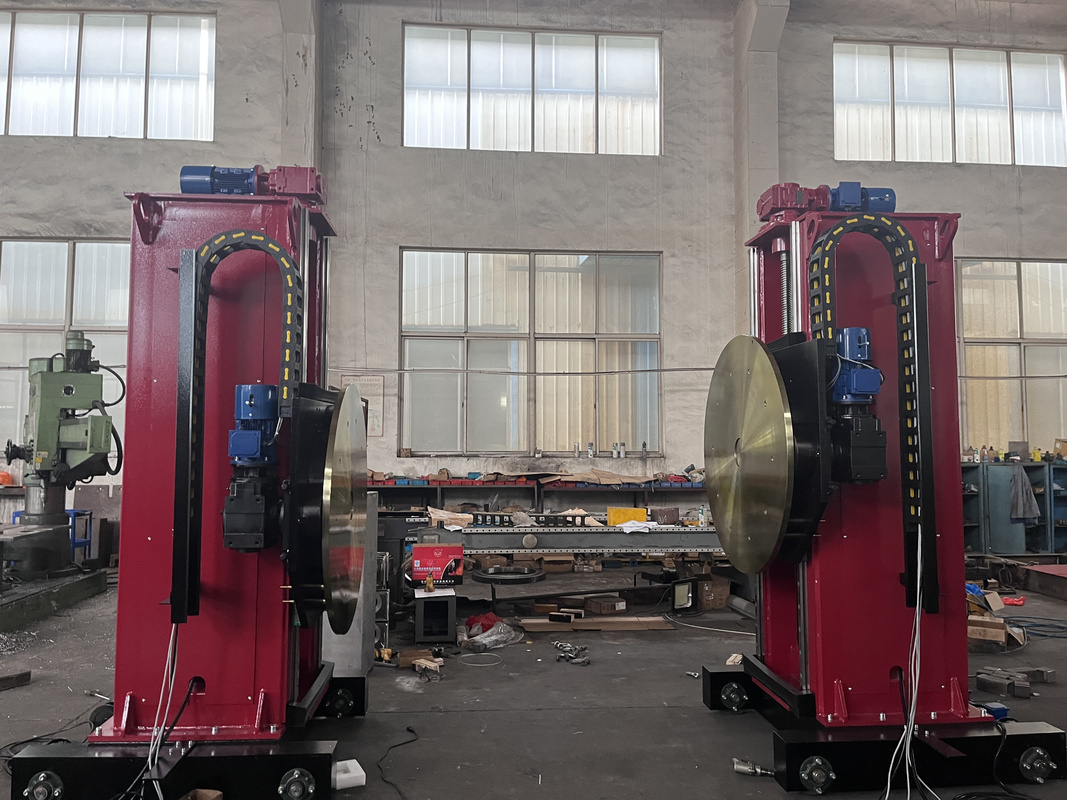
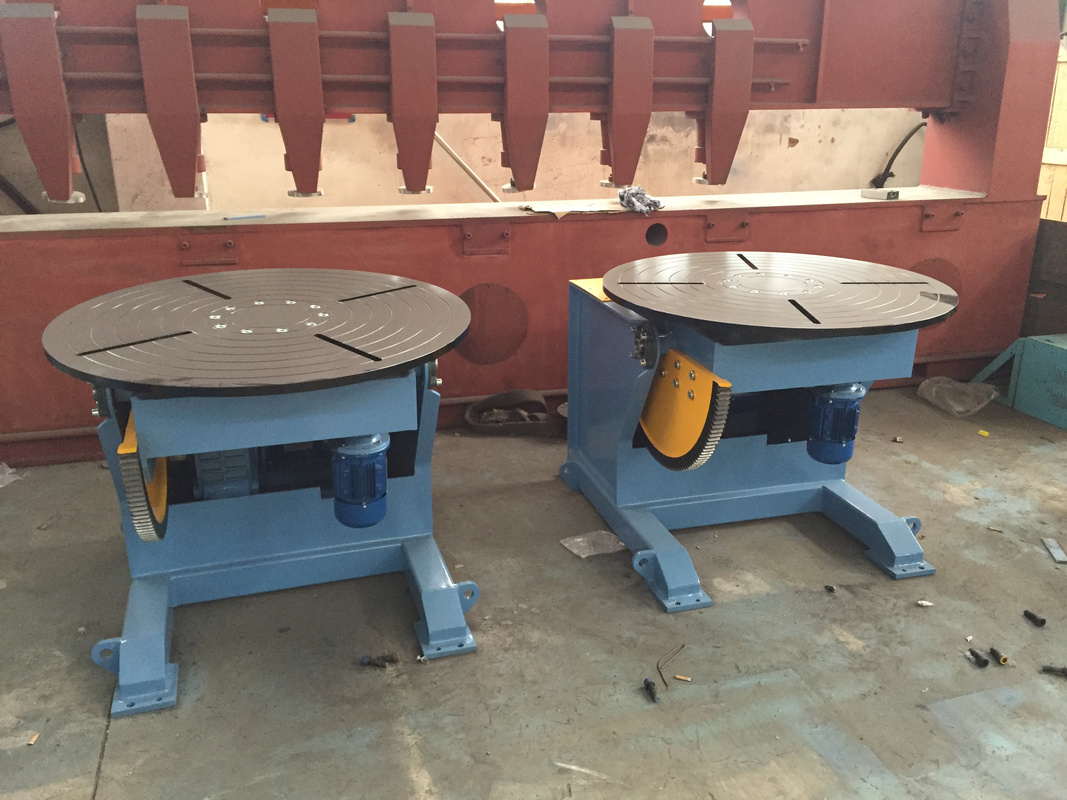
Launch ToolMANUFACTURING FACILITY & QUALITY CONTROL
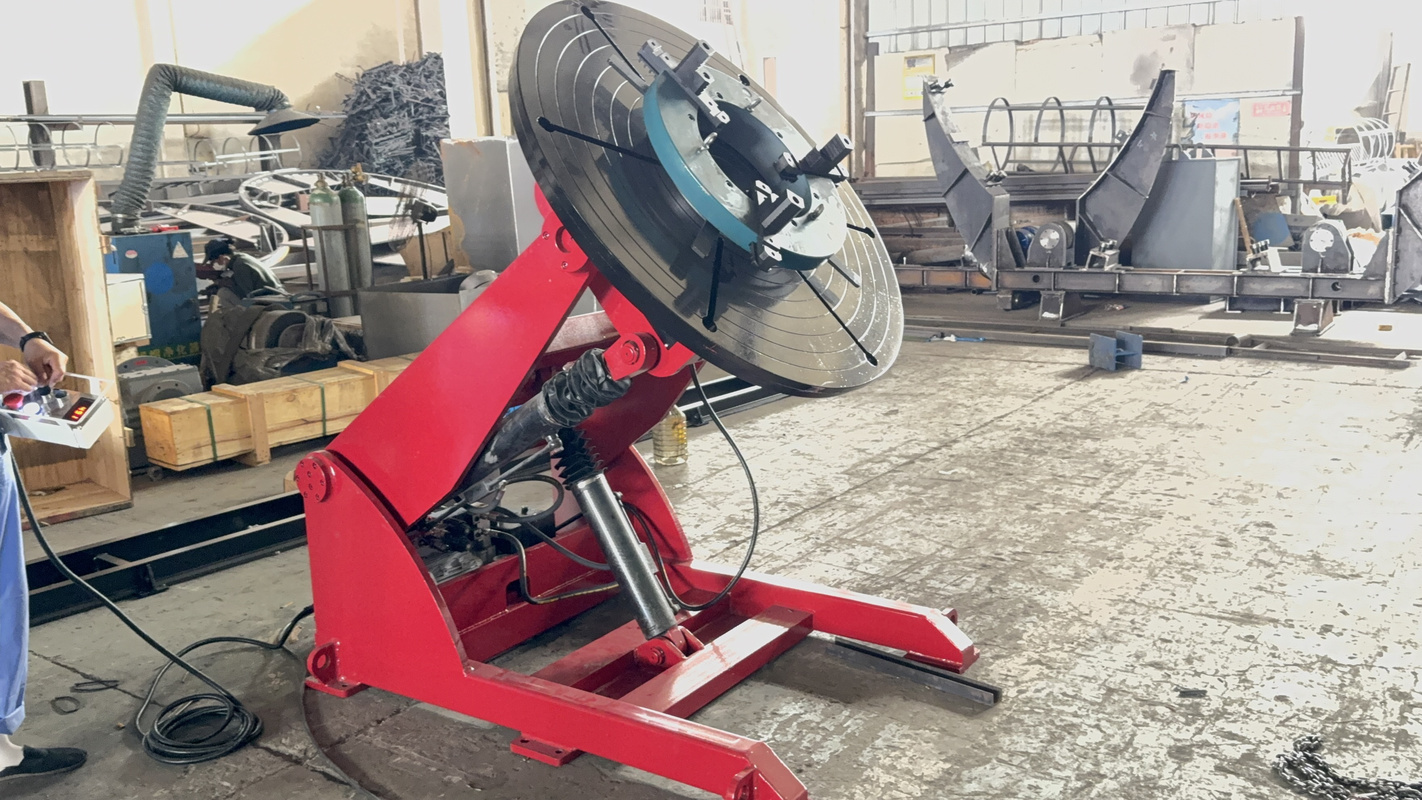
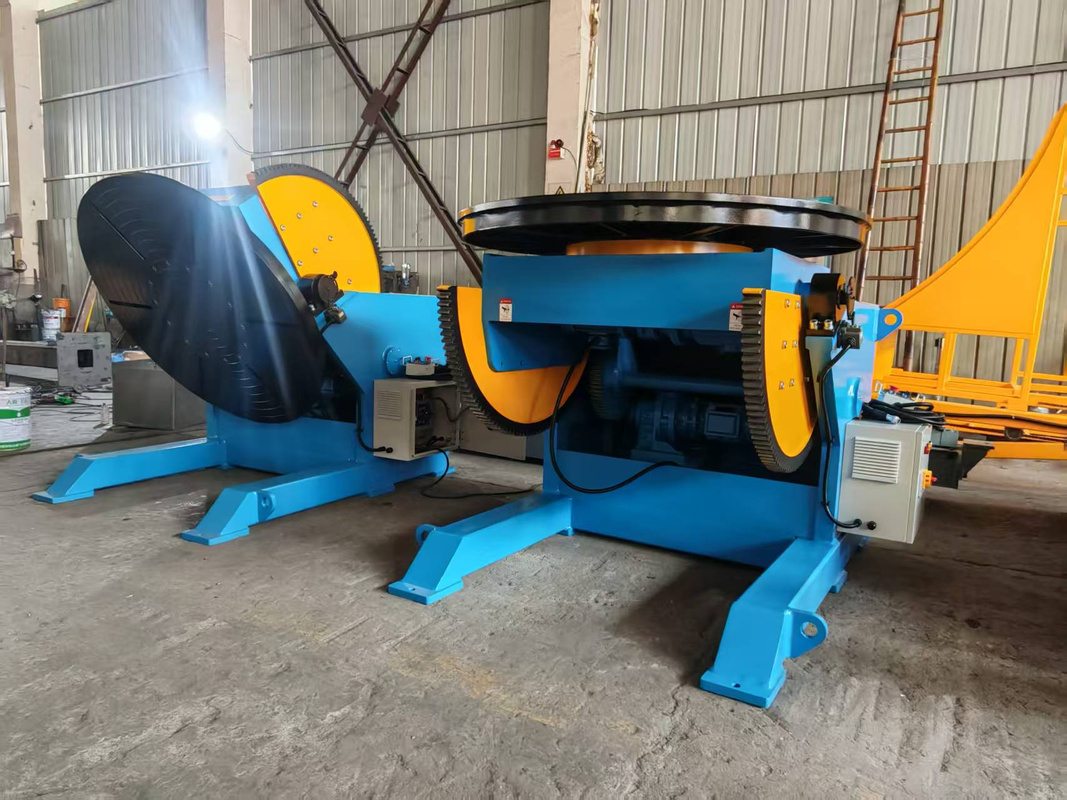
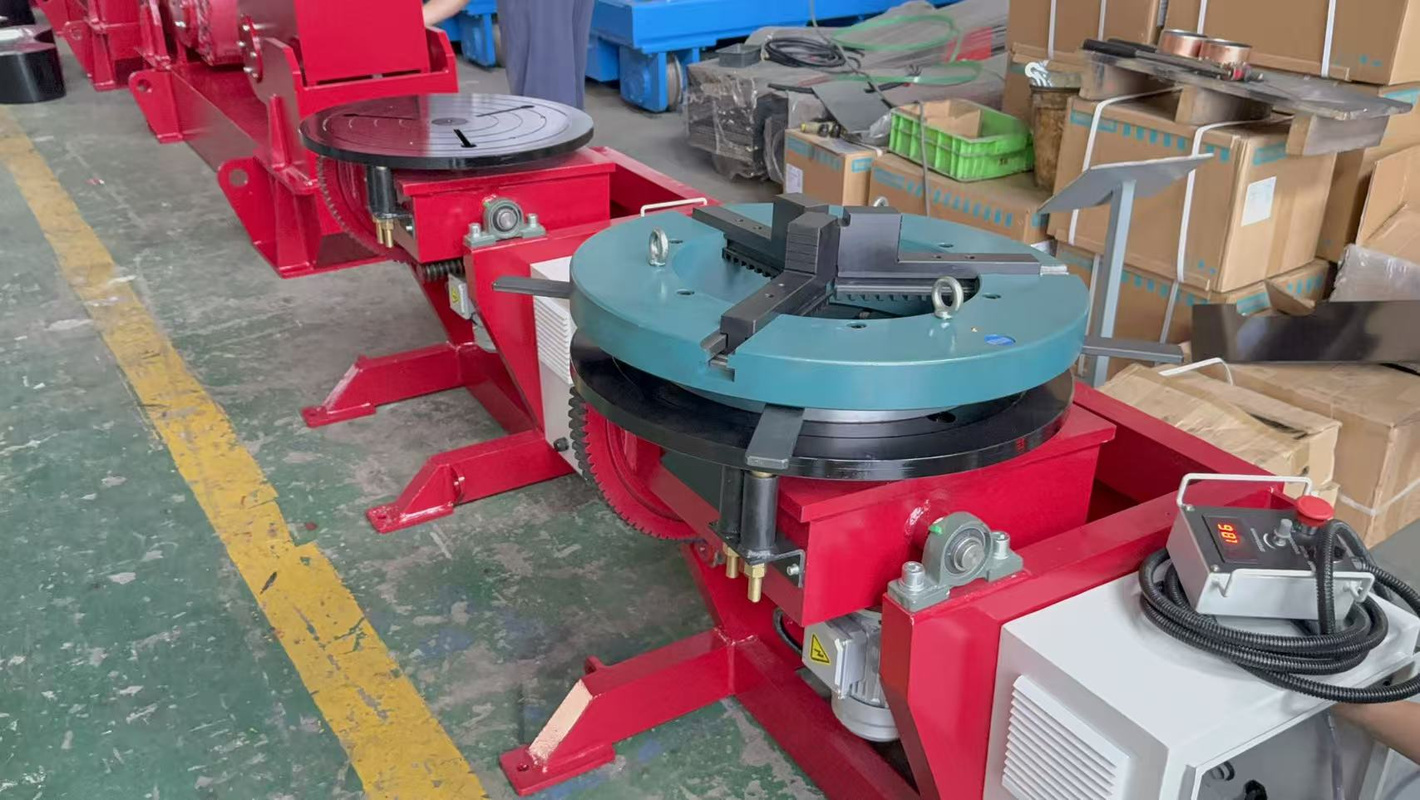
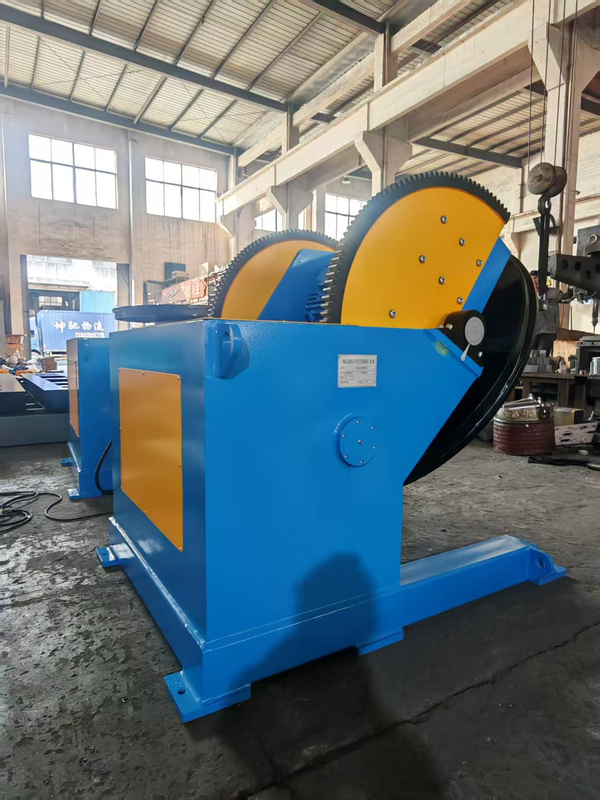
What is the maximum load capacity of an Aubrik heavy duty welding positioner?
Standard HB-Series is 300kg to 20,000kg in eight models. With our optional OEM custom options, these become up to 50,000kg capacity, but our standards conform to the higher ISO 3834-2:2021 standard, not simply adding a heavier frame. It is generally recommended to oversize the workpiece weight requirement by 20 to 30 percent for asset longevity.
Can the positioner integrate with KUKA, FANUC, or ABB robotic welding systems?
Yes – all HB models are “robot-ready” with an on-board Siemens PLC, supporting EtherCAT to seamlessly integrate with the three dominant robot brands. Dual-station operation is optionally available from the factory (load one side, weld the other), and our teams can provide custom integration for non-standard signaling requirements.
How does ATEX or IECEx compliance work for oil & gas applications?
The HB2000 and up are available with the optional ATEX 2014/34/EU Zone 1 Category 2G and NEC 500 Class 1 Division 1 Group C/D hazardous area approvals, as well as API 1104 certification for pipeline applications. All approvals comply with the IECEx scheme requirements and all documentation is assessed by EU-notified bodies for the European market, or ATEX certified laboratories to facilitate entry into North America. This consists of the machine nameplate, declaration of conformity, technical construction file and manufacturer’s quality assurance notification (requestable). Both the HB10T and HB20T come standard with the hazardous area certification option for oil & gas and nuclear applications. Refer to the hazardous zone compatibility matrix in the product section Aubrik to determine the correct model tier for your industry.
What is typical lead time to North America, EU, or Middle East?
Standard Entry-tier: 7-14 days FCA Wuxi. Standard Mid-tier: 14-30 days. Standard Heavy-tier: 30-45 days. Sea Freight: 28-45 days. OEM Customisation: 45-90 days total.
How do you handle eccentric or irregular workpieces such as off-center pressure vessels?
HB T-slot tables allow for adjustable center-of-gravity workholding to accommodate eccentric loads, and we can fabricate custom tables for non-cylindrical parts. For example, our HB20T Pressure-Vessel case study Aubrik shows a 20-ton 8m-long vessel handled on an 2,500mm table, with CG offset.
What is the maintenance schedule and how is spare parts availability handled?
HB positioners feature sealed gearbox systems and wear-resistant, low-maintenance components. The standard maintenance schedule includes lubricating parts every three months, checking clamping integrity monthly, and performance calibrating (positioning) annually. Aubrik provides long-term, stock availability for replacement parts at our Wuxi factory on a first-order, preferred customer basis, along with multi-lingual technical support.