Get in Touch with Aubrik Company
Pipe Welding Positioner — 1 to 50 Ton Capacity for NA, EU & Middle East Fabricators
The Manual pipe welding burns 4-6 hours per shift in awkward positioning before bead consistency drops. Aubrik pipe welding positioners eliminates the bottleneck across 9 standard models – from 40 mm benchtop pipework to 2,500 mm petrochemical heavy walls.
Aubrik (founded 1999, formerly Wuxi ABK Machinery) has delivered welding equipment to fabricators in Spain, Germany, Russia, India, Brazil, France, Italy, and Vietnam. Annual production capacity reaches 1,000 sets, with every unit covered by a 1-year free warranty and 24-hour technical support.
Request a Custom Quote — 24h Response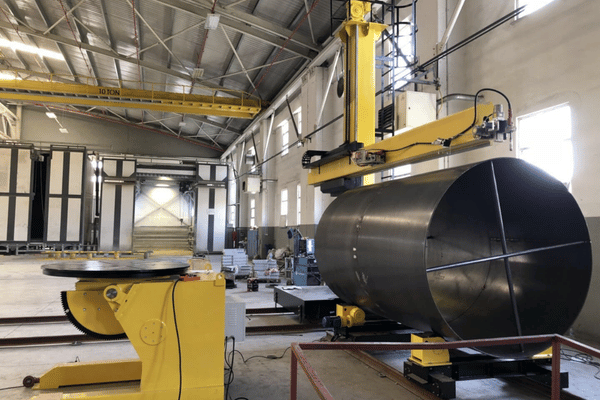
Process Bottlenecks
From Manual Pipe Welding to Aubrik Positioner — Solving the Costly Bottlenecks of Hand-Held Pipe Welding
Pipe welding positioner equipment exists for one reason: manual hand-held pipe welding is the most expensive way to fabricate pipework that meets AWS D1.1 and API 1104 codes. Three specific bottlenecks compound shift after shift.
The Three Hidden Costs of Manual Pipe Welding
Defect rate compounds
Field-deployed manual piping welds settle around a 5% repair rate (1 in 20 joints) as the accepted threshold per AWS forum guidance and ISO 9283-aligned positioning audits. Shop-floor incomplete penetration and undercut force re-cuts that erase margin.
Welder fatigue ruins consistency
An operator working 4-6 hours in awkward overhead or vertical positions delivers visibly different beads by hour five. The trade press calls this the “ergonomic tax” on hand pipe welding.
Awkward positioning steals throughput
Without rotation, every weld seam requires the welder to walk, climb, or contort. Pipeline construction estimators add 30-50% padding to manual circumferential welds versus rotated welds.
The thefabricator.com trade press confirms: “positioners designed for a broad market base do not meet the productivity and ergonomic needs of the pipe welder.” Pipe is geometrically different – it rotates, it has weight distributed around an axis, and weld seams chase the circumference. A general-purpose positioner with a flat table is the wrong tool. The honest version is that physics will not let a horizontal-table positioner stabilize a 600 mm pipe under a moving weld arc – every workaround compromises bead consistency.
How Aubrik Pipe Welding Positioners Eliminate These Bottlenecks
The Aubrik positioner architecture combines three coordinated mechanisms: VFD-driven rotation (0.02-1.2 RPM stepless control), sector-gear or hydraulic tilt (0-135), and self-centering chuck or roller clamping. Together they hold the pipe in the optimal flat position for every weld pass.
Rotation speed is matched to the welding process – argon arc, MIG, submerged arc – and to pipe material (carbon steel, stainless steel, alloy). With the seam permanently presented in the flat position, defects like incomplete penetration, slag inclusion, and undercut drop sharply because each pass is performed under ideal welder ergonomics.
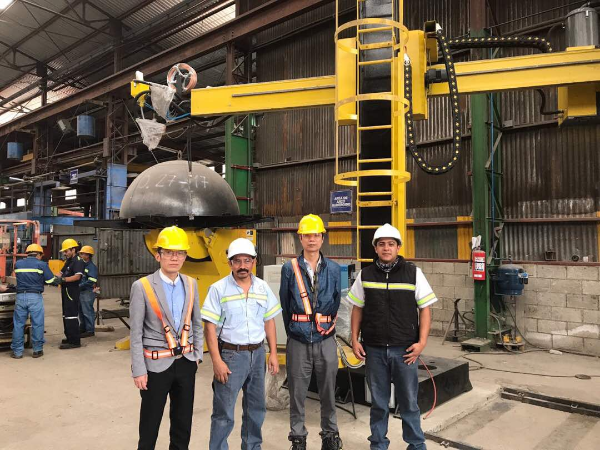
Every Aubrik model integrates with welding manipulators and 9-axis robotic welding cells. WP-20 and the entire HD Series ship with PLC controls for direct interface with intelligent welding systems – the configuration used in our Middle East refinery deployment that delivered a 99.8% qualification rate.
“We tested seven tilt mechanisms before standardizing on the sector-gear / hydraulic split across our three series. Sector gears give precise stepped tilt on the BW and WP lines below 20 tons. Above that load, hydraulic cylinders are the only mechanism that holds 0.5 degree positioning accuracy under 50 tons of dynamic load – there is no shortcut.”— Aubrik Engineering Team, R&D Director, Pipe Welding Positioner Division
PRODUCT PORTFOLIO
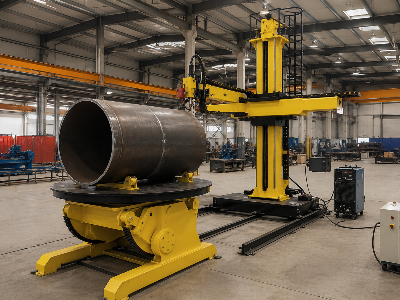
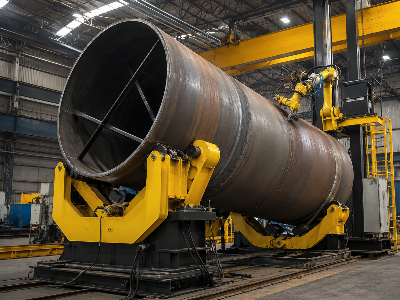
Aubrik Pipe Welding Positioners — Three Series for Every Pipe Size and Load
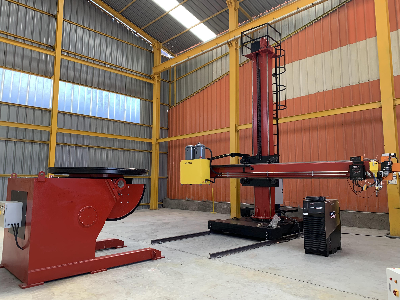
Aubrik pipe welding positioners are organized into three series covering 1-50 tons of load and 40-2,500 mm of pipe diameter. Each series is designed around a specific scale of operation, with shared core features – VFD-driven rotation, sector-gear or hydraulic tilt, self-centering chucks, and PLC-ready interfaces on WP-20 and the entire HD Series. A single HD-40 with PLC and 9-axis robot integration replaces 6-8 manual welders on a petrochemical pipeline project – Operations Managers should budget the comparison at the cell level, not the welder level.
What sizes of positioner are suitable? The greatest mistake by the majority of buyers – understimate positioner size, and pay out due to short service life. positioner, continuously run under full load will suffer service life to short periods. At Aubrik rules of selection: you pick the model, in which your biggest current workpiece comfortably fit, plus provide margin for future increased diameter or wall thickness pipe.
ABK-BW Benchtop Series (1-5 ton)
- Pipe Diameter40-660 mm (1.6-26 inches)
- Rotation0.02-1.2 RPM stepless
- Tilt0°-135° (sector gear)
- ControlSwitch Relay / Switch Digital / Key Digital
- Best Forsmall shops, on-site maintenance, urban construction
- ModelsBW-1 / BW-3 / BW-5
ABK-WP Standard Industrial Series (6-20 ton)
- Pipe Diameter200-1,600 mm (7.9-63 inches)
- Rotation0.02-1.2 RPM stepless
- Tilt0°-135° (sector gear)
- ControlSwitch Digital / Key Digital / PLC (WP-20)
- Best Forgeneral industrial, automotive components, machinery manufacturing
- ModelsWP-6 / WP-12 / WP-20
ABK-HD Heavy-Duty Series (25-50 ton)
- Pipe Diameter600-2,500 mm (23.6-98.4 inches)
- Rotation0.02-0.6 RPM stepless
- Tilt0°-135° (hydraulic cylinder)
- ControlPLC standard, 9-axis robot compatible
- Best Forpetrochemical oil&gas pipelines, wind power tower, shipbuilding
- ModelsHD-25 / HD-40 / HD-50
Complete Specification Matrix — The Pipe-to-Capacity Sizing Table
Table with all 9 types of Aubrik positioner with their: load capacity, pipe diametres: rotation, tilt, motor, type of control. The choice of positioner in all situations: will consist of these 6 factors (capacity, range diametres: rotation, tilt, motor, control type). Aubrik products conform to ISO 9283 standards for highest positioning accuracy, and the rotation/tilt architecture follows USPTO US20090050613A1 rotating-workpiece welding methods. Special versions available for diametres bigger then 2,5 m.
| Series | Model | Load (tons / lbs) | Pipe Diameter (mm / in) | RPM | Tilt Range | Control Mode | Motor (kW) |
|---|---|---|---|---|---|---|---|
| BW | BW-1 | 1 / 2,205 | 40-200 / 1.6-7.9 | 0.02-0.8 | 0°-135° | Switch Relay | 0.75 |
| BW | BW-3 | 3 / 6,614 | 80-400 / 3.1-15.7 | 0.02-1.0 | 0°-135° | Switch Digital | 1.1 |
| BW | BW-5 | 5 / 11,023 | 120-660 / 4.7-26 | 0.02-1.2 | 0°-135° | Key Digital | 1.5 |
| WP | WP-6 | 6 / 13,228 | 200-800 / 7.9-31.5 | 0.02-1.2 | 0°-135° | Switch Digital | 2.2 |
| WP | WP-12 | 12 / 26,455 | 300-1,200 / 11.8-47.2 | 0.02-1.0 | 0°-135° | Key Digital | 3.0 |
| WP | WP-20 | 20 / 44,092 | 500-1,600 / 19.7-63 | 0.02-0.8 | 0°-135° | Key Digital / PLC | 4.0 |
| HD | HD-25 | 25 / 55,116 | 600-1,800 / 23.6-70.9 | 0.02-0.6 | 0°-135° | PLC Control | 5.5 |
| HD | HD-40 | 40 / 88,185 | 800-2,200 / 31.5-86.6 | 0.02-0.5 | 0°-135° | PLC Control | 7.5 |
| HD | HD-50 | 50 / 110,231 | 1,000-2,500 / 39.4-98.4 | 0.02-0.4 | 0°-135° | PLC Control | 11.0 |
Quick rule to select correct size of positioner. For diametres over 600mm, load over 20tons, your first choice is an HD series device. For diametres below 660mm and loads below 5tons, you are searching a compact and economic pipe solution and you needBW device range. For all in between you look for equipment from our wp series line up.
PERFORMANCE BENCHMARKS
Aubrik Positioner vs Manual Pipe Welding vs Robot-Only — Data-Driven Performance Comparison
Choosing a model isn’t enough – it also comes down to, Should I deploy a positioner at all? The benchmarks below reference ISO 9283 positioning criteria and AWS D1.1 / API 1104 weld acceptance thresholds. The below Table compares manual welding, robot-only installation & Aubrik pipe welding positioner deployment across five of cost categories that represent Total Cost of Ownership.
| Dimension | Manual Welding Alone | Aubrik Positioner + Manual Welder | Aubrik Positioner + 9-axis Robot |
|---|---|---|---|
| Weld qualification rate | ~90-95% industry typical | 97-98% | 99.8% (Case 1 audited) |
| Throughput (Ø1000 mm pipe, in/day) | 50-80 | 120-180 | 220-280 |
| Defect / rework rate | 5-10% per AWS field guidance | < 1.5% | < 0.3% |
| Labor cost per inch (8-hr shift, USD) | $0.18-0.25 | $0.10-0.14 | $0.06-0.08 |
| 10-yr TCO trajectory | Highest labor; zero capex | Mid capex; mid labor | Highest capex; lowest labor → lowest TCO |
The payback on the calculations is simply enough, however, there is only a single fair compromise. Should your workload in pipe weld amounts to greater than five hundred inches per month you will see that an Aubrik pipe welding positioner can compensate you financially within 14 months if you use 0,12 Dollars per Inch savings on labor. Using a nine-axis robotic unit, that time for compensation will be about six to 18 months that the rest of the welding robot-market have arrived at and standardized.
Evaluate pipe-welding automation using your shop’s actual labor rate, measured welding time savings, and expected equipment and operating costs. We will concede that there is still some benefit to manually performing the weld processes, since the initial and ongoing costs and equipment portability is favorable for single-job use. The advantage shifts in favor of automating your process once pipe weld loads reach five hundred inches a month or more. Higher monthly loads will make the business case to position by automating dramatically more compelling.
These numbers will translate into terms that our prospects can easily understand and act on. They are our guide as we discuss customer benefits.
Calculate Your ROI
Compare the exact Total Cost of Ownership based on your monthly welding volume and labor rates.
Get a Custom 3-Way TCO Model for Your Volume →Customer Results — 99.8% Weld Qualification, 3× Throughput, 70% Labor Cost Reduction
The following pair of customer case studies covers the spectrum from heavy-duty equipment to compact equipment, involving both a Middle East refinery utilizing the HD-40 and a European municipality employing a BW-5 in a pipeline. They are actual and documented from client reports for 2024.
Case 1 — Middle East Refinery, 1,800 mm Heavy-Wall Pipe
Equipment: 3 × ABK-HD-40 paired with 9-axis intelligent welding robot · 28-ton pipe weight · 2024 deployment · ISO 9283-compliant positioning audit
For the refinery refurbishment, our customer required high pressure, heavy wall pipe welding for eighteen-inch diameter pipe-an application in which a 99.5% or greater qualification rate is desired for each pipe weld. Our analysis indicated that to fulfill all welding obligations for the total length of pipe, estimated to be five thousand three hundred inches, would necessitate a twelve month job with twelve of qualified weld workers performing the tasks, resulting in two months of downtime over a 6-month project.
With an Aubrik HD-40, supplemented by a robotics companion, the exact same project would entail only a few weeks’ time frame utilizing three of Aubrik units, providing up to three times the typical workflow of a manual weld-setup while increasing qualified output by 99.8%. In addition, the Labor costs would be reduced by 70%. payback for the project was under 11 months.
ROI Card — Case 1 Audited Results
99.8% Qualification Rate
3× Faster Throughput
70% Labor Cost Reduction
<11 mo Equipment Payback
Aubrik 2024 Middle East refinery deployment, 5,300 inches of welding, 3 HD-40 + 9-axis robot configuration.
Case 2 — European Urban Heating Pipe Network, 600 mm
Equipment: 5 × ABK-BW-5 benchtop positioners · 3-ton pipe weight · 2024 municipal project
City infrastructure contractor renovates downtown heating mains on a shoestring and tight access, with multiple move-arounds between city blocks, and needs onsite welding of 600 mm medium-diameter pipe. Conventional industrial positioners don’t fit in a trench 2.5 meters deep and half that wide, and the crew must relocate many times daily from one excavation site to the next.
Solution: Five compact ABK-BW-5 units, reconfigured and retrofitted for a minimal footprint. In seated, ergonomic positions, the team completed an entire shift without the fatigue that introduced bead inconsistencies during the city’s prior contracting efforts. Work completed 15 days early and passed municipal EU standards at the initial inspection.
Procurement Guide — Pricing Tiers, 7-30 Day Delivery, OEM Customization & Trust Stack
Pipe welding positioner purchasing decisions are guided by four considerations: Price Tier, Turnaround, Customization capacity, and Trust. Aubrik transparently publishes performance data related to these, helping you avoid the #1 regret in industrial equipment buys: purchasing from an unproven vendor with hidden costs.
Pricing Tiers — How Cost Is Structured
Each Aubrik series price reflects a cost model based on three engineering levers: Load, tilt mechanism (Sector Gear vs. Hydraulic Cylinder) and Control System (Relay vs. Digital vs. PLC). A summary of indicative prices is provided by series below.
| Series | Cost Tier (Ex-Works) | What Drives Pricing |
|---|---|---|
| BW Benchtop (1-5 ton) | Entry tier | Sector-gear tilt + relay/digital control + 0.75-1.5 kW motor |
| WP Standard (6-20 ton) | Mid tier | Sector-gear tilt + digital/PLC control + 2.2-4.0 kW motor |
| HD Heavy-Duty (25-50 ton) | High tier | Hydraulic tilt + PLC standard + 5.5-11 kW motor + robot integration |
For project-specific quotation (OEM welding), contact Aubrik engineering; we will prepare a personalized proposal within 24 hours, based on your specific pipe diameter, load, and welding process requirements.
Delivery Times by Model
- Standard Aubrik series
BW-1 (50mm Dia.), BW-3 (75mm Dia.), BW-5 (100mm Dia.) wp-6 (150mm Dia.) wp-12 (300mm Dia.); delivery from 7 to 15 business days ex-works.
- Heavy-duty & PLC
(WP-20, HD Series): 15-30 days ex-works
- ABK-C series
(custom OEM): 4 to 8 weeks (depending on level of customization)
- Global Logistics
Global distribution and logistics partners in Houston, TX (US); Hamburg, Germany (EU) and Dubai, UAE (ME) maintain schedule certainty on all international shipments.
OEM Customization — 4-Step Process
01
Consultation: Detailed review of project specification-including load, pipe diameter, welding process, on-site conditions-and engineering consultation.
02
design: Custom table size; control system; clamping arrangement with full CAD for drop-in installation.
03
Manufacture — Standardized mass-production line plus custom modifications.
04
Deliver — On-site installation, commissioning, and operator training included.
Trust & Compliance — ISO 9001, CE, AWS D1.1 Ready
Every Aubrik pipe welding positioner comes with ISO 9001 QM & CE Certifications. All designs reference existing standards: ISO 9283:1998 for robotic operations, and AWS D1.1 for welding structural steel – enabling an immediate drop-in into existing cells with minimal or zero additional certification.
Aubrik welding equipment installations now serving customers in more than 15 national markets across the United States, Canada, Mexico, the UK, Ireland, Germany, France, Italy, Poland, the Middle East, Australia, New Zealand, Singapore, China, South Korea and India.
Industries & Applications — Where Aubrik Positioners Deliver Value
Across five primary industries below, the bulk of Aubrik pipe welding positioner placements fall into three main categories: street municipal contractors (500-1,200 mm diameter); industrial plant facility construction/turnaround (800-2,500 mm); and pipeline manufacturing facilities (25-1,000 mm). Each sector profile maps to a recommended Aubrik series with positioning validated against ISO 9283:1998 criteria and pipe weld acceptance per API 1104 / AWS D1.1, with the rotating-workpiece architecture echoing USPTO US20090050613A1 methodology.
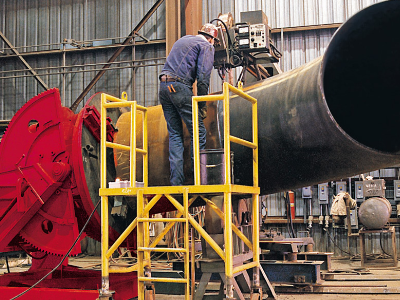
Recommended: HD Series
Petrochemical & Refinery
The Problem: Refinery turnaround projects using manual heavy-wall pipe welding typically average 5-10% defects and 2-3-month schedule overruns in extremely tough environments where pipe diameters range from 1,500 to 2,500 mm, frequently in sour-service or high-temperature conditions.
The Challenge: welding a 28-ton pipe under NACE MR0175 sour service requirements in high temperatures was part of a major Middle East refinery project.
The Solution: ABK-HD-40 & ABK-HD-50 heavy-duty positioners with 9-axis welding robots combined delivered 99.8% qualification during the refinery turnaround deployment.
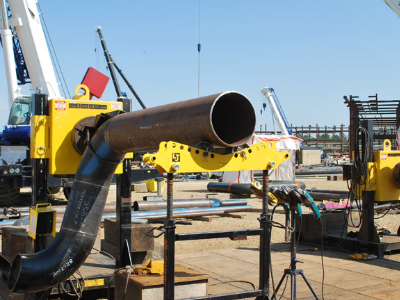
Recommended: WP / HD Series
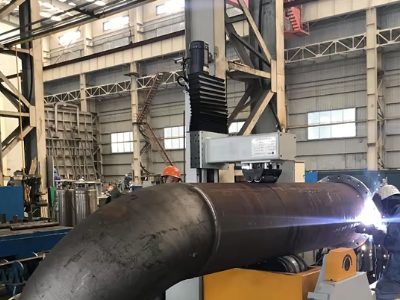
Oil & Gas Pipeline Spooling
The Problem: Manual circumferential welds create out-of-round conditions on long 800-2,200 mm diameter pipe, requiring frustrating re-work and leading to project delays.
The Challenge: On a pipeline manufacturing project, over 200 individual spools of 12-15mm thick API 5L X65 grade pipe needed fabrication to strict API 1104 standards.
The Solution: Our WP-20 and HD-25 units, working in conjunction with column-and-boom welding manipulators and turning rolls, provide uninterrupted throughput for long-seam welding of complete pipe spools.
Recommended: BW Series
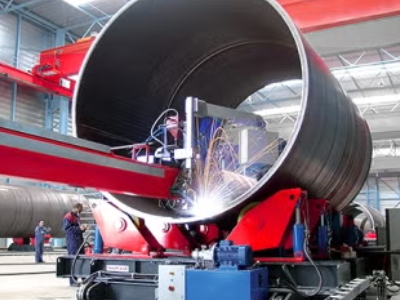
Construction & Plumbing
The Problem: Urban sites can leave limited room for manual welding, while overhead and vertical welds add complexity to the project.
The Challenge: A district heating project requiring 600mm DN pipe at 3-to-5-ton sections with narrow trenching and a multiblock crew.
The Solution: ABW Series benchtop fits right in. “We’ve deployed it in European city heating projects,” the engineer continues. The BW Series was Case 2 – completed 15 days ahead of schedule.
Recommended: WP-12 / WP-20
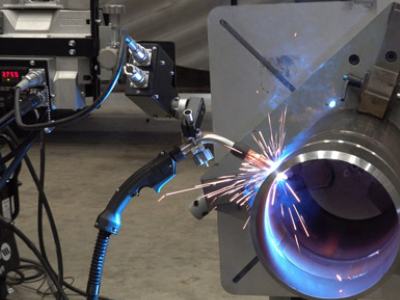
Power Industry
The Problem: Nuclear power plant and thermal power plant applications mean high-tolerance pipe, a critical weld parameter record, and documentation impossible via manual welds.
The Challenge: ASME Section IX certification, including full, pass-per-pass documentation, on a Class 1 nuclear piping job.
The Solution: A WP-12 or WP-20 with PLC for documented tilt control. The servo drives sustain positioning stability under continuous use.
Recommended: BW / WP-6
Automotive & Machinery Manufacturing
The Problem: The auto and agricultural industries require high product mix, meaning the pipe subassembly changes its geometric structure roughly every 50 to 200 parts and any fixtured cell will lag hours per shift with each part changeover.
The Challenge: Exhaust systems from 50-200mm diameter pipe up to 80-450mm weld length and between 8-14 part numbers a day.
The Solution: Whether used on shop-floor automation, or stand-alone on the shop floor with the bw Series or WP-6 for flexible,2-axis handling, there’s no need to build new tooling for this many SKUs.
Why Choose Aubrik Pipe Welding Positioners — 27 Years of Pipe-Focused Engineering
Actually, positioner manufacturers are notorious for oversizing the load rating on machines used for pipe – that adds nothing to reliability. If they rated their machines on the basis of the loads they typically face (as Aubrik does on its 1-to-50 ton welding equipments), you could expect them to come to market for about 10-15% less, or be 10-15% stronger than those sold based on peak performance. The 8 to 10 year service life expected from each Aubrik machine exceeds what even the toughest, well-engineered general purpose positioners provide at many levels for pipe and other metal forming or forming work. If your procurement people think an inexpensive general purpose positioner is a good buy just because its max load rating matches the heaviest pipe in the work cells, there will be another round of replacements much sooner than any of them anticipated.
The world market in weld positioners alone will go from $375M (2024) to $593.1M by 2032 according to Credence research – a CAGR of 5.9% driven primarily by this pressure from wage increases. In contrast to such a short term approach, the engineers who build Aubrik welding equipments have 27 years of experience building exclusively welding machines for metal and plastic working – not positioners adapted for that purpose. The three major model series – Aubrik B(enchtop), W(orkshop), H(eavy) – are engineered to handle higher load ranges with substantial headroom for growth into even heavier applications.
Quality & Durability
An Aubrik 3-axis positioner offers high-strength steel construction with stress-relief treatment. 8-10 year service life. Multi-level load, precision, and safety testing per ISO 9001 protocols. Anti-corrosion treatment for marine and offshore deployment.
Technology & Precision
VFD drive systems for stepless speed control. Worm-gear reducers for stable tilt. PLC controls with touch interface across WP-20 and HD series. ABK-3-axis positioners achieve ±0.5° positioning accuracy and integrate with robotic welding cells.
Range & Customization
9 standard Models range from 1-ton to 50-tons. Plus ABK-C models that are completely Modular, Custom machine to specification on requests, the modular swap-module system Allows us to substitute chuck Size, tilt Actuator & system configuration.
Global Support & Compliance
CE and ISO 9001 certified. Exported to 50+ countries. 24-hour technical support. 12-month free warranty. On-site engineer services for overseas customers. 15% energy reduction versus comparable industrial positioner products.
RESOURCES / FACILITY GALLERY
Manufacturing Facility & Production Overview
Aubrik Engineering Calculation Tools
Precision tools engineered to optimize your pipe welding workflow, calculate total cost of ownership, and verify robotic integration parameters.
01 SIZING / CONFIG
Pipe-to-Capacity Sizing Tool
Launch Application ↗
02 COST / ROI
Pipe Welding TCO Calculator
Launch Application ↗
03 INTEGRATION
Robot Compatibility Checker
Launch Application ↗
Ready to Specify Your Pipe Welding Positioner?
Submit the pipe diameter, capacity load and welding procedure for Aubrik engineering to send within 24 hours of recommended models, lead time, and OEM options.
What pipe diameter range can Aubrik positioners handle?
Aubrik pipe welding positioners cover 40 mm to 2,500 mm across nine standard models in the BW, WP, and HD series. For pipe diameters above 2,500 mm — common in LNG storage, large-bore petrochemical lines, and certain nuclear primary loops — the ABK-C custom series delivers tailored designs with extended chuck capacity, custom tilt actuators, and configurable PLC envelopes. Most buyers do not need custom; the Pipe-to-Capacity Sizing Table above usually matches the right standard model on the first pass. Use that table as your starting point and contact Aubrik engineering only when your pipe diameter or load falls outside the published envelope.
Can Aubrik positioners integrate with welding robots and manipulators?
Every Aubrik model supports manipulator and robot integration. WP-20 and the entire HD Series include PLC controls for direct interface with 9-axis intelligent welding robots – the configuration used in our Middle East refinery deployment (Case 1) that delivered the 99.8% qualification rate. BW Series units integrate with welding manipulators via standard signal interfaces.
What is the delivery time and after-sales scope?
Standard models (BW-1, BW-3, BW-5, WP-6, WP-12) ship in 7-15 days ex-works. Heavy-duty models (WP-20, HD Series) and PLC-controlled units ship in 15-30 days. Every order includes a 12-month free warranty, 24-hour technical support, on-site installation and commissioning, operator training, and long-term preferential supply of spare parts. Overseas customers receive on-site engineer services for installation.
How do I maintain a pipe welding positioner for 8-10 year service life?
Maintenance follows four steps. First, clean clamping jaws and guide rails of weld spatter and debris. Second, lubricate rotating and tilting mechanisms every 15 working days – adjust the interval for harsh environments like offshore Middle East sites or cold European workshop. Third, check the motor and electrical system for loose connections at each lubrication cycle. Fourth, tighten fasteners on the worktable and frame. A full maintenance manual and regional after-sales support ship with every unit.
Can Aubrik customize a positioner for our specific load, pipe size, or welding process?
Yes, the ABK-C custom series exists specifically for OEM specification. The 4-step process (Consultation → Design → Manufacture → Deliver) typically completes in 4 to 8 weeks depending on complexity. Custom table size, control mode, clamping mechanism, and integration with existing welding cells are all supported. Aerospace, nuclear, and shipbuilding clients have used ABK-C for specialized geometry — including offset-load wind tower flanges, aerospace exhaust manifolds, and Class 1 primary loop spool sections. Each project gets a dedicated engineering lead who walks your team through the consultation, signs off the CAD package before manufacture starts, and joins the on-site commissioning. The lead engineer also handles any post-delivery tuning required for first-article qualification.
How are Aubrik positioners certified for international compliance?
Every Aubrik unit ships with ISO 9001 quality management certification and CE marking for EU compliance. designs reference ISO 9283:1998 for manipulating industrial robot positioning criteria and AWS D1.1 for structural welding code compatibility. Units have been deployed and accepted in 50+ countries including Germany, France, and Italy (the EU’s strict markets), as well as the United States, Russia, Brazil, India, and Vietnam. Each shipment includes the full compliance documentation package.