Get in Touch with Aubrik Company

Last updated: October 2026
The best boiler production equipment manufacturers depend on the job: Aubrik for configurable panel and tube-welding packages, Pemamek for integrated tube shops, Schwarze-Robitec for boiler bending, Faccin Group for shell and head forming, and Polysoude for tube-to-tubesheet welding. For a high-performance production line, start with the component you need to manufacture and the operation you need to perform.
A boiler factory purchases equipment to manufacture pressure parts. The finished boiler may deliver steam and hot water, but these duties don’t indicate the production equipment needed on the factory floor. For an industrial boiler project, start with the parts used in steam generation, and the operations that create them. A tube bender, shell roll, and orbital welding system each solve a different production problem. This guide compares 19 manufacturers worldwide, based on these practical differences.
Quick Picks
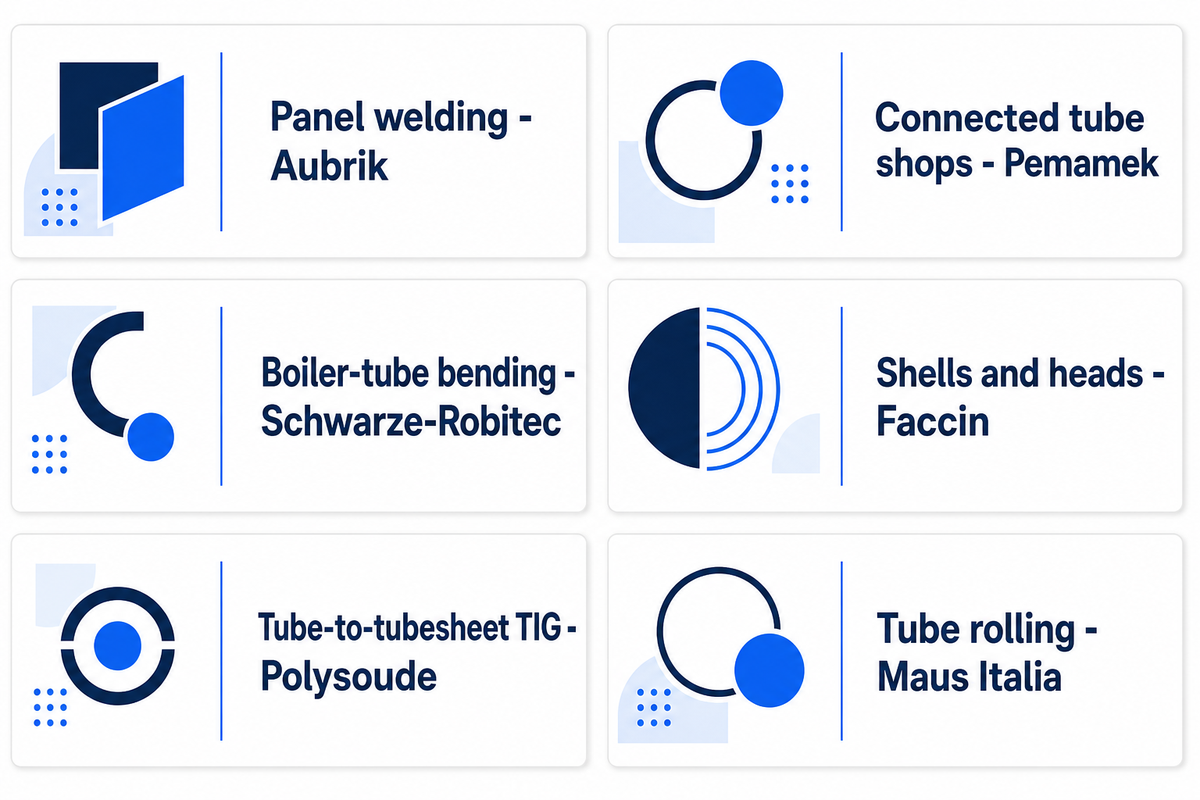
- Best for configurable membrane-panel and tube-welding packages: Aubrik.
- Best for coordinated water-wall and tube-shop automation: Pemamek.
- Best for dedicated boiler-tube and membrane-wall bending: Schwarze-Robitec.
- Best for shell rolling alongside dished-head forming: Faccin Group.
- Best for orbital TIG tube-to-tubesheet welding: Polysoude.
- Best for automated tube rolling, facing and tubesheet assembly: Maus Italia.
Disclosure: This guide is published by Aubrik. We list ourselves first because this is our website, not because we claim to be the market leader. The other 18 manufacturers are grouped by what they’re best for, in no particular order within each group.
How We Selected These Boiler Production Equipment Manufacturers
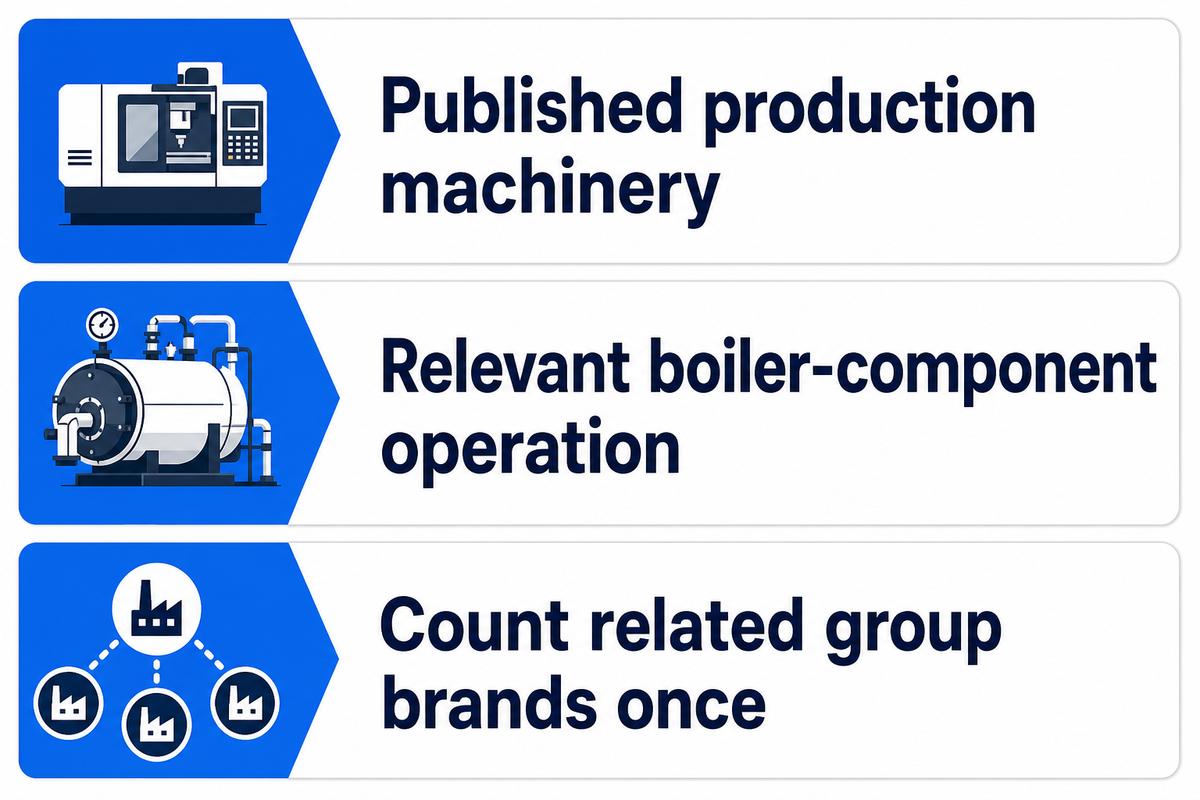
Company information was confirmed against official sites and public sources in October 2026. Manufacturers with published production machinery, powered installation equipment or an identifiable system integration role, relevant to making boiler components, were shortlisted. The screening covered company identity, equipment families and the work each system performs. Trading companies, distributors, sourcing platforms, directories, media sites and used-equipment dealers were excluded, along with finished-boiler manufacturers that didn’t document an equipment offer. Related brands in the same group are counted as one.
“Best for” describes the application fit for a given equipment range. This doesn’t reflect measured rankings for reliability, worldwide sales or market share. The scope includes large fabrication systems and smaller specialist stations because both can be necessary in a boiler shop. A supplier for one station is explained by that function rather than by a whole-factory contract.
For readers still defining the process sequence, the boiler manufacturing process guide outlines the main fabrication steps and how they interconnect. Here, the focus will be on which manufacturers to consider once the principal operation is defined.
Compare 19 Boiler Production Equipment Manufacturers
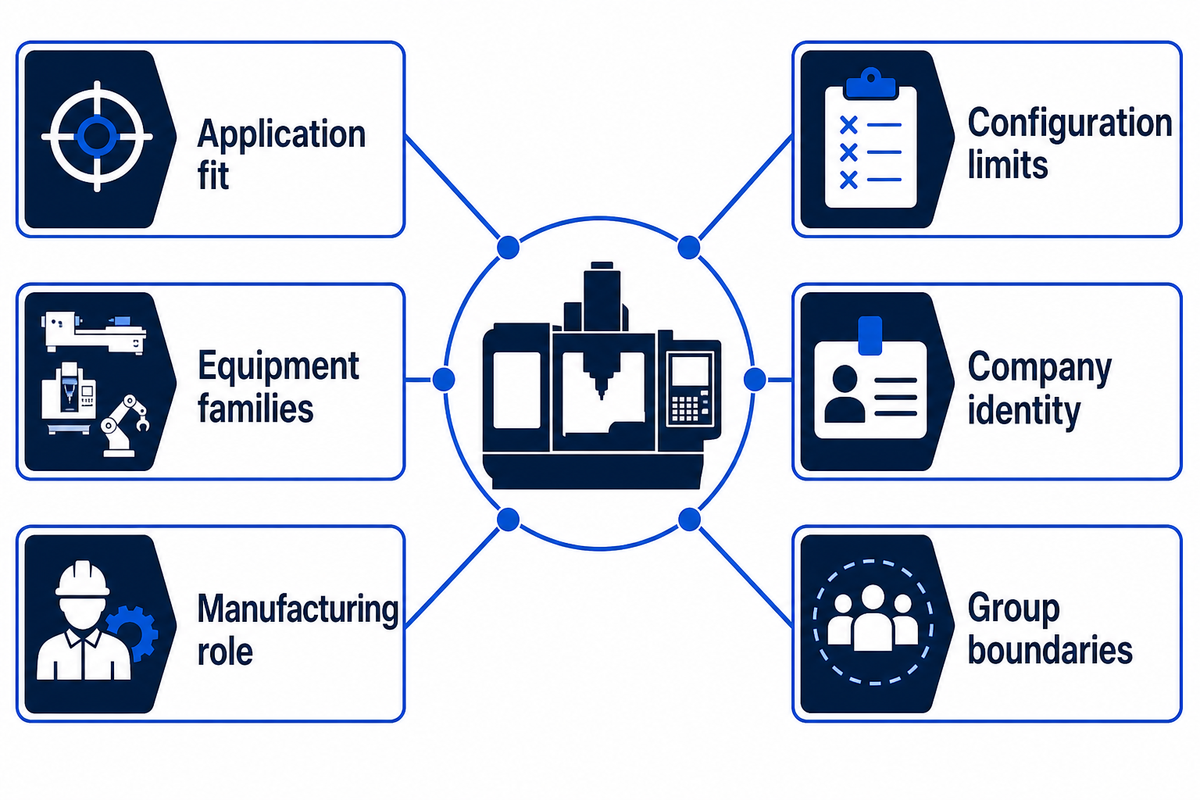
Boiler Factory Equipment Map
The Boiler Factory Equipment Map groups manufacturers by the component and operation their published equipment addresses.
Use the table to form a process-specific shortlist. Compare a membrane-panel package with another panel package, or an expander-and-drive system with another installation system. Prices and capacities of unrelated operations aren’t a valid basis for comparison. Founding dates below follow company histories; where a business origin differs from the present entity, both are identified.
| No. | Company Name | Headquarters | Founded Year | Best For | Brief Introduction | Main Equipment | Key Advantages | Potential Disadvantages | Official Website |
|---|---|---|---|---|---|---|---|---|---|
| 1 | Aubrik | Wuxi, China | 1999 | Coordinated panel and tube work | Welding machines and line integration | Panel welders; tube welders; benders | Selectable station packages | Define shell and inspection scope separately | https://aubrikmc.com/ |
| 2 | Pemamek | Loimaa, Finland | 1970 | Automated water-wall and tube shops | Production-system manufacturer | Panel lines; tube preparation; welding | Connected handling and process stations | Layout and transfer engineering required | https://pemamek.com/ |
| 3 | Schwarze-Robitec | Cologne, Germany | 1903; tube-bender production began in 1930 | Boiler coils and wall bending | Specialist tube-bending manufacturer | Boiler benders; twin-head systems | Dedicated boiler and membrane concepts | Joining remains a separate operation | https://schwarze-robitec.com/ |
| 4 | Pines Engineering | Warren, Ohio, USA (U.S. operations) | 1940 in its history timeline; 1943 marks early rotary-bender development | Heavy-wall tube bends | ParkOhio bending-equipment business | CNC benders; H&H tooling | Machine and tooling coordination | Capacity depends on tube geometry | https://pines-eng.com/ |
| 5 | BLM GROUP | Cantù, Italy | 1960, according to the company’s profile | Formed heating-system tubes | Tube-processing machinery group | SMART; 4-RUNNER; AST8-VE | Bending and end-forming cells | Heating components, not whole power boilers | https://www.blmgroup.com/ |
| 6 | AMOB | Vila Nova de Famalicão, Portugal | 1960 | Custom tube-forming cells | Portuguese machinery manufacturer | Tube benders; end-forming cells | Part-specific automation engineering | Custom tooling depends on drawings | https://amob.co.uk/ |
| 7 | DAVI | Cesena, Italy | 1966 | Cylindrical boiler shells | Plate-rolling machinery manufacturer | MCA; MCB; MCE; handling | Rolling with feed and ejection | Example sizes are configuration-specific | https://www.davi.com/ |
| 8 | HAEUSLER | Duggingen, Switzerland | 1936 | Boiler-shell plate forming | Metal-forming machinery builder | EVO; VRM; FLEX; HDR | Three- and four-roll choices | Welding equipment supplied separately | https://haeusler.com/en/ |
| 9 | Faccin Group | Visano, Italy | 1968 business origins; Faccin Srl established in 1977 | Shells and dished heads | Faccin, Boldrini and Roundo group | Plate rolls; presses; flanging | Complementary forming operations | Several modules, not one universal machine | https://www.faccingroup.com/ |
| 10 | Linsinger | Steyrermühl, Austria | 1946; predecessor activity dates to 1939 | Boiler-head edge preparation | Milling and sawing manufacturer | ORBIT head-edge machinery | Automatic measuring and alignment | Head forming is a different process | https://www.linsinger.com/ |
| 11 | Polysoude | Nantes, France | 1961 | Tubesheet TIG welding | GWT orbital-welding business | TS heads; P6/P6 HW | Fusion and wire-fed configurations | Head access limits configuration | https://www.polysoude.com/ |
| 12 | Maus Italia | Bagnolo Cremasco, Italy | 1961 business origins; Maus Italia entity established in 1972 | Automated tubesheet assembly | Tube-tool and automation builder | MA systems; Matig 502 | Rolling, facing and welding options | Not a membrane-panel production line | https://www.mausitalia.it/ |
| 13 | Elliott Tool Technologies | Dayton, Ohio, USA | 1892 Wiedeke origins; acquired by Elliott in 1969 | Tube installation stations | U.S. tube-tool manufacturer | Expanders; rolling motors; preparation | Installation tools and documentation | Match wall, diameter and reach | https://www.elliott-tool.com/ |
| 14 | T.C. Wilson | Queens, New York, USA | 1925 | Boiler tube rolling and flaring | U.S. tube-equipment manufacturer | Enforcer-500; Series 114/116 | Distinct rolling and flaring options | Select tools for the required end form | https://www.tcwilson.com/ |
| 15 | Powermaster | Navi Mumbai, India | 1972 | Powered tube expansion | Indian industrial-tool manufacturer | Hydex; HEP/HED; A Series | Drive systems plus boiler expanders | A Series provides no flaring | https://www.powermaster.in/ |
| 16 | Fronius | Pettenbach, Austria | 1945 | Boiler welding and cladding | Welding-technology manufacturer | Seam systems; orbital; cladding | Joining and overlay options | Fixtures and handling need definition | https://www.fronius.com/ |
| 17 | DWT PipeTools | Bottrop, Germany | 1987 | Panel fin removal and beveling | Pipe-preparation manufacturer | MF bevelers; fin-removal tools | Two preparation cuts in one operation | Does not make membrane seams | https://www.dwt-pipetools.com/en/ |
| 18 | PROTEM | Étoile-sur-Rhône, France | 1971 first S28 machine; PROTEM trademark registered in 1980 | Portable tube-end machining | Portable-machining manufacturer | US25TP; US30CH; GR | Bore-clamped machining options | Clamping bore limits tool access | https://www.protem.fr/ |
| 19 | KRAIS | Czachowo, Poland | Not publicly disclosed | Tube expansion with automation | Polish tube-tool manufacturer | KS3; FTKS-L; SwiftRoll X1 | Manual tooling to automated stations | Match the expander and drive | https://www.krais.com/ |
Integrated Boiler Production Equipment Manufacturers
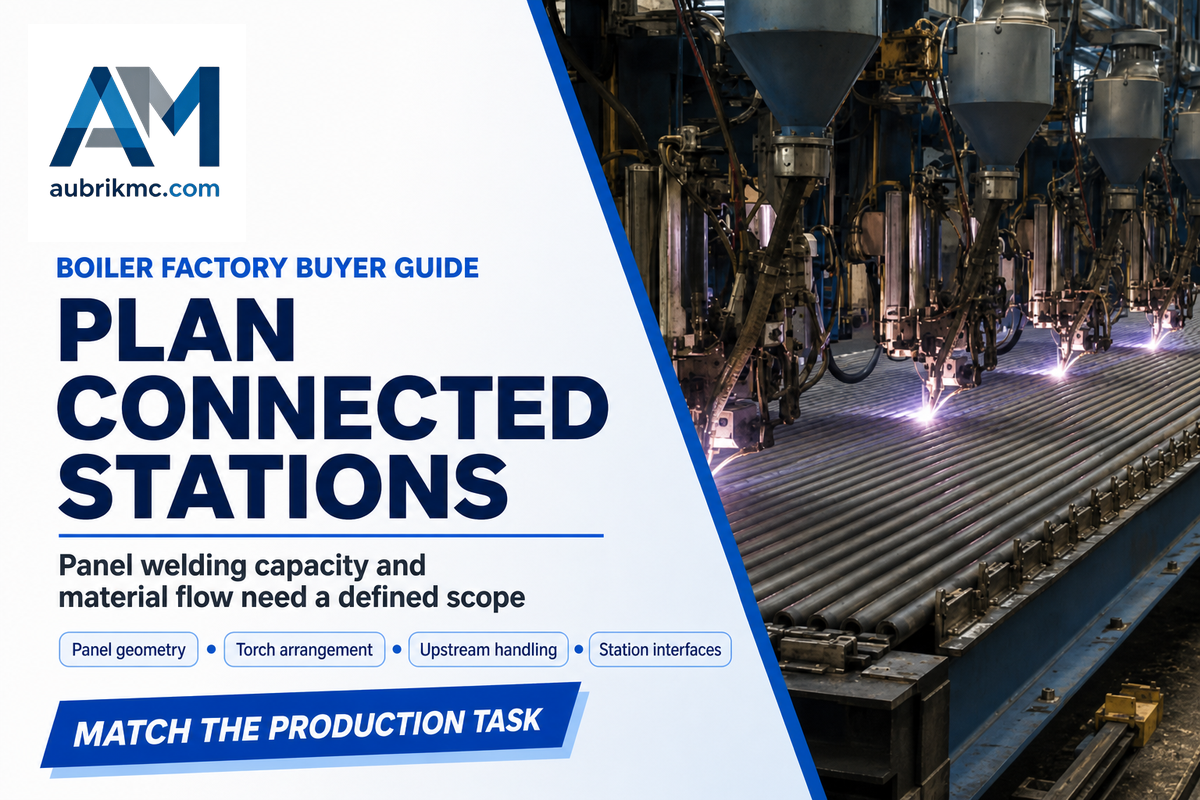
An integrated package connects several fabrication stations and defines how work moves between them. For water-wall production, the sequence may include fin-bar preparation, tube handling and membrane welding. Buyers comparing these companies should focus on the included stations and transfers, because a panel line and a complete boiler factory are different purchasing scopes.
The membrane-panel welding equipment category is the appropriate starting point for long tube-to-fin seams, while individual tube butt joints are addressed in a different piece of equipment.
1. Aubrik: Best for configurable membrane-panel and tube-welding packages
Headquarters: Wuxi, China · Founded: 1999 · Type: Welding machinery manufacturer and production-line integrator.
Official website: https://aubrikmc.com/
Main equipment: Membrane-panel welders, tube-to-tube welding machines and panel benders.
Quality / documentation: The website states ISO 9001 quality certification and CE product conformity; these describe different scopes.
Aubrik is a practical starting point when the purchase includes membrane-panel welding and preparation for subsequent tube assembly. According to its product page, the standard four-torch configuration has a 1600 mm working width and accepts 22–89 mm tubes, while the custom six-torch version lists 2500 mm and 22–108 mm respectively. That distinction gives a buyer a concrete starting point for discussing panel geometry, torch arrangement and upstream handling rather than treating every package as the same machine. The selected stations define the package: shell forming and inspection equipment still need their own delivery scope.
Related equipment: tube-to-tube welding systems for the butt-joint stage.
2. Pemamek: Best for integrated water-wall and boiler tube-shop automation
Headquarters: Loimaa, Finland · Founded: 1970 · Type: Automated welding and production-system manufacturer.
Official website: https://pemamek.com/
Main equipment: PEMA membrane-wall lines, tube-shop systems and heavy-fabrication welding equipment.
Quality / documentation: ISO 9001:2015 and ISO 14001:2015, according to its certification announcement.
A boiler factory planning several connected operations has a different purchasing problem from a shop replacing one welder. Pemamek’s power-generation page describes both membrane-wall production and a tube-shop workflow that can connect shot blasting, end beveling, cutting, welding and seam grinding. Its stationary panel-welding description gives typical widths of 1600–3500 mm with 2–6 SAW power sources, which makes this a useful comparison for buyers considering coordinated material flow. Such integration also makes the layout, transfers between machines and handling equipment part of the investment, rather than optional details added after machine selection.
Tube Bending and Forming Equipment Manufacturers
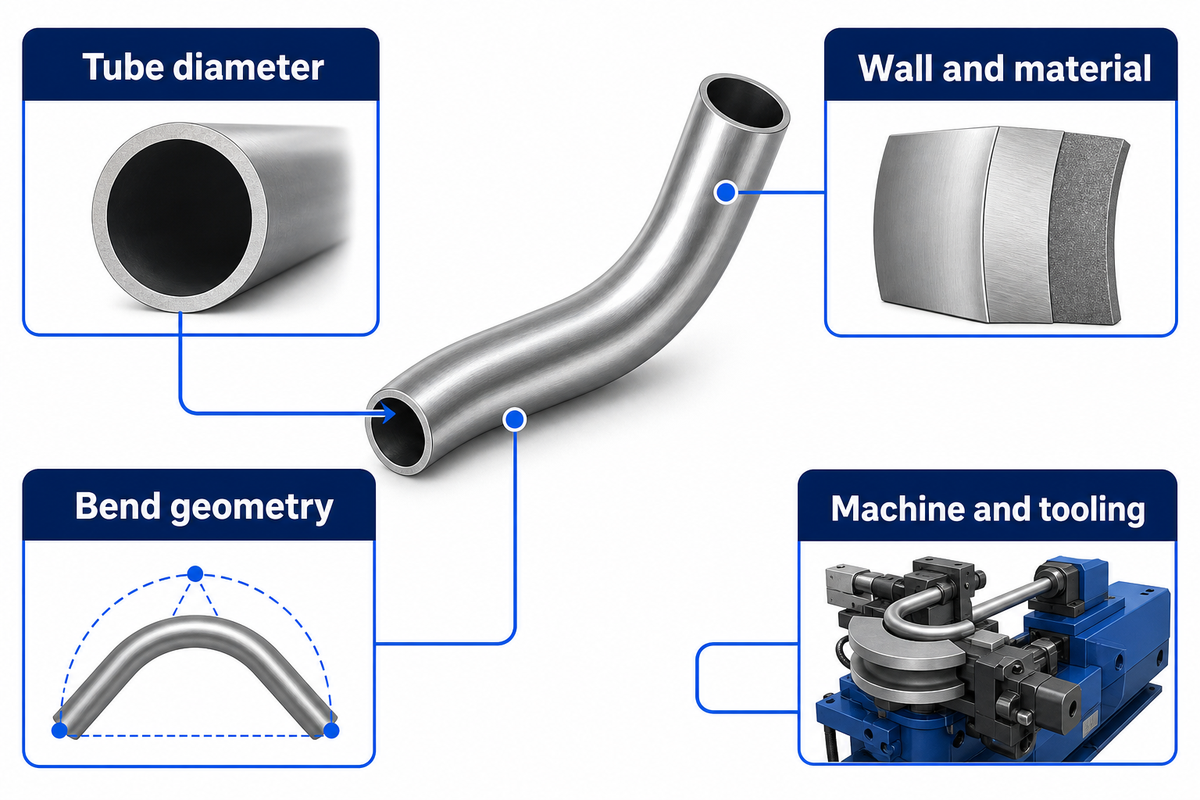
Tube-forming equipment must match the part geometry as well as the material. Boiler coils, connecting tubes and assembled membrane panels call for different machine concepts. The following manufacturers have published boiler or heating-component applications; for buyers developing heating solutions, the useful distinction is the specific workpiece each offer addresses, particularly when individual tubes and welded panels appear in the same project.
Whole boiler panel bending should be specified separately from individual tube bending, even where both occur on the same factory layout.
3. Schwarze-Robitec: Best for boiler coils and membrane-wall bending
Headquarters: Cologne, Germany · Founded: 1903; tube-bender production began in 1930 · Type: Tube-bending machine manufacturer.
Official website: https://schwarze-robitec.com/
Main equipment: Boiler tube benders, twin-head systems and membrane-wall bending machines.
Quality / documentation: ISO 9001 quality system stated on its company page.
Schwarze-Robitec separates ordinary tube-bending requirements from the demands of boiler and power-station manufacture. Its industry page includes dedicated boiler-tube systems, twin-head arrangements and machinery for bending membrane walls, giving buyers a reason to discuss both individual tube shapes and already assembled panels with the same specialist. A factory producing repeated coil geometries can therefore compare a process-specific bending proposal instead of selecting solely from a general maximum-diameter catalog. The limitation is the process boundary: bending machinery forms the workpiece, while panel welding and final assembly remain separate operations in the production plan.
4. Pines Engineering: Best for heavy-wall boiler tubing and application-specific bend tooling
Headquarters: Warren, Ohio, USA (U.S. operations) · Founded: 1940 in its history timeline; 1943 marks early rotary-bender development · Type: Tube-bending equipment manufacturer in ParkOhio.
Official website: https://pines-eng.com/
Main equipment: Manual, electric CNC and hybrid CNC benders; H&H bend tooling.
Quality / documentation: ISO 9001:2015 according to its website.
Pines gives particular attention to the tooling that controls a bend, which matters when thick walls and demanding materials dominate the job. The company describes serpentine and controlled-wrinkle bending for boiler applications, and its history records the CNC250 heavy-duty 10-inch pipe bender introduced in 2011. H&H tooling within the same business provides a direct connection between the machine and the dies that contact the tube. Capacity must still be considered against the specified wall, material and bend geometry, because the largest diameter in a machine description can’t establish every possible combination.
5. BLM GROUP: Best for bending and end-forming heating-system tubes
Headquarters: Cantù, Italy · Founded: 1960, according to the company’s profile · Type: Tube-processing machinery group.
Official website: https://www.blmgroup.com/
Main equipment: SMART and 4-RUNNER benders; 3-RUNNER and AST8-VE end-formers.
Quality / documentation: ISO 9001:2015 listed for BLM, ADIGE and ADIGE-SYS.
BLM GROUP’s boiler application is clearly described on its HVAC page: bending and end-forming tubes and heating elements inside boilers and other heating systems. The page links SMART and 4-RUNNER bending equipment with 3-RUNNER and AST8-VE end-forming options, and describes both coil-fed and single-feed production. That combination is useful when the purchasing unit is a formed component with several end operations, especially where flexible cells must accommodate different part families. The documented offer is component production; it doesn’t mean that these machines bend large power-boiler membrane walls or assemble a complete boiler.
6. AMOB: Best for custom tube-forming cells for boiler components
Headquarters: Vila Nova de Famalicão, Portugal · Founded: 1960 · Type: Tube-bending and metal-forming machinery manufacturer.
Official website: https://amob.co.uk/
Main equipment: CNC tube benders, end-formers and custom production cells.
Quality / documentation: AMOB certification details: Not publicly disclosed.
AMOB’s custom-solutions page explicitly includes boiler and power-plant components alongside its other industrial applications. For a buyer whose tube requires several operations, the attraction is the ability to discuss bending, end-forming and the surrounding cell as a defined engineering project. Its published range extends from simpler bending arrangements to CNC equipment, so the useful comparison is the proposed system for the actual drawings rather than the brand name alone. A custom cell also brings a concrete purchasing constraint: tooling and automation have to be designed around the component family, which makes a generic catalog comparison incomplete.
Shell Forming and Head Preparation Equipment Manufacturers
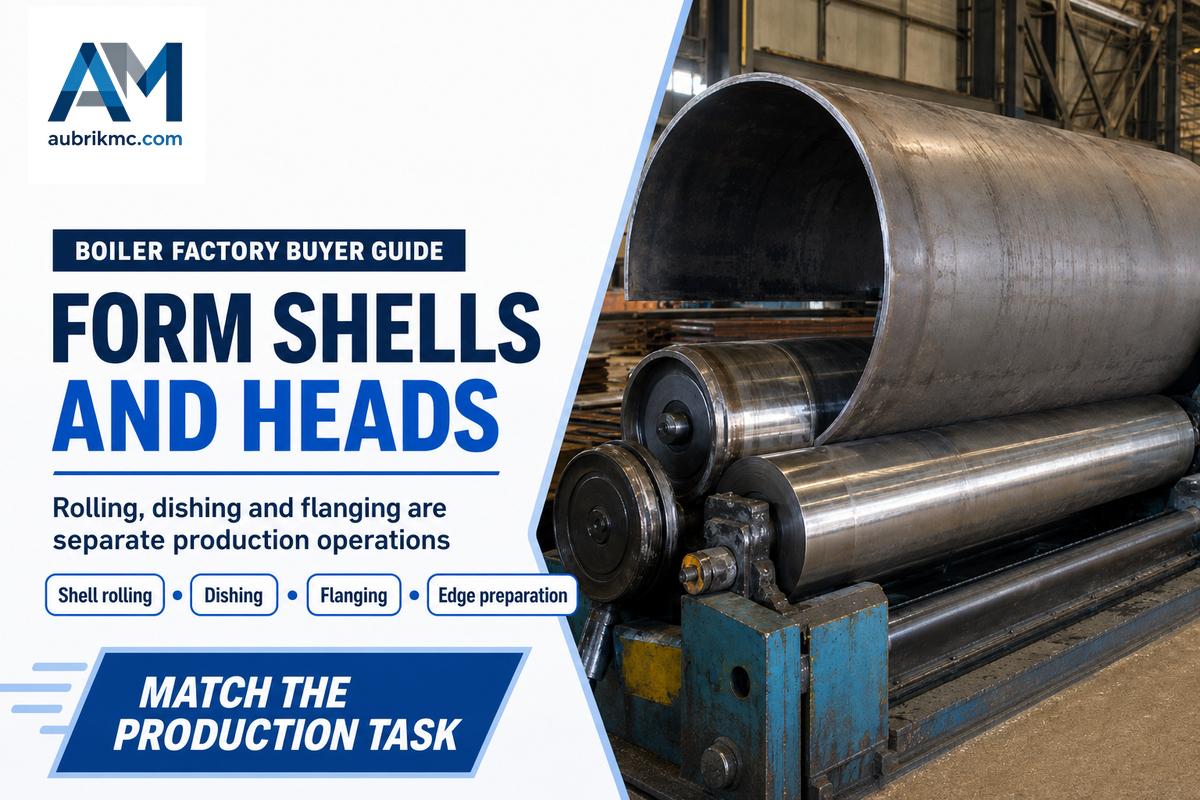
Shell rolls create the cylindrical body, head-forming equipment shapes the ends, and edge-milling machines prepare those ends for welding. Factories making boilers and pressure vessels may buy these operations together during an expansion, but their equipment remains distinct. The manufacturers below cover complementary parts of that sequence rather than interchangeable versions of one machine.
7. DAVI: Best for automated rolling of cylindrical boiler shells
Headquarters: Cesena, Italy · Founded: 1966 · Type: Plate and angle rolling machinery manufacturer.
Official website: https://www.davi.com/
Main equipment: MCA, MCB and MCE plate rolls and automated rolling lines.
Quality / documentation: ISO 9001, ISO 14001 and ISO 45001 listed by the company.
DAVI’s current HVAC application page connects plate rolling with the manufacture of cylindrical shells for heating equipment, including electric hot-water boilers. It describes automation around the roll, such as sheet feeding and finished-shell ejection, so the comparison can include how an operator or handling system moves material through the station. The page gives an example diameter range of 240–720 mm for the relevant HVAC solution, which is more useful than an unqualified claim about the manufacturer’s largest machine. Those dimensions belong to that configuration; a different shell geometry or plate specification requires a separately selected rolling arrangement.
8. HAEUSLER: Best for three- and four-roll forming for boiler shells
Headquarters: Duggingen, Switzerland · Founded: 1936 · Type: Metal-forming machinery manufacturer.
Official website: https://haeusler.com/en/
Main equipment: EVO and VRM four-roll machines; FLEX and HDR three-roll machines.
Quality / documentation: DIN EN ISO 9001 stated on its website.
HAEUSLER offers both three-roll and four-roll machines and explicitly identifies boiler and heat-exchanger manufacture as an application. Its website also carries a Viessmann customer reference about equipment used in stainless-steel heat-exchanger production, giving the application claim a named manufacturing context. Buyers can compare EVO or VRM concepts with FLEX or HDR alternatives while considering their own component shape and production sequence. The supplied operation remains plate forming, however, so longitudinal welding, tube installation and pressure-part inspection need to be covered elsewhere in the factory equipment plan.
9. Faccin Group: Best for shell rolling plus dished-head forming
Headquarters: Visano, Italy · Founded: 1968 business origins; Faccin Srl established in 1977 · Type: Metal-forming machinery group including Faccin, Boldrini and Roundo.
Official website: https://www.faccingroup.com/
Main equipment: 4HEL and HAV plate rolls, PGD/PPM presses and RIBO flanging machines.
Quality / documentation: ISO 9001:2015 stated by Faccin.
Faccin Group is relevant when the buying decision covers both cylindrical shells and dished heads. Its application page lists 4HEL and HAV plate rolls alongside presses and RIBO flanging machines, with cold and hot forming options for different head-production requirements. The company publishes a 4HEL series envelope of up to 150 mm plate thickness, but the useful engineering discussion still concerns the actual width, material and required shape. A combined group portfolio doesn’t turn rolling, dishing and flanging into one universal machine; each operation remains a separate module in the proposed production scope.
10. Linsinger: Best for automated weld-edge preparation of boiler heads
Headquarters: Steyrermühl, Austria · Founded: 1946; predecessor activity dates to 1939 · Type: Milling and sawing machine manufacturer.
Official website: https://www.linsinger.com/
Main equipment: ORBIT boiler-end beveling machinery.
Quality / documentation: ISO 9001 and ISO 14001 listed on the company website.
Linsinger occupies a specific position after the head has been formed and before it’s joined to the shell. The ORBIT boiler-end offering automates edge preparation with measuring and alignment, and its published families cover head diameters of 25–1200 mm, 600–2400 mm and 1800–7000 mm. Those overlapping families help a buyer locate an appropriate machine class without treating the overall range as the capacity of one unit. The purchase addresses the weld edge: it doesn’t replace the press or flanging machinery that creates the head’s main shape.
Welding, Tube Joining and Preparation Equipment Manufacturers
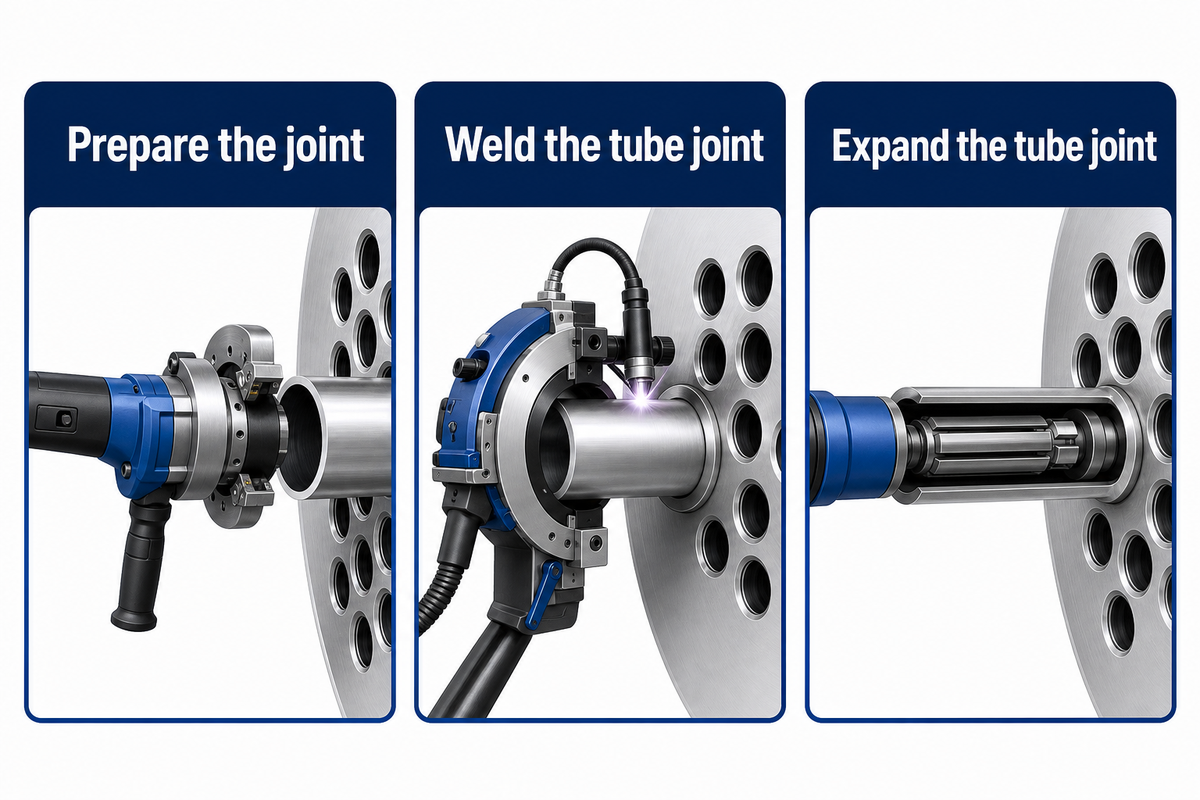
Tube joining can mean a welded joint or a mechanically expanded joint, with different preparation and equipment for each. Portable beveling and fin-removal machines prepare parts for assembly; they don’t perform the subsequent weld. The specialists below are grouped by that role, including powered installation systems where tube tools form part of the working equipment.
11. Polysoude: Best for orbital TIG tube-to-tubesheet welding
Headquarters: Nantes, France · Founded: 1961 · Type: Orbital-welding system manufacturer within Global Welding Technologies.
Official website: https://www.polysoude.com/
Main equipment: TS 34 and TS 8/75 heads; P6 and P6 HW power-source systems.
Quality / documentation: ISO 9001:2015 certification noted in its history.
Polysoude makes sense when the repeated joint is a tube entering a tubesheet and the process calls for orbital TIG welding. According to its product page, closed and open welding heads support different joint arrangements, while P6 and P6 HW systems provide six-axis control for cold- and hot-wire configurations. Automated positioning can extend the package beyond a manually located head, which matters when a tubesheet contains many repeated welds. Access around each tube, its position relative to the sheet and the space available for the head still determine the workable configuration.
12. Maus Italia: Best for automated tube rolling, facing and tubesheet welding
Headquarters: Bagnolo Cremasco, Italy · Founded: 1961 business origins; Maus Italia entity established in 1972 · Type: Tube-tool and assembly-automation manufacturer.
Official website: https://www.mausitalia.it/
Main equipment: MA 400, MA 500, MA 2501 and Matig 502 automation.
Quality / documentation: ISO 9001, ISO 14001 and ISO 45001 listed by the company.
Maus Italia combines tube tools with dedicated automation for repeated tube-assembly operations. Its published MA 2501 description brings rolling, facing and TIG welding into a double-axis system, while Matig 502 provides automated positioning for tube-to-tubesheet welding. For a shop evaluating the movement between preparation and joining stations, that range creates a useful alternative to buying each operation from a different specialist. The application remains tubesheet assembly: this family of equipment doesn’t replace a membrane-panel welding line simply because both processes use tubes.
13. Elliott Tool Technologies: Best for boiler tube installation with dedicated rolling tools
Headquarters: Dayton, Ohio, USA · Founded: 1892 Wiedeke origins; acquired by Elliott in 1969 · Type: Tube-tool manufacturer.
Official website: https://www.elliott-tool.com/
Main equipment: Tube expanders, rolling motors and tube installation tools.
Quality / documentation: Certificates of conformance available on request, per its 2026 catalog.
Elliott’s offer is centered on the work needed to install tubes, with expanders, rolling motors and related preparation tools. That makes it a relevant comparison when an established shop making boilers or shell-and-tube heat exchangers needs a defined installation operation rather than a new multi-station fabrication line. Its 2026 catalog also describes certificates of conformance available on request, a useful form of product documentation that should be distinguished from company management-system certification. Selection remains specific to the tube and joint: outside diameter, wall thickness and the reach through the tubesheet determine the appropriate tooling combination.
14. T.C. Wilson: Best for fire-tube and water-tube installation tooling
Headquarters: Queens, New York, USA · Founded: 1925 · Type: Tube-tool and tube-maintenance equipment manufacturer.
Official website: https://www.tcwilson.com/
Main equipment: Enforcer-500 expanding system; Series 114 and 116 boiler expanders.
Quality / documentation: T.C. Wilson certification details: Not publicly disclosed.
T.C. Wilson separates several boiler expansion operations within its product range. Series 114 covers parallel expansion with a double flare, while Series 116 is a self-feeding flaring option; the Enforcer-500 expanding system adds a powered equipment choice to the tooling catalog. A buyer replacing an existing tube-installation setup can therefore compare the intended joint operation and its drive arrangement together. The key limitation is tool selection: a straight-rolling requirement, a flared end and a beaded end are different jobs, even when the nominal tube size is unchanged.
15. Powermaster: Best for straight boiler-tube expansion without flaring
Headquarters: Navi Mumbai, India · Founded: 1972 · Type: Tube-tool and industrial-tool manufacturer.
Official website: https://www.powermaster.in/
Main equipment: A Series expanders plus Hydex hydraulic tube-expansion systems with HEP pumps and HED drives.
Quality / documentation: ISO 9001:2015 and ISO 45001:2018 stated on its profile.
Powermaster supplies powered expansion equipment as well as the expanders themselves. Its Hydex page lists HEP hydraulic pumps paired with HED drives, while the separate A Series page describes boiler-tube expansion without flaring over a published 7/8 to 4 1/2 inch outside-diameter range. This gives a buyer two distinct selection tasks: choose the required end operation, then match the expander and drive to the tube and joint. The A Series limitation is specific and useful: it doesn’t create a flared end, and its catalog range must not be substituted for the operating range of every Hydex drive.
16. Fronius: Best for automated welding and cladding of boiler components
Headquarters: Pettenbach, Austria · Founded: 1945 · Type: Welding technology and automation manufacturer.
Official website: https://www.fronius.com/
Main equipment: Seam welding systems, orbital carriages and cladding systems.
Quality / documentation: ISO 9001 certificate published by Fronius International.
Fronius’s automation portfolio includes seam welding, orbital arrangements and cladding systems used on boiler components. The company describes protective cladding of membrane walls, which gives it a different role from a manufacturer whose offer is limited to joining tube and fin into a new panel. For a fabrication shop, the relevant question is whether the required operation is structural joining or applying a weld overlay to an existing surface. The welding package also needs the appropriate fixtures and handling arrangement, so a power source or process name alone doesn’t define a complete production cell.
17. DWT PipeTools: Best for portable boiler-panel fin removal and beveling
Headquarters: Bottrop, Germany · Founded: 1987 · Type: Pipe preparation equipment manufacturer and service company.
Official website: https://www.dwt-pipetools.com/en/
Main equipment: MF-series pipe bevelers and boiler tube fin-removal tooling.
Quality / documentation: DIN EN ISO 9001 stated on its company page.
DWT’s boiler-panel application combines two preparatory tasks in one operation: removing the fin beside a tube and beveling the tube end. Its published tooling table links specific pipe diameters to compatible MF machines, including 20.0 mm and 76.1 mm examples across different tool arrangements. A shop that already has panel production equipment can use that information to compare a portable preparation station for the next assembly step. This is an end-preparation purchase; the tools don’t make the long membrane seams that join the panel in the first place.
18. PROTEM: Best for portable boiler-tube end machining
Headquarters: Étoile-sur-Rhône, France · Founded: 1971 first S28 machine; PROTEM trademark registered in 1980 · Type: Portable machining equipment manufacturer.
Official website: https://www.protem.fr/
Main equipment: US25TP, US30CH and GR-series tube-preparation tools.
Quality / documentation: PROTEM certification details: Not publicly disclosed.
PROTEM offers portable machining equipment for boiler-tube preparation, including US25TP and US30CH machines and GR tooling for membrane-fin removal. The US25TP entry is a useful example of why the dimension labels matter: it gives 25.4 mm as the minimum clamping inside diameter and 63.5 mm as the maximum tube outside diameter. A buyer can therefore begin with the available bore and required cut instead of reading the two numbers as one outside-diameter range. That clamping requirement is the practical limitation, particularly when a small tube has a thick wall.
19. KRAIS: Best for boiler-tube expansion with optional automation
Headquarters: Czachowo, Poland · Founded: Not publicly disclosed · Type: Tube-tool and rolling-system manufacturer.
Official website: https://www.krais.com/
Main equipment: KS3, FTKS-L, P2 and PZ expanders; SwiftRoll X1 automation.
Quality / documentation: KRAIS certification details: Not publicly disclosed.
KRAIS offers boiler expanders for rolling, flaring and deep-reach work, with KS3, FTKS-L, P2 and PZ families addressing different installation tasks. Its SwiftRoll X1 system adds automated tube expansion and facing, making the company relevant to buyers moving beyond a manually positioned rolling operation. The range allows a shop to compare individual tooling with a more automated installation station while keeping the joint-making process consistent. An expander alone is still only part of the setup: the rolling drive and the tube-specific tool arrangement have to be selected together.
How to Choose a Boiler Production Equipment Manufacturer
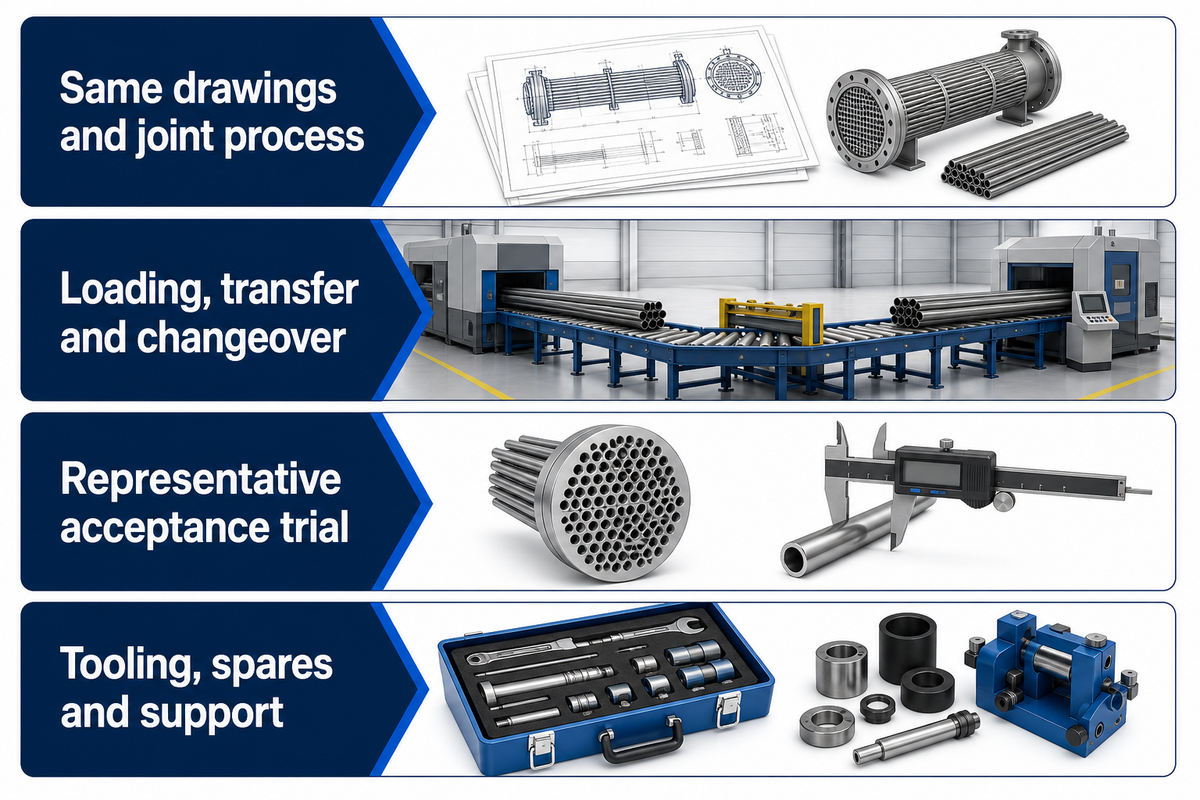
Shortlist suppliers against a defined workpiece and operation, then compare automation systems. A panel line, plate roll and tube expander, for example, are systems to solve different problems in the same factory. The objective of the comparison should be to identify whether each piece of equipment can make the component being produced, in the production mix, with an acceptance test to prove the equipment can meet the challenges of the job.
Start with the component and the next operation
Identify inputs and outputs, and define your typical applications by component drawing, whether you serve commercial and industrial customers or a smaller market. For a membrane panel, that might mean prepared tubes and fins entering a welding line, followed by a completed panel ready for handling and bending. For a shell, that could mean a cut plate entering a roll and a cylinder leaving for seam welding. For a tube sheet, that might mean a purchase for expansion, facing and tube to tubesheet welding.
Keep factory equipment separate from the finished boiler system, whether the inquiry concerns oil boilers or commercial boilers. A burner, combustion chamber or combustion control package, including one marketed for clean combustion or advanced combustion control, is concerned with the operating boiler design; it doesn’t prove the supplier’s ability to fabricate the machinery. Clarify that in procurement documents for industrial steam projects, heating systems, water systems and petrochemical applications. It prevents an equipment inquiry from becoming a mixed list of boiler builders, component suppliers and machine manufacturers.
Compare geometry under the same conditions
Send a representative drawing set, not a set showing the maximum diameter. Many factors can change a machine’s selection. For buyers, these can include tube outside and inside diameters, wall thickness, material, bend radius, and access at the ends; panel buyers also need tube pitch, fin dimensions, finished width and the largest panel assembly. For buyers of plate-rolls, these can include thickness and material, as well as the required cylinder diameter. A headline maximum without those conditions is a poor basis for comparing offers.
Separate the model you’re buying from the maker’s overall product range. Aubrik’s four- and six-torch examples have different published panel widths; PROTEM’s US25TP figures distinguish clamping inside diameter from tube outside diameter. Those are different kinds of limits. For formed water-wall assemblies, the panel bending and boiler-tube quality guide helps frame the discussion about tube condition through the next process.
What should a boiler equipment quotation include?
Defined machine configurations include designated tooling, limits on workpiece sizes, and methods of loading and unloading. The utilities (compressed air, lubrication, etc.) should be specified as well as controls and who’s responsible for installation. Also ask for training. Optional equipment should be listed separately. The technical specifications should identify the material and part geometry behind any output claim and the changeover tasks included in the quoted cycle time.
Design and installation should also be defined, especially where a new station is to be connected to existing industrial processes. A reasonable offer should separate the cost of the machine from tooling sets, freight, site preparation, commissioning and initial spare parts. Ask for the acceptance criteria and exclusions with the quotation, as this will support discussion of what is and isn’t included in the offer. Provide the same drawings and production mix to all bidders, which will encourage bids based on the same work to be performed. That creates a cost comparison tied to the same work instead of a contest between differently equipped machines.
Match the joining process to the drawing
Tube expansion and tube-to-tubesheet welding are separate operations, even if they occur on the same heat exchanger or boiler assembly. Choose the joining route with the responsible design and fabrication team and specify the machine around that route. For tube expansion, define the expanders, the drives, and the means to determine if the result is as required. For welding, define the joints, access, the materials to be welded and the welding process.
Product quality requires more than a general equipment description. Define product quality, including what high-quality means for your parts, through required dimensions and joint results, with structural integrity requirements set by the responsible engineering team. Ask how station equipment handles the actual joint preparation and part variation in your drawings. A tool to prepare the joint may be the right equipment purchase if access controls the job; a fixed, automatic cell may be a better choice if repeated joints control the purchase. Such purchases don’t ensure the pressure containing assembly meets its requirements.
Plan material flow around the machine
Check the arrangement and movement of material before and after the proposed station. Long tubes require support and means of transfer; large, heavy panels require a means of conveyance to and from the next process. A fast welding cycle may be of little value if the previous part hasn’t yet been removed from the station. The supplier should describe loading, alignment, processing, unloading and changeover as separate parts of the workflow.
For connected production lines, identify who supplies conveyors, fixtures, sensors, and the interface between stations. Also identify who solves a problem that spans those boundaries. A control enclosure needs an agreed-upon location and access way in the layout, along with the space required to work on the workpiece. Assess a proposed smart technology feature in terms of the job it performs, e.g. capturing a process setting, recording a machine alarm, or identifying a discrepancy. Automation should be aligned with the production mix: frequent short batches can make setup and tool changes more important than the fastest repeat cycle. Evaluate operational efficiency over a representative shift, based on the staffing and handling proposed.
What should a factory acceptance test demonstrate on your parts?
When using a part family, use a demanding configuration instead of just the simplest part to demonstrate the family. The test plan must indicate which dimensions, joint results, cycle elements and changeovers will be observed, who provides the material, and what documents will be delivered. Agree on the method of measurement before the test. The test plan must include material transfer between work stations where that transfer is part of the supplier’s scope.
When discussing output, distinguish processing time from loading, setup and unloading time, and from inspection time. Record changes made by the operator during the test. Define reliable performance through the result of the test, and the configuration that presents the biggest challenge to your operational needs. An acceptance test is most useful when both sides can decide from the recorded results whether the contracted requirements have been met, rather than relying on a general impression that the machine runs well.
Read quality documents at the right level
Profiles report on company-published quality information and should not be confused with independent certification audits. During supplier qualification, verify the current certificate, legal entity, manufacturing location, and the relevant scope. An ISO management-system certificate, a machine’s conformity documentation, and the records required for a finished boiler are different documents, and one shouldn’t be considered a substitute for another. Keep this check during qualification, as the comparison of the machine should stay on equipment fit.
Request the documents needed by your team for the operation, maintenance and quality control of the equipment. These may include manuals, electrical drawings, calibration records, spare parts lists, agreed inspection records, etc. In case international standards or project constraints impact the purchase, name them and have a qualified team establish the acceptance requirements. Referencing equipment as compliant should specify the requirement and scope. Don’t assume a pressure equipment approval from a supplier company profile.
Compare ownership costs and service responsibility
To evaluate if a piece of equipment is cost-effective for your workload, compare total cost of ownership using the costs you’re able to identify: tooling and consumables, maintenance, utilities, training, spares, and expected support. Ask who will supply tooling, how remote technical support works, and what tasks require a service visit. A machine that meets the drawings still requires a lifecycle support plan to operate the machine in the country where it will be used.
Separate manufacturing energy consumption from boiler efficiency. With the former, we’re discussing how to run the factory equipment. With the latter, we’re discussing the boiler’s conversion of fuel into useful thermal energy or steam. Thermal efficiency pertains to that operating boiler’s efficient heat delivery and not to the production rate of a plate roll. Neither follows from the name of the machinery being purchased. If energy efficiency or uptime is a part of your purchasing case, request measurements and definitions for the configuration rather than applying a general marketing statement to your production line. To reduce energy use against sustainability targets, establish the current consumption in the factory and define the limits of measurement for the proposed change, with sustainability goals stated in measurable terms.
Frequently Asked Questions
Which boiler production equipment manufacturer is best?
The best fit depends on the component and manufacturing operation.
For an initial shortlist, compare Aubrik and Pemamek for panel-production equipment, Schwarze-Robitec and Pines for boiler-tube bending, and DAVI, HAEUSLER or Faccin for plate forming. Polysoude and Maus address tube-to-tubesheet operations, while several later entries focus on expansion or portable preparation. These are application-based starting points. Your drawings, production mix and acceptance requirements determine which proposed machine is suitable.
Reduce that first shortlist to suppliers offering the same operation, then send each the same drawing package. Compare the proposed tooling, handling equipment and acceptance trial as closely as the machine itself. A broad portfolio is useful when several stations must work together, while a specialist may fit a single process addition. The practical question is which offer covers your required work and clearly assigns responsibility for the interfaces around it. A published maximum capacity is a starting point for this discussion, not a replacement for a quotation tied to your parts.
Who is the largest boiler production equipment manufacturer?
This list does not establish a largest manufacturer.
The companies cover different equipment categories, and comparable revenue or shipment data for boiler-production machinery alone wasn’t established in this research. Group revenue would also include unrelated products at some businesses. The numbering is therefore an editorial sequence, with the host company disclosed first. Use the equipment categories to shortlist suppliers; don’t interpret position in the table as a market-share ranking.
What is the difference between a manufacturer and a supplier?
A supplier can sell equipment without manufacturing the machine itself.
This roundup includes companies with published manufacturing evidence and a relevant boiler-fabrication equipment offering. Their production arrangements differ, and a manufacturer may still use outside component suppliers or regional distributors. Distribution concerns the sales channel, rather than the production operation. A purchasing agent or reseller can be useful, but it should identify the actual machine maker and service responsibilities.
How much does boiler production equipment cost?
Pricing depends on the machine, tooling and automation scope.
A portable tube-preparation tool and an integrated membrane-panel line are different purchases. This article doesn’t offer a universal price range because comparable configured quotations weren’t obtained. Request an itemized offer against your drawings, including tooling, handling, commissioning and support, then compare bids with equivalent scope.
Is membrane-panel equipment suitable for every boiler factory?
It is relevant when welded tube-and-fin panels are part of the product.
A factory making a different steam boiler construction may instead prioritize shell rolling, tube-sheet work or other operations. Start with the product drawing and manufacturing route. Buying a panel line because it appears under “boiler equipment” doesn’t establish that it fits the components your factory makes.
Can one manufacturer equip an entire boiler factory?
Some offer several stations, but the complete scope needs explicit definition.
Map each operation and assign responsibility for every machine, transfer and interface. A supplier with a broad portfolio may cover multiple processes; specialist manufacturers may fill the remaining needs. Ask for a station-by-station proposal before treating a package as a complete factory solution, including any equipment supplied by third parties.
Discuss Your Boiler Fabrication Equipment Scope
Preparing a new production line or adding a station to an existing shop? Aubrik can discuss its boiler fabrication equipment packages against your component drawings. Include the tube and panel dimensions, materials, expected product mix and the operations you want to bring into scope. Existing layout and handling constraints are useful inputs too.
Use the comparison above to determine the relevant equipment category prior to requesting a proposal. A specific request supports the definition of the starting point of the discussion: which operations the proposed equipment covers, what accessories are included, and what the acceptance trial must show on your parts.
References & Sources
Company histories, product descriptions and quality information are drawn from the manufacturers’ published websites and product literature, reviewed in October 2026. The official website is identified in each profile. Equipment dimensions refer to the named model or configuration, and the profile explains where a date represents a predecessor or a product milestone.