Get in Touch with Aubrik Company
Membrane Panel Welding Machine
Multi-Torch SAW Solutions for Boiler & Industrial Panel Manufacturing
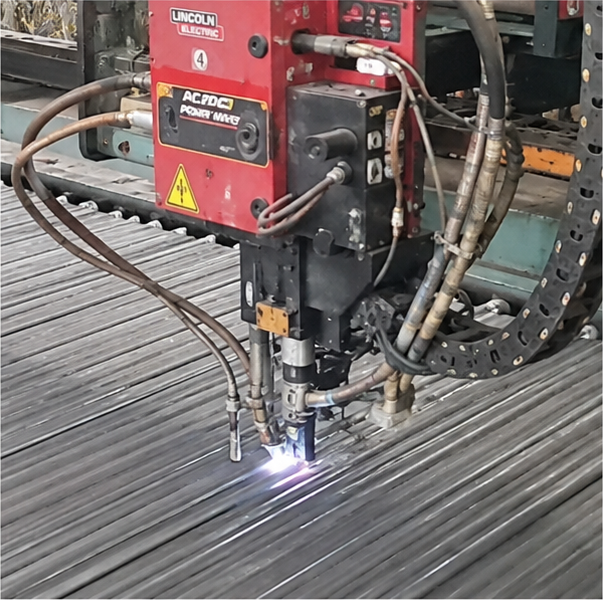
Aubrik multi-torch membrane panel welding machine systems pair four to six independently controlled Lincoln Powerwave® AC/DC twin-wire submerged arc welding (SAW) heads with auto-seam tracking and Siemens HMI control, so boiler manufacturers, heat exchanger fabricators and sandwich panel producers can replace unreliable manual welding lines without sacrificing weld quality, code compliance, or capital efficiency.
Request Custom Quote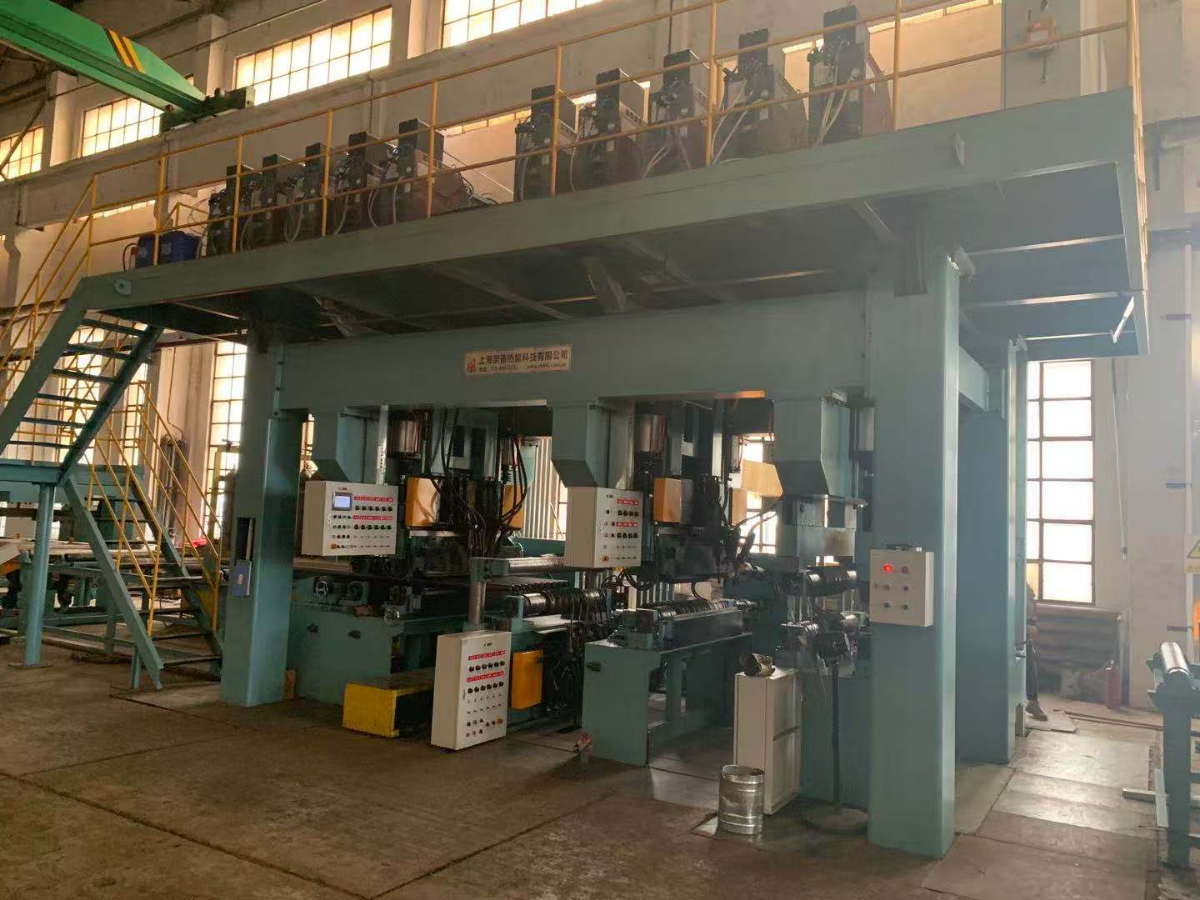
Core Technical Specifications
≥28 kg/h
Deposition rate per torch (Lincoln Powerwave® twin-wire)
0.8–2.0 m/min
Welding speed (stepless adjustment, 400–1200 mm/min wire feed)
±0.5 mm
Auto-seam tracking precision across full panel width
3–16 mm
Panel thickness range (tubes 22–108 mm OD)
2 / 4 / 6 + Hybrid
Torch options with SAW + MIG/MAG hybrid
ISO 9001 + CE
30-year deployment record, exported to 13+ countries since 2008
For: EN · PROC · MGR
From Hand-Weld Bottleneck To Multi-Torch SAW Production — The Membrane Panel Welding Challenge
Boiler manufacturers, sandwich panel producers and heat exchanger fabricators share one production bottleneck that procurement teams routinely miscalculate: the hidden challenge of traditional manual welding of membrane panels collapses under modern volume requirements. Single-torch MIG/MAG operators average roughly 0.3–0.5 m/min of usable continuous weld, fight the inconsistent panel distortion problem across spans longer than 6 m, and need 3-4 operators per shift just to keep one line moving — an expensive labor crunch that delays delivery by weeks.
When Brazilian boiler supplier Caldema Equipamentos Industriais retired its self-made MIG tube panel line, the public reason was blunt: “the process was unreliable, causing too much rework, and efficiency did not meet expectations.” The replacement SAW line delivered a 35% productivity gain in the first year, with panels straight off the line and rework cycles minimised.
System Architecture & Precision Mechanics
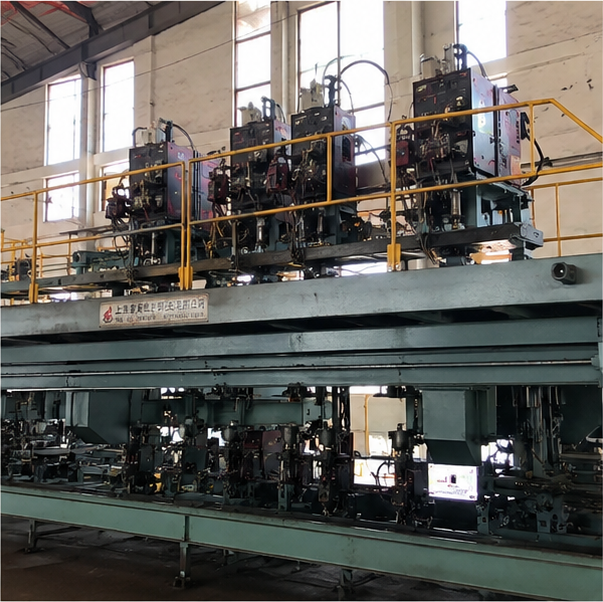
A membrane panel welding machine built on multi-torch submerged arc welding (SAW) tackles every root cause simultaneously, since the trade-off between speed and weld quality is structural, not operator-dependent. Aubrik engineers built the system around four to six independently controlled Lincoln Powerwave® AC/DC twin-wire heads with Hiwin C3 linear guides and ±0.5 mm auto-seam tracking — the resolution to the same panel-distortion problem USPTO patent US20050167468A1 documents for boiler tube panel welding.
Process Execution & Global Compliance
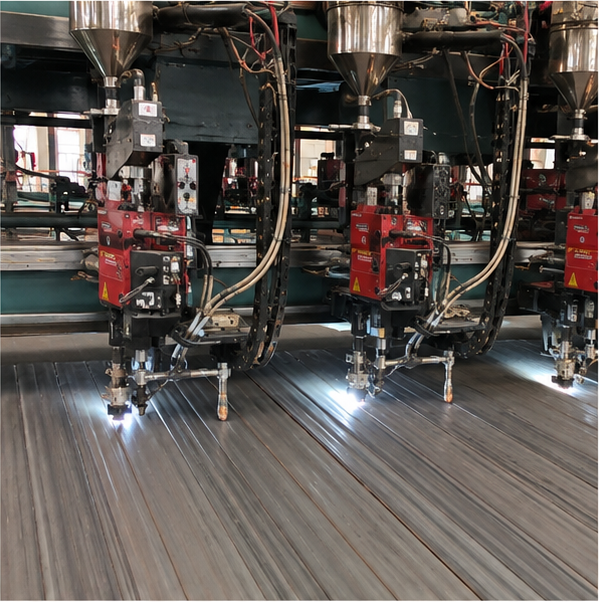
Multiple torches weld parallel fin-to-tube seams simultaneously; a granular flux blanket protects the weld pool from atmospheric contamination so penetration reaches 3–5 mm instead of the 1–1.5 mm typical of MIG/MAG; and automated travel-speed control eliminates the operator-skill ceiling that limits single-arc lines. Submerged arc welding itself is a 90-year-old arc welding process (first patented 1935), but the multi-torch architecture is what turns it into a production-grade membrane panel welding system rather than a single-pass research bench. Aubrik delivers this configuration with a 1-year warranty and ISO 9001 + CE certification as the baseline factory standard, with the 30-year deployment record across 13 countries backing the reliability claim. That is the differentiator that procurement teams comparing equipment from Wuxi against Pemamek or single-source Lincoln integrators evaluate first.
Thickness Paradox & Field Adaptation
One contradiction worth retiring before procurement: the common assumption that SAW is “only for thick steel” is in fact not always true — contrary to the rule of thumb, the same multi-torch SAW system that welds 16 mm CFB boiler water-wall panels also handles 3 mm membrane panels for cold-storage and electronics housings. Field experience contradicts the thin-panel myth: with stepless travel-speed control (400–1200 mm/min wire feed), thin-panel SAW is the structural reason a single Aubrik line replaces two separate MIG/MAG cells.
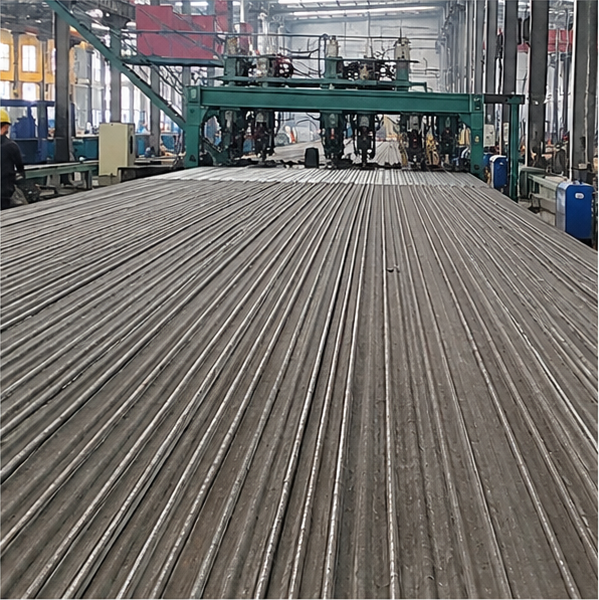
Procurement Dynamics & Integrated ROI
That single-system flexibility is why the membrane panel welding machine — together with the saw welding machine product family in the procurement catalog known as the sub arc welder, submerged arc welder or subarc welding machine — has become the default capital investment for fabricators moving from 100 to 1,000 panels per quarter. Compared to a Lincoln submerged arc welding machine sold as a stand-alone power source (roughly USD 58,000 for the Lincoln Power Wave® AC/DC 1000SD) or an ESAB submerged arc welding machine in the same class, the integrated Aubrik line packages the same Western-tier power source electronics inside a complete production system at saw welding machine price tiers that fit a single-line capital budget rather than an enterprise capex programme.
For: EN (Primary) · PROC (RFQ Match)
Aubrik Multi-Torch SAW Architecture — Torch-Count Selection & Module Configuration
The membrane panel welding machine we configure for boiler and panel fabricators uses three baseline architectures plus a hybrid line for mixed-material work. Each architecture carries a different torch count, working width, and power profile, and each is selected against a single decision dimension: how many square meters of certified-quality membrane panel you need to ship per shift. Most customer orders settle on the standard 4-torch SAW model, which serves the largest share of customer orders because the combination of 1600 mm working width and four independently controlled Lincoln Powerwave® AC/DC twin-wire torches hits the daily production sweet spot for industrial steam boiler builders without the floor-space and capex burden of a 6-torch system.
Parameter Table — Standard & Customised Models
| Parameter | Standard (4-Torch SAW) | Customised (6-Torch SAW) | Hybrid (SAW + MAG) |
|---|---|---|---|
| Working Width | 1600 mm | up to 2500 mm | 1600–2500 mm (optional) |
| Number of Welding Torches | 4 | 6 | 4 SAW + 2 MAG |
| Welding Process | Twin-Wire SAW (AC/DC) | Twin-Wire SAW (AC/DC) | SAW + MIG/MAG |
| Panel Thickness | 3–12 mm | 3–16 mm | 3–16 mm |
| Tube Diameter | 22–89 mm | 22–108 mm | 22–108 mm |
| Wire Diameter | 2.4 / 3.2 mm | 2.4 / 3.2 mm | 1.6–3.2 mm |
| Power Capacity | 4 × 650 A (100% duty cycle) | 6 × 650 A (100% duty cycle) | 4 × 650 A SAW + 2 × 500 A MAG |
| Air Pressure / Flow | 0.6 MPa, 200 L/min | 0.6 MPa, 300 L/min | 0.6–0.8 MPa, 300 L/min |
| Control System | Siemens Simatic HMI Touch Screen | Siemens Simatic HMI Touch Screen | Siemens HMI + PLC |
| Power Supply | 380V / 440V, 50/60 Hz | 380V / 440V, 50/60 Hz | 380V / 440V, 50/60 Hz |
Behind every torch sits a 100 mm vertical stroke plus 40 mm fine-tuning module, so the seam-tracking system can compensate for the linear misalignment, length, pitch, and straightness deviations that USPTO patent US20050167468A1 (process and apparatus for boiler tube panel welding and straightening) identifies as the central distortion problem in large tube panel fabrication. Hiwin C3-grade linear guide rails and a closed-loop flux delivery hopper feeding granular flux to each arc keep deposition consistent across an 8-hour shift.
🎯 Aubrik Multi-Torch SAW Deposition Ladder
How torch count × panel thickness × material maps to daily production capacity.
Per-shift output projected from per-torch deposition (≥28 kg/h Lincoln Powerwave® twin-wire) × independently active torches × 8-hour shift. Field output narrower than peak deposition because of changeover, flux recovery cycles and code-mandated inspection holds.
| Torch Count | Panel Thickness | Material | Welding Speed | Daily Capacity (m²/day, 1-shift) |
|---|---|---|---|---|
| 2 (entry / R&D) | 3–6 mm | Carbon steel SA-36 | 1.2–2.0 m/min | 400–600 |
| 2 | 6–10 mm | Carbon steel SA-36 | 0.8–1.5 m/min | 350–500 |
| 4 (standard) | 3–6 mm | Carbon steel | 1.0–1.5 m/min | 900–1200 |
| 4 | 6–10 mm | Carbon steel SA-36 / SA-178 | 0.8–1.2 m/min | 800–1100 |
| 4 | 10–12 mm | Stainless 304 / 316 | 0.6–1.0 m/min | 600–850 |
| 6 (custom) | 3–8 mm | Carbon steel | 1.2–2.0 m/min | 700–1100 (2500mm wide) |
| 6 | 8–12 mm | Carbon + alloy | 0.8–1.5 m/min | 500–800 (2500mm wide) |
| 6 | 12–16 mm | Stainless / duplex | 0.6–1.0 m/min | 400–650 |
| Hybrid 4+2 | 3–16 mm mixed | Carbon + stainless / Inconel | 0.8–1.5 m/min | 600–900 (mode-dependent) |
The ladder is the procurement question, not the welding question. Boiler fabricators producing fewer than 100 panels per quarter often over-spec by jumping to a 6-torch line; CFB boiler builders and biomass boiler manufacturers running multi-shift production usually under-spec by clinging to the standard 4-torch line when a 6-torch + hybrid line would clear the same backlog in two shifts instead of four. A hybrid SAW + MAG line pays off when downstream operations call for precision MIG fill on stainless or Inconel cladding inside an otherwise SAW-driven production cell.
“We tested the four-torch configuration on a 1600 mm boiler water-wall panel against the same operators running the legacy MIG line. With the same panel geometry, the four-torch SAW pass came off the line in a single setup with full root and cap fusion; the MIG version needed two setups and a rework pass to clear the X-ray. That single test is why we built the deposition ladder rather than a generic spec sheet — torch count is not a marketing choice, it’s an output-per-shift decision.”
Need exact torch-count for your panel mix?
Download Multi-Torch Spec Sheet (PDF) →
EN + MGR · PROC (TCO)
SAW Vs MIG/MAG Vs Manual — The Cost-Crossover Threshold That Justifies Multi-Torch Capital
Procurement teams comparing a four-torch SAW membrane panel welding machine against a stack of MIG/MAG cells almost always start from the wrong baseline: equipment sticker price. In practice the decision rests on cumulative weld meters per quarter and the per-meter consumable cost. Industry analysis from The Fabricator and Red-D-Arc both confirm that SAW per-pass cost runs roughly half of GMAW for heavy continuous fabrication; field data from boiler manufacturers running both processes shows a per-meter weld cost crossover well below the volume any commercial boiler shop produces in a quarter.
| Cost / Quality Dimension | Multi-Torch SAW (Aubrik) | MIG / MAG (single arc) | Manual Stick / TIG |
|---|---|---|---|
| Weld penetration | 3–5 mm (granular flux protected) | 1–1.5 mm | 1–3 mm operator-dependent |
| Welding speed | 0.8–2.0 m/min (stepless) | 0.3–0.5 m/min sustained | 0.1–0.2 m/min |
| Consumable die cost (typical) | USD 500 (granular flux, recoverable 15–20%) | USD 20,000 (precision tooling per profile) | USD 100–300 (electrodes per shift) |
| Spatter & slag | Eliminated under flux blanket | Continuous cleanup required | Heavy spatter, manual chip-out |
| Operator PPE | Reduced (arc submerged under flux) | Full UV / IR protection | Full UV / IR protection |
| Operators per shift (1 line) | 1 | 3–4 | 3–6 |
| Code-grade weld (ASME / EN 12952) | Achievable with WPS / PQR | Achievable but rework-heavy | Operator-dependent |
🎯 SAW Vs MIG/MAG Cost Crossover
The break-even point in cumulative weld meters per quarter
SAW lines carry higher equipment capex than a comparable bank of MIG/MAG stations, but the per-meter cost gap inverts quickly once continuous welding hours accumulate. Mathematically the crossover threshold is a four-variable function:
Crossover Meters ≈ (Δ Capex) ÷ [(MIG cost/m) − (SAW cost/m)]
where SAW cost/m ≈ (die $500 + flux net of 15–20% recovery + labor 1 operator) ÷ output meters
and MIG cost/m ≈ (die $20,000 amortised + filler wire + labor 3–4 operators) ÷ output meters
Practical reading: For a fabricator running a single shift of continuous boiler membrane wall production, the per-meter weld cost gap lands SAW at roughly 50–60% of MIG/MAG cost (industry average, per iKing Welding analysis and Megmeet SAW vs GMAW comparison). Δ Capex therefore self-amortises in the first 12–24 months of single-shift production for any commercial boiler shop running >5,000 m of weld per quarter — and the gap widens further on multi-shift lines because labor headcount dominates MIG/MAG total cost.
Assumptions: industry-average flux pricing 2024–2025, comparable code-grade quality on both lines, no rework cycle penalty applied to MIG line (which would shift the crossover earlier). Exact crossover depends on shop labor rate, electricity cost and panel material — request a quote-specific cost model for your facility.
ROI Card · Silver Tier
5-Year TCO Pattern for SAW Membrane Panel Welding vs MIG/MAG (industry-average reference)
Consumable die cost roughly 40× lower (USD 500 SAW vs USD 20,000 MIG per profile). Flux recovery system recaptures 15–20% of granular flux per shift, reducing material waste. Labor headcount drops from three to four operators per MIG line to a single operator per SAW line. Combined, fabricators report per-meter weld cost reductions in the 50–60% range for continuous boiler-grade production (Megmeet, iKing, Red-D-Arc industry benchmarks). Exact payback period depends on shop production volume, labor rate and panel material — we provide a quote-specific TCO model on RFQ.
Procurement Note: One contradiction worth surfacing for procurement: SAW is not only economical for thick steel. With travel speed and heat input controlled (the multi-torch SAW system supports stepless 400–1200 mm/min wire feed across 100% duty cycle), the same line that welds 16 mm CFB boiler panels also welds 3 mm panels for cold-storage and electronics housings. That single-system thickness range collapses the case for keeping two separate welding processes on the shop floor for thin-versus-thick panel work.
For: EN (Code Compliance) · PROC (Supplier Qualification)
Boiler-Code-To-Welding-Standard Crosswalk — ASME · PED · EN ↔ AWS · ISO 3834 · EN 1090
Code compliance is the single procurement question that can disqualify a Chinese-built membrane panel welding machine before specifications are even compared. For most boiler buyers the honest answer is that compliance depends not on the welding machine alone but on the chain that runs from the boiler design code (ASME Section I or EN 12952) through the welding fabrication spec (AWS D1.1 or EN ISO 3834-2) to the executed weld procedure qualification record (WPS/PQR). A membrane panel welding machine that supports the right power profile, travel-speed control and seam-tracking precision is the equipment-side prerequisite; the certification chain is the system-side prerequisite. Aubrik’s role is to ship a machine that the certification chain can be built on top of.
Boiler-Code-To-Welding-Standard Crosswalk
| Application Domain | Pressure Vessel / Boiler Code | Welding Fabrication Spec | Aubrik Equipment-Side Fit |
|---|---|---|---|
| US Industrial / Power Boilers | ASME Section I (Power Boilers, PG-25 / PG-27 tube wall & attachment weld) | AWS D1.1 Structural Welding Code — Steel | 4× Lincoln Powerwave® AC/DC twin-wire SAW + 650 A 100% duty cycle supports WPS/PQR under ASME Sec IX for the equipment side |
| EU Industrial / Power Boilers | PED 2014/68/EU Category IV · EN 12952-3 (design) · EN 12952-5 (workmanship) | EN ISO 3834-2 (highest-tier quality) · EN 1090-2 EXC3 | Notified Body type examination compatible; OEM customisation supports WPS/PQR + welder qualification under EN ISO 3834-2 |
| Industrial Steam & Process | EN 12953 (shell boilers) · PED Cat II–III | EN ISO 3834-3 Standard quality | Standard 4-torch model + Siemens HMI parameter logging supports weld traceability |
| Petrochemical / Heat Exchanger | ASME Section VIII Div.1 / API 660 reference | AWS D1.1 / EN ISO 3834-2 | Hybrid SAW + MAG model for Inconel and duplex cladding overlay; NACE MR0175 material chains compatible |
| Construction & Cold Storage | CE Machinery Directive 2006/42/EC | EN 1090-2 EXC2 (sandwich panel) · EN ISO 3834-3 | Standard 4-torch model + 3–8 mm thin-panel SAW capability fits non-pressure sandwich panel use |
PROCUREMENT INSIGHTS
Three procurement notes that this crosswalk forces into the open. First Aubrik ships ISO 9001:2015 and CE conformity as standard; the boiler-side codes (ASME Sec I, PED Cat IV) are completed in the fabricator’s own quality system on top of the equipment, with notified body involvement for the highest hazard category. Second the equipment-side qualifying step is welder-procedure qualification — running test coupons through the multi-torch SAW machine to demonstrate that the parameter envelope you intend to use produces mechanical properties meeting ASME Sec IX or EN ISO 3834-2. Every weld parameter is logged by the Siemens HMI, so the qualification record is auditable. Third the PED 2014/68/EU framework explicitly allows full ISO 9001 quality + notified body type examination as the conformity route for Category IV equipment — which is the route Aubrik customers in Spain, Germany, Italy and France use for boiler membrane wall production, with evidence supplied on RFQ.
In petrochemical and metallurgical work working with corrosion-resistant materials, the equipment-level USPTO patent landscape is worth tracking: US6852945B2 (laser welding boiler tube wall panels) documents an alternative laser approach for similar geometry, and US6889887B1 (boiler water wall tube panel aligning jack device) covers the alignment fixturing prior art that informs our Hiwin C3 guide-rail and dual-stroke seam-tracking module choices.
For: MGR (Application Match) · EN (Technical Validation)
5 Industry Applications — Capacity, Material & Certification Decoder
The same multi-torch SAW machine architecture serves five distinct industrial applications, each with its own panel geometry, material grade and certification expectation. Below, the decoder shows the configuration mapping we use during RFQ scoping; behind it sits the same engineering history that produced equipment installed across thirteen countries since the first export shipment in 2008.
| Industry | Typical Panel Type | Thickness / Tube OD | Material | Certification Requirement | Recommended Aubrik Model |
|---|---|---|---|---|---|
| Boiler & Power | Water-wall + heat exchanger panel + superheater coil | 8–16 mm / 22–89 mm | Carbon steel SA-36 / SA-178 / SA-213 alloy | ASME Sec I + PG-25/PG-27 / PED 2014/68/EU Cat IV / EN 12952 | 6-torch SAW (500–800 m²/day @ 2500 mm) |
| Construction & Cold Storage | Sandwich panel, sound insulation, cold-room wall | 3–8 mm | Carbon + galvanized steel | CE Machinery Directive + EN 1090-2 EXC2 | Standard 4-torch SAW (800–1200 m²/day @ 1600 mm) |
| Automotive & Electronics | Pressure sensor housings, industrial sensor cases | 3–6 mm | Stainless 304 / 316 | RoHS + automotive OEM QM | Hybrid SAW + MAG (precision MIG fill on stainless) |
| Petrochemical & Metallurgical | Corrosion-resistant heat panels, reformer panels | 6–16 mm | Duplex 2205 / Inconel 625 cladding | NACE MR0175 + ASME Sec VIII Div.1 | 6-torch SAW + DC power supply (Inconel weldability) |
| Medical Equipment | Micro membrane panels for medical sensors | 3–5 mm | 316L stainless | ISO 13485 + sterility / biocompatibility | Hybrid SAW + MAG + AI-vision inspection module |
APPLICATION INSIGHTS
Two procurement realities sit behind the decoder. First the boiler & power application drives the majority of multi-torch SAW capital deployment because membrane wall and heat exchanger panel production runs on tight ASME / PED audit cycles where rework cost on a single panel can exceed the per-meter SAW saving for an entire quarter. Second the construction and cold-storage application is the fastest-growing volume application because the same 4-torch standard model that serves boiler customers also welds the 3–8 mm sandwich panels at 800–1200 m²/day — a capacity that no single-arc MIG/MAG cell can match without doubling the labor budget.
For boiler and biomass boiler fabricators working with finned tube water wall panels, fluidized bed (CFB) economiser and superheater coils, the geometry challenge is consistent across applications: hold the linear misalignment, pitch and panel straightness inside specification across spans of up to 26 m. That is the same problem set USPTO patent US20050167468A1 identifies for boiler tube panel welding and straightening, and the alignment-prior-art documented in US6889887B1. Our answer is the closed-loop seam-tracking module (100 mm vertical stroke + 40 mm fine-tuning) combined with Hiwin C3 guide rails — the same hardware regardless of which industry application you are configuring for.
VISUAL AUDIT · PRODUCTION FLOOR
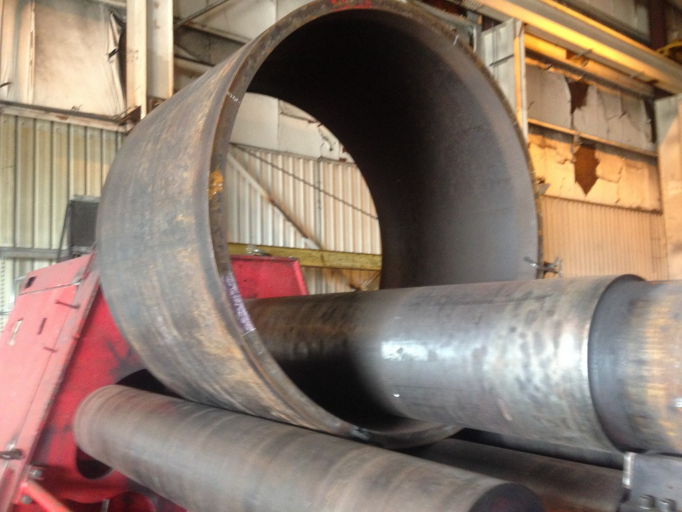
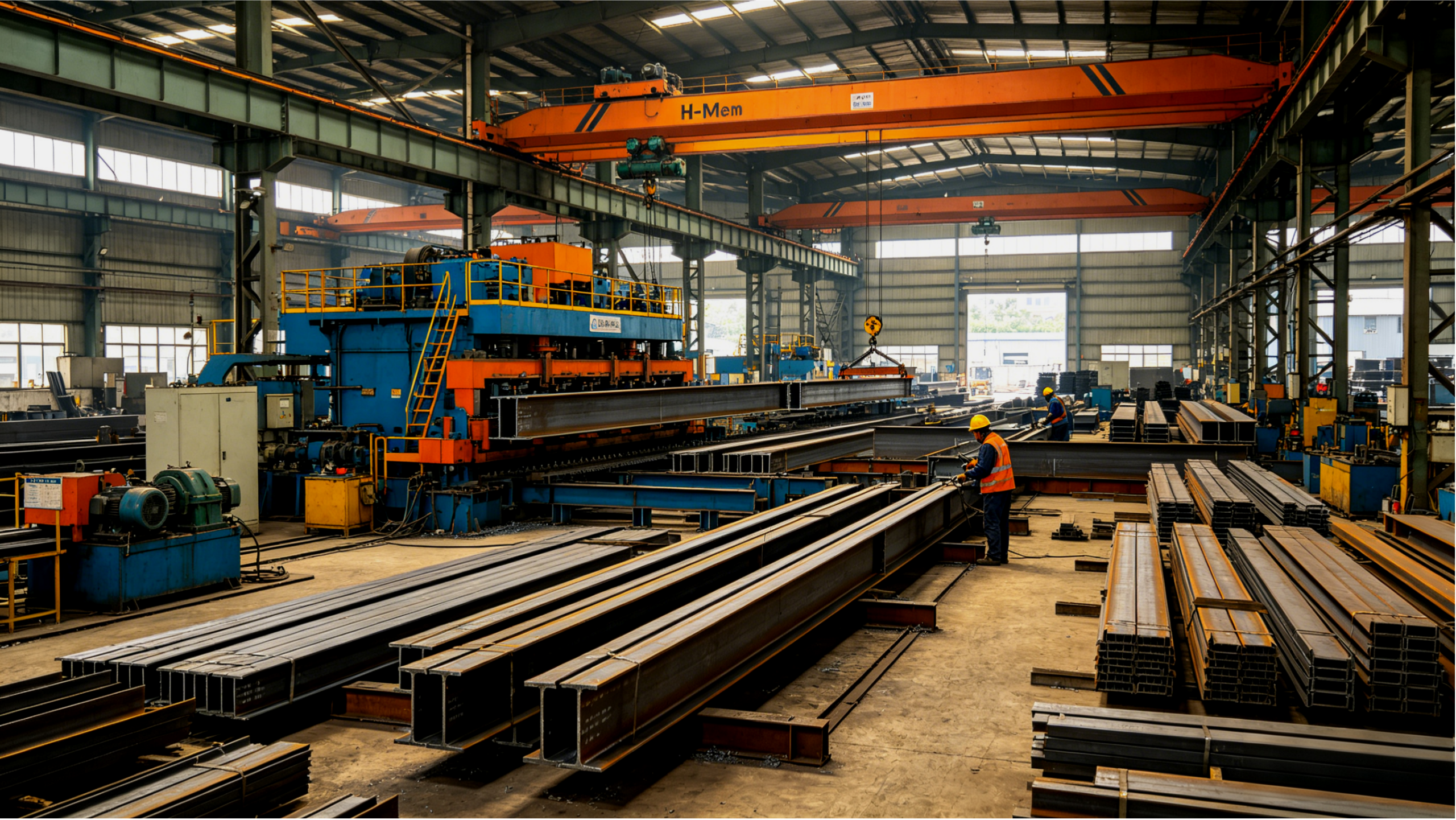
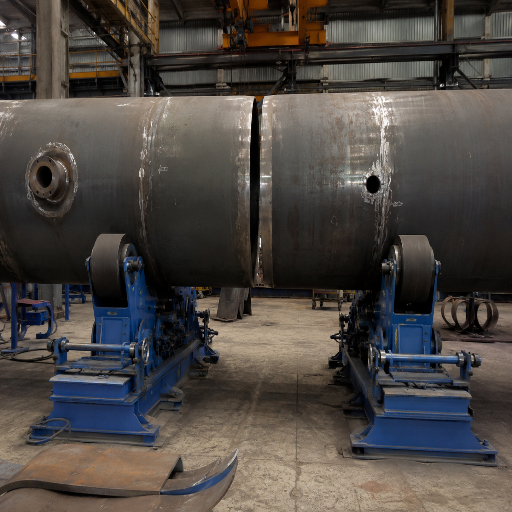
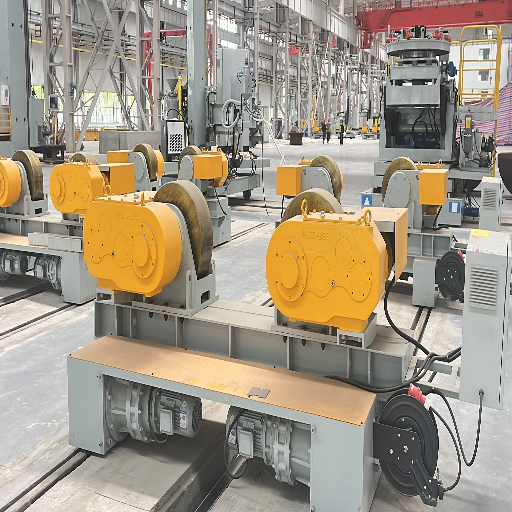
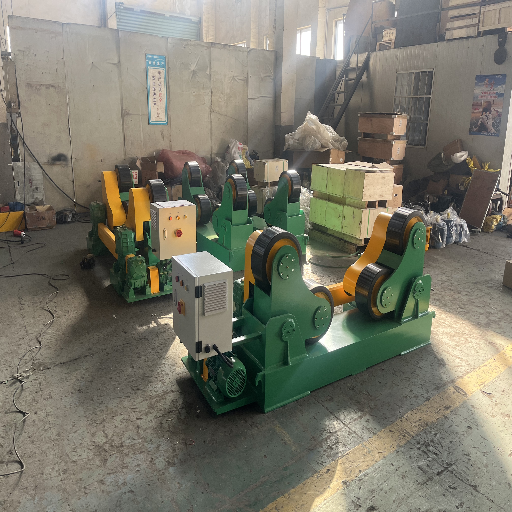
Facility Audit: Heavy Equipment Assembly




For: PROC · EN (Standards Applicability) · MGR
Aubrik Quality Stack — ISO 9001 + CE + 30-Year Deployment Record
The single trust question Chinese-built capital equipment has to answer in US and EU procurement is not “do you have ISO 9001 on the website” — it is “what is your in-the-field track record measured in deployed machines, year-on-year continuity, and post-sale service network.” Aubrik is a thirty-year industrial welding equipment manufacturer producing roughly 1,000 welding sets and 200 cutting sets per year, with continuous export shipments since 2008.
1996
First domestic membrane panel welding line shipped
2008
First export shipment (Asia–Middle East)
1,000
Welding sets produced per year (current annual capacity)
200
Cutting machine sets per year
13+
Active export markets (USA, India, Russia, Philippines, Malaysia, UAE, Indonesia, Spain, Germany, France, Italy, Brazil, Vietnam)
ISO 9001:2015
Quality Management — manufacturer level
CE
European Conformity (Machinery Directive 2006/42/EC + PED 2014/68/EU OEM customisation route)
EN / ES / RU / AR
Multi-language sales & technical support (legacy continuity from 2008)
The trust gap for unknown Chinese welding equipment is a real challenge, and Aubrik engineers address it through three structural choices rather than marketing claims. First, the Lincoln Powerwave® AC/DC twin-wire power source is the same Lincoln Electric power source class used by Pemamek in the Caldema PEMA 3000/6 deployment and by US power source supplier Lincoln Electric’s own Power Wave® AC/DC 1000SD product line. Pairing Chinese-built mechanical architecture (gantry, cross-rail, flux recovery, seam tracking) with Western-tier power source electronics is the deliberate Aubrik engineering choice for boiler-grade applications: Aubrik delivers buyers the procurement-language familiarity of Lincoln AC/DC behaviour without the integrated-system capex of a Pemamek-class line. In structural terms this matters because the differentiator is not “Chinese versus Western,” it is “Lincoln Powerwave electronics inside an Aubrik production-line architecture.”
Second, the 1-year warranty plus free wear-parts policy covers contact tips, wire feed rollers, flux recovery seals and routine consumable replacement under normal duty cycle. Aubrik engineers OEM customisation as a structured engineering service — working width up to 2500 mm, 2–6 torches, hybrid SAW + MAG, loading robot, AI vision inspection, MES dashboard — rather than as a bolt-on quote line. Third, the legacy multi-language sales operation in EN / ES / RU / AR is the same trade-language continuity that 2008-onwards export customers have used — it is the reason a Brazilian, Russian or Spanish boiler fabricator does not need to translate a quote, a manual or a service ticket through three intermediaries. Aubrik provides this multi-language continuity across all 13 export countries as a baseline factory commitment, not as an enterprise tier upgrade. Compared to a single-source Lincoln submerged arc welding machine or ESAB submerged arc welding machine catalog purchase, the integrated Aubrik line carries the same Western-tier electronics inside a complete production system.
Need A Detailed Factory-Capability And Certification Audit Packet?
Download Multi-Torch Spec Sheet (PDF, 8 Pages) →
For: EN + MGR (Automation Investment Decision)
OEM Customization & Automation Upgrades — From Loading Robot To MES Integration
Customisation on our membrane panel welding machine breaks into four engineering categories. Working-width extension up to 2500 mm scales the gantry, cross-rail and flux recovery hopper proportionally without changing the per-torch Lincoln Powerwave® power source. Torch-count extension from two through six (or hybrid SAW + MAG) adjusts the power distribution and the synchronisation logic in the Siemens HMI but keeps the seam-tracking dual-stroke module identical per torch. Automation upgrade modules — loading robot, AI vision inspection, MES dashboard — bolt onto the standard line through documented IO/PLC interfaces rather than requiring core-machine redesign.

Loading Robot — 500 Kg Payload Class
The loading robot module handles 500 kg payload across panel-loading and finished-panel discharge, removing one of the two remaining operator-intensive operations on a multi-torch SAW line (the other is flux recovery, which is automated by the 260 L hopper with preheating). This robot integrates with the Siemens HMI so the welding programme triggers loading and discharge cycles in sequence with the welding pass — a single panel completes load, weld, X-ray hold, and discharge without operator intervention beyond the supervisory dashboard.
AI Vision Inspection
The AI vision inspection module sits inline after the welding pass and before the X-ray inspection bay. It is not a replacement for code-mandated NDT (X-ray, ultrasonic, magnetic particle inspection) — it is a real-time defect-detection layer that flags surface porosity, undercut, and fin-bar misalignment before the panel reaches the X-ray bay, reducing rework cycle time by catching defects at the welding line rather than at the inspection station. In boiler shops where rework of a single panel can consume four to eight hours of cross-line capacity, the AI vision module’s value is measured in capacity preserved, not in defect-rate change.
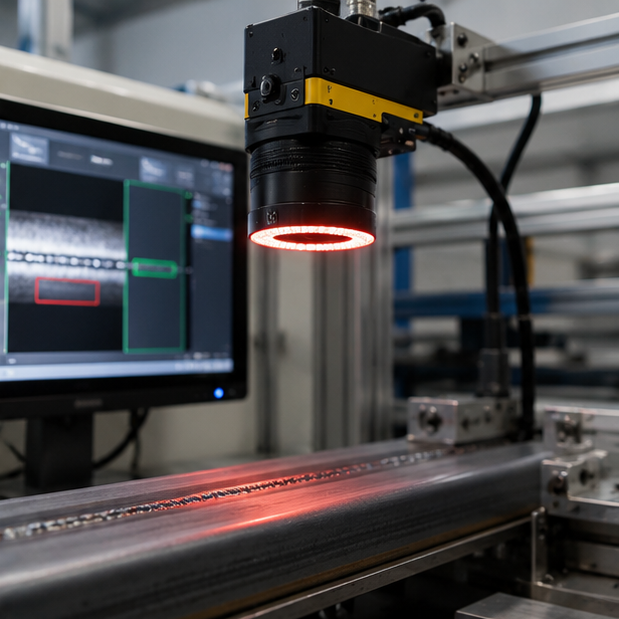
MES Integration & Production Dashboard
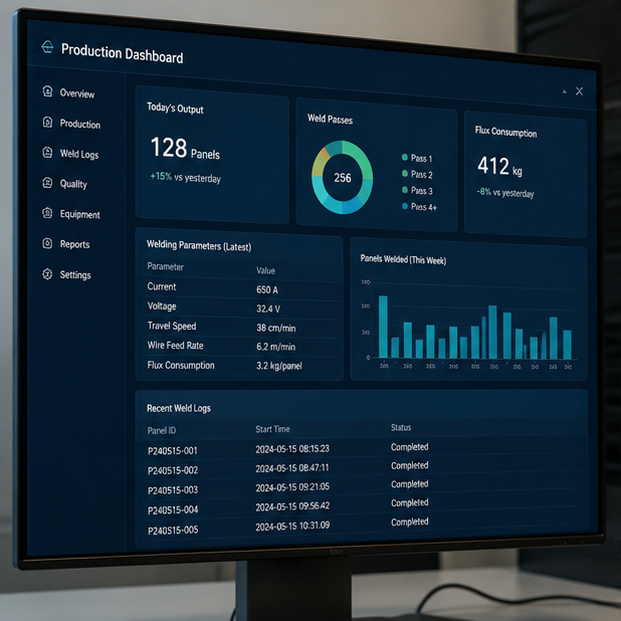
The MES-integrated digital dashboard exports welding parameter logs from the Siemens HMI in structured form: torch current, voltage, travel speed, wire feed rate, flux consumption per panel — all timestamped against panel serial number. For ISO 9001 + PED 2014/68/EU Cat IV operations, this is the data layer that makes weld traceability auditable. A thin-client web view drives the dashboard, so production managers can pull shift-end output reports without entering the welding cell.
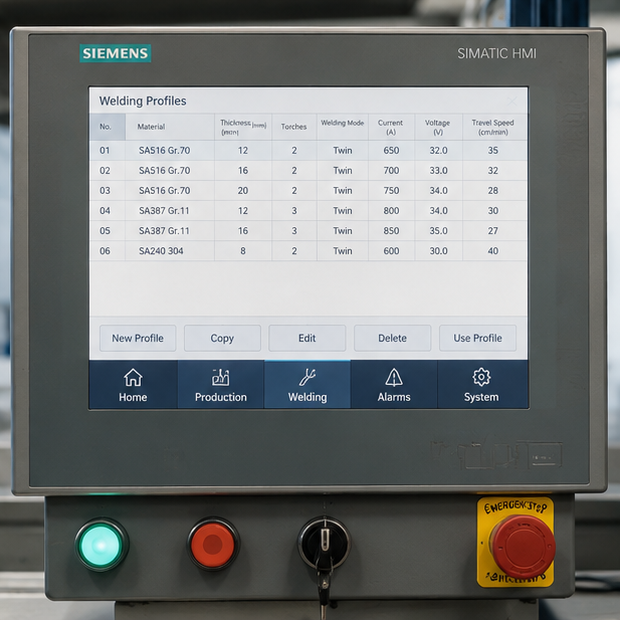
50+ Preloaded Welding Profiles
The Siemens HMI ships with more than fifty preloaded welding profiles indexed by panel material, thickness and torch count. Operators set the panel parameters and the HMI proposes a starting profile; the operator approves, edits or saves a derivative profile for the next production run. This is the architecture that holds the operator-skill ceiling at “basic training” rather than “certified SAW welder” — a single-operator-per-shift line is feasible because the profile library codifies the parameter expertise that would otherwise sit only in a senior welder’s head.
Want A Custom OEM Customisation Engineering Estimate For Loading Robot Or MES Integration?
Book 15-Min Video Demo With Production Engineer →
Engineering Toolkit
Membrane Panel Welding Machine Evaluators
Multi-Torch SAW Capacity Calculator
SAW vs MIG/MAG Cost Crossover Calculator
Boiler-Code Compliance Checker
FAQ — Membrane Panel Welding Machine
Common questions from boiler manufacturers, sandwich panel producers and heat exchanger fabricators evaluating multi-torch SAW for the first time.
Q1: What welding process does the Aubrik membrane panel welding machine use, and why submerged arc welding over MIG/MAG?
This machine uses multi-torch submerged arc welding (SAW) with twin-wire Lincoln Powerwave® AC/DC power sources, 2 to 6 independently controlled torches per line. SAW is preferred for membrane panel production over MIG/MAG for three measurable reasons: weld penetration runs 3–5 mm versus 1–1.5 mm for MIG, the granular flux blanket eliminates spatter and reduces operator PPE requirements, and per-pass consumable cost runs roughly half of MIG/MAG for continuous heavy fabrication (per industry benchmarks from The Fabricator and Red-D-Arc). For boiler-grade membrane wall production where each panel requires 100% X-ray inspection, the SAW quality consistency directly reduces rework cycle cost.
Q2: What panel thickness and tube diameter range does the standard 4-torch model handle?
Our standard 4-torch model handles panels 3–12 mm thick with tube diameters 22–89 mm OD at 1600 mm working width. Our custom 6-torch model extends to 3–16 mm thickness and 22–108 mm tube OD at up to 2500 mm working width. Both models support carbon steel, stainless 304 / 316, and alloy materials with parameter envelope adjustment through the Siemens HMI. For Inconel cladding or duplex stainless applications, the Hybrid SAW + MAG model is recommended.
Q3: How does multi-torch architecture affect deposition rate and daily production capacity?
Per-torch deposition rate is ≥28 kg/h with Lincoln Powerwave® twin-wire SAW. Four torches active in parallel give roughly 112 kg/h system deposition; six torches scale that to ≥168 kg/h. Daily panel production capacity, however, is governed by panel changeover, flux recovery cycles, and code-mandated inspection holds, not by peak deposition alone. Single-shift output runs 800–1200 m²/day for the standard 4-torch model on 1600 mm carbon-steel panels (heat input parameters: 25–35 kJ/in, well below the conventional 85 kJ/in ceiling that recent research is challenging) and 500–800 m²/day for the custom 6-torch model on 2500 mm wide panels. Output dips on heavier-gauge or alloy materials because travel speed drops to maintain penetration consistency. See the Multi-Torch SAW Deposition Ladder above for the full torch × thickness × material map, and the Cost Crossover Threshold for how output translates into per-meter weld cost.
Q4: Is the machine compliant with ASME Section I, PED 2014/68/EU, and EN 12952?
Equipment ships with ISO 9001:2015 quality management and CE marking under the Machinery Directive (2006/42/EC) as standard. For ASME Section I (US Power Boiler) and PED 2014/68/EU Category IV (EU pressure equipment) applications, code compliance is completed at the fabricator level through welder-procedure qualification (WPS/PQR under ASME Sec IX or EN ISO 3834-2) using the machine’s parameter envelope, with the Siemens HMI logging every weld parameter for auditable traceability. The qualification chain runs machine parameter envelope → WPS draft → test coupon weld → mechanical property test → PQR issuance → operator qualification under EN 287 or ASME Sec IX → production weld. PED notified body type examination evidence including welding-procedure approval and welder-qualification scheme is supplied on request for boiler-grade builds in EU markets, and we partner with TÜV Rheinland, Bureau Veritas and DNV for notified body engagement when required by the end-customer audit chain.
Q5: What metals can the machine weld?
Carbon steel (SA-36, SA-178 boiler tube grades), stainless steel (304, 316, 316L medical-grade), and alloy materials (duplex 2205, Inconel 625 cladding via Hybrid SAW + MAG mode). Parameter adjustment is made through the Siemens HMI with 50+ preloaded welding profiles indexed by material and thickness. This thickness range of 3–16 mm covers thin construction-grade sandwich panels through heavy CFB boiler water-wall panels on a single machine — and contrary to the common misconception that SAW is only for thick steel, the same multi-torch line welds 3 mm membrane panels by controlling travel speed (stepless 400–1200 mm/min) and heat input.
Q6: What operator skill level is required?
Basic training only. Our Siemens HMI ships with 50+ preloaded profiles indexed by panel material, thickness, and torch count — operators select rather than dial parameters from scratch. That is why we run single-operator-per-shift versus the 3-4 typical for MIG/MAG.
Q7: What is the typical lead time and what spare parts are included in the warranty?
Lead time is 60–90 days for the standard 4-torch model, 90–120 days for custom 6-torch or Hybrid SAW + MAG type, plus 30–45 days for OEM customisation modules (loading robot, AI vision, MES integration). Sea freight transit adds 30–60 days depending on destination. Our 1-year manufacturer warranty covers the full machine including Lincoln Powerwave® power sources, Siemens HMI and Hiwin C3 linear guides. Free wear-parts (contact tips, wire feed rollers, flux recovery seals) ship with the original delivery, and common spare parts are stocked for 7-day shipment from regional service hubs.
Q8: Can the machine be customised for our specific panel width or torch configuration?
Yes — customisation is the default rather than the exception. Working width is configurable up to 2500 mm, torch count from 2 to 6 plus Hybrid SAW + MAG, material thickness range adjustable through power supply and seam-tracking module rating, and automation modules (loading robot 500 kg payload, AI vision inspection, MES-integrated digital dashboard) bolt on through documented IO/PLC interfaces. RFQ scoping uses the 5-Industry Application Decoder above to match panel mix and certification requirement to the right model baseline before specifying customisation.