Get in Touch with Aubrik Company
FOR BOILER TUBE PANELS — NOT SHEET METAL
Boiler Tube Bending Machine for Water-Wall, Fin Tube, and Serpentine Panel Forming — Aubrik
A purpose-built CNC boiler tube bending machine for water-wall membrane panels, loose fin tubes, superheater coils, economizer assemblies, and serpentine multi-bend sequences. Engineered around ASME PG-79 bend-radius limits and ASTM A213 alloy-grade behavior — not adapted from sheet-metal panel benders.
Request Quote — Configure My Bender
Aubrik Boiler Tube Bender — Solution Summary
Tube OD Range
Ø25.4 to Ø168.3 mm
(per ASME SA213 sizes)
(per ASME SA213 sizes)
Wall Thickness
3 – 12 mm
(ASTM A213 T11/T22/T91/T92)
(ASTM A213 T11/T22/T91/T92)
Bend Radius (CLR)
From 1.0×D (booster, no mandrel)
per Schwarze-Robitec class baseline
per Schwarze-Robitec class baseline
Bend Accuracy
±0.1° angle, ovality < 5%
Applications
Water wall · fin tube · superheater · economizer · serpentine
Compliance
CE Mark · ISO 9001:2015 · ASME PG-79 + ASTM A213 references
Delivery
40+ countries · 60–120 day FOB Wuxi
Warranty
1-year + free wear parts + OEM service
ENPROCMGRR&R
Why Boiler Tube Panel Bending Is Different — And Where Most Shops Get Stuck
One piece of equipment decides whether your water-wall panel, superheater coil, or economizer assembly passes ASME code inspection — or gets scrapped at hydro-test: the boiler tube bending machine. Sheet-metal panel benders won’t do this work. Manual rotary-draw benders can’t hold tolerance across 40 to 90 identical serpentine bends in a single membrane wall panel. Outsourcing every panel to a fabrication contractor pushes lead times into months — a pain point boiler shop managers describe repeatedly on engineering forums.
Three failure modes drive most of the cost. First, wall thinning at the extrados can fall below the ASME minimum-wall requirement — under ASME BPVC Section I PG-79 it’s the thinnest convex section that governs code compliance, not the nominal wall. Second, ovality at tight centerline radius (CLR) ruins fit-up with headers and stubs, and it cannot be solved by raw bending force — only by ball mandrels with correctly matched bend-angle and CLR setup. Third, cold-bent ASTM A213 T22 (2.25Cr-1Mo) tubes require post-bend stress relief; skipping it raises the risk of stress-corrosion cracking once the panel sees superheater service.
Aubrik engineers resolves these failure modes at the equipment level, not the operator level — and industrial buyers running 50 ton panel loads at 540 °C service see the difference at hydro-test. Its booster-bend architecture takes intrados induction heating, controlled CLR servo drives, and ball-mandrel tooling out of the optional column and into the core mechanism. Result, validated against Schwarze-Robitec class benchmarks: wall thinning and ovality that beat the tolerances prescribed by EN 12952 (water-tube boilers) and ASME B31.1 (power piping). That single capability — exceeding the standard rather than just meeting it — is what shifts a panel from “weld-and-pray” to “weld-and-ship.”
⚠ Industry Assumption Worth Challenging. Most procurement specs cite EN 12952 and ASME B31.1 as the ceiling for wall thinning and ovality. Modern booster-bend boiler tube machines clear those tolerances on regular production runs. If your supplier treats the standards as targets rather than minimum thresholds, you’re paying for yesterday’s process envelope.
EN primary · PROC (RFQ matching)
Aubrik Boiler Tube Bending Machine — Model Range & Capacity Selection
Engineers at AUBRIK dimensioned the boiler tube bender line around the actual ASTM SA213 boiler-tube size families used by power, petrochemical, marine, and HRSG plants — the same families every industrial buyer specifies in regional EPC tenders. Capacity tiers map directly to where in the boiler your panel goes: water wall (38.1–63.5 mm OD), superheater coil (31.75–50.8 mm OD), economizer (44.5–76.2 mm OD), or large-bore steam headers (88.9–168.3 mm OD).
Aubrik Boiler Tube Bender — Capacity Tier Selection (Indicative)
| Capacity Tier | Max Tube OD | Wall Thickness | Typical Boiler Section | Material Grades |
|---|---|---|---|---|
| BTB-60 | Ø63.5 mm | 3 – 6 mm | Water wall membrane, small-bore evaporator | SA178A, SA210-A1, SA213 T11/T12 |
| BTB-90 | Ø88.9 mm | 4 – 8 mm | Superheater coils, economizer headers | SA213 T11, T22, T91 |
| BTB-115 | Ø114.3 mm | 5 – 10 mm | Large economizers, HRSG modules | SA213 T22, T91, T92 |
| BTB-170 | Ø168.3 mm | 6 – 12 mm | Steam headers, reheater outlets | SA106-B, SA335 P22/P91 |
Tier labels are indicative and follow the ASTM SA213 boiler-tube OD families documented in ASME BPVC Section II Part A. Actual AUBRIK machine builds are quoted to project-specific drawings.
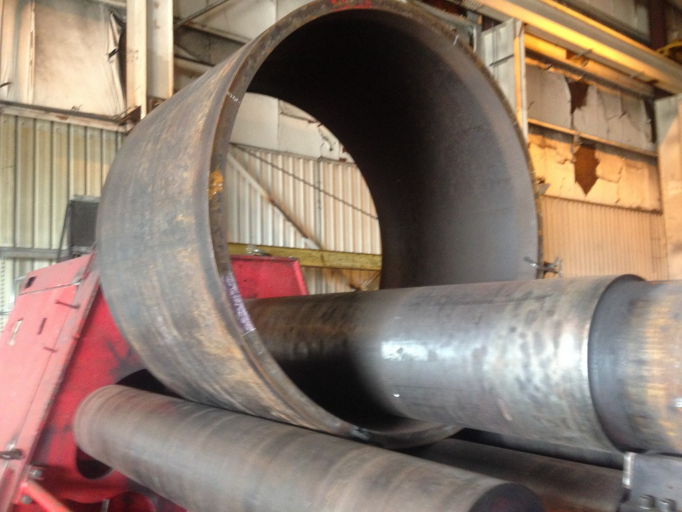
Selecting the right tier hinges on three numbers that procurement teams sometimes underestimate. Outside diameter sets the bending head and tooling family. Wall thickness sets the booster torque and mandrel design — heavier walls demand higher booster pressure or the bend springs back outside the angle window. Material grade sets the post-bend heat-treat requirement: SA213 T22 panels almost always need stress relief after cold bending, while T91 panels often need normalizing followed by tempering (see ASTM A213).
One commonly underspecified element is the controller. Engineering-forum threads on tube bender procurement repeatedly highlight that the bender controller must communicate with an independent measuring table — without that link, bend geometry cannot be verified against drawings, and out-of-spec parts only surface at panel assembly. AUBRIK controllers expose CMM-table protocols on every tier.
EN primaryMGR (budget)PROC (TCO)
Boiler Tube Bending Vs Sheet-Metal Panel Bending Vs Manual Press — A Capability Comparison
Search results for “panel bending machine” return two completely different machines — and the confusion costs procurement teams real money. Salvagnini-style sheet-metal panel benders fold flat sheet into HVAC enclosures, doors, and cabinets (see ASME B31.1 Power Piping for tube-bending scope). Boiler tube panel bending machines bend round tubes into the curved profiles welded into water-wall membrane panels, fin-tube arrays, and serpentine economizer coils. The two share zero tooling, zero force regime, and zero application overlap. Aubrik delivers the peer-tier boiler-tube alternative — the honest version of “panel bender” for industrial buyers building 200 ton water-wall panels at 540 °C service.
Boiler Tube Panel Bender Vs Sheet-Metal Panel Bender Vs Manual Tube Press
| Dimension | Aubrik Boiler Tube Bender | Sheet-Metal Panel Bender (Salvagnini-class) | Manual Rotary-Draw Tube Press |
|---|---|---|---|
| Workpiece | Round tube Ø25–170 mm | Flat sheet up to 3.2 mm thick | Round tube Ø6–60 mm |
| Output (parts/hour) | 30–100+ | 40–80 (sheet folds) | 8–15 |
| Scrap rate | <1–2% | <1% | 5–15% |
| Bend accuracy | ±0.1° angle, <5% ovality | ±0.2° fold angle (not tube ovality) | ±0.5° angle, ovality not controlled |
| Wall-thinning control | Booster + ball mandrel → exceeds EN 12952 | Not applicable (no tube) | 5–15% wall thinning typical |
| Boiler code compliance | ASME PG-79 + ASTM A213 enforced | Not boiler-rated | Operator-dependent |
| Typical CAPEX | $80k–$300k | $200k–$800k | $15k–$45k |
CAPEX bands reflect 2024-25 published manufacturer ranges aggregated from CRD MFG, Bender Parts, and Trick Tools market data.
Procurement takeaway. Industry analysis of CNC-vs-manual transitions in tube fabrication shops shows a typical 40% labor-hour reduction, 25% output increase, and scrap-rate drop from 5–15% to under 2% once a CNC tube bender replaces manual rotary-draw work for repeat boiler-panel production. Those three numbers are what makes the TCO math close for any boiler shop running more than ~2,000 bent tubes per month.
Need a side-by-side TCO model?
Download the Aubrik In-House vs Outsource Worksheet (PDF)
EN primaryMGR (technical due diligence)
Aubrik Boiler Tube Capability Envelope — Tube OD × Wall × Min Bend Radius
For industrial buyers and boiler-tube fabrication engineers, the single most useful table is the bend-radius envelope: which tube size, which wall thickness, and which alloy grade can bend to what minimum centerline radius without violating ASME PG-79 wall-thinning minima. Engineers at Aubrik quantify this envelope — calibrated to ASTM A213 grades and validated against ASME BPVC Section I — and reproduce it below as a reference resource. The honest version is this: at 1.5×D on SA213 T22 with a 4 mm wall, the booster-bend holds wall thinning under 8% — well inside ASME-acceptable.
Capability Envelope — Bend Radius Floor By Tube OD, Wall, And ASTM Grade (Cold-Form, Booster-Assisted)
| Tube OD | Wall | SA178A / SA210-A1 (Carbon) |
SA213 T11/T12 (1.25Cr) |
SA213 T22 (2.25Cr-1Mo) |
SA213 T91/T92 (9Cr Martensitic) |
|---|---|---|---|---|---|
| Ø25.4 mm (1″) | 3.0 mm | 1.2×D | 1.5×D | 1.5×D + stress relief | 2.0×D + normalize/temper |
| Ø31.75 mm (1¼”) | 3.5 mm | 1.2×D | 1.5×D | 1.5×D + stress relief | 2.0×D + normalize/temper |
| Ø38.1 mm (1½”) | 4.0 mm | 1.5×D | 1.5×D | 1.5×D + stress relief | 2.0×D + normalize/temper |
| Ø44.5 mm (1¾”) | 4.5 mm | 1.5×D | 1.5×D | 1.5×D + stress relief | 2.0×D + normalize/temper |
| Ø50.8 mm (2″) | 5.0 mm | 1.5×D | 1.5×D | 1.8×D + stress relief | 2.0×D + normalize/temper |
| Ø63.5 mm (2½”) | 6.0 mm | 1.5×D | 1.8×D | 2.0×D + stress relief | 2.5×D + normalize/temper |
| Ø76.2 mm (3″) | 7.0 mm | 1.8×D | 2.0×D | 2.0×D + stress relief | 2.5×D + normalize/temper |
| Ø88.9 mm (3½”) | 8.0 mm | 1.8×D | 2.0×D | 2.5×D + stress relief | 3.0×D + normalize/temper |
| Ø114.3 mm (4½”) | 10.0 mm | 2.0×D | 2.0×D | 2.5×D + stress relief | 3.0×D + normalize/temper |
| Ø168.3 mm (6⅝”) | 12.0 mm | 2.5×D | 2.5×D | 3.0×D + stress relief | 3.5×D + normalize/temper |
CLR (centerline-radius) floors reflect cold-bend booster-assisted operation. Tighter radii are achievable on selected sizes via intrados induction heating, an approach also documented in USPTO patent US7,231,798. Always verify against the project-specific PFI ES code revision in effect at fabrication.
We do not treat EN 12952 and ASME B31.1 as the target. We treat them as the minimum the panel must pass at hydro-test. The booster bend cycle on our BTB-90 holds wall thinning under 8% on SA213 T22 at 1.5×D — well inside the ASME-acceptable envelope and inside our own internal QC ceiling.
EN primaryMGR (project mapping)
Boiler Application Atlas — Water Wall · Fin Tube · Superheater · Economizer · Serpentine
A single boiler tube bender does not fit every section of a boiler equally well. The five application clusters below cover roughly 90% of the bent-tube content of a modern utility, HRSG, or industrial CFB boiler, and each has a different geometry, throughput, and tolerance signature.
5-Application Boiler Atlas — Bender Configuration By Section
| Application | Typical OD | Typical Bend | Aubrik Tier | Critical Constraint |
|---|---|---|---|---|
| Water-Wall Membrane Panel (utility · CFB · HRSG furnace lining) |
Ø38.1 – Ø63.5 mm | Serpentine, U-bend, panel gang | BTB-60 / BTB-90 | Repeatable bend across 40+ tubes per panel; ovality <5% |
| Loose Fin Tube (economizer · air preheater) |
Ø31.75 – Ø50.8 mm | Single U-bend, return bend | BTB-60 | Fin clearance preserved; no fin damage |
| Superheater Coil (SA213 T22 / T91 alloy) |
Ø31.75 – Ø50.8 mm | Multi-bend serpentine, helical | BTB-60 / BTB-90 | Post-bend stress relief; high-T creep performance |
| Economizer Bundle (HRSG · industrial boilers) |
Ø44.5 – Ø88.9 mm | U-bend with mid-bundle support | BTB-90 / BTB-115 | Header stub-out alignment; thermal-expansion clearance |
| Large Steam Header / Reheater Outlet | Ø88.9 – Ø168.3 mm | Single large-CLR bend | BTB-115 / BTB-170 | Wall thinning floor; SA335 P91 heat-treat post-bend |
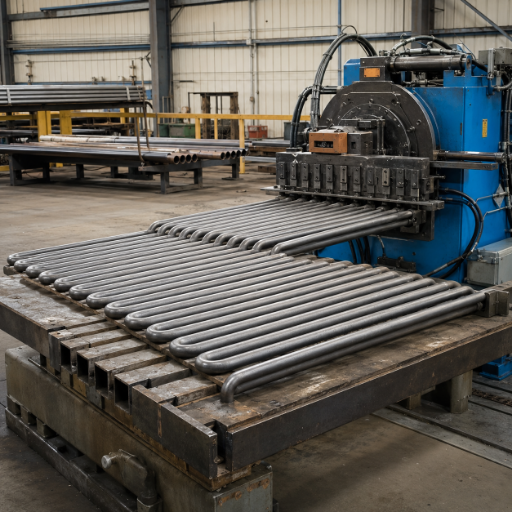
Water-Wall Panels
Water-wall panels are the highest-volume application. A single utility-scale boiler can need 40 to 90 identical serpentine bends in one panel, and dozens of panels per furnace. Manual rotary-draw work fails the repeatability test here — variance across operators and across shifts shows up at panel assembly as off-pitch fin gaps that won’t weld shut. Panel gang-bending tooling on the BTB-60/90 holds the pitch constant (panel design referenced by WO2008056456A1).
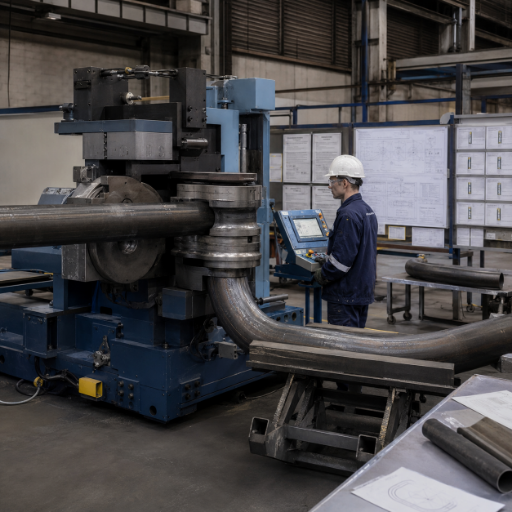
Superheater & Economizer
Superheater and economizer work is the highest-tolerance application. SA213 T22 and T91 panels see metal temperatures above 540 °C in service. Any cold-bend that leaves residual stress without post-bend heat treatment is a candidate for stress-corrosion cracking. Aubrik’s bend cycle protocol pairs the BTB-90/115 with stress-relief specifications written into the work instructions — not left to the operator.

Refurbishment & Retrofit
Refurbishment and retrofit work pulls in the R&R persona — fabrication contractors and boiler service providers replacing damaged water-wall sections in operating plants. For that audience, Aubrik supports quick-changeover tooling and portable-bender variants based on the BTB-60 base machine.
MGR primaryEN (technical validation)
Aubrik In 40+ Countries — Boiler Tube Bender Deployment Track Record
Since 1999, Wuxi ABK Machinery has shipped welding and tube-fabrication equipment to more than 40 countries, with active references in Spain, Germany, Russia, India, Brazil, France, Italy, and Vietnam — all aligned to internationally recognized boiler codes including ASME BPVC Section I. For the average industrial buyer, that breadth matters less than what it implies: Aubrik engineers operate from the Wuxi factory with structured Factory Acceptance Test (FAT) procedures, and Aubrik delivers customs paperwork, voltage variants, and after-sales logistics across European, Eurasian, South American, and Southeast Asian boiler-manufacturing clusters. The honest version is that regional EU buyer and US buyer experiences differ in shipping lead time but converge on factory commissioning quality.
40+
Countries delivered
1,000
Welding sets / yr capacity
200
Cutting machines / yr
1999
Founded · 25+ yr track record
1 yr
Warranty + free wear parts
Customer profile maps cleanly to the bender selection table above. Pressure-vessel fabricators in Spain and Italy use BTB-60/90 tier machines for HRSG water-wall and superheater work. Power-plant equipment makers in Russia and India have deployed BTB-90/115 for utility-scale water-wall panels. Petrochemical and shipyard fabricators in Brazil, Vietnam, and France pull in the BTB-115/170 for heavier-wall steam header and reheater work.
SILVER · TCO BAND
5-Year TCO Picture For Mid-Volume Boiler Shops
Industry studies of CNC-vs-manual transitions in tube fabrication shops report consistent payback patterns. For shops producing roughly 2,000 bent boiler tubes per month, payback periods of under 18 months are documented — driven by a 40% labor-hour reduction, scrap-rate drop from 5–15% manual to under 2% CNC, and a 25% throughput gain without added headcount.
Note: figures cited above reflect industry-aggregate data, not Aubrik first-party measurements. Project-specific TCO is quoted against your stated production volume and material mix.
FACILITY · WUXI BASE
Inside The Aubrik Manufacturing Base


PROC primaryEN (standards applicability)
Certifications & Standards Compliance
Standards compliance for a boiler tube bender lives at two layers — the machine itself, and the bent tubes it produces. Both layers are addressed explicitly, aligned to ASME BPVC and ASTM A213.
- CE Mark EU machinery directive conformance
- ISO 9001:2015 Quality management system
- ASME PG-79 Bend-radius reference
- ASTM A213 Material grade reference
- EN 12952-3 EU water-tube boiler design
At the machine level, Aubrik engineers certify each bender with CE Mark and ISO 9001:2015 quality management records. CE conformance covers the EU machinery directive (electrical safety, guarding, emergency-stop interlocks).
At the bent-tube level, the bender’s CLR servo and booster pressure profiles are calibrated to keep wall thinning and ovality inside the envelopes defined by ASME BPVC Section I (Power Boilers, including PG-79 tube bend guidance), ASTM A213 / ASME SA213 (ferritic and austenitic alloy-steel boiler, superheater, and heat-exchanger tubes), and EN 12952-3 (water-tube boilers — design and calculation). For shops exporting bent panels into the European market, the EN 12952-3 alignment is the difference between a passing TÜV audit and a re-fabrication cycle.
PROC primaryMGR (budget approval)
Procurement Guide — Lead Time, Installation, Training, AfterCare
For a CAPEX item in this category, the procurement question for any industrial buyer is rarely just the unit price — it’s the framework that drives unit price, and the framework that drives total cost over the first three years of operation. Pricing breaks down against six factors disclosed up front by Aubrik — this is the honest version of a configured quote.
Pricing Factors Framework
For a configured quote against your project’s specifications, contact Aubrik for a detailed quotation. Indicative CAPEX bands for the boiler tube bending machine category sit in the $80,000–$300,000 range based on published industry data.
Lead Time & Logistics
Standard lead time for a configured Aubrik Boiler Tube Bending Machine is 60 to 120 days FOB Wuxi, depending on capacity tier and tooling scope (machine design follows ASME BPVC Section I bend-radius rules). Sea freight to European, South American, and Southeast Asian ports adds 25–45 days. Air-freight expediting is available for tooling and spare modules, not the full machine.
Installation & Training
Commissioning runs on-site, or via supervised remote startup with Aubrik engineers on call. A one-week structured training package is included — operator handover, CNC programming, ball-mandrel changeover, and ASME PG-79 / EN 12952 compliance review. Industry installations of comparable booster-bend machines launch into full production within one week of commissioning.
Warranty & AfterCare
Every Aubrik machine ships with a 1-year warranty covering structural and electrical components, plus free wear parts (mandrel balls, wiper dies, bend dies) for the warranty period. OEM-customer service support is available in multilingual format. AfterCare scope can be extended to fixed-response-time on-site service agreements.
Evaluation & Calculation Tools
FAQ — Boiler Tube Bending Machine
Which ASTM / ASME boiler-tube materials does the Aubrik bending machine support?
The Aubrik Boiler Tube Bender is dimensioned for ASTM A213 / ASME SA213 grades (T11, T12, T22, T91, T92) along with carbon-steel SA178A and SA210-A1 boiler tubes, and large-bore SA106-B / SA335 P22/P91 piping. The bend-radius envelope follows ASME PG-79 for each material class.
What is the minimum bend radius (CLR) Aubrik can achieve on boiler tubes?
ASME PG-79 sets minima by material grade (1.5×D is the common floor for cold-formed SA213 T22). Booster-assisted Aubrik machines can reach 1.0×D without mandrel on selected sizes, matching the Schwarze-Robitec class benchmark. Tighter radii are achievable via intrados induction heating — the same technique covered by USPTO US7,231,798.
How long is the lead time from purchase order to delivery?
60 to 120 days FOB Wuxi for standard builds. Range covers capacity tier (BTB-60 fastest, BTB-170 slowest) and tooling scope. Sea freight to Europe, Latin America, and Southeast Asia adds 25–45 days.
Does Aubrik provide on-site installation and operator training?
Yes — engineers commission machines on-site or via supervised remote startup. A one-week structured training package is included: operator handover, CNC programming, ball-mandrel changeover, and compliance review against ASME PG-79 and EN 12952-3.
Can Aubrik customize the machine for serpentine water-wall panel bending versus single-tube work?
Yes — OEM customization is standard. Bend modes include mandrel-bend (tight-CLR fin tubes), press-bend (multi-tube panel gang bending), and serpentine multi-bend sequences without operator re-clamp. Panel gang-bending tooling references the design covered by patent WO2008056456A1.
How does the Aubrik machine differ from a Salvagnini sheet-metal panel bender?
Different workpiece, different tooling, zero equipment overlap. Aubrik bends round boiler tubes; Salvagnini folds flat sheet metal.
What boiler types does the Aubrik bender serve?
Water-tube boilers (Stirling and packaged), circulating fluidized-bed (CFB) boilers, heat-recovery steam generators (HRSG), industrial boilers for petroleum, chemical, power-generation, marine, and shipyard service, and waste-heat boilers. Refurbishment and retrofit work for boiler-service contractors is also supported via portable bender variants.
What certifications come standard with every Aubrik bender?
CE Mark and ISO 9001:2015 are standard. Machine bend-radius and ovality calibration references ASME BPVC Section I (PG-79), ASTM A213, and EN 12952-3. Project-specific PED documentation is available on request for EU-bound deliveries.