Get in Touch with Aubrik Company

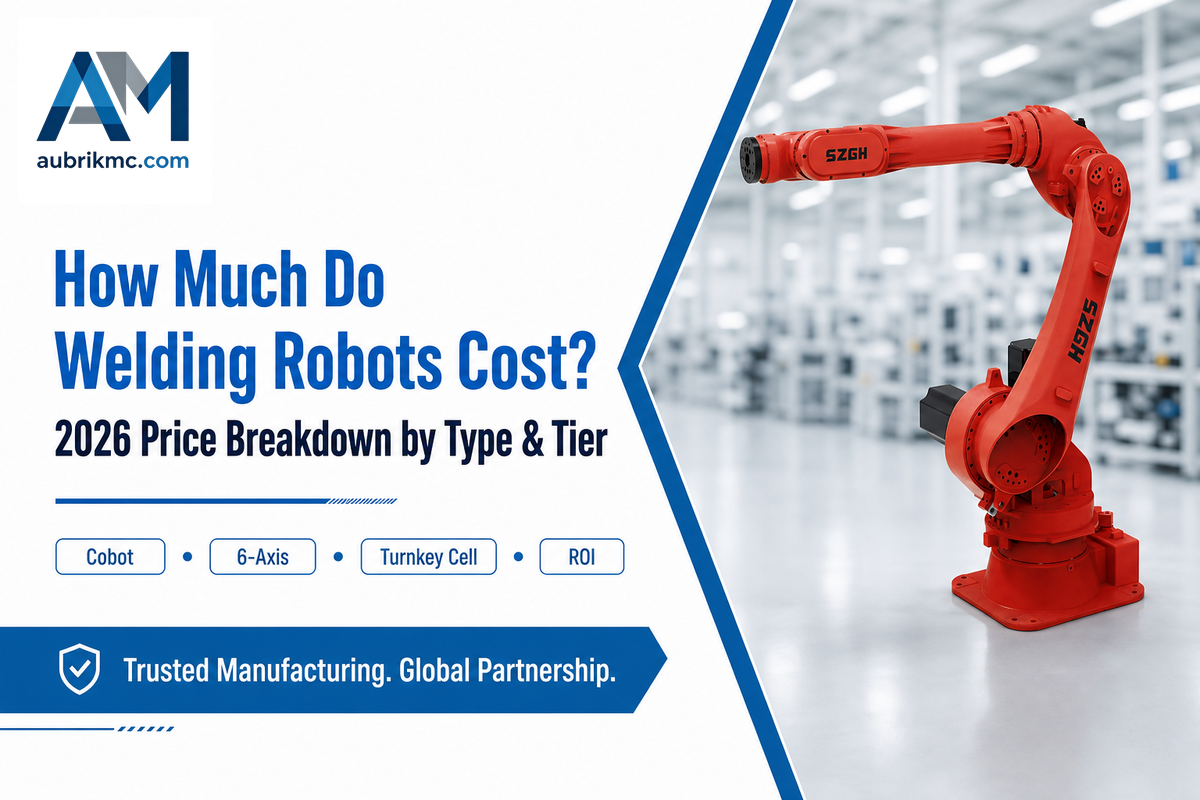
How much do welding robots cost? Welding robot cost is $10,000 to over $500,000 depending on robot type, welding process, and how much of the cell is integrated, with most shops evaluating a first cell landing between $75,000 and $250,000 once the robot, power source, positioner, and safety guarding are all counted together. Vendor homepages rarely show the number you actually pay — this guide breaks the price down by robot type, welding process, and ownership tier, then walks through the line items competitors’ quotes tend to leave off the first page.
Quick Specs: Welding Robot Cost Snapshot
Entry cobot welder $25,000 – $80,000 6-axis articulated arm (bare) $50,000 – $150,000 Turnkey welding cell (integrated) $75,000 – $250,000+ Multi-robot line $250,000 – $500,000+ Typical payback period 12 – 24 months Arm as share of total project cost 25% – 40%
Welding Robot Cost at a Glance
Price guides for welding robots tend to cite a single number – the arm itself. That number is real, but it isn’t the project cost. A complete robotic welding cell – robot, power source, positioner, safety guarding and programming – lands somewhere between $50,000 and $250,000, with an entry-level collaborative package starting near $25,000 for the arm alone, a range independently corroborated by trade coverage from The Fabricator.
| Tier | Price Range | What’s Usually Included |
|---|---|---|
| 1. RaaS / leased cobot | $2,000 – $4,000/month | No capital outlay, monthly Robots-as-a-Service plan |
| 2. Cartesian / SCARA arm | $10,000 – $50,000 | Arm only, best for flat spot/TIG/MIG on small-medium parts |
| 3. Entry cobot welder | $25,000 – $80,000 | Arm + basic MIG torch + hand-guided teach pendant, minimal guarding |
| 4. Mid-range 6-axis arm | $60,000 – $150,000 | Arm + welding head + controller, no full cell integration |
| 5. Turnkey cell — MIG process | $75,000 – $190,000 | Robot + power source + positioner + enclosure + programming |
| 6. Turnkey cell — TIG/laser process | $150,000 – $250,000+ | Same as Tier 5, higher-cost end-effector and process controls |
| 7. Multi-station gantry cell | $200,000 – $350,000 | Cartesian/gantry frame + multiple weld stations + shared material handling |
| 8. Custom multi-robot system | $250,000 – $500,000+ | Multiple robots + vision + material handling + line integration |
| 9. Refurbished / used (any tier above) | 40% – 60% off new | Certified used arm, often with a warranty from the reseller |
Most suppliers don’t publish the prices for all nine tiers together in a single chart, as none supplies all three product ranges. It should be specified in your quote which tier you’ve purchased, as well as what’s represented by the price quoted: arm, cell, or something else. Whatever the price tag says, ask whether it’s the purchase price of the arm alone or the initial cost of the whole welding operation — the gap between the two is exactly what the rest of this guide unpacks.
What Drives Welding Robot Prices Up or Down
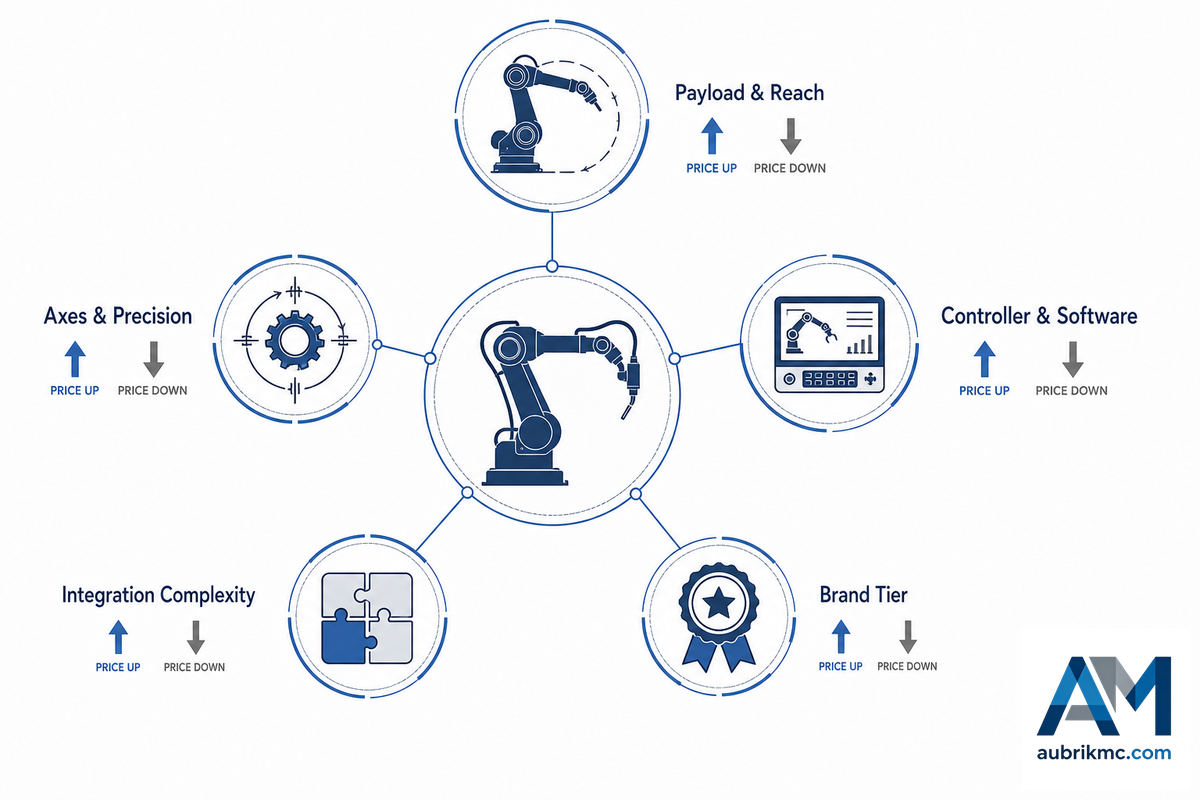
There are six independent variables which contribute to the price of a robotic welding system, rather than a single line item on an invoice that’s simply called “welding systems.” These are the same cost factors — the factors affecting welding robot prices most directly — that any credible welding tools vendor should walk you through before quoting:
- Payload and reach: a 6 kg cobot arm will cost less than a 300 kg heavy-payload articulated arm used to manipulate weldments up to the size of a compact car.
- Welding process: the cost can range from the lowest price for a MIG torch up to very high figures for laser welding heads or electron beam gun systems.
- Positioner or turntable: the addition of a 2-station servo positioner will cost between $5,000 and $60,000, and can sometimes equal the cost of the robot itself when used with long or heavy parts.
- Safety guarding: typical safety features, such as a perimeter fence with interlocks and light curtains, can cost between $4,500 and $23,000 for a standard 6-axis cell (the latter line item often isn’t itemized separately by suppliers of cobot arms).
- Integration and programming: commonly cited as accounting for between 30-50% of total project costs in a complex cell, though this number is expected to decrease as offline simulation software capabilities advance.
- Fixturing and tooling: perhaps the most underestimated of the costs. A welding automation forum survey of cell owners indicated part-fixturing to be the most challenging and recurring problem, more so than the programming itself.
If your volumes don’t justify the investment in any of the levels of ownership above, contracting the work to a shop offering contract metal welding services can fill the gap while you build a case for an investment.
Robot Type Cost Tiers: Cobot vs 6-Axis Articulated vs SCARA/Cartesian
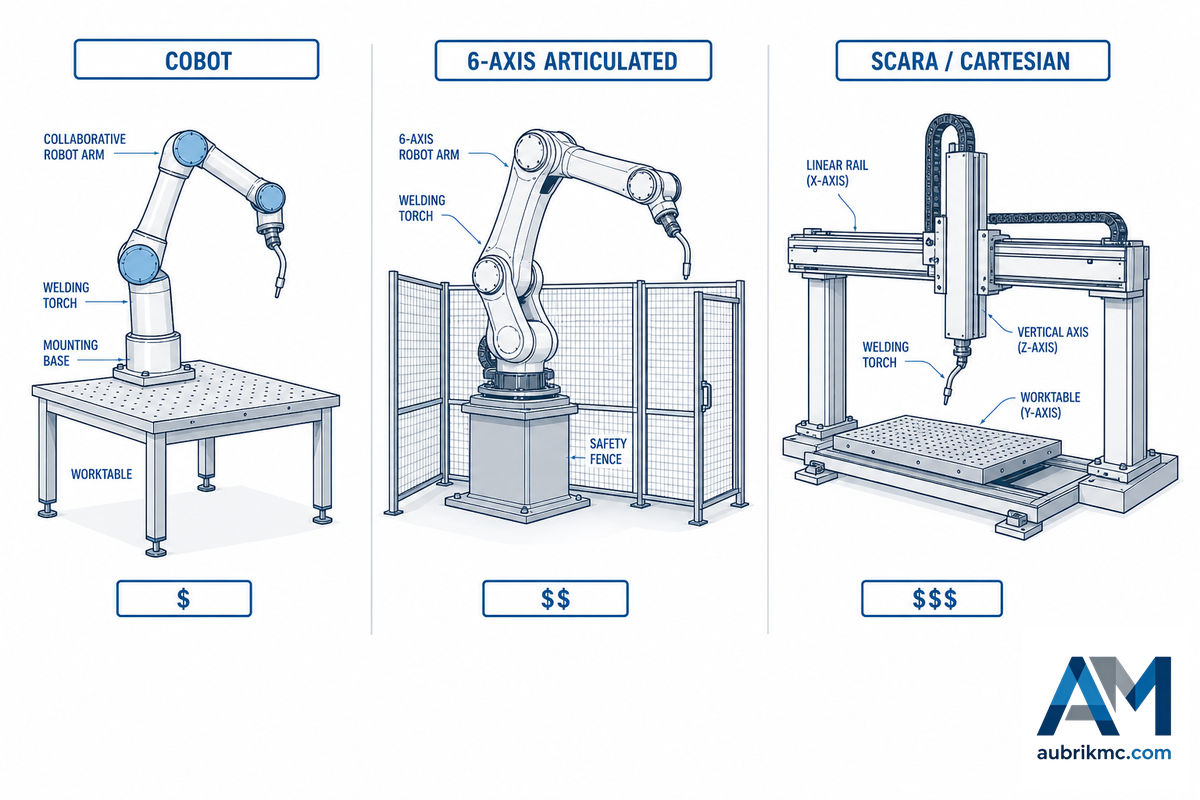
Kinematic type is the fundamental characteristic which establishes the upper price ceiling of a robot and defines its work envelopes and limitations, and global adoption data from the International Federation of Robotics tracks installations across all four types. Nearly all robotic welding installs fall into one of these four basic types of welding robots — articulated arm robots, collaborative robots (cobots), Cartesian robots, and SCARA robots — and each type carries its own advantages of robotic welding for a given part mix. Articulated arm welding robots and SCARA welding robots boost productivity most on repeatable joints; Cartesian welding robots do the same on long, straight seams.
| Robot Type | Arm Price | Best Welding Process | Best Application |
|---|---|---|---|
| 6-Axis Articulated | $50,000 – $150,000+ | MIG, TIG, spot, laser | Complex angles, heavy fabrication — see a robotic welding cell build-out |
| Collaborative (Cobot) | $25,000 – $80,000 | MIG, TIG, plasma | Small shops, high-mix/low-volume — see cobot welding specifics |
| Cartesian / Gantry | $10,000 – $50,000 | Spot, seam, laser | Large flat weldments |
| SCARA | $10,000 – $40,000 | Spot (flat plane only) | Small parts, electronics-adjacent assembly |
Is Robotic Welding Worth It?
Worth-it status depends on volume, part mix, and how consistently incoming material fits up. Robots reward repeatable geometry: arc-on time rises from 10-30% on a manual welder to 50-90% on a robotic cell, which is where the 3-5x productivity gains originate. Robots are a weaker fit for one-off parts, wide part mix, or inconsistent fit-up tolerances — ease of use drops fast once a cell has to be reprogrammed for every batch.
Does the Welding Process Change the Price? (MIG vs TIG vs Laser vs Spot)
The part at the end of the robot arm-the welding gun or torch-bolted to the robot’s wrist, can impact the total price as much as the type of robot you buy. Arc welding, spot welding, and laser welding each demand different welding conditions, and the type of welding you need drives the end-effector spec more than the robotic arm itself does.
| Process | Relative End-Effector Cost |
|---|---|
| Spot welding | Lowest — simplest gun, minimal consumables |
| MIG welding | Baseline — wire feeder + torch, $2,000–$6,000 for the gun/feeder alone |
| TIG welding | Moderate — tighter process control, higher-precision torch |
| Laser / electron-beam welding | Highest — can push a Cartesian arm’s total price past $100,000 on its own |
Turnkey Cell vs Robot Arm Alone, Where the Real Money Goes
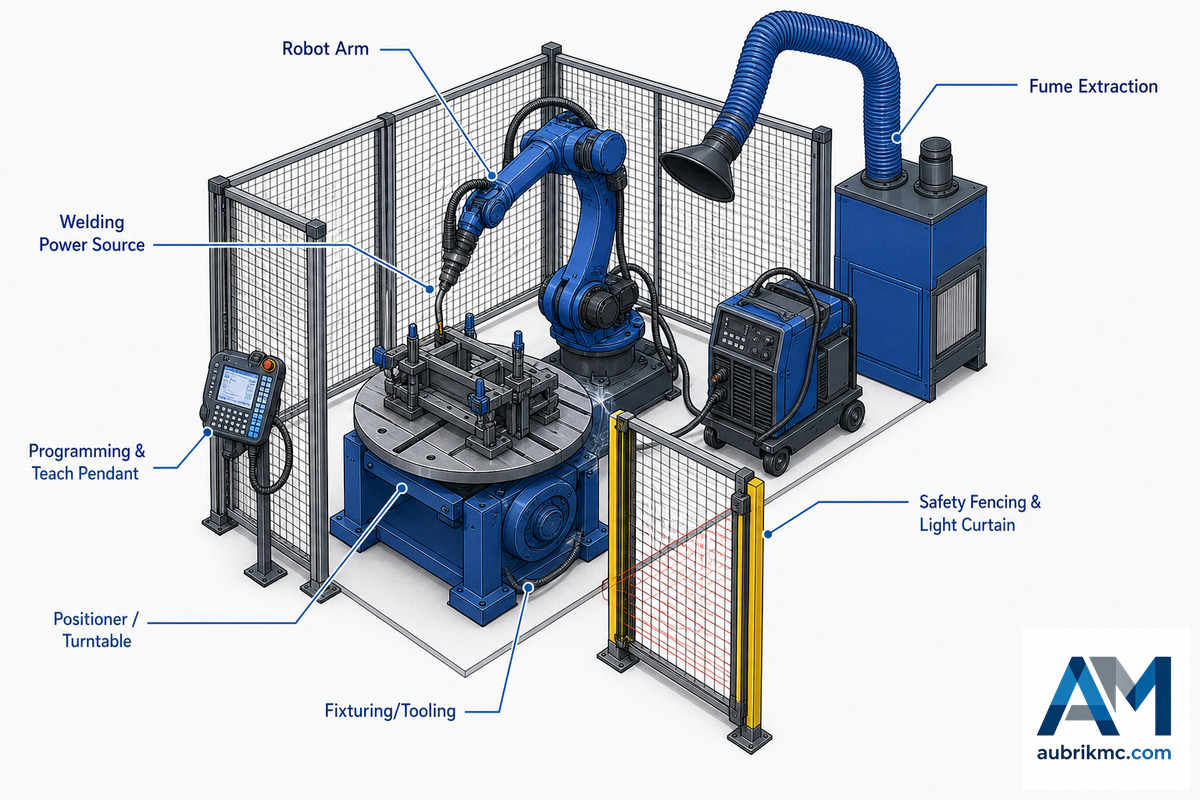
Here’s the part the 3rd party price guides don’t tell you. The 3-Layer Hidden-Cost Hierarchy that’s in every real quote is presented below – arm, integration/build out, and ongoing cost, listed vertically in that order. The components of a robotic welding cell rarely show up as one number, and the cost of a robotic welding machine bought piecemeal almost always exceeds a bundled quote — a dynamic reinforced by recent patents like US12277369B2 and US11648683B2, both aimed at shrinking the integration slice of that stack.
| Line Item | Cost |
|---|---|
| Robot arm + controller | $65,000 |
| Welding power source | $22,000 |
| Two-station servo positioner | $18,000 |
| Safety fencing + interlocks | $12,000 |
| Integration + programming | $25,000 |
| Floor prep + electrical | $15,000 |
| Operator training | $6,000 |
| Shipping + rigging | $8,000 |
| First-year consumables | $18,000 |
| Year 1 Total | ~$189,000 |
25-40%Arm’s Share of Total Cost~2.9xReal Year-1 Multiplier on a $65K Arm30-50%Share Spent on Integration
Two Patents Aimed at Shrinking That Multiplier
Two recently issued patents indicate where that multiplier might start to drop. Neither is mainstream, yet, but they both clearly target the most overlooked line item.
- A 2024-2025 patent on simulated weld paths covers offline path-generation software, which will start reducing that 30-50% slice devoted to integration.
- Another patent for autonomous welding robots, describes a system that learns a joint without any manual input from the operator.
⚠️ ImportantGet a quote broken out by line item before you compare vendors. Two “robot” quotes that differ by 3x are usually not comparing the same scope, one may be arm-only, the other a full turnkey cell.
Hidden and Ongoing Costs: The Real Total Cost of Welding Automation
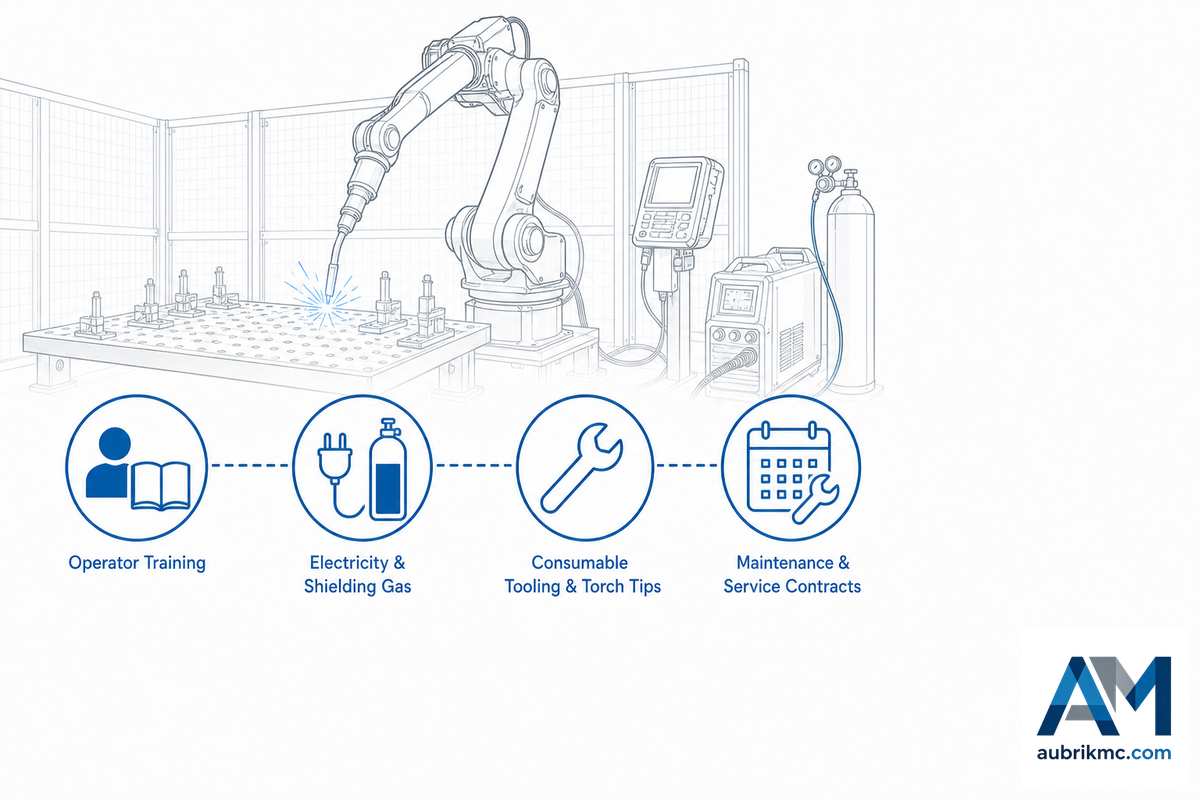
In addition to the up-front integration cost, your welding robot will incur costs every year it’s running. The first-year costs of consumables (welding wire, shielding gas and contact tips) can run as high as $12,000-$36,000, with another $2,000-$12,000 tacked on each year for the annual TCP calibration, lubrication, and sensor inspections.
📐 Engineering Note
Robot safety just changed underneath the industry: ISO 10218-1:2025 and ISO 10218-2:2025 replaced the prior edition with more explicit functional-safety requirements, and the U.S.-harmonized ANSI/A3 R15.06-2025 replaces the 2012 version. None of the three top-ranked competitor guides we reviewed mention this 2025 overhaul. If your integrator’s safety-guarding quote still references the 2012-era standard, ask why.
There’s a common misconception on the topic of robot safety: OSHA doesn’t actually have a dedicated standard for robotics. OSHA’s own robotics page states plainly that “there are currently no specific OSHA standards for the robotics industry.” Robot cell safety is instead enforced through the general Machine Guarding standard and the General Duty Clause, that doesn’t make guarding optional.
- OSHA’s standard maximum penalty for a serious or other-than-serious violation is $16,550 per violation as of the 2026 adjustment, a general industrial-safety figure, not a robot-specific rule.
- For tax years beginning in 2026, IRS Publication 946 sets the Section 179 expense deduction at $2,560,000, in addition to a 100% bonus first-year depreciation provision that will enable the taxpayer to take a $200,000 deduction for the year of the $200,000 system placement in service.
Make sure to confirm current year figures with a tax professional before budgeting around them; limits and percentages are adjusted annually and will change.
Brand and Market Tier Positioning
The brand selected tends to correlate closely with one of the pricing categories described above, rather than constituting a unique cost variable. Tier-one Western and Japanese robotic welder brands (FANUC, Yaskawa/Motoman, ABB, KUKA) are toward the top of the price range for 6-axis articulated and carry excellent service networks, consistent with the installation-share data in the IFR World Robotics report. OTC DAIHEN is unusual in manufacturing both the robot and the welding power source in-house, which can simplify integration.
- Tier-one brands: Higher arm cost, superior service, finest process control.
- Value-tier and Asian brands: Lower arm cost, higher integration responsibility transferred to purchaser.
This isn’t an endorsement of one brand over another; rather, it’s information necessary to quickly evaluate if a given price point makes sense given the brand’s tier. Manufacturers that build robotic welding systems internally rather than purchasing another’s arm at a mark-up provide an easy way to sidestep this tier evaluation.
ROI and Payback Period, The Buy-Threshold Payback Test
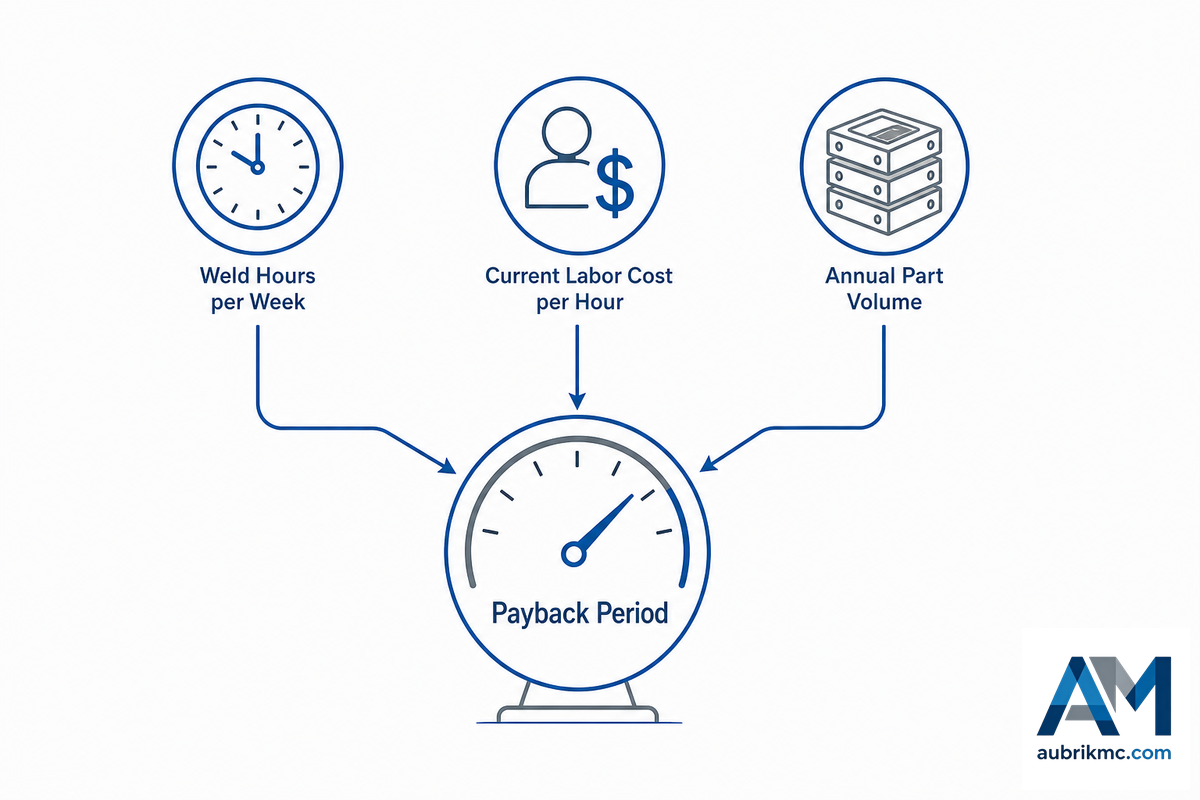
3-Input Buy-Threshold Triad: Substitute system cost, monthly labor cost savings, and monthly rework savings into this simple equation and obtain a payback period that can be independently verified prior to obtaining a quote from an integrator. Framed as a return on investment question, a robotic welding investment only clears the bar once labor cost reductions outpace the amortized system cost.
3-Input Buy-Threshold Triad (worked example)
Start with a real number: the median welder wage was $51,000 in May 2024, per the U.S. Bureau of Labor Statistics’ Occupational Outlook. Loaded with benefits and overhead (BLS Employer Cost data puts this addition at roughly 33% for manufacturing occupations), a fully-loaded welder costs approximately $67,800 per year.
An illustrative industry example (unaudited vendor figures, not an independently verified case study): a fabricator replacing four manual welders (~$358,200/year combined in labor, materials, safety, and rework) with one robotic cell requiring two operators (~$201,400/year) would save $156,800 per year. On a $225,000 investment, that pencils out to a payback of about 17 months, treat it as a worked example of the math, not a guaranteed outcome.
Substitute your own numbers: Payback (months) = System Cost ÷ (Monthly Labor + Rework Savings). If your shop’s fully-loaded labor savings run $10,000/month, a $180,000 system pays back in 18 months; at $15,000/month, the same system pays back in 12 months.
How Long Does It Take for a Welding Robot to Pay for Itself?
12 to 24 months is a typical payback range for many cells, the majority driven by labor savings, but also helped by increased arc-on time and less rework. Those operating in two-shift environments realize quicker paybacks since their capital is being depreciated across double the production volume. Our example (17 months for $225,000) falls into this range, but using the substitution equation with your actual labor and rework savings provides more accurate insight.
Is Robotic Welding Worth It for a Small or Mid-Size Shop?
When the choice is between manual and automated welding, production volume is often more significant than shop size. A 2024 Minnesota State University thesis found that for one specific low-volume part, manual welding was measurably faster and more cost-effective than the robotic alternative tested. A separate, independent 2024 MNSU thesis reached the opposite conclusion for higher-volume work: robotic welding’s time efficiency and cost-effectiveness advantage grows as production volume increases.
- The two thesis results don’t conflict, when you put them together: Both papers identify a consistent volume threshold at which robot economics prevail. Manual welding can win out when volume dips below that point.
- Volume below a certain threshold-say, a shift’s worth of work per year-typically can’t amortize fixed costs of an automated system quickly enough.
Advantages of Starting Small
- Cobot packages now start under $60,000 turnkey
- Robots-as-a-Service (RaaS) plans run $2,000–$4,000/month with no capital outlay
- Deployment in days, not the 6–12 weeks typical of a traditional cell
⚠ Limitations
- High part-mix, low-recurring-geometry shops may find programming time exceeds welding time
- Inconsistent incoming fit-up tolerances undermine weld quality gains
- Volume below a shift’s worth of work per year rarely amortizes fixed costs quickly enough
If you’re evaluating a first cell vs. a lower-commitment option, a column-and-boom welding manipulator falls in the price range just below that of a full robot. These units can handle some of the same welding tasks as the cell without the integration complexity of a robotic cell-consider this “middle ground” option during pricing evaluations along with other robot options, such as those evaluated in the robotic welding systems comparison referenced above.
Can Small Businesses Afford Welding Robots?
Yes, more so than five years ago. Cobot welding systems now start under $60,000 for a basic turnkey setup, and Robots-as-a-Service programs remove the capital barrier entirely with monthly plans. The practical starting point is your highest-volume, most repetitive part family, prove the payback there before expanding automation shop-wide.
Industry Outlook: Where Welding Robot Pricing Is Headed
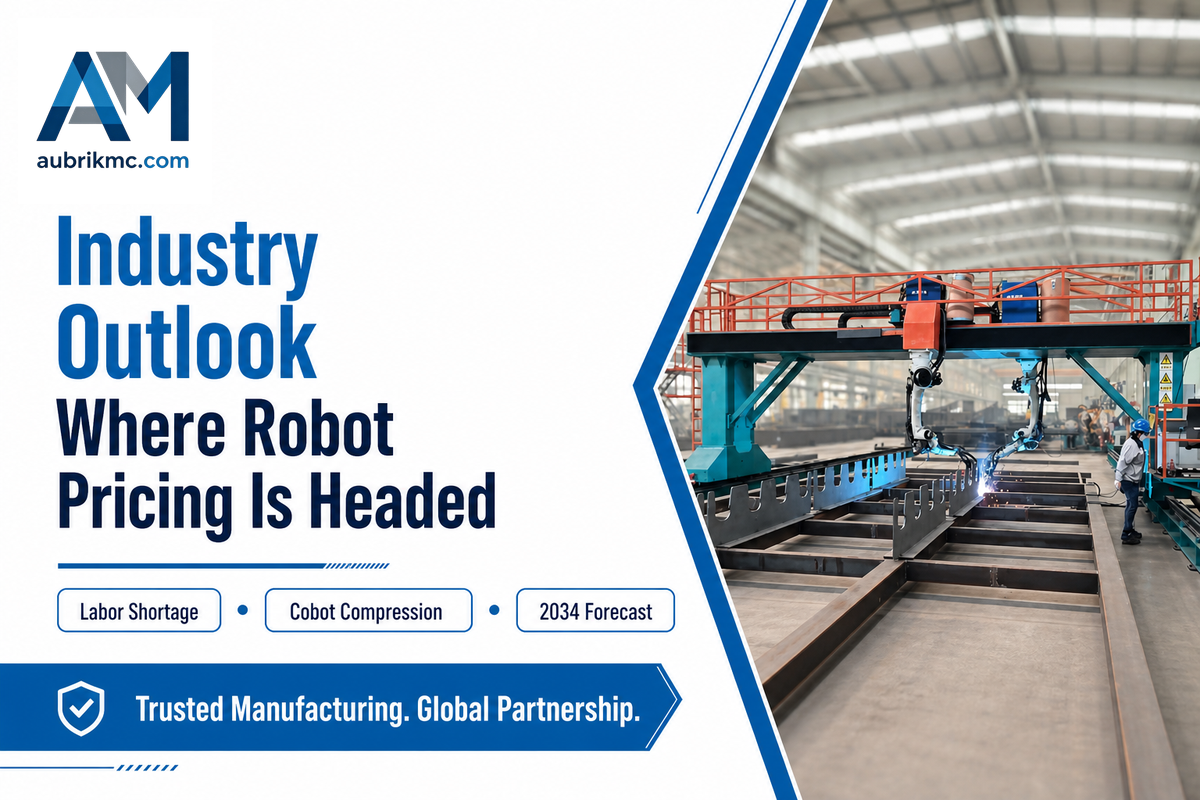
(Updated July 2026.) What’s really driving these decreasing entry prices? The honest answer is labor-not a dramatic market size change, as some of the headlines suggest. Welding applications in automotive plants, heavy fabrication shops, and energy-sector fabricators report the same welding needs: fewer qualified hands and rising welding costs per hour, which is the real reason collaborative welding keeps getting cheaper to buy into.
- There are currently over 157,000 U.S. welders aged 55 or older who are approaching retirement, and over 320,500 additional welders are expected to be needed nationally by 2029 to meet existing demand, according to WeldingWorkforceData.com as reported in AWS’s Welding Digest.
- BLS predicts just 2% growth in employment for welding specialists between now and 2034 (below the average job growth rate), with the majority of the nearly 45,600 annual openings resulting from existing welders leaving the profession due to retirement or job transfers, not from increased demand.
BLS notes directly that automation may limit overall demand for these workers. Read plainly, that is the market’s own adjustment mechanism already in motion: a flat-to-shrinking labor pool is pushing steady-state shops toward automation regardless of what the robot itself costs.
Regional Reality Behind the Global Growth Number
The total number of global industrial robot installations topped 542,000 in 2024, per the International Federation of Robotics, more than doubling over the last decade. However, the U.S. and wider Americas region saw robot installations decrease in the same year: U.S. installations were down 9% to 34,200 units, and the wider Americas region was down 10% to 50,100 units. Global market growth doesn’t directly equate to a thriving U.S. market for these machines, the machines are being produced and sold internationally, while the U.S. market continues on its own adoption trajectory.
- Advances in offline programming, machine-vision systems, and adaptive, self-learning welding-path software (the two patents referenced above) should further reduce integration costs over time, which currently range from 30-50% of the price of a complete cell.
- Background context only: the robotic welding market is projected to grow globally from about $9 billion in 2026 to $27.9 billion in 2034, a 15.2% CAGR, per Fortune Business Insights, a market-size figure, not what any individual shop should expect to pay.
Frequently Asked Questions
Q: What is the average cost of a welding robot?
See the range
Robotic welder cost varies widely by welding type: a bare arm goes for anywhere from $10,000 (Cartesian/SCARA) to $500,000+ (heavy-payload articulated). A full turnkey cell — the number that matters to most buyers — runs from $75,000 to $250,000 once the power source, positioner, safety guarding, and programming are all factored in. Multi-robot lines and custom systems can push well past $500,000 depending on scope.
Q: Do welding robots require frequent maintenance?
See the maintenance schedule
Preventative maintenance every 3-6 months (TCP calibration, lubrication, sensor checks) generally costs $2,000-$12,000 annually, depending on robot type and duty cycle. Cobots need less: some collaborative platforms are rated for 8-10 years of maintenance-free drive-motor operation because they have fewer wear points than traditional heavy-payload arms. Budget for occasional torch and wire-liner replacement on top of the scheduled service contract.
Q: How much space do you need for a welding robot?
See the space guidance
It needs to accommodate the working envelope of the robot, plus any necessary clearance for the positioner, safety guarding, and material flow into and out of the cell. Compact SCARA or Cartesian setups may have smaller floor-print requirements; a 6-axis cell with a two-station positioner will require substantially more space and may also need additional room for fume extraction or electrical service.
Q: Does the welding robot cost include the welding power source?
See what’s included
Not usually. Most advertised robot prices cover the arm and controller only. The welding power source is priced separately, running $8,000-$25,000 depending on process. Some OEMs (OTC DAIHEN, for instance) make the arm and power source in-house and may offer bundled pricing. Always ask for clarification when comparing quotes.
Q: Is a used or refurbished welding robot a safe way to cut cost?
See the trade-off
In many cases, yes, provided you adhere to two important rules. First, purchase only through a certified reseller who stands behind the used unit with a warranty; refurbished robot units are 40-60% less than new, but uncertified units may present an unacceptable risk on repeatability and lifespan. Second, don’t forget that the robot arm is just 25-40% of the overall cost. While you’ll save 40-60% on the arm itself, the positioner, safety guarding, integration labor, and first-year consumables still have to be purchased at market price, reducing your total savings somewhat.
Q: What’s the fastest way to get an accurate quote instead of a range?
See the shortcut
Send an integrator your part geometry, material, target cycle time, and annual volume, and ask for a line-item breakdown, not a single number.
The Team Behind This Report
Aubrik (Wuxi ABK Machinery) has manufactured welding positioners, manipulators, and robotic welding cells since 1999, and this cost breakdown draws on pricing patterns our engineering team sees across export inquiries for robotic and semi-automated welding systems, cross-checked against the independent government, academic, and standards sources cited throughout. We build automation hardware ourselves, so the numbers above are framed as an honest market reference, not a quote for our own equipment, talk to our team directly for that.
References & Sources
- Occupational Outlook: Welders, Cutters, Solderers, and Brazers — U.S. Bureau of Labor Statistics
- Employer Costs for Employee Compensation — U.S. Bureau of Labor Statistics
- Robotics Safety Overview — U.S. Occupational Safety and Health Administration
- OSHA Penalties — U.S. Occupational Safety and Health Administration
- Publication 946: How To Depreciate Property — Internal Revenue Service
- Global Robot Demand in Factories Doubles Over 10 Years — International Federation of Robotics
- Where Are the Welders? (October 2025) — American Welding Society
- ISO 10218-1:2025, Robotics, Safety Requirements — International Organization for Standardization
- ANSI/A3 R15.06-2025 Robot Safety Standard — American National Standards Institute
- Comparative Study of Robotic and Manual Welding in a Low-Volume Production Environment — Minnesota State University, Mankato
- Time and Cost Efficiency Analysis of Robotic Welding at Scale — Minnesota State University, Mankato
- US12277369B2: Generating Simulated Weld Paths for a Welding Robot — USPTO
- US11648683B2: Autonomous Welding Robots — USPTO
Related Articles
- Cobot Welding: A Complete Buyer’s Guidewhere cobot pricing and fit-check criteria are covered in depth
- Robotic Welding Cell: Components and Selection Guidethe terminology and component breakdown behind the turnkey-cell pricing above
- Robotic Welding Systems — Aubrik’s full robotic welding systems and manipulator lineup
- Metal Welding Servicescontract welding as an alternative to buying automation outright
- Aubrik Welding Equipment Manufacturerpositioners, manipulators, and robotic welding cells built since 1999