Get in Touch with Aubrik Company

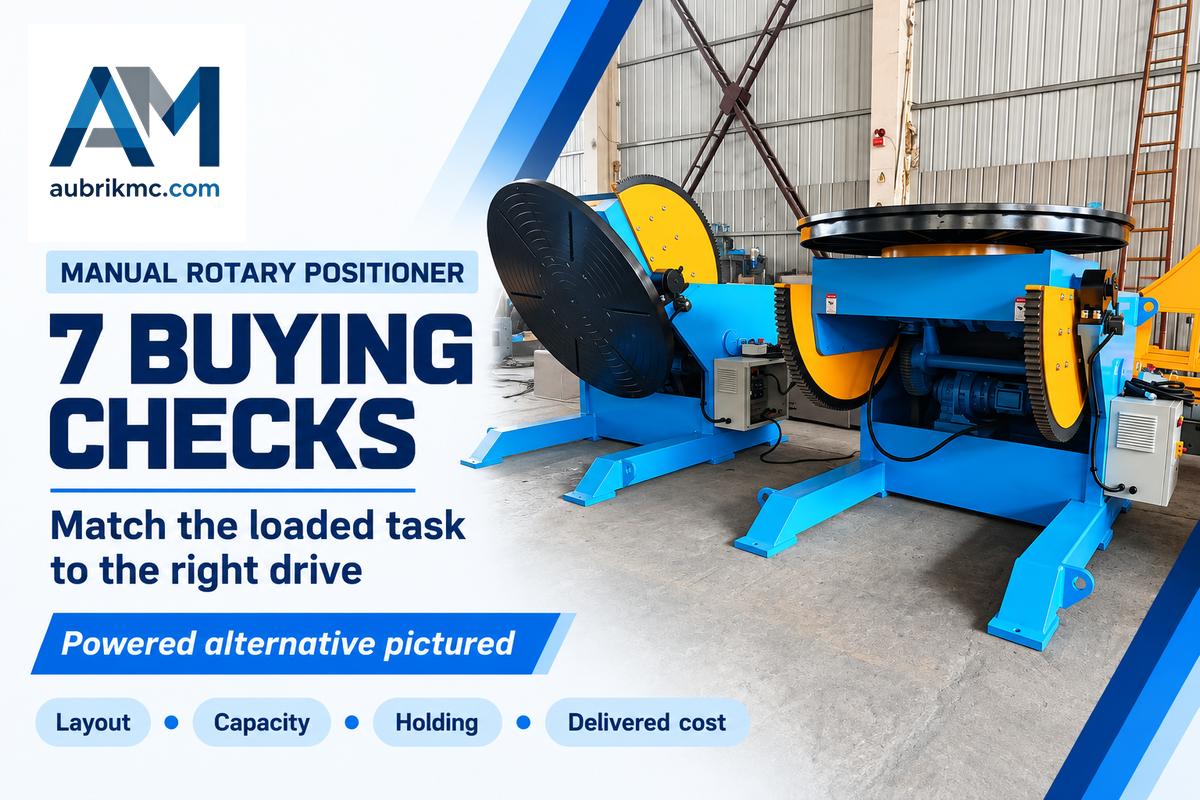
A manual rotary positioner allows an operator to turn a secured workpiece into a position for welding, fitting or inspection. Choose one based on how the load moves, how it locks, and what it carries throughout the full working range. If the job requires controlled rotation while the arc stays on, compare a powered drive first before ordering.
A small faceplate stand and a frame that flips an entire welding table can both be sold as manual positioners. Their price tags describe different purchases across the welding industry. This guide to welding positioners looks at seven checks of the delivered setup, the fixture and the actual work it does.
What a Manual Rotary Positioner Actually Does
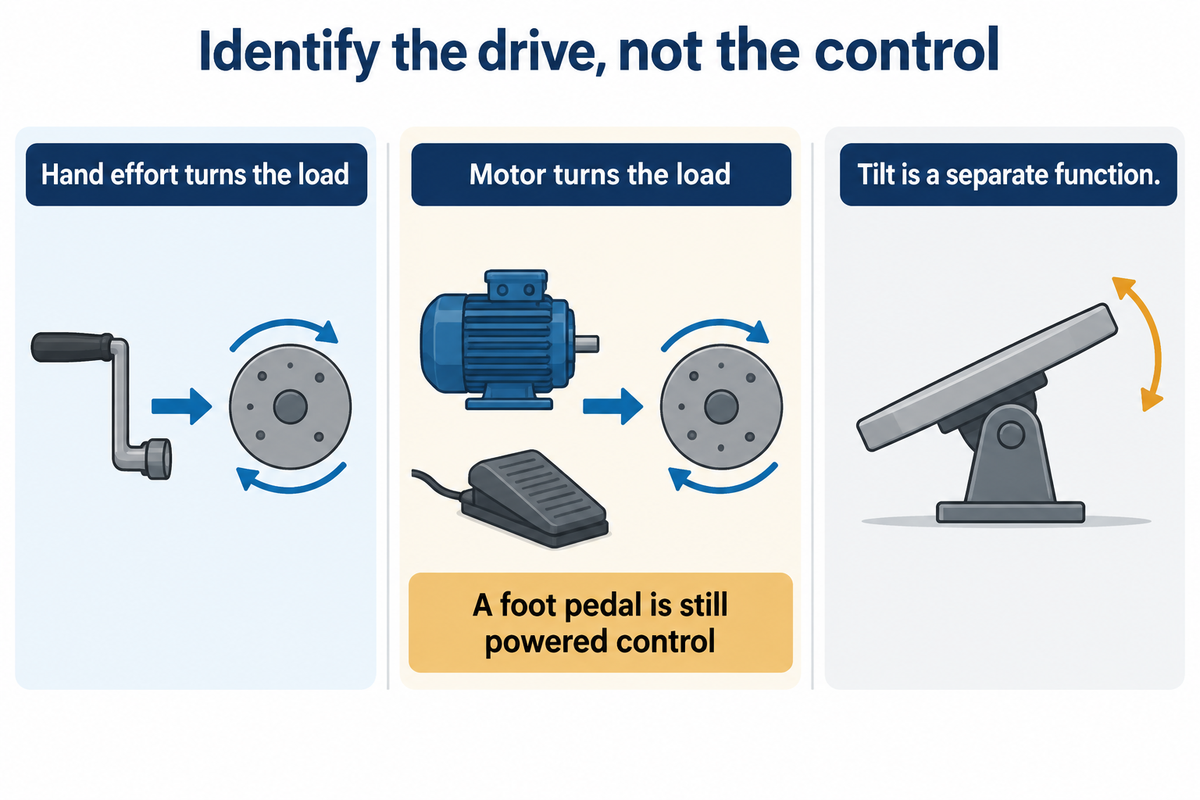
A manual rotary positioner uses an operator’s effort to move the load, either directly or through a handwheel and gearing. Rotation, tilt and height adjustment are separate functions. A machine with manual tilt can still have a motor-driven rotation; the word “manual” next to its controls doesn’t identify the drive.
Start an enquiry with three questions: what turns the workpiece, what changes its angle, and what holds it after movement stops? Record the tilt angle separately from the rotational speed and drive type. A pedal-controlled motor is still a powered drive if a welder operates the pedal. Manual welding describes who controls the welding gun and can take place on either kind of positioner.
Heck’s WFWPM10 product listing provides a useful contrast: it identifies manual operation and leaves motor power and rotation speed unspecified. Aubrik’s published positioner family includes powered rotation. Neither description should be reduced to a single control-label checkbox.
Assessing the suitability of rotary tables for welding service is also required. For infrequent assembly tasks, a hand-operated layout might suffice. For automatic welding, the buying question changes to integrated motion and controls. Decide what task the machine will perform, and then consider the accessories.
Choose the Positioner Layout Before the Capacity
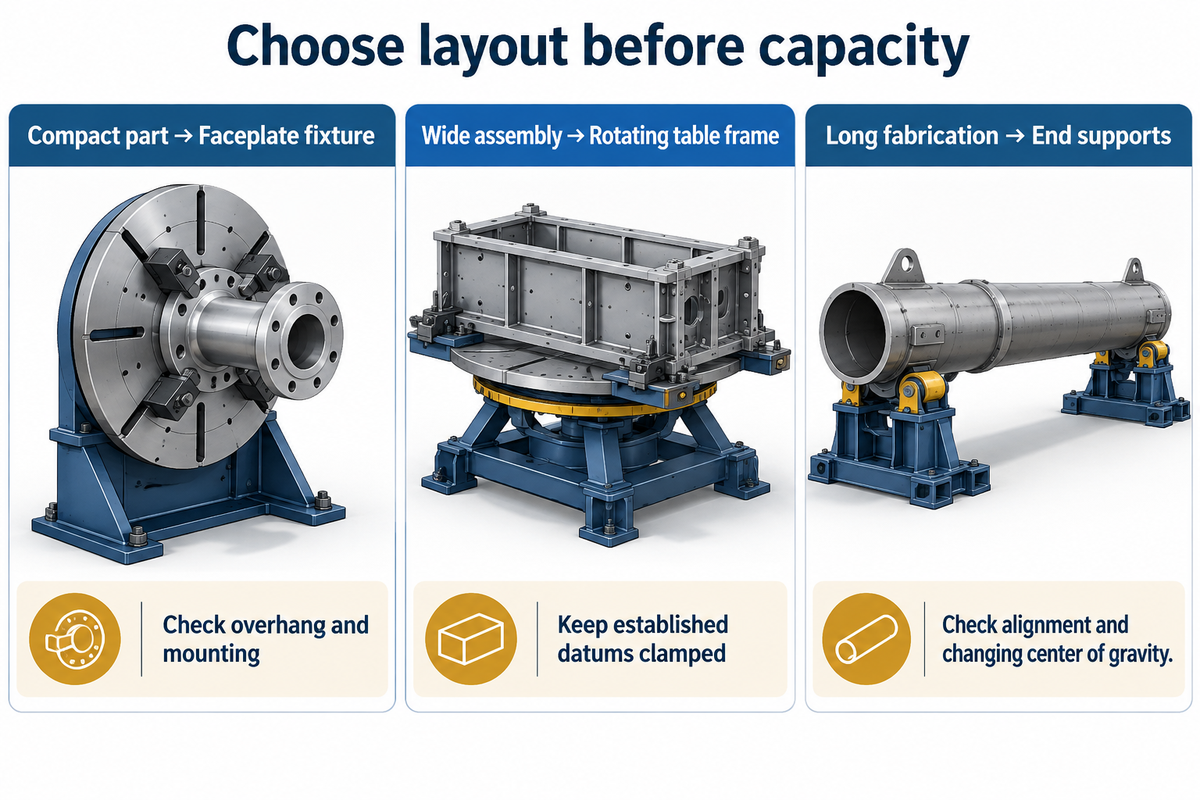
A small faceplate positioner suits parts that attach to a chuck or compact fixture; a table-rotation frame suits assemblies already clamped across a welding table. Long workpieces may need support at both ends. Compare these types of welding positioners by supported shape and weld access before choosing a capacity.
A pump manifold provides a good example. In a 2023 application account, Bluco indicates alignment issues when an unclamped assembly was transferred. The solution was to combine a manual positioner and modular fixturing to rotate the assembly while it was still clamped. The key lesson is that for repeated setups, a faster rotation mechanism can’t recover alignment if lost during the setup.
| Task or part | Layout to compare | Purchase condition |
|---|---|---|
| Short flanged spool | Faceplate with a compatible chuck | Check jaw reach, bore clearance and overhang. |
| Small bracket assembly | Bench-mounted rotary fixture | The mounting surface must carry the loaded unit. |
| Wide rectangular frame | Table-rotation frame | Keep the assembly clamped through the turn. |
| Pump manifold with several joints | Modular fixture on a rotating table | Preserve the established datums between welds. |
| Long beam fabrication | Headstock and tailstock arrangement | Confirm support alignment and the changing center of gravity. |
| Large cylindrical shell | Turning rolls or a supported fixture | Choose support from shell geometry and contact surfaces. |
| Continuous circular seam | Powered rotary drive | Demonstrate the required travel speed under the actual load. |
| Intermittent inspection stations | Indexed manual positioner | Specify the required angular stops and repeatability. |
| Robot-coordinated weld path | Integrated servo positioner | Coordinate the axis with the robot and cell protection. |
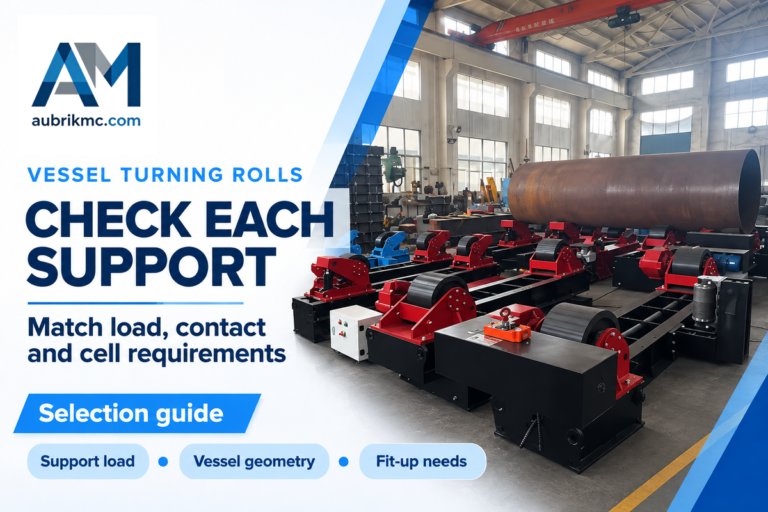
For a shell that rests on its outside diameter, compare turning rolls for cylindrical work before forcing it onto a faceplate. A column-and-boom manipulator (equipment that carries the welding head) moves or supports the welding head; it doesn’t replace the workpiece support. Those distinctions prevent buying the wrong machinery for the available workspace.
Check Load Capacity in Every Working Orientation
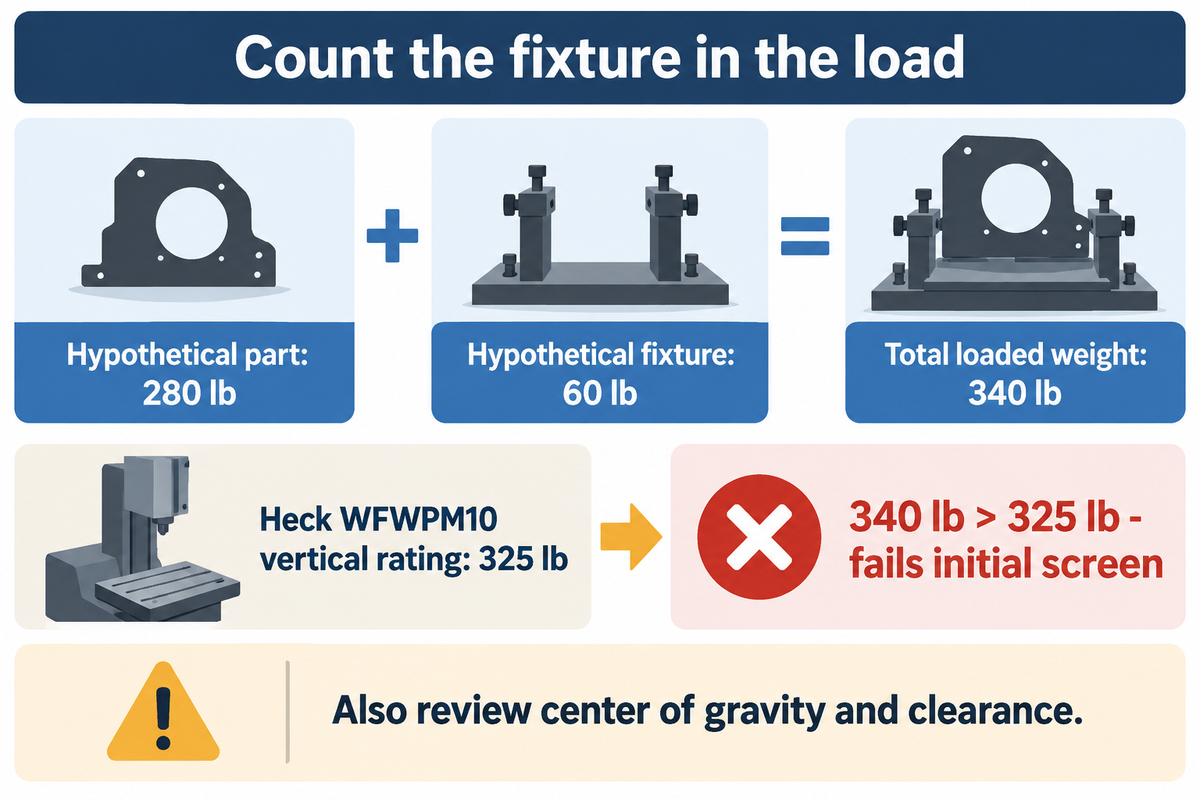
Heck lists 675 lb horizontal capacity and 325 lb vertical capacity for its WFWPM10. That difference makes orientation a constraint on purchase. Add the workpiece, chuck, adapter and fixture before checking the appropriate rating, and then have the supplier evaluate the center of gravity and the complete movement envelope.
According to Koike’s positioner sizing guidance, center-of-gravity location, eccentricity and swing clearance affect selection. Weight farther from the axis creates a larger turning moment. A tall fixture can therefore make a modest weldment harder to handle than a heavier, compact load located close to the axis.
| Selection field | Heck WFWPM10 listing | Strong Hand BuildPro rotary frame listing |
|---|---|---|
| Basic layout | Compact square worktable on a stand | Frame for rotating a welding table |
| Published load rating | 675 lb horizontal; 325 lb vertical | 2,400 lb listed capacity; confirm the exact table and loading arrangement |
| Table or supported surface | 12 × 12 in table | Compatible table top selected separately |
| Listed height adjustment | 28, 29, 32 or 34 in | 28–36 in table-height range |
| Listed angular positions | Table tilt stops at 0°, 30°, 45° and 90° | Positive faceplate locking at 15° increments |
| Rotation mechanism description | Manual operation | Hand crank with worm gearing |
| Base and support | 24 × 24 in base | Outrigger configuration; compare the footprint with the work envelope |
| Center-of-gravity provision | Buyer check: submit the loaded fixture drawing for review | Mounting adjustment in 1 in increments |
| Quote scope | Buyer check: confirm chuck, clamps and adapters separately | Table top sold separately |
Sources: Heck WFWPM10 and Strong Hand Rotary Positioners, checked October 23, 2026. Values are attributed to the product listing. Confirm the permitted loading of the ordered configuration; the two layouts aren’t interchangeable.
How do I choose the proper rotary welding positioner for my needs?
Take a fully loaded drawing and the required movements and check the manufacturer’s capacity envelope. For a hypothetical 280 lb part and 60 lb fixture, the total is 340 lb. This exceeds the WFWPM10’s vertical rating, so the configuration fails the initial screen. Passing a weight comparison alone would still leave center of gravity, mounting and clearance to assess.
A quotation limited to the bare part weight may look more attractive, as it describes a smaller machine. Send the fixture drawing at the same time as the part drawing. Include any projections that go below the table and any components added during assembly.
Check the Lock Before Releasing the Workpiece
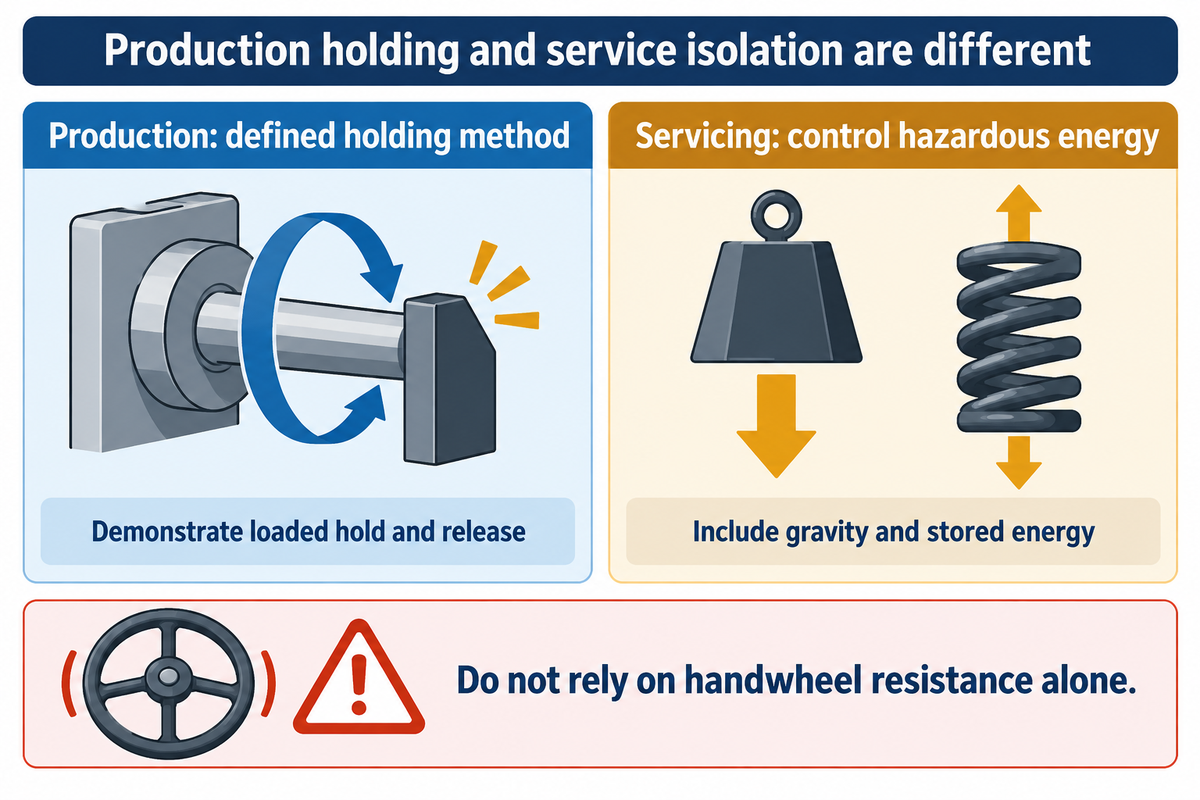
A positioner needs a defined holding method for every intended working position. Confirm which device controls rotation and which secures tilt, together with the manufacturer’s sequence for positioning, locking and unloading. A handwheel that feels resistant to turning shouldn’t be used to substitute a defined holding arrangement.
Worm gearing needs particular care in a specification. Spiroid’s technical guidance warns against relying exclusively on its gear-set self-locking behavior as a system’s only brake. Separately, a 2019 experimental study demonstrated vibration-controlled backdrivability in a tested worm mechanism. Both point to design conditions that a generic “self-locking” label leaves unanswered.
Ask the supplier to demonstrate the specified holding and release sequence with a representative loaded fixture. Include access to the handle when the workpiece is tilted. Precise positioning also depends on backlash and fixture alignment. A positive indexing stop and an accuracy specification are different requirements.
There are other limits to consider. The normal production lock should not be assumed to provide every isolation function needed for servicing. NIOSH’s energy-control guide includes gravity among hazardous energy sources and recommends acquiring equipment compatible with the site’s isolation procedures. A DIY adaptation requires the same evaluation for the complete mechanism; adding a handwheel doesn’t guarantee that the mechanism is designed to hold a load.
Manual or Powered Rotation for Circular Welds?
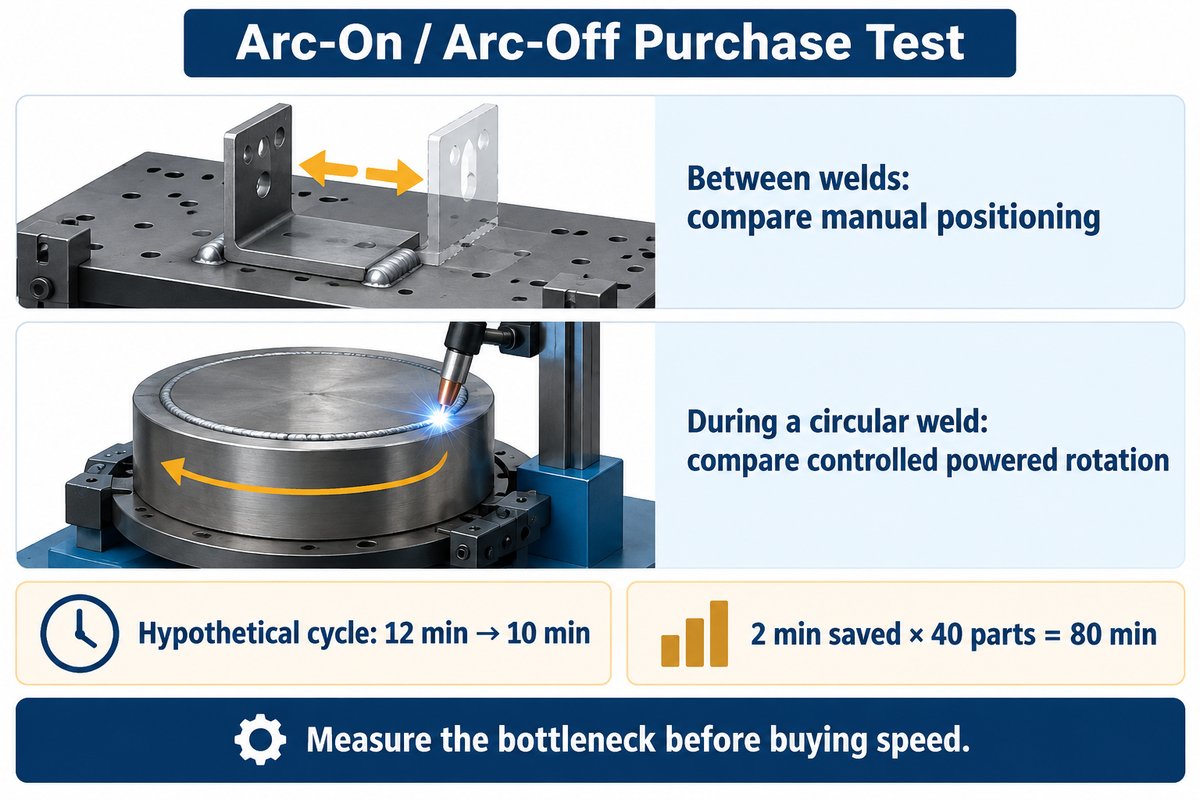
Use the Arc-On / Arc-Off Purchase Test: decide whether rotation happens between welds or must continue during the weld. Hand positioning is a practical candidate for separate joints and intermittent operations. A seam that needs smooth and controlled travel usually favors powered rotation with a suitable loaded speed range.
Test the sequence as given. A bracket with short welds on several faces can be turned and locked between passes. A circular weld made with a stationary torch requires the workpiece to move smoothly while the arc is on. For a task that permits hand rotation, judge consistency during a loaded trial against the welding procedure.
A wider discussion on the rotary welding positioner guide covers drive and process choices. Variable speed is useful only when the machine can maintain the required motion with the loaded fixture. A powered welding positioner turntable doesn’t, in itself, create a complete automated welding cell. When planning automation, consider controls and safeguarding the entire robotic welding system.
How does a rotary welding positioner improve welding productivity?
A positioner can reduce handling and repeated clamping by presenting the joint to the welder while the assembly stays secured. The gain is dependent on where the current cycle loses time. Time loading, positioning, welding and unloading separately; a quicker rotation will have little effect if fixture changeover consumes most of the shift.
Worked planning example. Suppose a shop measures a 12 min cycle with 4 min handling and 8 min welding and other work. A trial fixture reduces handling to 2 min. The new cycle time is 10 min, saving 2 min per part, or 80 min over a 40 part batch. Examples like this show how different trials can be compared; they aren’t an output claim for a listed machine.
In this case, a plant manager or finance buyer has a bottleneck test. Pay for the operation that actually reduces cycle time. If welding time dominates, faster indexing alone has limited value. High-quality welds still require control over welding. Staff should also confirm the proposed sequence against the applicable welding procedures and personnel qualification scope as described in the AWS Certified Welder Program.
What the Price Includes, and What It Leaves Out
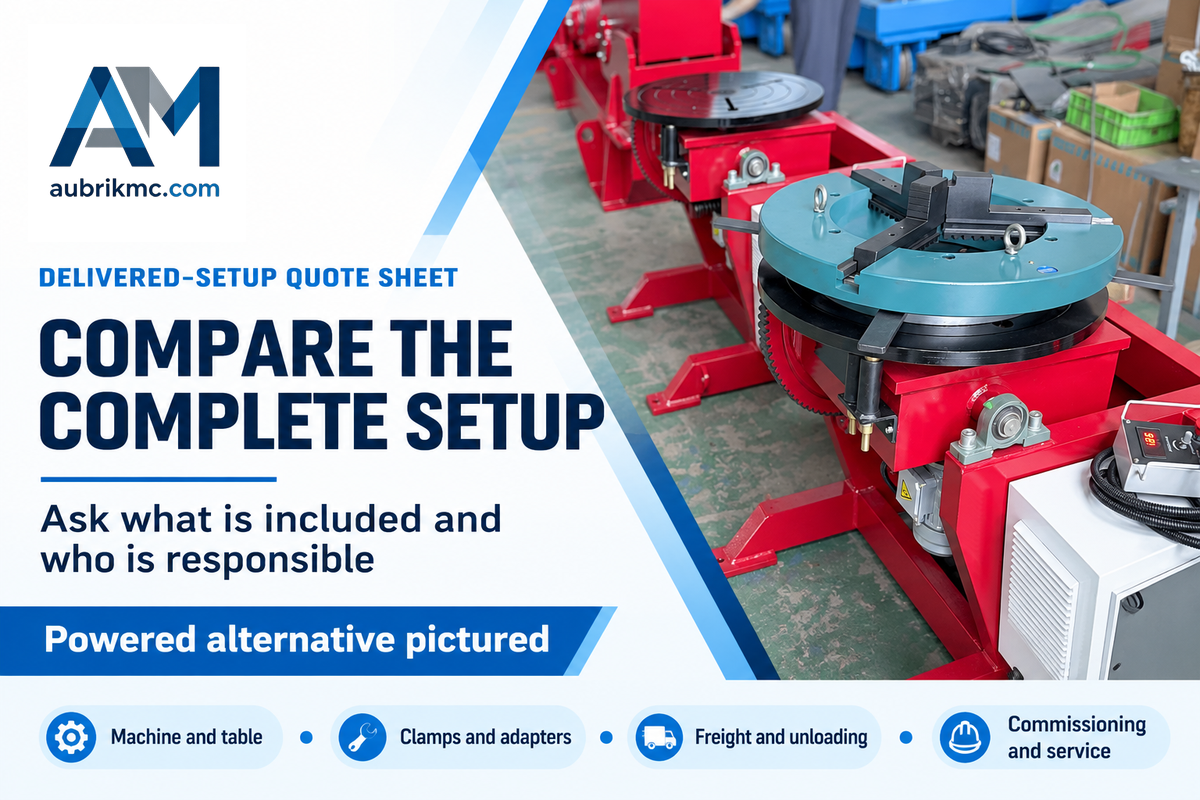
Heck’s WFWPM10 page listed US$1,195 on October 23, 2026. Consider that a historical price for that model, then compare the complete usable setup. A quote should show the faceplate or table, clamping equipment, delivery terms and installation; each could be included or charged separately.
Use the Delivered-Setup Quote Sheet to compare offers. Fill the quoted amount and the responsible party for each item. A lower machine price can lose its advantage if a shop has to build a clamping adapter, or arrange for extraction and/or unloading before the first part can be welded.
| Quote line | What procurement records | Who checks the consequence |
|---|---|---|
| Base machine | Exact model and included movements | Production: does it perform the required sequence? |
| Table or faceplate | Size, hole pattern and inclusion | Tooling: can the existing fixture mount? |
| Chuck and clamping | Jaw range, mounting adapter and all added weight | Engineering: does the loaded arrangement remain suitable? |
| Holding arrangement | Indexing, tilt retention and operating instructions | Safety: can operators follow the specified sequence? |
| Current return | Rated assembly and connection requirements | Welding: is it suitable for the intended process? |
| Freight and import charges | Named delivery place and agreed trade terms | Finance: what remains payable locally? |
| Unloading and siting | Lifting provision, floor preparation and installation | Facilities: is the station ready to receive it? |
| Commissioning and instruction | Who demonstrates the actual loaded setup | Production: who accepts the trial? |
| Service and wearing parts | Warranty scope, spare parts and support arrangements | Maintenance: what stops work if a part wears? |
For imports, specify the delivery term and the named place in writing. In his ICC Academy explanation of EXW and DDP, Miguel Angel Bustamante describes the cost responsibilities and states that the final unloading costs under DDP depend on the transport contract. Generally, specify unloading, as “delivered” doesn’t necessarily cover all site activities.
Fit the Positioner into the Welding Station
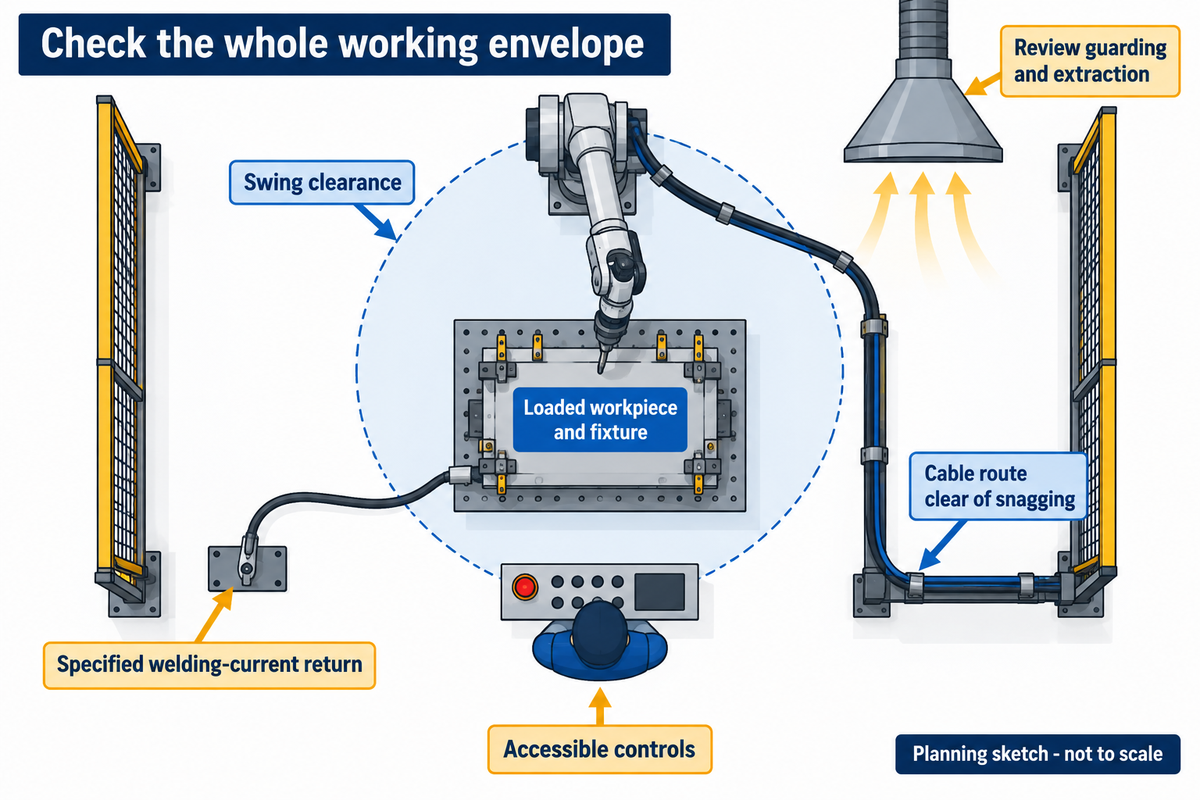
The station must accommodate the workpiece through its full movement while preserving torch access, cable routing and operator clearance. Check it with the intended fixture and welding equipment in place. A compact base can still require a large clear area when a bulky assembly swings past the table edge.
Draw the largest loaded outline in each orientation intended. Include the clamp handles and the welding gun. A seemingly suitable positioner can become an awkward workstation due to a hidden hand crank located behind a hot weldment. Bringing the joint into the required position can improve access; however, planned changes from overhead welding to another position must remain within the applicable procedure. Repositioning should also allow a workable posture. OSHA’s ergonomics guidance discusses lifting and repositioning aids and locating suitable work tables.
Electrical routing matters during turntable welding even when the rotary drive needs no power. Establish the manufacturer’s specified welding-current return path and avoid assuming that bearings, gears or incidental contact provide it. For structures and fixtures regularly used in that circuit, the regulation states:
“joints shall be bonded or provided with adequate current collecting devices.”
A cable connected to a rotating part requires a route to prevent wrapping and snagging. Guarding for rotating parts and pinch points belongs in the station assessment under OSHA’s machinery-guarding requirements. The ANSI listing for Z49.1-2021 covers broader welding safety; a positioner does not remove the need for ventilation, fire precautions or appropriate protective equipment.
Check utilities on the exact order. A purely hand-operated stand has no rotary drive supply, while a powered stand may require a specified electrical service. Don’t assume 220V, phase or frequency from a photograph. Installation requirements and the manufacturer’s instructions should reach facilities staff before purchase approval.
What to Send with a Positioner Enquiry
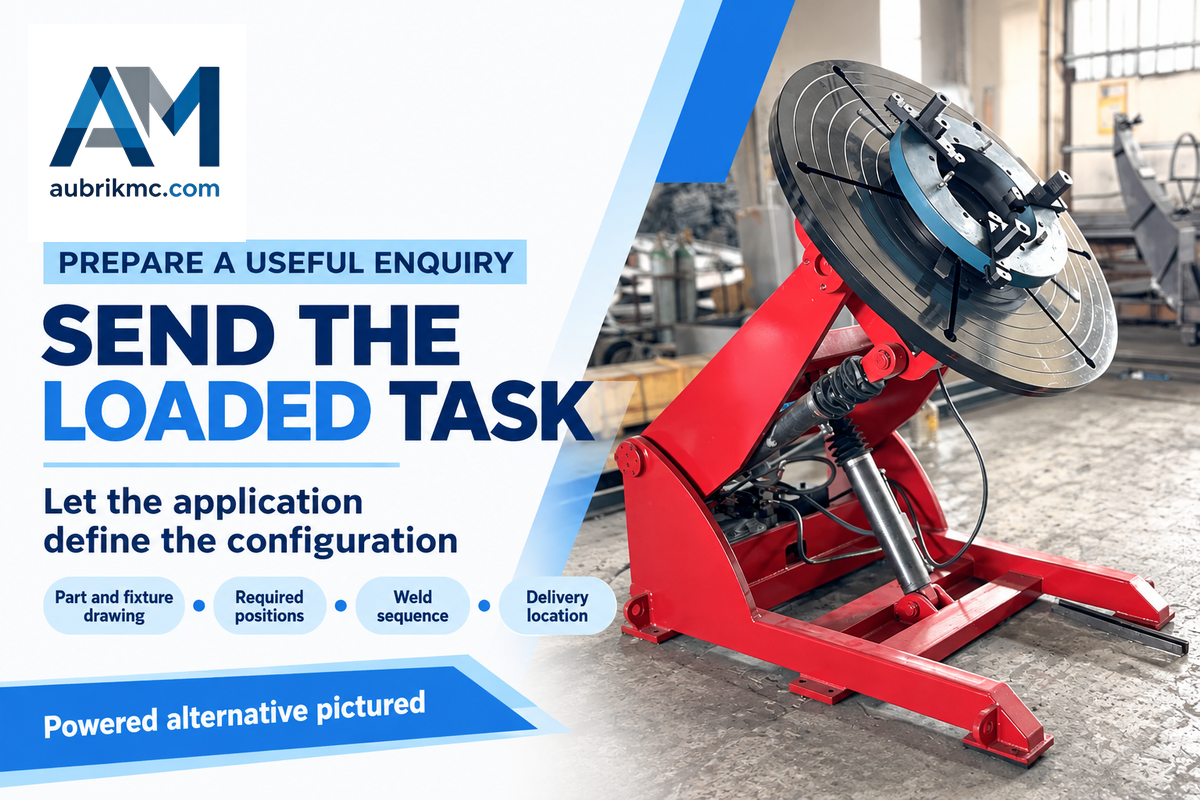
Send the part drawing, the full fixture arrangement and a short description of the weld sequence. Provide required positions, available floor space and whether movement occurs between or during welds. This allows the supplier to assess the application and provide a quote with meaningful exclusions.
For a repeat batch, give measured cycle times and the handling step to be eliminated. For a high-capacity weldment, give the location of the center of gravity and the support proposal. Inspection requirements belong in the same package: tell the supplier what alignment or angular result must be achieved rather than requesting unspecified “precision.”
Select a manual layout when it meets the loaded positioning task and its operating sequence works for the shop; if the arc-on test indicates the need for powered motion, review Aubrik welding positioners and send the application drawings for a configuration enquiry. Include the fixture weight and delivery location so engineering and procurement are comparing the same purchase.
Frequently Asked Questions
Are manual rotary positioners accurate?
They can provide repeatable positioning when the mechanism, stops and fixture suit the task. Accuracy depends on the complete loaded arrangement, including backlash, mounting stiffness and part location. An indexing increment describes the available stops, while angular tolerance is a separate specification. For inspection or precise fit-up, specify the required result and request a demonstration or documented specification for that setup.
Can one positioner be used with different welding processes?
Yes, provided its load support, current-return arrangement and station layout suit each intended process. TIG may require both hands free, while other welding applications place different demands on torch access, spatter protection and travel control. Compare the equipment with the actual welding procedure. Changing the process or welding position can also affect the applicable qualification scope, so include those details in the review.
What are the main drawbacks of a manual weld positioner?
Operator effort and movement consistency can limit a manual weld positioner, especially with an unbalanced load or a seam needing steady travel. Access to the controls may become difficult as the part tilts. These drawbacks depend on the layout: a balanced table assembly behaves differently from a small cantilevered faceplate. Evaluate the full sequence, including loading and release, before deciding to motorize an existing fixture.
Can welding current pass through the positioner bearings?
Use the specified return connection or rated collecting arrangement. Bearings and gears shouldn’t become an accidental welding-current path; follow the equipment instructions for the intended duty.
Can a manual positioner handle heavy assemblies?
Yes. Manual describes the drive, not a universal maximum load. Balanced designs can support substantial assemblies, while another layout may reach its usable limit with a much smaller offset part. Compare the manufacturer’s permitted loading, center-of-gravity limits and operating method. A large advertised capacity should never replace an assessment of the complete weldment and fixture.
Does a manual positioner need an electrical supply?
A hand-operated rotary drive needs no motor supply. The welder and any powered lift or accessories still need their specified services.
References & Sources
- OSHA: General requirements for all machines, 29 CFR 1910.212.
- OSHA: Arc welding and cutting, 29 CFR 1910.254.
- NIOSH: Hazardous Energy Control Resource Guide.
- ANSI: Z49.1-2021, Safety in Welding, Cutting, and Allied Processes.
- Worm gear mechanism with switchable backdrivability, 2019.
- The Fabricator: Welcome to the world of positioneering.