Get in Touch with Aubrik Company

Last updated: October 2026
The best wind tower production line manufacturers vary by production stage: Aubrik, Pemamek and ENABL for coordinated lines; HAEUSLER, DAVI and Faccin for forming; LINSINGER and Miba for preparation; and Lincoln Electric, ESAB and Koike for welding. Choose by included equipment and your tower programme, rather than list position.
A tower factory buys a chain of connected operations. A plate roll, growing line and automatic welding station solve different parts of that chain, even when each is advertised for use in wind tower production. The table below isolates those roles so a fabricator can short-list suppliers for a new plant, additional production bay or specific bottleneck. The systems serve onshore and offshore wind energy production through the machinery used to fabricate steel tower sections.
Quick picks
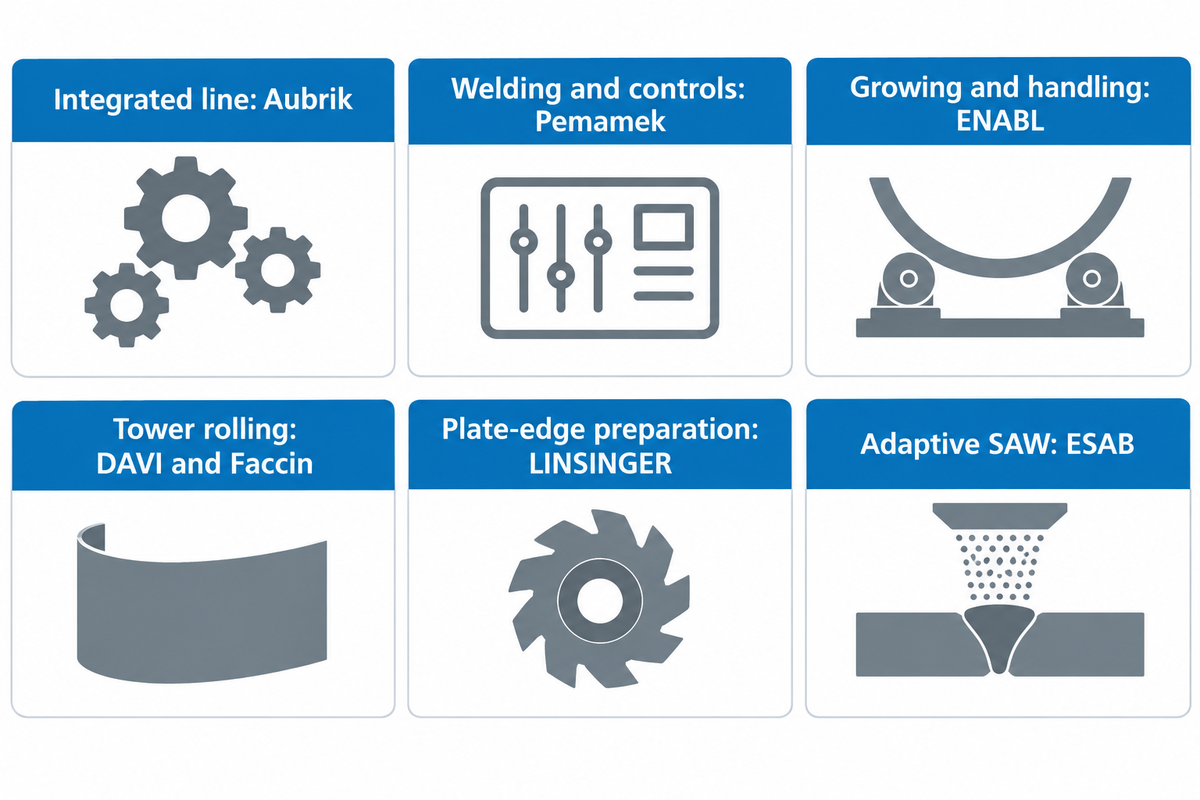
- Best for an integrated line with coordinated welding and handling: Aubrik.
- Best for coordinated welding, assembly and controls: Pemamek.
- Best for tower growing lines and production handling: ENABL.
- Best for dedicated automated tower rolling: DAVI and Faccin.
- Best for four-side plate-edge preparation: LINSINGER.
- Best for adaptive submerged-arc welding: ESAB.
These are initial options for a job. A supplier chosen for a forming job may need to work with a separate welding and handling supplier, while an integrator may need to coordinate equipment made by a couple of manufacturers.
How we selected these manufacturers
We choose manufacturers that have dedicated tower production equipment offers: integrated production systems, automated plate forming, plate or weld seam preparation, or tower-specific welding and handling systems. Company information was checked against official product, history, contact and quality pages, public filings and other identified public sources in October 2026. Trading companies, directories, sourcing platforms, used-equipment dealers, finished-tower fabricators and wind turbine manufacturers without a qualifying equipment offer were excluded.
Each profile provides information on the company’s actual supplies and at least one purchasing constraint. Established Year refers to the first year of operation for the business under consideration; profiles show later incorporation and mergers, and identify the historical predecessor businesses to the firm. Certification statements are attributed to the company or its published certificate. “Not publicly disclosed” is used only for a field still unavailable after checking company materials and another relevant public source. This is a comparative analysis of sourcing, not a ranking based on sales, installed capacity or market share.
Lists of wind turbine tower manufacturers serve buyers sourcing finished structures. Here businesses in the wind energy sector are sourcing the machinery for wind tower manufacturing. Being in wind turbine technology or turbine components by itself doesn’t suggest an offer of production machinery. Lists of the largest wind turbine manufacturers answer a different sourcing question. A “top wind turbine tower” list may also serve finished structures rather than fabrication machinery.
Wind Tower Equipment Scope Map: compare 20 manufacturers
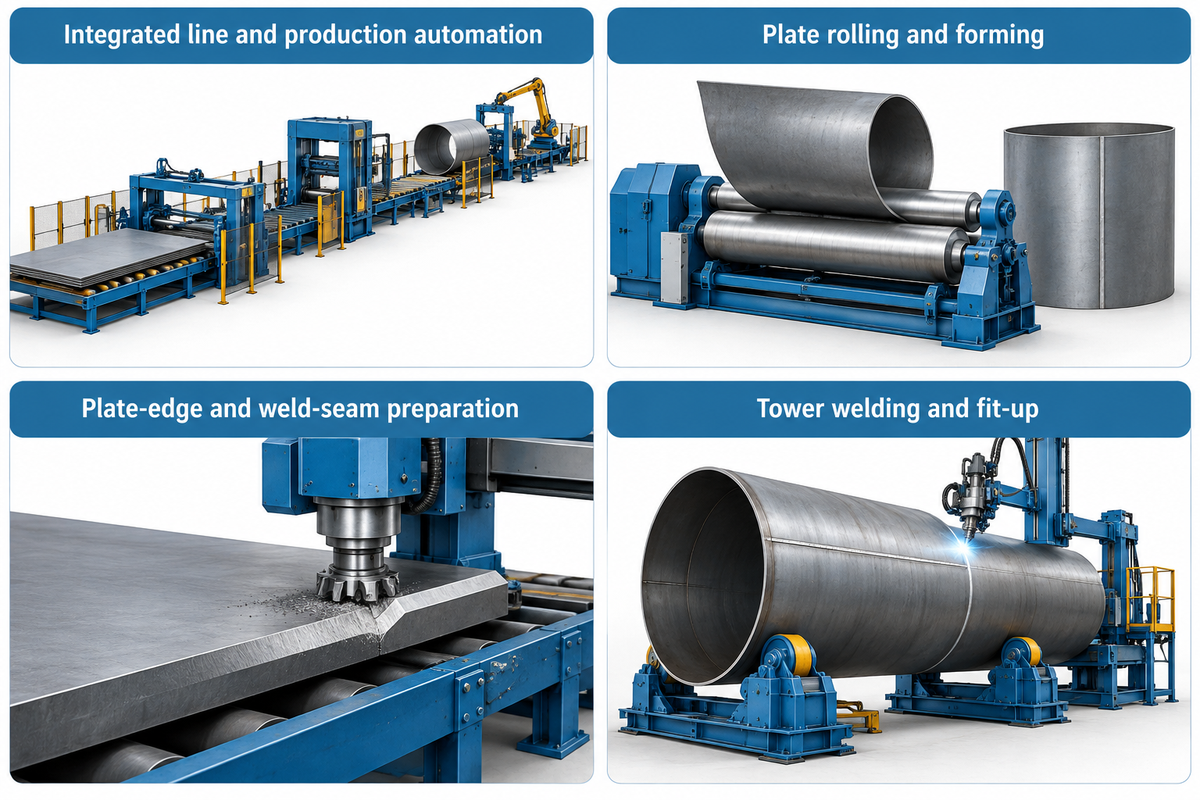
Read the Main Products and Potential Disadvantages columns in combination to determine if equipment under consideration prepares plate, forms a can, or joins tower sections or coordinates several operations. A complete facility requires other support systems to provide for the utilities, inspections, and movement of material between different stages of production.
| No. | Company Name | Headquarters | Founded Year | Best For | Brief Introduction | Main Products | Key Advantages | Potential Disadvantages | Official Website |
|---|---|---|---|---|---|---|---|---|---|
| 1 | Aubrik | Wuxi, China | 1999 | Fabricators sourcing an integrated tower line with coordinated welding and handling stations | Welding-equipment builder offering a configured tower-line package. | WT-WM manipulators; WT-WR rotators; WT-WL-5000 | Six-stage line planning and dedicated tower welding products | Capacity, price and delivery quoted by configuration | https://aubrikmc.com/ |
| 2 | Pemamek | Loimaa, Finland | 1970 | Coordinated PEMA welding and assembly automation | Welding-automation manufacturer connecting tower stations and controls. | Assembly stations; roller beds; robotic door welding | WeldControl coordination and tower-specific robotic processes | Plate rolling remains separate equipment scope | https://pemamek.com/ |
| 3 | Key Plant | Leek, United Kingdom | 1956 | Tower fit-up and growing-line handling | Manufacturer of weld automation and heavy positioning equipment. | Growing lines; rotators; column-and-boom; transport systems | In-house automation manufacture and linked material movement | Upstream forming needs a separate machine interface | https://www.keyplant.com/ |
| 4 | Primo Automation | Chennai, India | 1995 | Indian tower fabrication system integration | Automation builder publishing a multi-station tower fabrication range. | SAW stations; fit-up lines; tilting and painting rotators | Welding, assembly and finishing-handling modules | Heavier shells require options beyond the stated configuration | https://primoautomation.com/ |
| 5 | AMET | Rexburg, Idaho, USA | 1989 | U.S. tower welding system engineering | Welding-system manufacturer with dedicated tower assembly equipment. | SAW systems; growing lines; fit-up and turning rolls | In-house controls and selectable welding-head arrangements | Rolling and coating are outside the welding package | https://ametinc.com/ |
| 6 | ENABL | Hedensted, Denmark | 2021 | Coordinated tower welding, growing lines and handling | Wind-industry equipment business combining several established engineering companies. | Multi Seam Welding Stations; growing lines; customized rotators | Named tower-factory installations and coordinated production equipment | Factory layout drives project-specific integration | https://enabl-wind.com/ |
| 7 | HAEUSLER | Duggingen, Switzerland | 1936 | Tower forming with coordinated plant engineering | Plate-forming manufacturer offering wider plant engineering with production partners. | HDR, EVO and VRM plate rolls; BENDtronic | Dedicated supports, measurement and forming controls | Wider plant scope includes partner equipment | https://haeusler.com/ |
| 8 | DAVI | Cesena, Italy | 1966 | Automated tower-can rolling lines | Plate-roll manufacturer offering several tower-line automation levels. | Wind Energy Lines; High Productivity Lines; Smart Lines | Rolling and plate-handling automation selected by production needs | Downstream growing and girth welding need other stations | https://www.davi.com/ |
| 9 | Faccin | Visano, Italy | 1968 | Dedicated WT forming systems | Forming-equipment builder with separate tower, foundation and door-frame products. | WT tower systems; OWF foundation rolls; DF rolls | Dedicated wind-energy forming families and CNC handling | Section welding and finishing remain downstream scope | https://www.faccingroup.com/ |
| 10 | AKYAPAK | Bursa, Turkey | 1962 | Tower rolling linked to in-house welding automation | Machine builder offering a dedicated wind-tower rolling line. | AHS-RK four-roll tower line; welding automation | Rolling platform connects with its welding and handling range | Connected stations require additional project selection | https://akyapak.com/ |
| 11 | LINSINGER | Steyrermuhl, Austria | 1946 | Four-side plate-edge milling before tower rolling | Milling specialist preparing plate edges for tubular fabrication. | PFM FALCON; PFM plate-edge milling machines | Multiple edge profiles and four-side preparation in one clamping | Rolling and welding require separate or partner equipment | https://www.linsinger.com/ |
| 12 | Miba Automation Systems | Aurachkirchen, Austria | 1999 | Longitudinal and circumferential weld-seam milling | Special-machinery business preparing weld grooves on tubular components. | Long-seam mills; rail-mounted circular-seam mills | Laser guidance, scanning and automated workpiece positioning | Seam preparation excludes the actual welding process | https://www.miba.com/ |
| 13 | Lincoln Electric | Cleveland, Ohio, USA | 1895 | Tower submerged-arc welding automation | Welding manufacturer with mechanized tower-section automation packages. | Power Wave AC/DC 1000 SD; controllers; turning rolls | Power-source, seam-tracking and control-system coordination | Forming and factory handling need integration | https://lincolnelectric.com/ |
| 14 | ESAB | North Bethesda, Maryland, USA | 1904 | Adaptive multi-wire tower welding | Welding-equipment manufacturer with adaptive tower and monopile systems. | Adaptio; CaB 460; Aristo 1000 AC/DC; 815 SAW | Adaptive control for varying groove geometry | Rolling and complete-factory supply remain separate | https://esab.com/ |
| 15 | Koike Aronson / Ransome | Arcade, New York, USA | 1985 | Tower construction and positioning systems | Cutting and positioning manufacturer publishing dedicated tower welding stations. | Cutting systems; welding stations; positioning rolls | Separate long-seam, internal fit-up and external weld-out arrangements | Weld-package and station interfaces vary by project | https://www.koike.com/ |
| 16 | LJ Welding Automation | Edmonton, Alberta, Canada | 1976 | North American onshore growing-line integration | Manufacturer linking tower-can handling with submerged-arc welding. | 100-TON growing line; Predictive Tandem Subarc | Coordinated fit-up, welding and production-data interfaces | Large offshore shells need a different arrangement | https://www.ljwelding.com/ |
| 17 | Redrock Automation | Glasgow, United Kingdom | 2011 | Tower rotators and welding manipulators | Automation manufacturer supplying tower welding and growing-line equipment. | Rotators; growing lines; manipulators; SAW systems | Bespoke equipment manufacture and commissioning options | Upstream plate forming requires other equipment | https://redrockautomation.com/ |
| 18 | Zhouxiang | Wuxi, China | 1991 | Dedicated tower assembly and transfer equipment | Manufacturer publishing tower welding, assembly and transfer machinery. | Hydraulic fit-up; flange welding; transfer and coating rolls | Dedicated hydraulic alignment and flange-handling stations | Very large offshore sections may need wharf-side joining | https://www.zhouxiangmachinery.com/ |
| 19 | Fengwei | Wuxi, China | 2002 | Tower cutting and welding-assistant integration | Equipment builder combining CNC cutting with tower welding systems. | CNC cutting; HGK rotators; welding manipulators | Manufacturing, installation and connected station control | The rolling station needs separate specification | https://www.wxfengwei.com/ |
| 20 | Yueda | Zhengzhou, China | 2003 | Tower fit-up and SAW production packages | Welding-equipment manufacturer with a dedicated tower-production offer. | Tower SAW; hydraulic fit-up; flange welding; transfer | Production stages extend through handling and coating support | Larger diameters need a different or customized configuration | https://www.yuedatech.com/ |
Business dates given aren’t indicators of equipment performance. For example, an established engineering business can trade through a newer legal entity, while a recently combined business can retain much older predecessor experience. Distinctions of this kind are shown in the profiles without considering age of the company as a purchasing factor.
Integrated line and production automation manufacturers
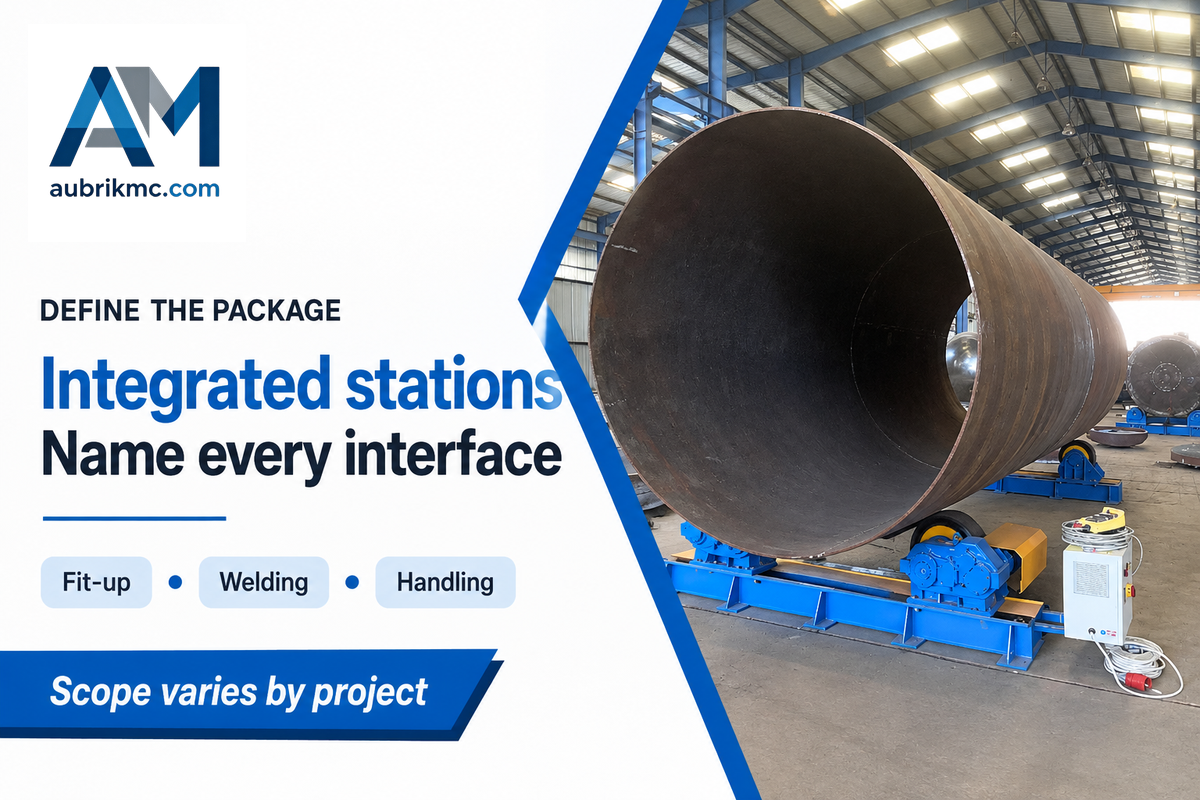
Start with these builders when the buying problem is a group of interconnected stations. Their packages still differ: Some focus on welding and assembly. Others integrate a larger factory. The purchase specification should name each included operation and its interface with equipment supplied by others.
1. Aubrik: Best for fabricators sourcing an integrated tower line with coordinated welding and handling stations
Disclosure: This guide is published by Aubrik. We list ourselves first because this is our website, not because we claim to be the market leader. The other 19 manufacturers are grouped by what they are best for, in no particular order within each group.
Headquarters: Wuxi, China · Founded: 1999 · Type: welding and fabrication equipment manufacturer
Official website: https://aubrikmc.com/
Main products: WT-WM manipulators, WT-WR rotators and WT-WL-5000 integrated welding lines.
Quality: ISO 9001 and CE marking, according to its website.
Aubrik’s website identifies the business as Wuxi ABK Machinery and presents a six-stage tower line linking cutting, rolling, fit-up, welding, inspection and coating, alongside dedicated welding and girth-welding equipment. Within that range, the published WT-WL-5000 table specifies a 2.5–6 m workpiece diameter for that model; it’s a model envelope rather than a ceiling for every configured line. Fabricators can begin with the integrated wind tower production line or discuss how dedicated stations would connect to existing equipment, with the actual station list defining the proposal. Line capacity, price and delivery are configured to order, so buyers don’t get a fixed catalogue package price.
2. Pemamek: Best for coordinated PEMA welding and assembly automation
Headquarters: Loimaa, Finland · Founded: 1970 · Type: welding and fabrication equipment manufacturer
Official website: https://pemamek.com/
Main products: PEMA assembly stations, roller beds and robotic door-cutting and welding systems.
Quality: ISO 9001, ISO 14001 and ISO 45001 certificate documents on its company page.
Pemamek’s tower range brings assembly, positioning and welding under coordinated control, making it relevant when separately operated stations are the weak point in a production bay. Its published WeldControl 100 arrangement coordinates the assembly station, column-and-boom and roller beds, while WeldControl 300 Create/Scan addresses robotic door cutting and welding. That combination supports a shortlist built around how shells are aligned, rotated and welded, with the door operation considered as a distinct fabrication task rather than an incidental manual step. The cited package centres on welding, assembly and handling, so the plant still needs its plate-rolling equipment and the interface that delivers formed cans to these stations.
3. Key Plant: Best for tower fit-up and growing-line handling
Headquarters: Leek, United Kingdom · Founded: 1956 business origin; current limited company incorporated in 2009.
Official website: https://www.keyplant.com/
Main products: growing lines, rotators, column-and-boom welding systems and internal transport equipment.
Quality: its capabilities page lists UL/CSA 508A and Factory Automation Equipment accreditations.
Key Plant describes in-house design and manufacture of hard automation, with a tower range that follows workpieces through fit-up, growing-line assembly, rotation and internal transport. Its wind-sector examples include a 7 m × 6 m tandem circumferential column-and-boom arrangement, showing a defined welding-station configuration rather than a universal tower-size rating. The company’s own About page traces the business to 1956, while the current company registration records incorporation in 2009. Buyers seeking a complete factory should treat upstream plate forming as a separate machine interface within the wider welding-and-handling proposal.
4. Primo Automation: Best for Indian tower fabrication system integration
Headquarters: Chennai, India · Founded: 1995 · Type: welding and fabrication equipment manufacturer
Official website: https://primoautomation.com/
Main products: submerged-arc welding stations, fit-up lines, tilting rotators and blast/paint rotators.
Quality certifications: Not publicly disclosed.
Primo publishes a tower-fabrication equipment range covering rolling, beveling, welding, growing-line assembly and the handling needed around blasting and painting. Its stated configuration includes 40–120 ton rotators, a 5,000 mm shell diameter, 4,000 mm shell length and a 5 m × 4 m column-and-boom, which gives a fabricator concrete station duties to compare with its drawings. The breadth is useful for a project that needs the welding stations and surrounding handling considered together, particularly when the plant is being built around a defined section programme. Shells beyond the listed standard handling duty need optional or customized equipment, so the published range shouldn’t be extended to heavier workpieces without changing the configuration.
5. AMET: Best for U.S. tower welding system engineering
Headquarters: Rexburg, Idaho, USA · Founded: 1989 · Type: welding and fabrication equipment manufacturer
Official website: https://ametinc.com/
Main products: complete SAW systems, growing lines, fit-up stations and turning rolls.
Quality certifications: Not publicly disclosed.
AMET offers dedicated tower welding and assembly equipment, with its own controls hardware, software and system integration rather than only a welding power source. The published range includes single-wire, tandem and multi-wire welding-head arrangements, allowing the welding package to be considered alongside the way cans are fitted and turned through the work area. A Colorado School of Mines biography identifies the company’s 1989 foundation and Rexburg base. The tower offer is a welding-and-assembly system, so a greenfield factory still needs the upstream plate-forming and downstream coating operations beyond that package.
6. ENABL: Best for coordinated tower welding, growing lines and handling
Headquarters: Hedensted, Denmark · Founded: 2021 combination of four businesses.
Official website: https://enabl-wind.com/
Main products: Multi Seam Welding Stations, customized growing-line equipment and tower rotators.
Quality: ISO 9001, ISO 14001 and ISO 45001, according to its QHSE page.
ENABL’s documented tower work includes Multi Seam Welding Stations and customized growing-line equipment for Welcon’s factory expansion, giving the company a role in coordinated production rather than a single isolated handling task. Its published E-Towers project also describes customized rotators for a painting line, extending the comparison from weld production to the movement and support of sections during finishing. ENABL was formed from Eltronic Wind Solutions, BIIR, SONNE and Blaaholm in 2021, with the business combination announced in March and the legal merger effective in November. Its systems are engineered around the factory layout, making project-specific integration the purchasing commitment rather than an off-the-shelf complete-factory package.
Plate rolling and forming specialists
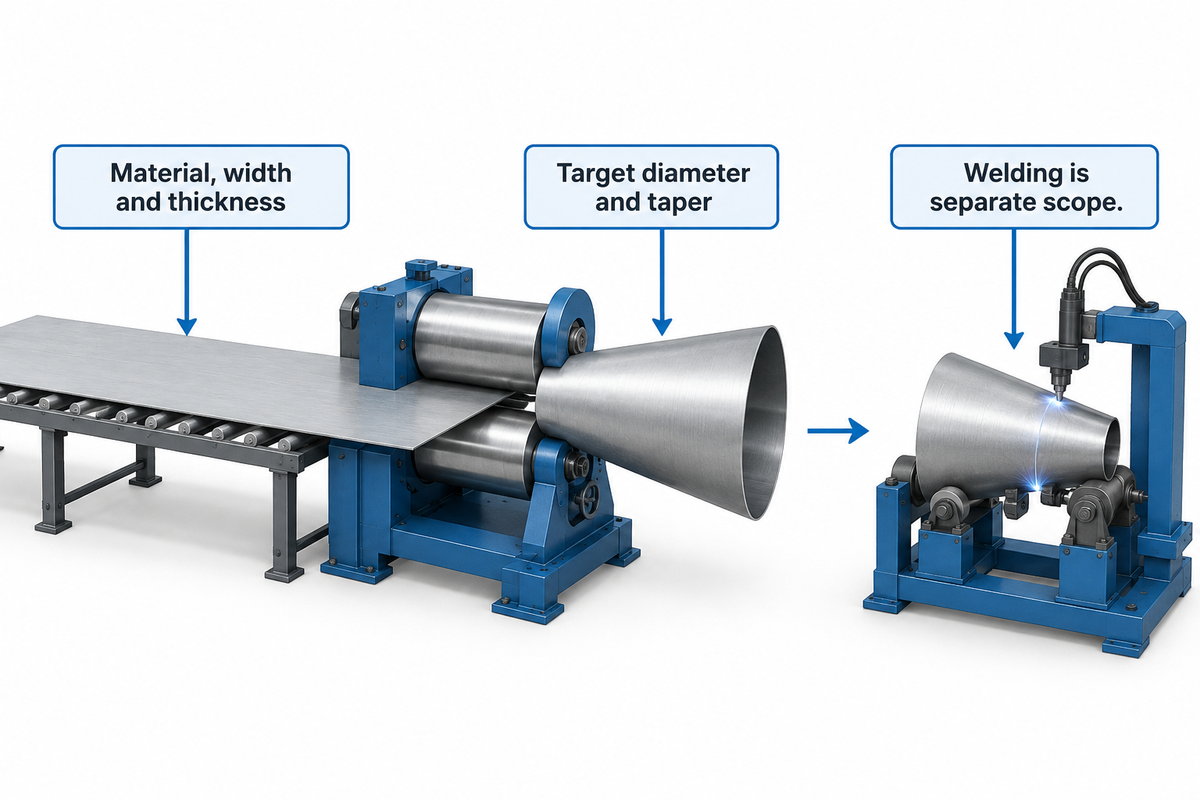
Forming suppliers shape plate into conical or cylindrical shells. Compare the plate material, width, thickness and target diameter together, then consider how the formed can reaches edge preparation or welding. A machine’s maximum thickness rating alone doesn’t describe the entire task needed in a wind turbine tower factory.
7. HAEUSLER: Best for tower forming with coordinated plant engineering
Headquarters: Duggingen, Switzerland · Founded: 1936 · Type: plate-forming equipment manufacturer and plant-engineering provider
Official website: https://haeusler.com/
Main products: HDR three-roll and EVO/VRM four-roll systems, BENDtronic controls and laser measurement.
Quality: DIN EN ISO 9001, according to its website.
HAEUSLER’s own tower-production machinery centres on plate forming, supported by dedicated roller tables, upper supports, side supports and roundness measurement rather than a bare bending machine. BENDtronic control and the different HDR, EVO and VRM architectures give buyers several ways to approach cylindrical and conical production while keeping the loading and support arrangements within the forming discussion. The company also offers plant engineering and project management with premium production partners, so a broader integrated concept can be available without every machine being manufactured by HAEUSLER itself. Wider fabrication-plant procurement therefore includes partner equipment and its interfaces, which is a different scope from buying one of the company’s own plate rolls.
8. DAVI: Best for automated tower-can rolling lines
Headquarters: Cesena, Italy · Founded: 1966 · Type: plate-rolling equipment manufacturer
Official website: https://www.davi.com/
Main products: Wind Energy Lines, High Productivity Lines and Smart Lines.
Quality: its 2023 MCO brochure displays DNV ISO 9001, ISO 14001 and ISO 45001 marks.
DAVI distinguishes several levels of automated tower rolling instead of presenting every line as the same configuration, with Wind Energy Lines, High Productivity Lines and Smart Lines addressing different production arrangements. Its CNC forming and plate-handling scope includes tapered-shell rolling and preparation for the longitudinal-welding stage, making it relevant when consistent can geometry and repeatable plate movement are the immediate needs. A fabricator comparing the options can focus on which loading, rolling and unloading tasks are automated, rather than assuming that a more extensive line name changes the underlying material duty. The rolling line doesn’t itself perform downstream can growing and circumferential welding, so those stations remain part of the rest of the factory.
9. Faccin: Best for dedicated WT forming systems
Headquarters: Visano, Italy · Founded: 1968 business origin; incorporated as Faccin srl in 1977.
Official website: https://www.faccingroup.com/
Main products: WT automatic tower systems, OWF foundation rolls and DF door-frame rolls.
Quality: its company page describes UNI EN ISO 9001:2015 certified production.
Faccin separates wind-energy forming into named families: WT for tower work, OWF for foundations and DF for door frames, which helps avoid treating all circular fabrication as one rolling job. The WT system uses a four-roll arrangement with Siemens CNC and coordinated plate handling, while the manufacturer describes in-house production of the forming equipment. Its history begins with Walter Faccin’s business activity in 1968 and distinguishes the later 1977 incorporation, so the earlier date represents business origin rather than the current legal event. WT supplies the forming stage of tower fabrication; section assembly, welding and finishing require the rest of the production equipment after the shell leaves the roll.
10. AKYAPAK: Best for tower rolling linked to in-house welding automation
Headquarters: Bursa, Turkey · Founded: 1962 · Type: plate-rolling equipment manufacturer
Official website: https://akyapak.com/
Main products: AHS-RK four-roll wind-tower line and welding automation.
Quality: its official history records ISO 9001 certification.
AKYAPAK’s AHS-RK is a dedicated four-roll wind-tower rolling line, with automated feeding and hydraulic forming presented around the needs of tower-shell production. The published design can connect with welding systems, columns-and-booms and rotators developed and manufactured within its wider equipment range, giving a buyer a route from the forming machine to connected stations. That makes the company useful to compare where a plant wants both a clear rolling foundation and the option to coordinate adjoining welding and handling equipment through the same manufacturer. The AHS-RK designation doesn’t mean every connected module is automatically included: those additional stations must be selected as part of the actual project scope.
Plate-edge and weld-seam preparation specialists
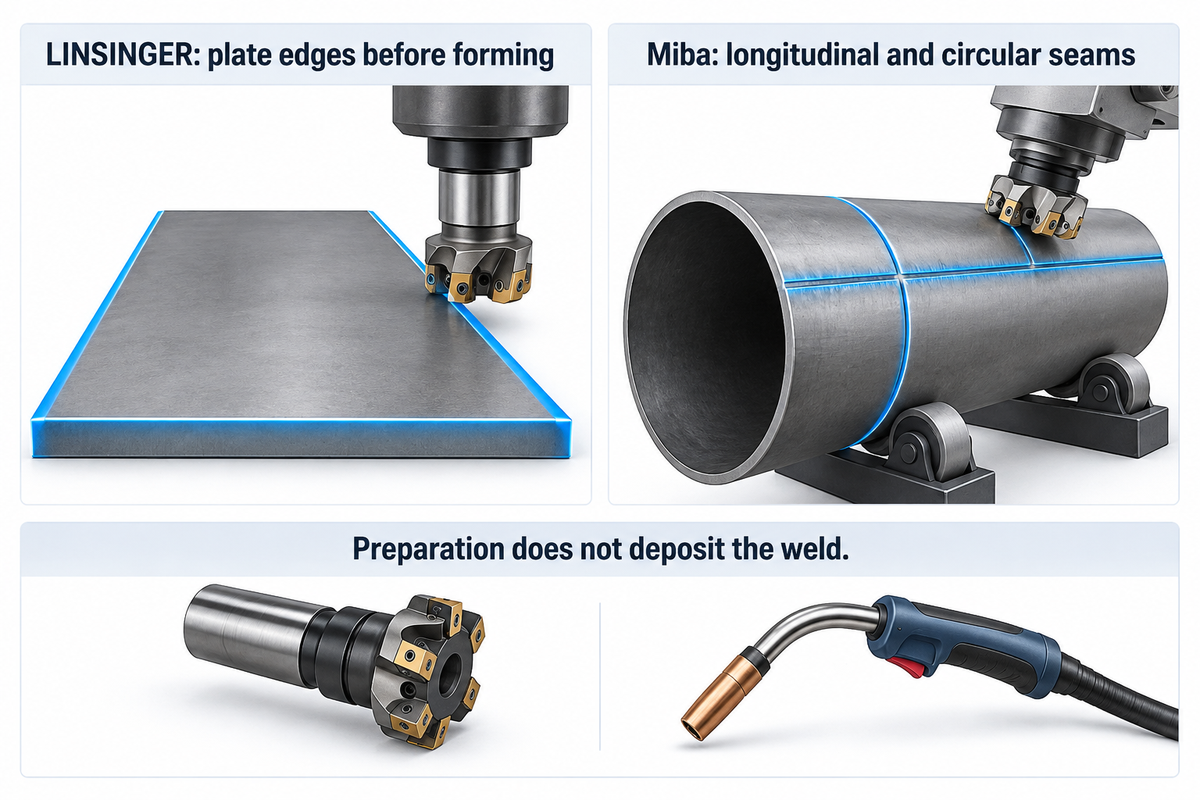
Edge preparation is a separate purchasing decision from rolling or depositing weld metal. LINSINGER works on plate edges before forming, while Miba’s range includes preparation of longitudinal and circular seams on tubular components. Both participate in wider partner-based production concepts, but their own machining roles remain distinct.
11. LINSINGER: Best for four-side plate-edge milling before tower rolling
Headquarters: Steyrermühl, Austria · Founded: 1946 · Type: specialist milling and sawing machinery manufacturer
Official website: https://www.linsinger.com/
Main products: PFM FALCON and PFM plate-edge milling machines.
Quality: ISO 9001 and ISO 14001:2015 certificate links on its company page.
LINSINGER’s PFM FALCON prepares all four edges of a plate in one clamping, including the longitudinal and transverse edges needed before the plate becomes a tubular shell. The published gantry concept accommodates trapezoidal and curved plates, with different edge profiles and tooling options that make it relevant to tapered tower sections as well as rectangular stock. Its history distinguishes the 1946 foundation of LINSINGER in Steyrermühl from the founder’s earlier 1939 acquisition, while its BIG 5 cooperation connects milling with partner bending, welding and handling expertise. The FALCON is an edge-preparation machine, so rolling, assembly and welding are separate equipment or partner scope after the plate leaves the milling operation.
12. Miba Automation Systems: Best for longitudinal and circumferential weld-seam milling
Headquarters: Aurachkirchen, Austria · Founded: 1999 as the separate MAS business.
Official website: https://www.miba.com/
Main products: long-seam milling machines and rail-mounted circular-seam milling machines.
Quality certifications: Not publicly disclosed for the MAS unit.
Miba Automation Systems prepares weld grooves on tubular components using long-seam and circular-seam milling machines, with laser guidance, scanning and automated workpiece positioning in its published range. Its long-seam page lists milling depth up to 150 mm, while the group’s 2024/25 report describes orders for offshore-wind projects in Europe, China and Korea, giving the machinery a specific tower and monopile production context. The MAS business became a separate GmbH in 1999; the parent Miba group dates its origin to 1927. These machines prepare the seam rather than deposit the weld, leaving forming and welding as separate process stages or partner-supplied equipment.
Wind tower welding and fit-up manufacturers
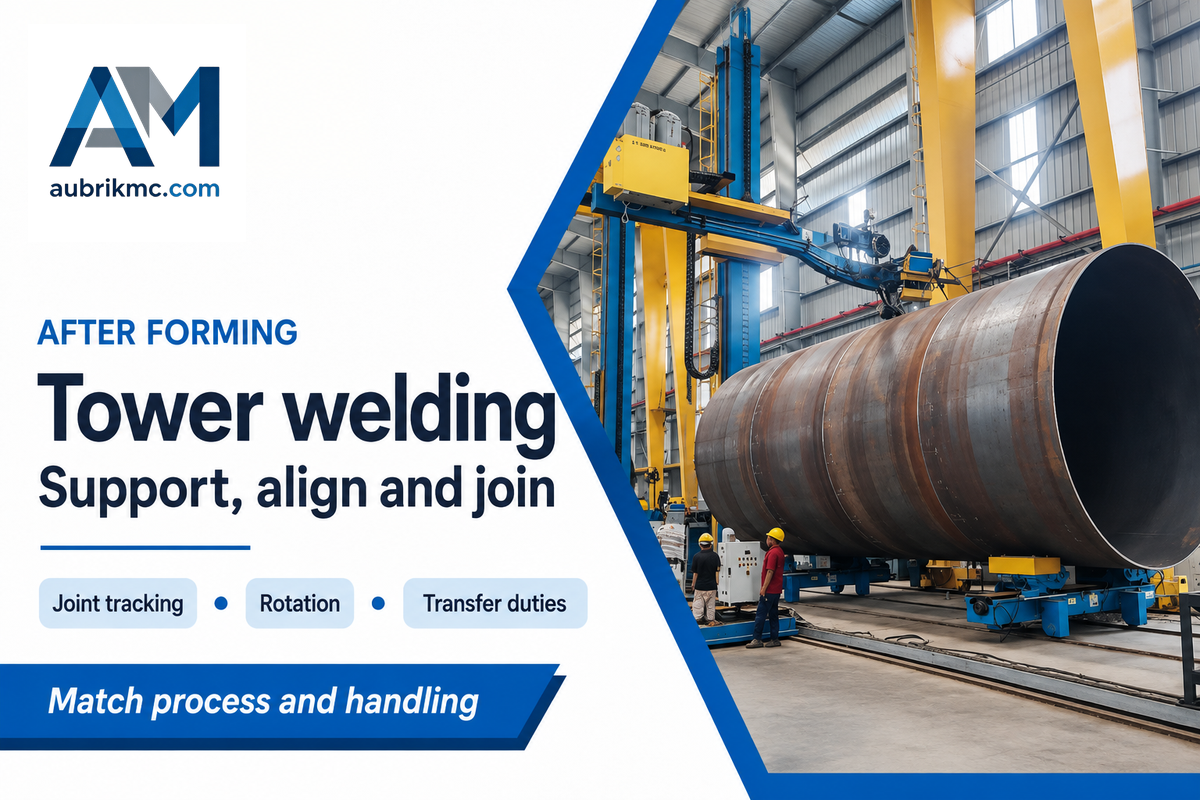
These manufacturers perform the work after forming. This includes holding and aligning adjacent cans, preparing and tracking the joint, and depositing weld. This equipment can be part of a new factory or an addition to a bay in an existing factory. Compare the welding process and control package alongside the load, rotation and transfer duties.
13. Lincoln Electric: Best for tower submerged-arc welding automation
Headquarters: Cleveland, Ohio, USA · Founded: 1895 business origin.
Official website: https://lincolnelectric.com/
Main products: Power Wave AC/DC 1000 SD, weld controllers, seam tracking and turning rolls.
Quality certifications: Not publicly disclosed for the specific package reviewed.
Lincoln Electric’s mechanized automation catalogue explicitly lists Wind Tower Sections, establishing a tower-production role beyond the company’s general welding power sources and consumables. The published package brings together Power Wave AC/DC 1000 SD equipment, weld controllers and PLC interfaces, Ethernet/DeviceNet communication, Advanced Seam Tracker and turning rolls. For a fabricator, that’s a way to compare the control of the arc, travel and joint tracking as one welding system. The cited offer handles tower-section welding and control; a complete fabrication factory still requires plate forming and the integration of wider material-handling equipment.
14. ESAB: Best for adaptive multi-wire tower welding
Headquarters: North Bethesda, Maryland, USA · Founded: 1904 business origin in Gothenburg.
Official website: https://esab.com/
Main products: Adaptio, CaB 460, Aristo 1000 AC/DC and 815 SAW.
Quality: the ESAB GROUP DNV certificate lists ISO 9001:2015, ISO 14001:2015 and ISO 45001:2018 for its stated sites and scope.
ESAB’s Adaptio technology targets submerged-arc welding of wind towers and monopiles, adjusting to changes in groove angle, gap and mismatch rather than treating every joint as identical. Its published system brings together CaB 460, Aristo 1000 AC/DC, 815 SAW and roller beds, connecting the adaptive control discussion to identifiable production equipment. That makes it a candidate where the factory’s welding requirement includes controlled response to joint geometry, with the original 1904 business history distinguished from the group’s later separation as a standalone listed company. The system addresses weld production, so tower rolling and responsibility for the complete factory remain separate procurement scope rather than an implied part of the SAW package.
15. Koike Aronson / Ransome: Best for tower construction and positioning systems
Headquarters: Arcade, New York, USA · Founded: 1985 for the U.S. business.
Official website: https://www.koike.com/
Main products: cutting systems, tower welding stations and positioning rolls.
Quality: ISO 9001:2015 quality management certification, according to its About page.
Koike’s dedicated Wind Tower Construction brochure divides production into three welding stations: longitudinal seams, internal circumferential fit-up and external weld-out, with cutting and positioning equipment around those tasks. MIG root welding, tandem SAW and powered seam tracking appear in the station arrangements, giving the buyer a process sequence to compare rather than only a turning-roll capacity. The 1985 U.S. business date is distinct from the Japanese parent’s earlier history and the later Ransome acquisition. The brochure offers alternative configurations, including customer-supplied weld packages, making station interfaces and integration a project responsibility rather than one universal complete-line specification.
16. LJ Welding Automation: Best for North American onshore growing-line integration
Headquarters: Edmonton, Alberta, Canada · Founded: 1976 · Type: welding and fabrication equipment manufacturer
Official website: https://www.ljwelding.com/
Main products: 100-TON GROWING LINE and Predictive Tandem Subarc System.
Quality: CSA/UL-certified equipment in-house and CE documentation on request, according to its website.
LJ Welding’s tower offer connects a 100-TON growing line with its Predictive Tandem Subarc System, bringing the alignment, support and girth-welding operations into one production discussion. Its published examples describe 4.3 m cans and the transfer of welding-procedure data to ERP/MES systems for traceability, which is useful when the plant wants production records as well as mechanical handling. The company’s fiftieth-anniversary history traces the business to 1976, distinguishing the original foundation from the change of ownership in 2006. Standard onshore arrangements aren’t the same configuration as large-diameter stacked-shell or offshore production, so that larger work calls for a different handling and welding arrangement.
17. Redrock Automation: Best for tower rotators and welding manipulators
Headquarters: Glasgow, United Kingdom · Founded: 2011 operating establishment; legal incorporation in 2010.
Official website: https://redrockautomation.com/
Main products: rotators, growing lines, positioners, column-and-boom manipulators and SAW systems.
Quality certifications: Not publicly disclosed.
Redrock describes its own manufacture of bespoke automation and demonstrates growing-line fit-up in its wind-tower material. Its range combines rotators, positioners, turntables and column-and-boom equipment, with installation, training and rental or extended-warranty options available around the machinery. The company states establishment in 2011, while the Red Rock Automation Limited registration records incorporation in December 2010. Its published tower-production role concerns welding and growing-line handling; the factory still needs separate forming equipment before the cans arrive at those stations.
18. Zhouxiang: Best for dedicated tower assembly and transfer equipment
Headquarters: Wuxi, China · Founded: 1991 brand history; later legal entity formed in 2001.
Official website: https://www.zhouxiangmachinery.com/
Main products: hydraulic fit-up, flange welding, transfer equipment and blast/paint rollers.
Quality: ISO 9001 quality system, according to its tower-production page.
Zhouxiang publishes a tower-production line connecting cutting, seam welding, hydraulic assembly, flange welding and the transfer or roller equipment used around blasting and painting. Its hydraulic fit-up arrangement uses four hydraulic cylinders to alter the roller centre distance and align adjoining cans, while separate inclined-rotator stations address flange work. Those specific arrangements make it a useful comparison where the factory’s problem is assembly geometry and movement between operations, with the 1991 brand history distinguished from the later legal-entity formation. For very large offshore towers, the manufacturer describes secondary joining at the wharf, so the workshop line alone doesn’t define the entire final-assembly arrangement.
19. Fengwei: Best for tower cutting and welding-assistant integration
Headquarters: Wuxi, China · Founded: 2002 · Type: welding and fabrication equipment manufacturer
Official website: https://www.wxfengwei.com/
Main products: CNC plasma cutting, HGK adjustable rotators, hydraulic turning rolls and welding manipulators.
Quality: ISO 9001 quality system and CE-certified machines, according to its company profile.
Fengwei describes its own design, manufacture and installation of welding and cutting equipment, giving its production-line page a defined machinery scope. The published equipment includes CNC plasma cutting, HGK adjustable rotators and hydraulic turning rolls, together with three-in-one control of the manipulator, power source and rotator. A fabricator comparing this range can examine how cutting and welding-assistant equipment connect within the workshop, particularly where an existing operation needs added positioning or coordinated station control. The listed line centres on cutting, welding and assisting equipment, so the tower plate-rolling station needs explicit separate configuration rather than being assumed from the production-line heading.
20. Yueda: Best for tower fit-up and SAW production packages
Headquarters: Zhengzhou, China · Founded: 2003 · Type: welding and fabrication equipment manufacturer
Official website: https://www.yuedatech.com/
Main products: longitudinal and circular SAW, hydraulic fit-up, flange welding and transfer systems.
Quality: ISO 9001:2015 quality management, according to its official company PDF.
Zhengzhou Yueda Technology Equipment, formerly Zhengzhou Yueda Automatic Welding Equipment, describes its own research, design and manufacture of dedicated welding machinery. Its tower line includes longitudinal and circular SAW, hydraulic fit-up, flange welding, transfers and blast/paint devices, giving buyers a view of the handling and finishing support around the welded section. The official company PDF states a 2003 foundation, while the product page describes an offshore diameter envelope reaching 8 m. Projects above that published diameter range require a different or customized configuration rather than a direct extension of the listed standard tower line.
How to choose a wind tower production line manufacturer
Choose a manufacturer against a defined production task and an agreed equipment boundary. A tower builder supplying onshore wind projects may need different forming, handling and finishing tasks in a factory compared to a factory making large offshore sections. The following questions change a supplier conversation to a comparison of the system that will actually be built.
What is included in a wind tower production line?
A wind tower production line will consist of equipment for the agreed stages of plate preparation, forming, shell assembly, welding, inspection and finishing. A particular quotation may cover only some of those stages. Name each of those stages, transfer routes and control interfaces, and specify what the manufacturer provides and what the factory provides.
The distinction matters across the wind energy supply chain: a wind tower manufacturer produces the structure, while its equipment suppliers manufacture the tools and equipment used to build it. Orders related to a wind farm or an offshore wind turbine programme should be converted to shell designs and production tasks before equipment is chosen. Identifying the right wind tower manufacturer for a project is different from deciding on the machinery for that part of the project.
What does the welding column and boom contribute?
A welding column and boom supports and positions the welding head along the required joint. The column, boom travel, carriage and control system must suit the work piece and the welding process. Rotators or a growing line move and support the shell. Evaluate those motions together because reach alone does not establish a usable welding station.
Sometimes equipment suppliers call this type of equipment a welding column boom or a welding manipulator. No matter what it’s called, the demonstration should show where the welder works, how the head reaches the seam and how the shell is supported during the operation.
- Define the representative plate and shell. Specify steel grade, plate width and thickness in millimetres, shell diameter and length in metres, taper geometry and section mass in tonnes. Indicate the smallest and largest routine parts, not only the largest headline diameter. Tower construction capacity is defined by the material and geometry the plant repeatedly processes.
- Match the equipment boundary with the bottleneck. A rolling upgrade, a fit-up station and a complete automation project call for different manufacturing capabilities. Indicate existing stations that will remain and operations being added. Mark the responsible supplier at each interface. Sometimes a specialist is the right choice, without supplying the entire factory.
- Consider a loaded production cycle. Record loading, alignment, tack or root work, welding, repositioning and unloading separately. Ask for the proposed cycle on the representative section, including operator tasks and transfers. A quick welding pass doesn’t assess the output of the complete tower manufacturing process. An advancement in torch control is useful only if the complete loaded cycle improves.
- Establish welding and inspection acceptance criteria. Use the agreed joint preparation, welding procedure, consumables and inspection requirements for the actual tower programme. Verify the applicability of the certificate and its holder, site, scope and validity once, together with the documentation concerning the equipment delivered. Don’t take a group management certificate as an assessment of every tower and welding procedure.
- Check access and handling. Show roller spacing, support reactions, transfer routes, crane loads, foundations and access for maintenance on the layout. Include the sequence around flanges, doors and coating. A tower-section programme for offshore wind farms can alter the access and handling as much as the welding package.
- Define controls and production records. Determine which controls are linked, which welding parameters are monitored and recorded and how the factory will access them. Where analytics or ERP/MES links are proposed, define the data fields, ownership, network interface and acceptance demonstration. A communications label on a brochure isn’t a complete definition of factory data. Judge technological advancements by a trial on the factory’s own representative section.
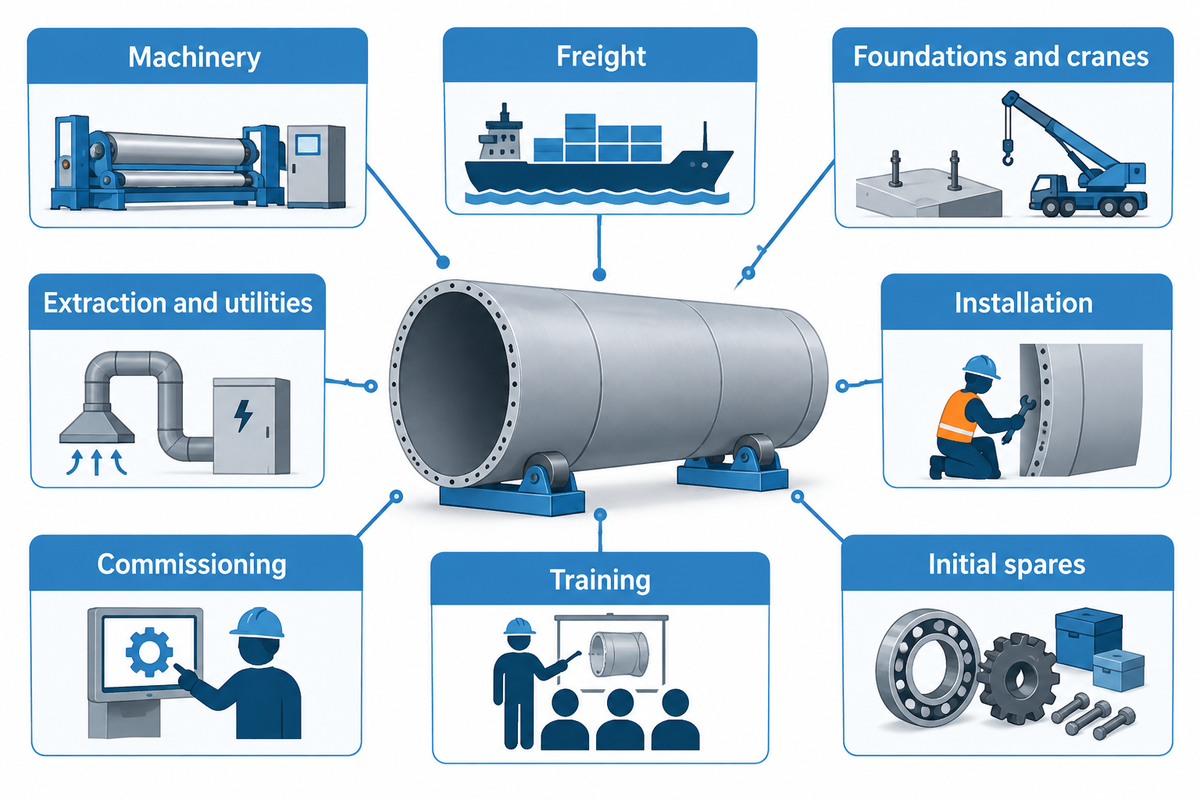
- Make a fair comparison of installed costs. Separately consider machinery, freight, foundations, cranes, extraction, utilities, installation, commissioning, training and initial spares. State the currency, delivery basis and buyer-supplied items. An equipment subtotal and an installed production system are different costs, even if both quotations contain the words wind tower production line.
- Reach an agreement on the level of support to be provided prior to placing the order. Identify who’s to undertake commissioning, what operator training will be provided, and what remote-access and critical spare parts agreements will be provided. Record the service response and other measures provided to address the plant’s location. The interfaces of existing equipment and the planned handover should also be documented. List long-lead time spare parts and state approved alternatives to limit exposure to supply chain disruptions. State the factory’s exposure to temperature, dust and corrosion to allow bidders to choose items for the various environmental conditions to suit that location.
Steel tubular-tower equipment also has a defined material boundary. A hybrid tower, a concrete section or a foundation, or a floating-wind structure, may also require a different production route to that used for rolled steel cans. The renewable energy sector includes all of these structures, but equipment qualified for one route shouldn’t be assumed qualified for another because both support wind power. Evidence of machinery for the specified tower-production route should be provided, and experience with other energy technologies shouldn’t be relied upon to substantiate the equipment.
Do
- Compare the same plate and section drawings.
- Name every included station and interface.
- Include transfers and operator tasks in the cycle.
Don’t
- Equate a maximum rating with routine output.
- Count partner equipment as one maker’s own manufacture.
- Compare machinery-only and installed-system prices.
For renewable energy projects, the responsibility of the tower builder is clearly defined when separated from the responsibility of the equipment builder. Turbine design and energy output describe the boundaries of the project. However, the production machinery must be defined by drawings and through process duties and acceptance conditions that belong to the factory. Don’t substitute a supplier’s work across renewable energy sources for a tower specific equipment reference.
Wind energy projects include a number of types of suppliers. Turbine OEMs buy or specify entire assemblies. A company qualifies for this comparison only in the wind turbine tower sector if it also provides production machinery to other fabricators. The distinction keeps a broad catalogue of wind energy solutions separate from a documented offer of machinery for the shop floor.
Frequently asked questions
Which manufacturers are best for integrated wind tower production automation?
Compare integrated automation options
Pemamek, ENABL and Key Plant are starting points for coordinated tower welding, assembly and production handling. Aubrik offers a configured tower-line package. Compare the stations actually included and the responsibility for their interfaces: an integrated welding line can still require separate rolling, inspection and coating equipment within the wider operating factory.
Which manufacturer is best for tower plate rolling?
Compare dedicated forming options
DAVI, Faccin, HAEUSLER and AKYAPAK offer dedicated tower-forming equipment. DAVI describes several automation levels; Faccin publishes its WT system; HAEUSLER offers HDR, EVO and VRM families; and AKYAPAK has AHS-RK. Match each proposal to plate width, steel grade, thickness and cone geometry, rather than choosing from a maximum thickness figure alone.
Are Chinese wind tower production line manufacturers reliable?
Assess manufacturers by their equipment proposal
Chinese manufacturers supply dedicated tower production equipment, but country of origin alone doesn’t establish reliability. Aubrik, Zhouxiang, Fengwei and Yueda publish tower-specific product lines. Compare their proposed machinery, representative production trial, documentation and support commitment. Apply the same acceptance and service requirements to Chinese, European, Indian and North American bidders.
Who is the largest wind tower production line manufacturer in the world?
Understand size comparisons
No comparable public tower-line sales ranking establishes a global leader. Revenue, welding-equipment and plate-roll sales data are for different businesses. Because of this, manufacturers are classified by their production role, allowing potential customers to evaluate equipment fit regardless of corporate size.
How much does a wind tower production line cost?
Define the quotation scope
A quotation for one wind tower production line requires a configuration-specific scope, with no comparable complete-factory public price range across these manufacturers. Total cost changes with plate duties, section mass, station count, handling and automation. When comparing equipment, consider foundations, cranes, extraction, utilities, transportation, installation, commissioning, training, control integration and spares. A low equipment subtotal can omit the interfaces needed to produce an accepted section, so define included and buyer-supplied items before comparing totals.
What is the difference between a manufacturer and a supplier?
Identify who makes and integrates the equipment
A manufacturer designs and builds equipment and may be a supplier and integrator; a supplier may distribute it or combine machines from other builders. One company may perform all three functions. To identify responsibility for a tower station, determine who manufactures the station, who integrates the line, and who commissions and takes responsibility for acceptance of the production run.
Discuss your tower production requirements
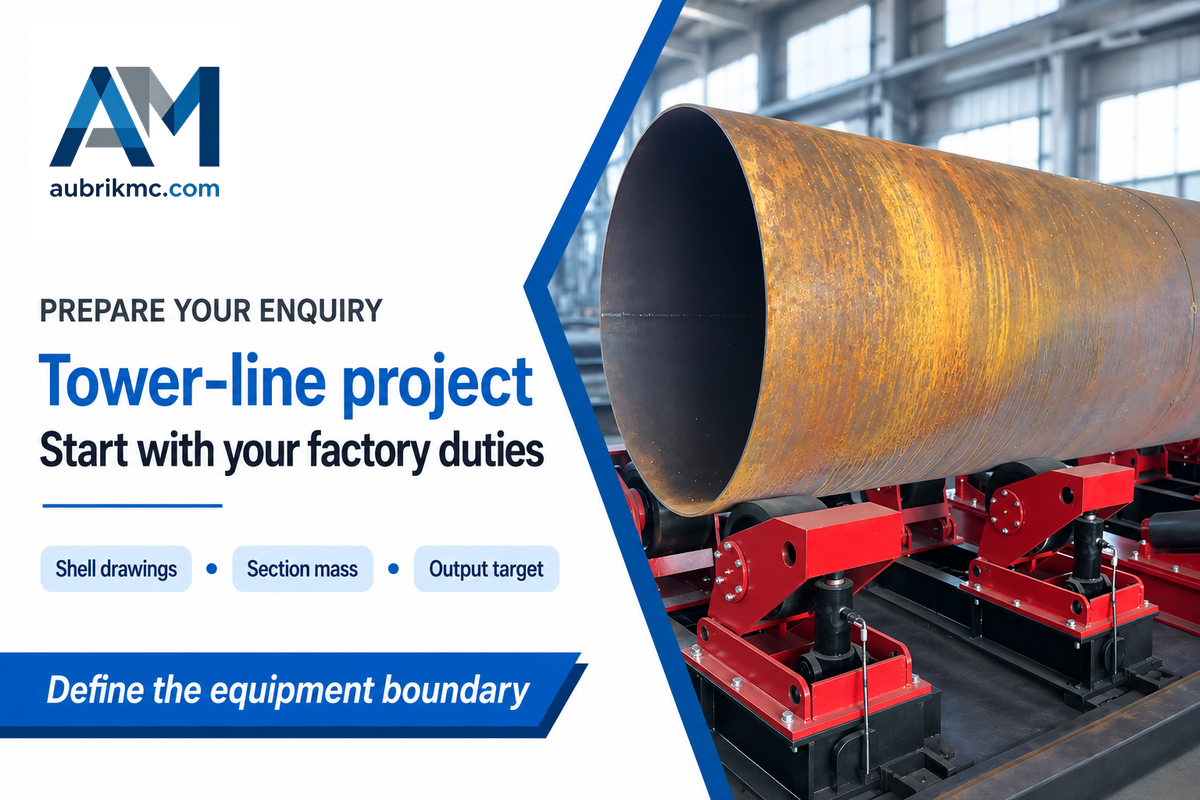
The best fit starts with your production scope. Send Aubrik the shell drawings, plate specification, diameter range, section mass, output target and existing factory layout. Our wind tower welding equipment and tower girth-welding stations can then be discussed against the operations you need to add or coordinate.
Key takeaway
A wind tower production line proposal should identify the equipment maker, included production stages and responsible integrator. These commitments should be matched with the factory’s plate, shell and output programme before prices are compared.
Discuss your tower-line configuration
References & Sources
Manufacturer product, company and quality publications support the attributed equipment descriptions above. The following public identity records supplement those company materials; they don’t certify machinery performance.
- Key Plant Automation Limited: company overview Companies House, United Kingdom.
- AMET founder biography Colorado School of Mines.
- Red Rock Automation Limited: company overview Companies House, United Kingdom.
Related articles
- Fit-up rotator manufacturers compare equipment for aligning and supporting shells.
- Welding manipulator manufacturers examine column-and-boom equipment for automated seams.
- Robotic welding system manufacturers compare robotic approaches for appropriate fabrication tasks.
- Cobot welding manufacturers understand another equipment category for suitable workshop applications.