Get in Touch with Aubrik Company
20 Welding Positioner Manufacturers: A Global B2B Shortlist


Worldwide B2B Manufacturer Comparison · Reviewed August 2026
Welding positioner manufacturers are companies that design or produce equipment for controlled workpiece rotation, tilt, and part positioning during welding and assembly. This guide compares 20 such manufacturers with current public evidence of a positioner product line. It’s a starting point for industrial due diligence, not a market-share, revenue, quality, or technical-performance ranking. WUXI Aubrik appears first because the client requested that display order; the placement doesn’t mean this research proves it’s the world’s number-one manufacturer.
Use the table to identify a suitable manufacturer profile, then send the same request for quotation to every shortlisted company. If you need model and capacity information rather than a company comparison, see Aubrik’s industrial welding positioner range.
How This Non-Ranked Manufacturer List Was Built

Our inclusion test was deliberately narrow. To qualify, a company needed a current first-party website showing that it manufactures welding positioners or supplies a clearly identified, robot-integrated positioner line. Pure traders, directories, marketplaces, listicles, and news publishers were excluded. That current product page supports what a company publicly represents; it does not independently prove factory ownership, order-specific load performance, delivery, certification, or after-sales results.
Founded years were taken from official histories or other public records when the convention was clear. If the exact year could not be confirmed, the table says Not clearly disclosed in reviewed public sources. We did not calculate a date from phrases such as “more than 40 years.” Where a date belongs to a parent, predecessor, or acquired brand, the distinction is stated instead of presenting corporate genealogy as uninterrupted manufacturing experience.
The 20-Maker Evidence Ledger
IdentityWho is the current company or brand?
Product lineIs a positioner range publicly visible now?
Buyer fitCompact, heavy engineered, or robot-coordinated?
Open questionsWhat must be verified in the quotation?
Important scope note: the Occupational Safety and Health Administration sources used later are United States references. They identify useful engineering risks, but they are not presented as worldwide legal requirements. Buyers must confirm the rules that apply at the installation site.
20 Welding Positioner Manufacturers for Industrial Buyers

The rows use the same eight fields for every company. “Key advantages” means a publicly visible portfolio or buyer-fit strength. “Potential disadvantages” means a constraint or verification question, not an allegation of poor quality. As requested, each official website is shown as a plain URL.
| No. | Company Name | Founded Year | Brief Introduction | Main Products | Key Advantages | Potential Disadvantages | Official Website |
|---|---|---|---|---|---|---|---|
| 1 | WUXI Aubrik (Wuxi ABK Machinery Co., Ltd.) | 1999 | China-based welding automation manufacturer serving industrial fabrication projects. It is displayed first solely because of the client-requested order, not an independently calculated rank. | Welding positioners; welding rotators; welding manipulators; column-and-boom systems; custom welding automation. | A broad, project-oriented positioner range can be sourced with adjacent vessel- and pipe-handling equipment. This can simplify technical coordination when one project needs several equipment families. | Capacity, controller brand, third-party certificates, installed references, delivery, commissioning, and service response must be confirmed for the actual configuration and destination. Most public capability statements are first-party. | https://aubrikmc.com/ |
| 2 | Koike Aronson / Ransome | 1918 (Koike); 1946 (Aronson business) | Established cutting and welding equipment group with a long-running North American positioner operation. Using both dates avoids presenting the Koike group date as the start of the Aronson positioner business. | Compact and gear-driven positioners; headstock-tailstock systems; turning rolls; welding manipulators; cutting equipment. | Its portfolio spans compact shop units and engineered heavy positioning systems. Official sizing material also gives buyers useful center-of-gravity and fixturing questions. | Quotation channel, standard versus engineered scope, availability, and service responsibility can differ by model and region. Buyers should obtain the model-specific load chart rather than generalize from the group portfolio. | https://www.koike.com/ |
| 3 | Pandjiris, Inc. | 1946 (welding-automation history) | United States manufacturer focused on welding automation and heavy-fabrication workholding. Its public range includes several positioner architectures rather than a single rotary table format. | Floor-turntable, headstock-tailstock and drop-center positioners; turning rolls; manipulators; controls; custom systems. | Strong fit for engineered applications that need heavy workpiece handling, multiple axes, or integration with other welding automation equipment. | Many systems are application-engineered and quote-based. International buyers should confirm the local installation, service, spare-parts, and warranty route instead of assuming North American coverage applies worldwide. | https://pandjiris.com/ |
| 4 | ALM Positioners | Not clearly disclosed in reviewed public sources | United States specialist in lift-and-rotate positioners and ergonomic material-handling systems. A current trade-show record also corroborates an active positioner and fixed-automation offering. | Lift-and-rotate positioners; headstock-tailstock and multi-axis systems; ergonomic handling equipment; fixtures; programmable controls. | A dedicated positioning focus and detailed application intake are useful for buyers whose main problem is weld access, elevation, rotation, or operator ergonomics. | Public product information emphasizes engineered lift-and-rotate solutions more than simple commodity turntables. Reviewed sources did not establish an exact company founding year, and project terms require a quotation. | https://www.almmh.com/ |
| 5 | Preston-Eastin | 1972 | United States positioning-equipment brand serving manual and automated fabrication. SMX Industrial Solutions acquired Preston-Eastin in 2025 while the operation remained in Tulsa. | Welding and robotic positioners; headstock-tailstock systems; skyhook positioners; turning rolls; robot transport units. | Several established architectures support manual stations, robotic cells, thermal spray, coating, and other industrial positioning tasks. | Ownership changed in 2025, so buyers should confirm the current contracting entity, warranty counterparty, and service contact. Engineered robotic systems also involve more integration effort than a standalone shop unit. | https://www.prestoneastin.com/ |
| 6 | LJ Welding Automation | 2006 (operating history) | Canadian welding-automation manufacturer offering standard and custom equipment for pipe, vessel, and heavy-component fabrication. A Canadian federal record independently corroborates its legal identity and welding-equipment development activity. | General, pipe and vessel positioners; turning rolls; welding columns and booms; seamers; custom automation. | Broad standard-to-custom coverage makes the company relevant when a project combines workpiece positioning with pipe or vessel welding automation. | Large systems require foundation, freight, utilities, and installation planning. Buyers outside the company’s core region should verify who provides commissioning, training, spares, and field service. | https://www.ljwelding.com/ |
| 7 | Key Plant Automation Ltd. | 1956 | United Kingdom-headquartered manufacturer of welding automation and workpiece-handling equipment for fabrication and heavy industry. | Fixed- and adjustable-height positioners; three-axis positioners; headstock-tailstock systems; turning rolls; column-and-boom manipulators. | Published product information covers compact capacities and very large engineered units, giving heavy-fabrication buyers several mechanical layouts within one product family. | Large-capacity equipment is a plant project, not a catalog-only purchase. Shipping route, floor and foundation loads, guarding, utilities, acceptance scope, and destination-specific service should be fixed before order. | https://www.keyplant.com/ |
| 8 | Pemamek Ltd. | 1970 | Finnish welding-automation company whose first product was a positioner. Its current focus includes large production systems for energy, shipbuilding, pressure-vessel, and heavy-fabrication applications. | Heavy welding positioners; robotic stations; panel lines; turning rolls; column-and-boom systems; production software. | Positioning equipment can be engineered as part of a larger automated production line, which suits buyers needing cell- or factory-level integration. | Turnkey scope, software, plant interfaces, and capital commitment may be excessive when the need is a basic standalone unit. Buyers should separate standard equipment price from line-engineering and lifecycle costs. | https://pemamek.com/ |
| 9 | IRCO Automation | 1963 (manufacturing history) | Canadian supplier of welding positioners and custom automation for heavy workpieces. Public records indicate a mixed role that includes engineering and custom manufacturing as well as retail, maintenance, and integration. | Tilt-rotate, three-axis, gimbal and low-profile positioners; turning rolls; manipulators; headstock-tailstock systems; custom robotic systems. | Multiple positioner geometries and custom-system experience can help when payload shape or access makes a standard two-axis table unsuitable. | Manufacturer, integrator, retailer, and service roles should be identified for the specific order rather than treated as one entity by default. International field-service coverage also needs confirmation. | https://ircoautomation.com/ |
| 10 | Bancroft Engineering | Not clearly disclosed in reviewed public sources | United States welding-automation company focused on precision rotary welding, positioners, and application-engineered systems. | Manual and automated positioners; rotary welding systems; weld lathes; fixtures; torch motion; programmable controls. | Positioning, tooling, torch control, and welding sequence can be developed as one precision application rather than purchased as disconnected components. | Public product information is oriented more toward precision engineered systems than an ultra-heavy standardized range. Reviewed first-party pages describe long experience but do not state one unambiguous founding year. | https://bancrofteng.com/ |
| 11 | MBC Company | 1966 (manufacturing history) | United States manufacturer with a focused range of compact rotary positioners and related bench-scale welding automation. | Bench welding positioners; programmable rotary positioners; chucks; foot controls; timers; small-part automation accessories. | A concentrated compact-positioner offering can suit repeatable small-part, tube, fitting, and circular-weld work without the cost or footprint of a large engineered system. | Capacity, axis count, and integration breadth are narrower than heavy or robotic-system suppliers. Buyers with eccentric, tall, or large workpieces must confirm the load chart and swing clearance carefully. | https://mbcwelding.com/ |
| 12 | Gullco International | 1954 | Canadian manufacturer known for portable welding mechanization and compact programmable automation used in fabrication shops and field-oriented applications. | Programmable welding positioners; welding tractors and carriages; seam trackers; gun holders; automation controls. | Portable and programmable products can improve repeatability without requiring a full robot cell. Its positioner control can coordinate rotation and weld on/off functions for suitable applications. | This positioner range is more concentrated in compact rotary automation than heavy multi-axis workpiece handling. Confirm payload geometry, welding-current path, chuck, and local distribution support. | https://www.gullco.com/ |
| 13 | Weldlogic, Inc. | 1978 | United States precision-welding automation company serving applications where rotation, tooling, torch motion, and process controls must work together. | Precision rotary positioners; weld lathes; seam welders; automatic welding systems; forming and tooling systems. | Strong relevance for process-specific automatic welding where repeatable motion, fixturing, and coordinated controls matter more than a generic high payload. | Projects are frequently application-specific, and the public catalog is not centered on off-the-shelf heavy-duty positioners. Scope, cycle proof, tooling ownership, and acceptance criteria need agreement. | https://weldlogic.com/ |
| 14 | United ProArc Corporation | 1966 | Taiwan-based manufacturer of welding, cutting, and positioning equipment for industrial production and automation projects. | Precision positioners; welding manipulators; turning rolls; cutting machines; seamers; integrated automation. | A diversified equipment range can support buyers who want positioners and adjacent welding automation from the same supplier. | Distributor, spare-parts, and service arrangements vary by market. Buyers should verify the producing entity, selected control components, documentation language, and destination support before comparing quotations. | https://www.proarc.com.tw/ |
| 15 | Cyclotron Positioners | Not clearly disclosed in reviewed public sources | India-based specialist presenting standard and custom welding positioners for workpieces across shop-scale parts and heavy industrial load classes. | Welding positioners; headstock-tailstock systems; rotary units; lifting and tilting systems; custom load-positioning equipment. | Broad published load scope and a specialist positioning focus give buyers several possible mechanical concepts for unusual workpieces. | Reviewed public material does not state an exact founding year. Overseas buyers should verify factory audit evidence, installed references, conformity documents, service coverage, spare parts, and acceptance support. | https://cyclotronpositioners.com/ |
| 16 | FÖRSTER welding systems GmbH | Not clearly disclosed in reviewed public sources | German welding-workplace and fixture specialist focused on ergonomic positioning, modular tables, and production setups. | Powered positioners; welding tables; modular fixtures; rail systems; workpiece-handling and workplace equipment. | Positioning equipment can be combined with a modular fixturing and workplace ecosystem, which is useful when access and setup time are central constraints. | This range is oriented toward ergonomic workstations and modular fixture integration rather than every class of very heavy turnkey line. The reviewed official page does not state an exact founding year, so buyers should recheck the date during vendor qualification. | https://forster-welding-systems.com/en |
| 17 | KUKA AG | 1898 | Global industrial robotics manufacturer offering servo positioners as robot peripherals for coordinated welding and handling cells. | Single- and multi-axis positioners; turn-tilt tables; robot travel units; industrial robots; cell software and controls. | Coordinated motion within a mature robot and controller ecosystem can reduce interface ambiguity when the complete cell is designed around KUKA automation. | Group founding year does not prove continuity of every current positioner product. Such equipment may also be unnecessarily complex for standalone manual welding, and the integrator remains critical to fixture, safety, commissioning, and service outcomes. | https://www.kuka.com/ |
| 18 | Yaskawa Electric Corporation / Motoman | 1915 | Global motion-control and robotics group with servo-controlled positioners for robot-coordinated workcells. | Single- and multi-axis positioners; headstock-tailstock fixtures; robotic welding cells; industrial robots; motion controls. | Positioner axes can be coordinated with Motoman robots and established motion-control technology, fitting production that needs repeatable multi-axis welding access. | This solution is ecosystem- and integrator-oriented rather than a simple manual positioner purchase. Buyers must identify responsibility for simulation, guarding, fixture validation, site acceptance, programming, and long-term support. | https://www.yaskawa-global.com/ |
| 19 | OTC DAIHEN | 1919 (DAIHEN group history) | Japanese-origin welding and robotics group supplying positioners for automated arc-welding cells, including independently operated and robot-synchronized configurations. | Robot positioners; arc-welding robots; power sources; controllers; coordinated cells and peripherals. | Robot, welding power source, controller, and positioner can be specified within one automation platform, which may reduce cross-vendor interface work. | This product line is most relevant to OTC robotic systems and may not fit a basic standalone requirement. Local integrator competence, spare parts, risk assessment, acceptance, and controller lifecycle should be verified. | https://www.daihen-usa.com/ |
| 20 | Carl Cloos Schweisstechnik GmbH | 1919 | German welding-technology manufacturer offering robots, welding power sources, software, and modular positioners for automated cells. | QIROX robot positioners; welding robots; power sources; robotic cells; automation and production software. | Positioners, robots, welding process equipment, and cell engineering are available within one welding-automation ecosystem. | Custom cell complexity, investment, and regional integration route may not suit buyers needing only a standalone turntable. Contracts should identify the manufacturer, integrator, service entity, acceptance owner, and warranty boundary. | https://cloos-group.com/ |
How to Read the Strengths and Limitations

The table does not convert dissimilar public information into a score. Compact rotary-positioner makers should not be penalized for lacking a 50-tonne product, and a robot original-equipment manufacturer should not receive an automatic advantage for controller integration when the buyer only needs a manual workstation. A useful comparison is between the project and the supplier profile.
Sparse website evidence is also not proof of weak engineering. It means the buyer has more work to do before relying on the claim. When the table says “confirm regional service,” that does not mean service is unavailable; it means the reviewed public sources did not establish a comparable worldwide response commitment. The same rule applies to delivery, certifications, installed references, spare parts, and acceptance tests.
Identity check: Ask which legal entity will manufacture the equipment, sign the contract, integrate the cell, issue the warranty, provide destination service, and hold the drawings. Those roles may belong to one company, several affiliates, or an independent integrator.
What a company history can and cannot tell you
Long history can support a continuity check, but the number is easy to overread. For example, a group founded in 1898 may offer a positioner developed much later. An acquired brand may retain its products while its contracting entity, factory, personnel, or service structure changes.
Meanwhile, a younger specialist may have deeper experience in one positioner architecture than a much older diversified group. Treat the founded year as identity context, then ask for current evidence: the legal quotation header, factory address, organization responsible for engineering approval, relevant installed references, current control components, and the service team that will support the shipped configuration.
Why the limitation column is not a negative score
The limitation column answers “what could prevent a fair purchase decision?” Limited heavy-load range matters only if the project is heavy. A robot ecosystem’s integration overhead matters only if the project does not need coordinated automation. Quote-based product ranges may actually be appropriate for a complex weldment, although they make public price comparison impossible.
Each limitation should therefore become a verification action. If a company publishes no regional response time, request the service-level commitment. If the website lacks a load chart, request the drawing for the proposed model. If a system is integrated by a third party, request a responsibility matrix.
Keep five identities separate during qualification
- Brand owner: controls the product or trade name shown in the proposal.
- Producing entity: builds and inspects the mechanical or electrical equipment.
- Contracting entity: receives the order and carries the commercial obligations.
- System integrator: combines the positioner with the robot, fixture, safety system, controls, and plant interfaces.
- Lifecycle service entity: commissions, maintains, repairs, and supplies parts at the destination.
Sometimes one manufacturer fills all five roles. Sometimes a parent company, regional subsidiary, distributor, and integrator divide them. Neither structure is automatically better. The risk appears when the buyer assumes the roles are unified and discovers after delivery that a warranty excludes integration, the local distributor cannot edit the controller, or the original factory does not own the fixture design.
The Positioner Portfolio Compass

Start with the production problem, not the oldest company or the largest payload on a brochure. Three broad profiles cover most shortlisting decisions.
For example, an automotive fixture, a pressure-vessel flange, and a repair-shop tube can have similar mass but very different handling needs. Record the heaviest fully fixtured part, then determine whether the welder needs to reposition it manually, rotate it continuously, or coordinate it with a robot. The right architecture can support throughput, productivity, and weld quality; those outcomes still depend on the welding process, fixture, operator, and acceptance criteria rather than the positioner brand alone.
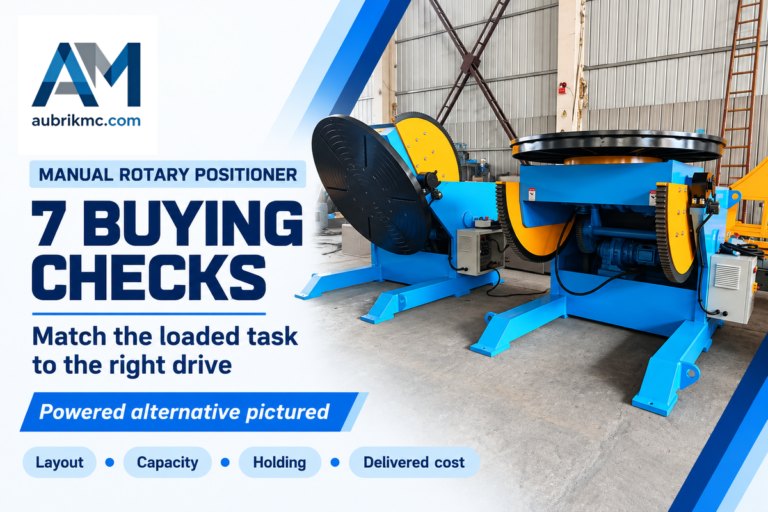
Compact standalone profile
Best starting point: small circular parts, fittings, tubes, repair, low-to-medium production, or a workstation that doesn’t need coordinated robot motion.
Manufacturer signals: published speed range, chuck or tooling options, welding-current return path, foot control, timer or simple programmable functions, and a load chart that accounts for workpiece position.
Hidden bottleneck: a light part can still overload a small positioner if the fixture pushes the center of gravity too far from the table. Swing clearance and low-speed stability may matter more than headline capacity.
Engineered heavy-workpiece profile
Best starting point: pressure vessels, large frames, rail equipment, energy components, construction machinery, or parts that need lift, elevation, headstock-tailstock support, or multiple axes.
Manufacturer signals: model-specific load charts, torque and eccentricity limits, structural calculations, foundation data, handling method, guarding concept, hydraulic or servo details, and factory-acceptance capability.
Hidden bottleneck: site readiness becomes part of the purchase. Floor load, anchors, crane access, cable routing, clearances, workpiece loading, transport permits, and commissioning can control the schedule.
Robot-coordinated profile
Best starting point: repeatable production where the robot and positioner must move as coordinated axes, or a dual-station cell where loading occurs while welding continues.
Manufacturer signals: supported controller combinations, simulation, axis coordination, cable and weld-current routing, functional safety, fixture interface, programming tools, integrator network, and lifecycle support.
Hidden bottleneck: the positioner may be mechanically capable while the complete cell still fails its cycle, access, safety, or maintainability target. Assign responsibility for system validation rather than assuming it follows the robot badge.
For operating instructions, detailed sizing, and model-level selection, use a dedicated how-to-use reference, heavy-duty welding positioner guide, or rotary welding positioner guide. Those technical intents are intentionally not repeated here.
How to handle projects that sit between profiles
Many real projects don’t fit one box. Heavy manual positioners may later become part of a robot cell. Compact rotary units may need recipe storage and communication with a welding power source but no robot. Even a mechanically standard headstock-tailstock system may have a custom fixture, guards, and loading system. In these cases, shortlist a mechanical-equipment specialist and an automation-ecosystem supplier, then compare the boundary of each proposal. One may offer stronger workpiece engineering while the other offers simpler coordinated controls. The deciding evidence isn’t the number of product families; it’s which party accepts responsibility for the interfaces that matter to the plant.
A practical two-stage shortlist
In stage one, remove suppliers that can’t confirm the required mechanical architecture, load geometry, destination support route, and document baseline. In stage two, issue the same controlled request for quotation to the remaining companies. Ask each to identify exclusions and assumptions in a separate schedule. This prevents an apparently complete quote from winning only because missing guarding, fixtures, installation, or acceptance work is hidden outside the price. It also gives finance and engineering teams a shared basis for comparing total project scope.
RFQ Evidence Checklist Before You Shortlist

Send every candidate the same workpiece package. Otherwise, one supplier may quote a basic table while another includes fixture, controls, guarding, installation, and acceptance. The totals will look different even when the underlying equipment price is similar.
| RFQ block | Information to provide | Evidence to request |
|---|---|---|
| Workpiece and fixture | Maximum and minimum part mass; weight of the fixtures, chuck and clamps; small parts, large parts, or heavy components; envelope; drawings; material; loading orientation; center of gravity in each operating position. | Model-specific load rating and safe-load chart, permitted eccentricity and center-of-gravity limits, table or shaft interface, swing-clearance review, and fixturing approval for the stated part positioning. |
| Motion and process | Required rotational travel and tilt angles; flat position or other weld orientation; variable speed range; indexing; repeatability; arc time target; welding process and current; manual repositioning, semi-automatic, or robot-coordinated operation. | Rated speed under load, axis torque, brake and holding method, welding-current return rating, motion-control architecture, and any model-specific duty limitations. |
| Production duty | Parts per shift; cycle target; production efficiency goal; shifts per day; changeover frequency; changeover method; product mix; rework limit; product quality baseline; planned future parts; ambient temperature; dust, fume, or outdoor exposure. | Evidence that the proposal can increase productivity or improve weld quality under the stated process, including measured cycle and arc time, duty basis, thermal assumptions, maintenance assumptions and recommended intervals, expected wear parts, capacity margin against the actual geometry, and fit with existing production lines. |
| Controls and integration | State whether the scope is an automated welding system, robotic welding cell, or standalone automation equipment; add robot, controller, power source, programmable logic, safety system, network, signals, and simulation needs. | Interface list, signal ownership, controller and software versions, backup method, cybersecurity boundary where relevant, functional-safety scope, customization boundary for automation solutions, and integration-responsibility matrix. |
| Site and utilities | Voltage and frequency; air or hydraulic supply; floor data; foundation; anchor method; loading crane or forklift; manual handling and ergonomics; cable routes; mechanical equipment footprint and access doors. | General-arrangement drawing, foundation and floor-load data, anchor plan, utility schedule, transport split, lifting points, installation method, and facility-interface checklist. |
| Compliance and documentation | Destination country; applicable machinery, electrical, robot, industrial welding, and equipment manufacturing requirements; buyer documentation standard; language; traceability expectations. | Declaration and certificate scope for the exact shipped configuration, risk-assessment responsibilities, manuals, drawings, bills of materials, inspection records, and document-delivery schedule. |
| Acceptance and lifecycle | Representative workpiece; measurable cycle, motion, load, accuracy, safety, and document criteria; operator and maintenance training needs; stated meaning of reliable welding for this process. | Factory- and site-acceptance plans that turn consistent bead, weld consistency, and quality of welds into observable criteria; responsible signatories, test instruments, deviation process, commissioning owner, training record, change-control process, periodic tests, maintenance records, warranty terms, and spare-parts list. |
| Commercial comparison | Compare welding positioner companies on the same Incoterm, destination, schedule, installation window, payment milestones, warranty location, and service response. | Itemized price separating equipment, fixture, controls, guarding, freight, duties, installation, commissioning, training, spares, travel, and optional work, plus evidence for why the proposed model is the right welding positioner. |
| Architecture label | Labels may include benchtop positioner, benchtop welding positioner, pipe welding, automated welding, or multi-axis welding positioners. | Ask the supplier to map the label to the actual axes, payload geometry, controls, setup, and acceptance scope; the category name alone does not prove capability. |
The load section should be completed before asking for a model. Manufacturer sizing guidance highlights total load, center of gravity, and eccentricity because a nominal payload doesn’t describe every operating position. These are engineering-risk principles, not a substitute for the manufacturer’s calculation or the rules at the destination. Aubrik’s welding positioner load-capacity calculator can help organize preliminary inputs, but the manufacturer must validate the final configuration. Separately, the OSHA guidance quoted below concerns safeguards around moving machinery rather than positioner load calculation.
“Safeguards are essential for protecting workers from preventable injuries.”
Three documents that make quotations comparable
First, a scope-responsibility matrix. Put the mechanical positioner, fixture, guarding, robot, controller, power source, cables, safety validation, foundations, installation, programming, training, and acceptance on separate lines. Assign a supplier, integrator, buyer, or shared owner to each line. “By others” is acceptable only when the other party is named and has accepted the task.
Second, an assumption and exclusion schedule. Require the supplier to state which part drawing, fixture mass, center of gravity, cycle, utilities, environment, codes, and destination conditions the price assumes. An omission in the schedule is easier to resolve before order than during site acceptance.
Third, an acceptance matrix. Translate “works as specified” into observable results: loaded motion, rotation-speed range, tilt positions, stopping behavior, indexing or repeatability where required, safety functions, communication signals, representative weld cycle, retained records, training, and recovery from common faults. Name whether each item is tested at the factory, at the site, or both; identify the evidence retained and the person authorized to accept a deviation.
Compare commercial risk, not just purchase price
Positioner projects can move cost between line items without changing the real total. One quotation may include a fixture but exclude engineering changes. Another may include commissioning but cap travel days. A third may bundle controls but require the buyer’s integrator to complete safety validation. Normalize the proposals into equipment, tooling, integration, civil work, freight, installation, commissioning, training, production ramp-up, spare parts, software, and planned maintenance. Then record the cost of buyer-supplied work. The lowest equipment line isn’t necessarily the lowest installed and accepted project cost.
What Current Search and Citation Data Suggests

The current search landscape mixes manufacturer pages with distributors, used-equipment listings, general selection guides, trade publications, and listicles. That is useful for discovery but not enough to prove who builds the machine, which entity will contract with the buyer, or whether a model is supported in the destination market. The proof window in this article therefore starts with current company and product evidence and ends with order-specific records.
The saved recent twelve-month slice is a low-volume, uneven United States English proxy: monthly values range from 0 to 40 and average 15.0. That is directional search-demand context, not worldwide market size. Open-market forecast pages were excluded from purchasing conclusions because their methods and commercial incentives were not sufficiently transparent.
Observed query refinements included “heavy duty welding positioner manufacturers” and “pipe welding positioner.” Those phrases narrow the requested architecture, while country modifiers narrow the support market; none proves who manufactures the machine. If your shortlist is restricted to pipe-only candidates, use the separate pipe welding positioner manufacturer comparison; that guide owns clamp, through-bore, and pipe-workflow evaluation. This page remains the company-level comparison across benchtop, heavy-duty, vessel, robotic, and other positioner portfolios.
Technology signals are more concrete. Robot manufacturers publish synchronized positioner portfolios, including dual-station and coordinated-axis concepts. Those matched-system options can reduce interfaces inside a robot ecosystem, but they do not make integration automatic. Facility interfaces, fixture access, safety, acceptance, training, maintenance, and change control remain system-level responsibilities.
For procurement, a missing official page for the product, factory-acceptance and inspection plan, certification scope, or named service route remains an evidence gap and a project risk. Because a listing position cannot resolve those gaps, keep the supplier conditional until current records answer them; for a prolonged sourcing cycle, repeat the identity and service check before award.
What changed in the 2026 review
Public evidence reinforces three buyer patterns. First, several suppliers currently present positioners as part of an automation platform rather than an isolated table. Second, one reviewed supplier application form asked for fixture weight, center of gravity, controls, elevation, mobility, and future automation plans before recommending a model. Third, official robot-positioner product pages show synchronized motion and dual-station utilization. These signals make interface ownership more important, not less: the buyer must establish who validates the machine or cell at the destination.
The review also found reasons for restraint. Public market forecasts produced precise growth figures without enough transparent methodology for this procurement article, so those figures were not used. Search prominence likewise does not prove manufacturing responsibility. Manufacturers can be less visible than distributors, while a highly visible robot brand may rely on an integrator for the actual cell.
How often should buyers recheck the list?
Recheck company ownership, product availability, regional contacts, and required documents before every significant purchase. Acquisitions, distributor changes, controller generations, and service coverage can change faster than the mechanical product category. For a long project, repeat the identity and support check before contract signature and again before shipment. The comparison date on this article is evidence of when the public review occurred; it is not a guarantee that every commercial detail remains unchanged.
Frequently Asked Questions
How do I verify that a welding positioner company is a manufacturer?
Start with a current official product page, an identifiable legal company, product-specific drawings or model information, and a technical sales contact that can answer questions about load geometry, controls, records, and acceptance. Then ask the quotation to name the producing entity, contracting entity, integrator, warranty counterparty, and service provider. Directory or distributor pages can help you discover a brand, but they don’t by themselves prove manufacturing responsibility. Keep dated copies of every source used during the shortlist and quotation review.
What information should I send to a welding positioner manufacturer?
Send the maximum and minimum workpiece drawings, part and fixture mass, center-of-gravity offsets, envelope, required rotation and tilt, speed range, duty cycle, welding process and current, workholding method, utilities, mounting, environment, destination, and applicable document requirements. For automated cells, add the robot, controller, power source, safety architecture, signals, cycle target, representative acceptance part, and a responsibility matrix for integration and commissioning. Label each value as supplier data, a buyer estimate, or an input that needs model-specific engineering confirmation before selection.
Should I choose a standalone or robot-integrated positioner?
Choose a standalone profile when the job mainly needs controlled manual or semi-automatic rotation and the production mix doesn’t justify coordinated robot axes. Consider a robot-integrated profile when repeatable access, synchronized movement, or dual-station utilization supports the business case. The robot option also adds fixture, simulation, guarding, programming, acceptance, maintenance, and integrator responsibilities, so compare the complete cell rather than the positioner alone. Record responsibility for synchronized motion, cell safety, fault recovery, and restart approval after a stopped weld cycle.
Does an older founding year prove better equipment?
No. Age can show business continuity, but it doesn’t prove the performance of the current model, retained engineering capability, factory continuity, or support in your country. Verify the current producing entity, design, quality documents, references, service route, and acceptance evidence.
Why does the table not compare public prices?
Welding positioner quotations change with payload geometry, fixture, axes, table or shaft interface, speed, controls, robot integration, guarding, document package, destination conformity, freight, foundation, installation, commissioning, training, spares, and warranty scope. A low public price may describe a bare standard unit, while a higher quotation may include a complete validated cell. Asking every manufacturer for the same itemized scope produces a more defensible commercial comparison than placing unrelated headline prices in one column. Separate options from the base equipment price.
Can a distributor or integrator still be a valid contracting partner?
Yes. Regional distributors may offer faster parts and service, while an experienced integrator may be the right party to own the robot-cell result. The key is disclosure. Confirm who manufactures the positioner, who has authority to approve changes, who owns the integration design, whose warranty covers each subsystem, and which entity will respond. Don’t label a company “manufacturer” solely because it sells the equipment, and don’t reject a useful partner solely because it performs more than one role.
What should happen when a manufacturer will not provide a load chart or acceptance plan?
Ask whether the information is available under a confidentiality agreement and whether a model-specific engineering review will accompany the quotation. If the supplier cannot define the safe loading basis or acceptance method, treat the gap as an unresolved procurement risk.
Do not fill the gap with a catalog payload. The appropriate response may be a conditional shortlist, a factory audit, a paid engineering study, or selection of another proposal with clearer evidence. Before accepting a conditional path, record the missing evidence, the supplier’s promised deliverable, its due date, the person authorized to close the gap, the commercial condition that remains open, and the review needed from engineering, safety, purchasing, and maintenance, then keep the proposal conditional until the promised record arrives and the responsible technical owner confirms that it answers the specific load and acceptance questions.
Build the Shortlist Around Your Evidence Requirements

Use this non-ranked list to identify the manufacturer profile that fits your workpiece and production plan. Then reduce the field with the same identity, load, integration, records, acceptance, and lifecycle questions for every candidate. WUXI Aubrik can be included in that process through its welding positioner product range, without assuming that any one supplier is universally best.
The most defensible shortlist isn’t the longest list of recognizable brands. It’s the smallest group of suppliers that can state who’s responsible, show how the proposed machine fits the real load, and agree on what evidence will prove the delivered system is acceptable.
For a United States installation, include the OSHA machine-guarding guidance in that evidence pack; for other destinations, use the governing local requirements.
References & Sources
- US Occupational Safety and Health Administration, machine guarding general requirements: https://www.osha.gov/etools/machine-guarding/introduction/general-requirements
- US Occupational Safety and Health Administration, robotics safety technical manual: https://www.osha.gov/otm/section-4-safety-hazards/chapter-4
- American Welding Society, welding codes and standards: AWS codes and standards
- ASSEMBLY Magazine, welding-cell application context: welding-cell application context
- Journal of Interactive Marketing study record on first-position effects: first-position effects study record
Company histories, product scopes, and official URLs are listed in the manufacturer evidence grid reviewed on August 31, 2026. First-party sources are used with attribution and don’t replace order-specific technical and commercial verification.