Get in Touch with Aubrik Company

20 Welding Turntable Manufacturers for Industrial Buyers


Unranked
Welding turntable manufacturers are companies that publicly present their own welding turntable, floor turntable, or rotary welding table product line. For industrial buyers, a useful longlist starts with that narrow question on the company’s own domain. This guide answers it for 20 companies worldwide. WUXI Aubrik is shown first at the client’s request; that editorial placement isn’t a claim of absolute rank, product superiority, or universal suitability.
This comparison is designed for discovery and technical shortlisting. It doesn’t replace a supplier audit, a review of machine drawings, a load-and-center-of-gravity calculation, or an agreed acceptance test. Product ranges, origin history, and local support can change, so buyers should recheck the evidence that matters to their project before issuing a purchase order.
Jurisdiction Note for Rotating Equipment

Industrial note for U.S. installations: OSHA’s machine-guarding rule requires one or more methods of guarding for hazards created by rotating parts and related machine areas. For other destinations, buyers should verify the applicable local requirements. In every turntable project, the quotation should make clear what sits inside the machine supplier’s scope and what remains the cell integrator’s responsibility.
For a UK installation, the HSE overview of PUWER is a jurisdiction-specific starting point, not a global compliance rule.
What Counts as a Welding Turntable Manufacturer?

For this article, a welding turntable manufacturer is a company that publicly presents its own turntable product rather than only listing another company’s equipment. Each included manufacturer must publicly name a welding turntable, floor turntable, or rotary welding table product. A generic welding-positioner line alone does not qualify. Even then, the exact motion and workholding arrangement still matter.
We included companies only when current public material showed both a manufacturing identity and a documented turntable product line. We excluded pure trading pages, online marketplaces, directories, listicle publishers, and companies for which the reviewed material showed only generic multi-axis or tilting equipment rather than a turntable line.
Without that boundary, a sourcing team can compare non-equivalent equipment and attribute a factory’s generic automation capability to a specific turntable. Current first-party product pages provide discovery evidence; a machine drawing and agreed acceptance criteria are needed to confirm a quotation.
Aubrik publishes a separate welding-turntable selection guide for equipment-class choices. This article stays focused on whether a manufacturer publicly offers a dedicated turntable product before the buyer starts comparing suppliers.
Keep the turntable scope distinct
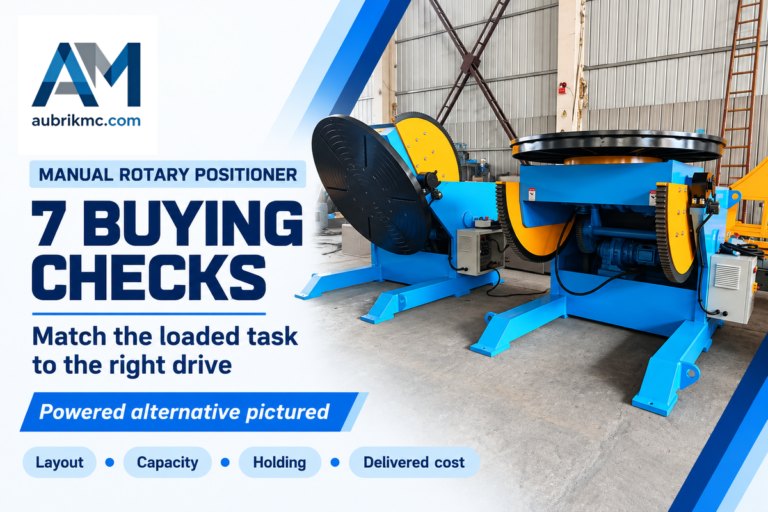
In the floor-turntable context used here, a horizontal worktable rotates about a vertical axis for a clamped workpiece. Supplier terminology and the chosen application still need checking before quotation. Specify the required axis, workpiece envelope, fixture, joint access, and welding attitude so the supplier can confirm that a one-axis table is the correct equipment class.
Where a cylindrical workpiece is supported on rollers rather than a table, review Aubrik’s rotator-versus-positioner comparison before treating the equipment classes as interchangeable.
For broader equipment-category context—not as a substitute for the dedicated turntable scope used here—see Aubrik’s welding-positioner product range.
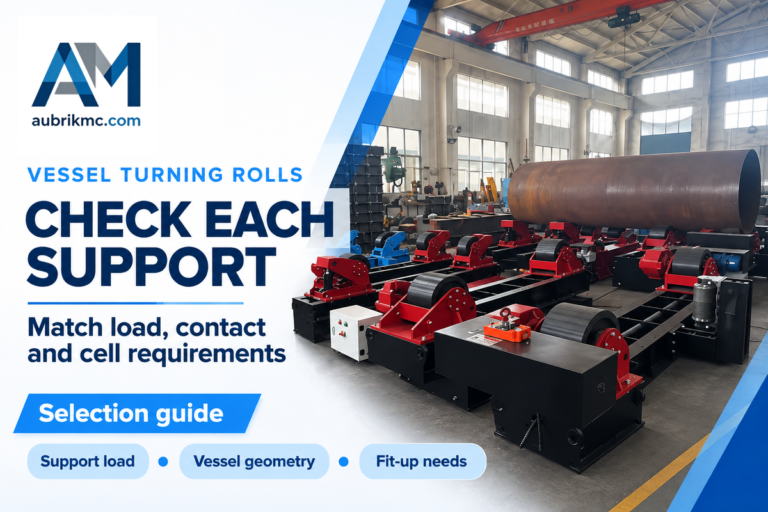
Where roller support is the actual workholding concept, use the separate welding-rotators and turning-rolls guide instead of treating that equipment as a table.
How We Evaluated the 20 Companies

Evaluation for this article is a non-ranked public-source comparison. Each row was screened against the same practical rules: a current official domain; a relevant product page or catalogue path; a manufacturing identity rather than a resale listing; a founded year only where a public source was sufficiently clear; and a limitation that keeps the row from reading like an endorsement.
- Product-line evidence first. Current manufacturer pages establish that a rotary welding product line is publicly offered.
- Apply founding-year restraint. Group heritage, predecessor dates, incorporation dates, and the present operating company can differ. Where the precise basis couldn’t be confirmed, the table says Unverified.
- Keep first-party claims attributed. A company page can explain what that company publishes; it is not independent proof of order-specific payload, delivery, certification scope, or field performance.
- Use procurement-relevant advantages. The table favors visible model coverage, published technical detail, customization scope, or automation focus over generic praise.
- Limitations are not fault findings. They flag a narrower product class, incomplete public information, group-date ambiguity, or a requirement to verify the quotation.
Catalogue wording does not establish product scope
Supplier catalogues may use related labels such as rotary welding positioners, rotary positioners, turntable positioners, rotary tables, rotary welding, rotational welding, or manufacturing welding positioners. They may also describe a 2-axis positioner, a manipulator, or welding floor turntables. Those labels trigger a scope check; they do not, by themselves, establish that a company makes the dedicated one-axis welding-turntable product required for this longlist.
Public pages can also contain application language such as welding applications, precision welding, welding operations, robotic welding cells, high-quality welding, pressure vessel, welding productivity, circumferential welding, welding tasks, smooth rotation, ergonomic work, welding environments, welding stations, TIG welding, submerged arc welding, and steel fabrication. These phrases describe possible context, not a promise that every quoted machine will deliver a precise and consistent result, hold and rotate every workpiece, or suit every heavy or complex project.
The same restraint applies to terms including customizable, customization, ergonomics, high-volume, consistent weld quality, welding needs, ergonomic work environment, high-precision, and welding projects. They are useful prompts for a supplier brief, not evidence of order-specific capability.
This approach gives procurement teams a repeatable first pass. It also avoids the common mistake of converting a company’s age, a maximum payload headline, or a search-result position into a quality ranking.
What public evidence can and cannot prove
Public evidence can narrow a field, but it cannot approve a specific order. An official product page can show a current product family, while a company page can describe the business or its history. Current data sheets may add dimensions, options, and published ratings.
None of these documents, by themselves, proves that the exact configuration in your purchase order will carry your fixture, arrive on a particular date, contain a specific control component, or pass your chosen acceptance test. Those are order-stage questions.
That distinction isn’t a reason to dismiss manufacturer material. It’s a reason to use it correctly. At the longlist stage, a company’s own pages are usually the most direct way to confirm whether the business still offers the equipment family. At the technical stage, a buyer needs the manufacturer’s response to the actual input sheet. At the award stage, the purchase order and technical appendices should identify what the supplier will build and how it will be checked. This article’s table is built for the first of those stages, while the later sections help move a candidate through the next two.
It’s also why the phrase “official website” in the table shouldn’t be read as “independently certified.” It means that the URL is the company’s own public domain, not a marketplace, reseller catalogue, or directory. That source type is intentional: it helps a buyer find the correct manufacturer contact and asks the buyer to request the next level of evidence before making a final choice.
Similar restraint applies to the advantage and limitation columns. “Published detailed range” means that a current page provides material a buyer can inspect. It doesn’t mean the published range has been independently tested for the buyer’s part. “Automation focus” means that the company publicly presents automated or robotic positioning products. It doesn’t mean the quoted machine will integrate with every robot, welding source, plant network, or fixture. “Public information not disclosed” is a research limitation, not a statement about the company’s engineering or manufacturing strength. For safety-related decisions, this longlist should be followed by a project risk assessment appropriate to the machine and installation; see ISO 12100 information for general risk-management context.
For that reason, no row uses a vague claim such as “best quality,” “leading global supplier,” or “ideal for all projects.” Such statements can’t be established by a consistent public-source process covering twenty different companies. Readers benefit more when the table is specific about what can be observed and direct about what a buyer still needs to validate.
20 Welding Turntable Manufacturers at a Glance

All official website entries below are displayed as plain URLs, not hyperlinks, so a buyer can copy them directly into a supplier review sheet. “Key Advantages” identifies a visible public strength, while “Potential Disadvantages” identifies a due-diligence boundary. It isn’t a negative product verdict.
| No. | Company Name | Founded Year | Brief Introduction | Main Products | Key Advantages | Potential Disadvantages | Official Website |
|---|---|---|---|---|---|---|---|
| 1 | WUXI Aubrik | 1999 | Chinese welding-equipment manufacturer that publishes Aubrik BY-series specifications and control options for a dedicated industrial welding-turntable range. | BY-series welding turntables; welding positioners; rotators; cutting equipment. | Published 50–2,000 kg standard range with stated custom and control-integration options. | Payload, runout, interface, and custom range are first-party published figures and need order-stage confirmation. | https://aubrikmc.com/ |
| 2 | Koike Aronson / Ransome | 1918 (Koike group history) | Welding and cutting equipment group with floor-turntable and positioning solutions. | Floor turntables; positioning systems; cutting and welding equipment. | Long public history and a visible floor-turntable product family. | Its 1918 group heritage should not be read as the founding date of every present regional operation. | https://www.koike.com/ |
| 3 | Key Plant Automation | 1956 | UK-based welding and handling equipment business with in-house floor-turntable manufacture. | Welding floor turntables; rotators; manipulators; welding automation. | Published floor-table range spans small to very heavy workpieces. | However, a broad capacity headline does not define the duty cycle, fixture, controls, or commissioning scope for a specific job. | https://www.keyplantusa.com/ |
| 4 | Preston-Eastin | 1972 (public company profile) | U.S. positioning-equipment producer with a dedicated welding floor-turntable offering. | Floor turntables; welding positioners; manipulators; turning rolls. | Public page gives a wide payload, speed, and table-diameter context. | The founding date was not confirmed from the current official product page; technical ranges still need a configuration check. | https://www.prestoneastin.com/ |
| 5 | LJ Welding Automation | 1976 | Canadian welding-automation manufacturer with a focused low-profile turntable line. | Low-profile, large-diameter, and high-speed welding turntables; positioners; turning rolls. | Detailed current catalogue structure and published speed/torque context. | Application data remains model-specific and must be checked for the selected configuration. | https://www.ljwelding.com/ |
| 6 | Pandjiris | 1946 | U.S. designer and manufacturer of welding automation and workpiece-positioning systems. | Turntables; positioners; turning rolls; manipulators; custom systems. | Official product line includes heavy turntable configurations. | Exact loading, control, and support arrangements are engineered by project, not set by the company-level description. | https://www.pandjiris.com/ |
| 7 | MERKLE Schweissanlagen-Technik | 1964 | German welding-equipment manufacturer whose current catalogue states that it develops and produces welding turntables in-house. | Welding turntables; circular-welding units; chucks; automation components. | Official 2025 catalogue identifies in-house production and a 50–5,000 kg turntable range. | Final specifications remain model- and option-dependent. | https://www.merkle.de/ |
| 8 | Kistler Cutting & Welding Techniques | 1966 | European manufacturer of mechanized cutting, welding, and positioning equipment. | H/TT turntables; welding positioners; cutting and welding machines. | Dedicated turntable family inside a wider mechanized welding portfolio. | Public information reviewed is product-family level and does not establish support availability in every country. | https://kistler-machine.com/ |
| 9 | SENLISWELD | 1999 | Welding-equipment manufacturer publishing a welding-turntable product range. | Welding turntables; positioners; rotators; manipulators; welding accessories. | Visible range from smaller turntables toward heavy custom workpiece handling. | Published payload figures do not replace a calculation for eccentric or long workpieces. | https://www.senlisweld.com/ |
| 10 | HALDEN | Unverified | Manufacturer of welding turntables and adjacent positioning equipment. | FT welding turntables; welding positioners; rotators; manipulators. | Public turntable page identifies a broad 0.1- to 100-ton family. | No precise founding year was located in the public material reviewed; model selection needs a center-of-gravity review. | https://haldencn.com/ |
| 11 | MISA Welding | 2019 | China-based fabricated-welding-equipment manufacturer with welding floor-turntable products. | Floor turntables; welding rotators; positioners; manipulators. | Dedicated fabrication equipment portfolio and a current product line. | MISA’s comparison content is not treated here as independent proof of other companies’ specifications or history. | https://www.misamfg.com/ |
| 12 | Kinetic Technologies | 2021 (operations began in December) | Welding-automation supplier and manufacturer with an RT rotary turntable positioner. | RT rotary turntable positioners; robotic welding systems; fixtures. | Clear focus on modular robotic-welding integration. | Robotics interfaces should be defined before comparison. | https://kinetictechllc.com/ |
| 13 | MK Products | 1966 | U.S. welding-equipment manufacturer with CobraTurn rotary welding models. | CobraTurn welding turntables; wire-feed and welding equipment. | Published compact turntable models with visible load classes and control features. | The cited range is comparatively compact and is not a like-for-like answer for large floor-table projects. | https://mkproducts.com/ |
| 14 | Lima Equipment | Unverified | Direct-from-factory welding-equipment maker with rotary welding-turntable products. | Rotary welding turntables; welding positioners; fabrication equipment. | Straightforward small-to-medium product presentation for shop equipment. | The public material reviewed did not clearly state a precise founding year or establish heavy-floor-table scope. | https://www.limaequipment.com/ |
| 15 | BOTA Heavy Industry Machinery Equipment | Unverified | Industrial equipment manufacturer with welding turntables and related positioners. | Welding turntables; rotators; positioners; welding manipulators. | Visible kilogram-class turntable range with variable-speed controls described. | Founding year and country-specific technical support were not confirmed from the reviewed public material. | https://www.bota-welding.com/ |
| 16 | ARC Specialties | 1983 | U.S. welding-automation company with floor-turntable and positioning-equipment material. | Floor turntables; positioners; robotic welding and automation systems. | Visible heavy-floor-turntable product family and automation experience. | The site had an availability limitation during this research pass, so catalogue data should be rechecked before a technical decision. | https://www.arcspecialties.com/ |
| 17 | Weldwire Company of Texas | 1966 | Texas welding-equipment manufacturer with floor turntables among its rotary handling lines. | Floor turntables; turning rolls; welding manipulators; positioners. | Dedicated floor-turntable product material within a practical vessel and fabrication equipment range. | Project specifications must define configuration and acceptance criteria. | https://www.weldwire-tx.com/ |
| 18 | MG Welding Plant | 1987 | UK welding-equipment company that states it designs and builds welding turntables in standard and custom sizes. | 5-, 10-, 15-, 20-, and 30-ton welding turntables; custom TIG-cladding machines. | Published heavy-duty turntable family with stated table diameters and standard or cladding rotation speeds. | Model-specific control options remain subject to the selected build. | https://www.mgwelding.co.uk/ |
| 19 | Cyclotron Automation | Unverified | Indian rotary-positioning specialist with dedicated welding turntables and multi-axis products. | Welding turntables; universal positioners; headstock-tailstock systems; robotic positioners. | Visible options include simple rotary tables and multi-axis fabrication applications. | The current public site describes operating experience but did not clearly state a legal founding year. | https://cyclotronpositioners.com/ |
| 20 | Wuxi Yuanpeng Machinery (Resize) | 2003 | Wuxi welding-machinery manufacturer whose Resize product page lists an HB welding-turntable range. | HB-12, HB-30, HB-50, HB-100, HB-150, and HB-200 welding turntables. | Dedicated public turntable category covering 1.2-ton through extra-heavy-duty models. | Project-specific confirmation of configuration, certification, and acceptance scope is still required. | https://www.resizeglobal.com/ |
How to use the table: Treat it as a longlist, then separate candidates by your workpiece envelope, fixture concept, process, controls, plant location, and evidence package. Broader portfolios can be valuable, but they are not proof that a particular model fits your assembly.
For a first screening meeting, divide the twenty names into three working groups instead of trying to choose one supplier immediately. Group one contains compact or bench-scale rotary products, where part diameter, chuck size, low-speed behavior, and operator access often matter more than a large payload headline. Group two contains floor turntables for larger fabrications, where loading method, base footprint, table height, and the shape of the fixture are usually decisive. Group three contains automation-cell providers, where the rotary table is only one part of the purchase and the controls, guarding, robot, welding power source, and commissioning scope need to be evaluated together.
Then mark each row by evidence level. A company with a strong public catalogue is easier to compare at discovery stage, but that does not make it a better supplier for every project. Conversely, a company with less public detail may still be a viable candidate if it can provide a configuration drawing, a calculation for the actual workpiece, and a clear acceptance plan during the request-for-quotation stage. This distinction is especially useful in custom heavy fabrication, where the fixture and handling method can change the machine more than the basic catalogue model.
Geography is another reason not to turn this table into a rank. Buyers may need local installation support, a preferred electrical component family, a specific documentation language, or a service response arrangement that a global website doesn’t describe. Put those requirements in the request package. Technically sound shortlists contain manufacturers that can document a suitable configuration and a commercially workable delivery scope for the actual plant.
A practical three-round shortlist
Round 1, public fit: use the table to eliminate companies that plainly sit outside the application. A compact CobraTurn-style product may be a sensible candidate for a light fixture but not for a vessel head. A heavy floor-table supplier may be relevant for a large fabricated structure but unnecessarily complex for small circular parts. Keep the comparison at product-family level and record why each company remains on the list.
Round 2, technical fit: send the same input sheet to a smaller group. Ask for a selected model, general arrangement, rated conditions, fixture interface, controls, utilities, and clear exclusions. Compare the answers line by line. If one supplier uses the bare part mass while another uses total rotating mass, the quotations aren’t comparable until that difference is resolved.
Round 3, delivery fit: review commercial and project requirements that a public page can’t settle: documentation, installation, training, spare parts, delivery logistics, service arrangement, acceptance test, and change-control process. At this stage, select the supplier that can document the full project scope, not simply the one whose website has the broadest wording.
Move From a Longlist to a Comparable Manufacturer Shortlist

This page is a manufacturer-discovery resource, not a replacement for a machine-selection study. After the public-source screen, keep only the companies whose product families broadly match the application, then ask each remaining manufacturer to identify its proposed model and the evidence that supports that proposal.
Use the same short supplier brief for every candidate: the intended application, required turntable class, approximate workpiece and fixture envelope, location, desired documentation, and proposed commercial scope. Record missing answers as open supplier questions instead of filling gaps with a catalogue assumption.
The brief should state whether the welding process is manual, mechanized, or fully automated and whether the work includes aerospace fixtures or another high-consequence fabrication. It should identify the intended access for the welder, the desired consistent weld and weld quality, any productivity objective, and whether the buyer expects to reduce avoidable reposition work, operator fatigue, or downtime. These are project questions, not performance promises for any published model.
For detailed load, geometry, workholding, speed, controls, and integration analysis, use Aubrik’s welding-turntable selection guide. Keeping that technical selection work on its dedicated page lets this article remain a focused comparison of manufacturers and their publicly visible turntable ranges.
Three checks before requesting quotations
- Confirm the product class: verify that the candidate’s current material names a dedicated welding turntable or floor turntable, rather than only a generic positioner.
- Confirm the public evidence boundary: distinguish a published product family from a configuration-specific commitment. Product pages can support discovery; drawings, options, and written confirmations support a project decision.
- Confirm delivery scope: ask the manufacturer to identify the selected model, included and excluded items, documentation, service arrangement, and the responsibilities it accepts for the quotation.
Keep Manufacturer Comparisons Evidence-Led

Use the table as a longlist, not an approval list. Public information can establish that a manufacturer presents a relevant turntable product and, where clearly disclosed, a qualified company-history date. It cannot establish universal product quality, destination-specific compliance, current delivery capacity, or fit for an individual workpiece.
Turntable Claim-Proof Ladder
Read published manufacturer material as a step in evidence, not as a cross-brand performance test. The short table below keeps the comparison focused on what a buyer can verify from public product material and what still needs a direct supplier response.
| Manufacturer product class | Published product-page figures | Buyer interpretation |
|---|---|---|
| WUXI Aubrik BY series | Public product range and stated options. | Request the selected configuration and its documentation. |
| LJ low-profile turntables | Current turntable family and catalogue context. | Confirm the relevant model with the supplier. |
| Key Plant floor turntables | Visible floor-turntable product family. | Do not infer included scope from a family page. |
| Preston-Eastin floor tables | Dedicated product page with public range context. | Ask for written confirmation of the quoted model. |
| HALDEN FT turntables | Public turntable family and model context. | Use public material for longlisting only. |
| MERKLE welding turntables | Current official catalogue and in-house production statement. | Confirm final options and regional delivery scope. |
| MG Welding Plant turntables | Current standard and custom turntable presentation. | Request the selected build description. |
| Cyclotron welding turntables | Dedicated turntable family beside multi-axis products. | Keep turntable and multi-axis claims separate. |
| BOTA turntable range | Public turntable product-line presentation. | Request model-specific commercial and technical scope. |
For a U.S. installation, the buyer should review the applicable OSHA machine-guarding requirement for the actual rotating-parts hazard. For any destination, the buyer and supplier should identify the applicable local requirements and assign the boundary between machine, fixture, guarding, and cell integration before an order is issued.
When two candidates remain, request the same written response from both. A clear response should state the proposed product, the assumptions behind it, the documents available, and the items that need the buyer’s confirmation. That comparison is more defensible than treating a broad public catalogue range as proof that two machines are equivalent.
Frequently Asked Questions
Is this list ranked from best to worst?
No. The article begins with Unranked. WUXI Aubrik is placed at No. 1 because the client requested that display order, not because the research establishes a universal ranking. The 20 rows are a public-source longlist. Product fit, documentation, commercial terms, support coverage, and acceptance requirements must be assessed for the individual project. It is not a scorecard for price, delivery, compliance, or application-specific performance. Each buyer still needs a technical and commercial comparison for the quoted workpiece and scope.
Why are some founding years listed as unverified?
Public sources may refer to a predecessor, group, brand, incorporation, or current operating company. When no single basis is clear enough to report responsibly, the table uses Unverified rather than guessing. It distinguishes public history from a verified operating-company date.
What this list doesn’t show: It doesn’t compare price, delivery time, independent quality performance, installed base, warranty terms, response time, certification scope, or suitability for a particular workpiece. Those facts are commercial or project-specific. The list is intentionally structured to help a buyer ask for them, not to replace them with unverified global claims.
References and Sources
Public-source research for this article includes current official product and company pages from the listed manufacturers, plus context from OSHA machine-guarding requirements, IEC 60204-1 information, ISO 12100 information, and The Fabricator’s fixturing discussion. Company claims are retained as first-party statements and should be revalidated for an actual order.
This is an editorial public-source comparison prepared for WUXI Aubrik’s website. It does not certify or endorse the products of other listed companies.
Trending now