Get in Touch with Aubrik Company

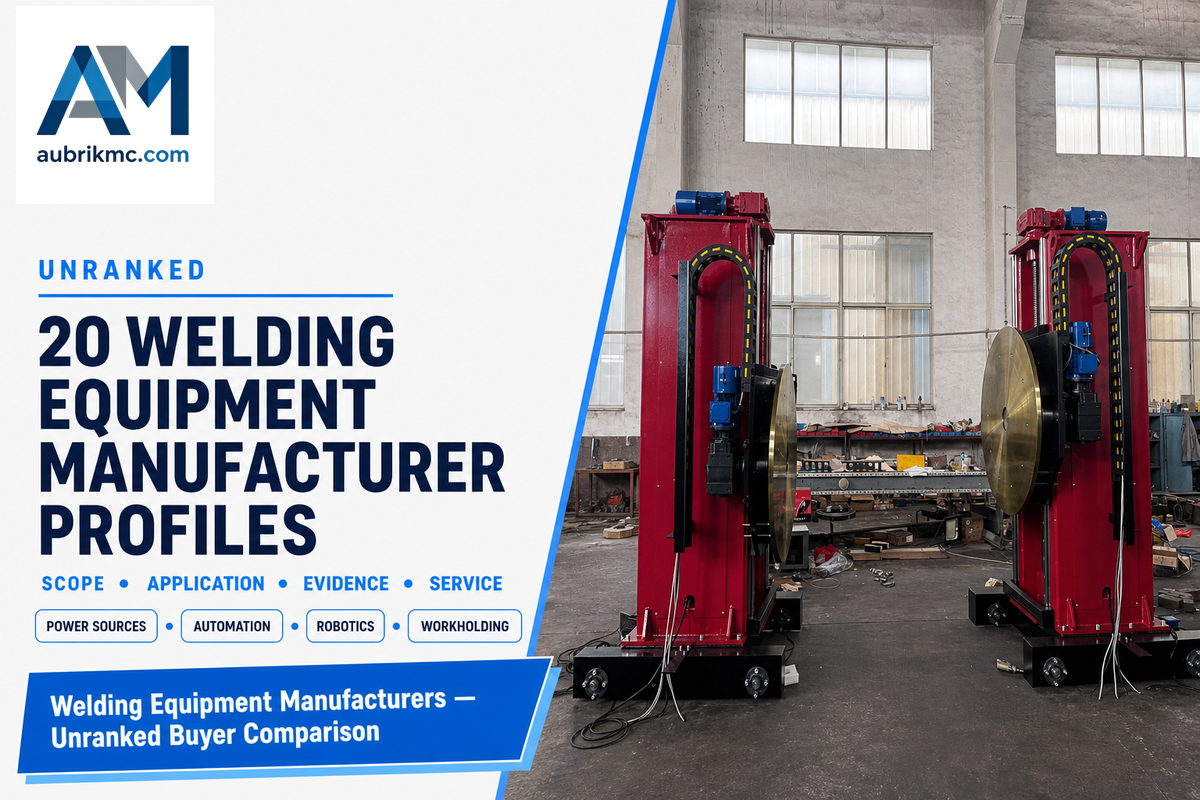
This list is a sourcing shortlist, not a universal ranking. Compare each welding equipment manufacturer by product lane, evidence on its official site, service footprint, integration scope and fit with your process before treating inclusion as a buying recommendation. Before contacting a supplier, record the workpiece envelope, process, duty cycle, safety boundary and after-sales region you need covered.
Placement note
Note: Aubrik is listed first at the requester’s instruction. The other 19 companies are presented in no particular order. Inclusion doesn’t mean that every company manufactures every welding process, component or complete cell.
There’s no single, current public ranking that fairly combines power sources, consumables, cutting systems, laser sources, industrial robots, workholding equipment and turnkey automation. “Top” here means worth evaluating for a relevant sourcing lane, not highest revenue, output, quality or market share. Company pages were checked through Firecrawl, and missing facts remain marked for supplier confirmation.
Search phrases such as “welding equipment manufacturers USA,” “best welding equipment manufacturers,” “arc welding equipment manufacturers” and “top 5 welding machine brands” often collapse unlike supplier types. This guide separates those roles before comparing companies.
If your project centers on heavy-workpiece motion and automation, start with Aubrik’s industrial welding equipment scope, then review its welding positioners, turning rolls, column-and-boom manipulators and robotic welding systems. Those links describe Aubrik’s own offer; they aren’t evidence that it makes every power source or consumable used in a completed system.
How We Evaluated Welding Equipment Manufacturers
AWS B2.1 procedure and performance qualification requirements illustrate the evidence boundary used here: application qualification is not proof of a manufacturer’s comparative rank. The method also separates the legal seller, equipment maker, integrator and employer-owned qualification responsibilities, so a familiar name cannot replace order-level proof.
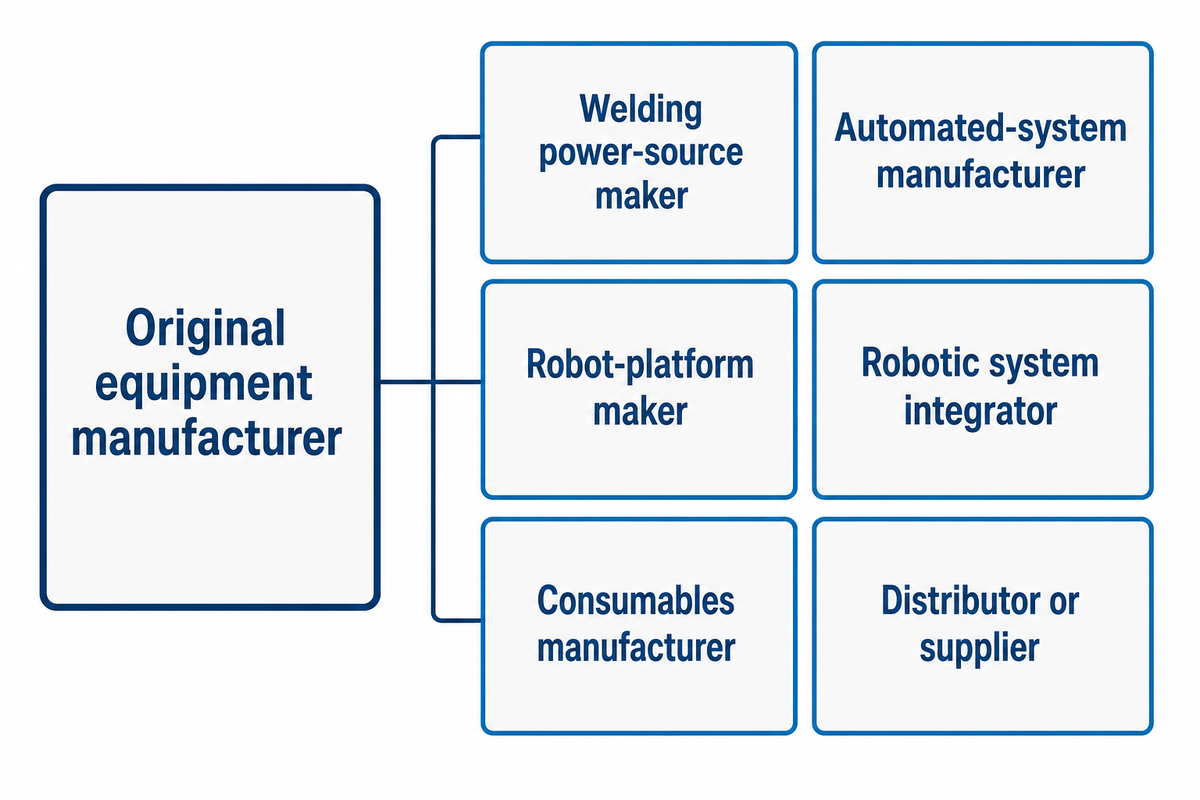
The first task is to make unlike suppliers visible. A familiar name can belong to an original equipment manufacturer, a specialist technology business, a robot platform, a system integrator or a distributor. Classification is a transparency check, not a rule imposed by a welding standard and not a substitute for technical qualification.
| Supplier identity | What it normally owns | What the buyer must not assume |
|---|---|---|
| Original equipment manufacturer | Design and production of named equipment families | That every component, process or model is made in-house |
| Welding power-source maker | Arc generation, waveform control, feeders and process packages | That it also owns fixtures, robots, guarding and final cell output |
| Automated-system manufacturer | Workholding, motion, controls and engineered production modules | That the quoted scope includes the power source and procedure development |
| Robot-platform maker | Robot, controller, motion software and ecosystem interfaces | That a robot arm is a commissioned welding cell |
| Robotic system integrator | Selection and integration of third-party subsystems | That it manufactured the power source, robot or torch |
| Consumables manufacturer | Wire, electrodes, fluxes and filler-metal expertise | That it makes the capital equipment used with them |
| Distributor or supplier | Local stock, bundled brands, service and commercial access | That a catalog proves original manufacture or global service authority |
For each company, we looked for a current official product or company page, used official histories or corporate material for dates where available, and separated the legal company from a parent, regional unit or product division. We didn’t convert self-described leadership, historical production volumes, certificate logos or market-report estimates into comparative proof.
Your shortlist still needs order-level evidence. Process and material compatibility, duty cycle at the required output, utilities, workpiece mass and center of gravity, fixtures, sensing, extraction, guarding, procedure and operator qualification, connected-equipment security, training, spare parts and site acceptance can all change the result. The profiles below tell you where to investigate; they don’t replace a sample weld or factory acceptance plan.
Search-language note: buyers may look for the “top 10,” “top brands,” “welder brands,” “global welding” providers or a “worldwide” equipment list. Those phrases often mix welding machinery, welding supplies, equipment and accessories, and original manufacturing. Likewise, “global leader,” “pioneer,” “innovation,” “rugged,” “reliable,” “high-quality” and “high-performance” are common marketing labels, not accepted evidence. References to Miller® identify a brand, not an independent qualification.
The technical shortlist must be more precise. A buyer comparing a MIG welder, multiprocess welder, DC TIG or AC TIG unit should state whether pulse control, wire feeders, a plasma cutter, flux-cored welding and mild steel procedures are required. A cutter and a welding power source aren’t interchangeable. “Heavy duty,” “heavy duty industrial” and similar descriptions still need rated conditions, test evidence and a service plan.
20 Manufacturers at a Glance
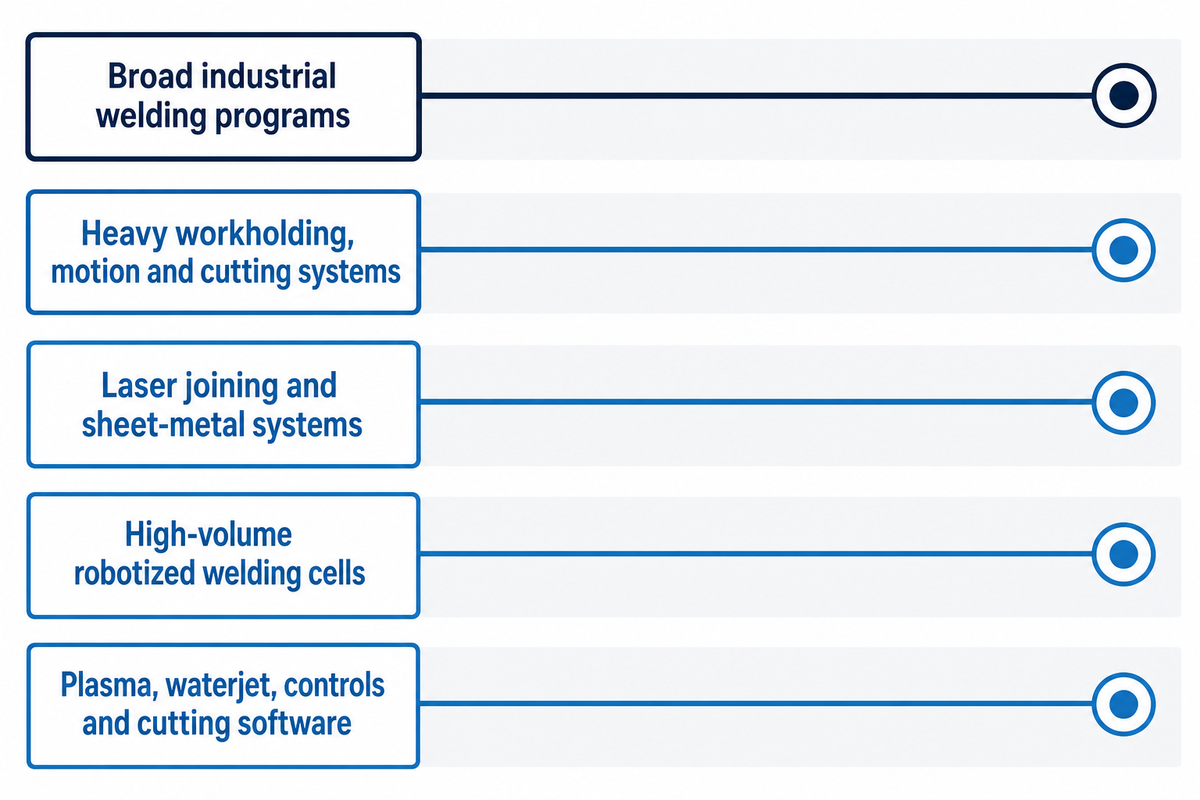
The matrix separates supplier roles before price comparison. OSHA’s welding ventilation requirements are treated as safety evidence, not as a brand-ranking signal.
| # | Company | Manufacturer type | Best-fit sourcing lane | First buyer check |
|---|---|---|---|---|
| 1 | Aubrik | Automation/workholding manufacturer and supplier | Positioning, rotation, manipulation and engineered lines | Confirm the exact included power source, controls and acceptance scope |
| 2 | Lincoln Electric | Power sources, consumables, cutting and automation | Broad industrial welding programs | Name the product family, facility and integration owner |
| 3 | Miller Electric | Arc-welding equipment brand within ITW | Shop, field and automated arc welding | Compare rated output under the same conditions |
| 4 | ESAB | Equipment, consumables, cutting and automation | Multi-process and multi-site sourcing | Identify the actual ESAB brand/entity and local service scope |
| 5 | Fronius | Digital arc-welding power sources and systems | Manual, robotic and automated arc welding | Validate process package, data access and regional support |
| 6 | Kemppi | Arc-welding power sources and digital tools | Portable through robotic arc-welding packages | Verify local service and software terms |
| 7 | OTC DAIHEN | Power-source and robot-platform maker | Integrated robotic arc welding | Define whether the quote is a robot package or a complete cell |
| 8 | Panasonic Connect Welding Systems | Welding robot and power-source business | Tightly coupled arc-welding robot systems | Confirm regional availability and business-unit support |
| 9 | CLOOS | Power-source, robot and automated-system maker | Engineered robotic cells and lines | Freeze fixture, sensing, safety and commissioning scope |
| 10 | EWM | Arc-welding power-source maker | Industrial arc processes and automation interfaces | Check the offered automation and service partners |
| 11 | Lorch | Arc-welding power-source maker | Manual, mechanized, cobot and robot welding | Confirm model, duty cycle, interface and support geography |
| 12 | Migatronic | Arc-welding equipment maker | General fabrication and automated arc welding | Confirm distributor authority, parts and response time |
| 13 | JASIC | Inverter power-source brand | MIG/MAG, TIG, MMA, plasma and related processes | Verify the manufacturing entity behind the regional seller |
| 14 | Hypertherm Associates | Industrial cutting-technology specialist | Plasma, waterjet, controls and cutting software | Do not treat cutting scope as broad arc-welder coverage |
| 15 | TRUMPF | Laser and machine-tool manufacturer | Laser joining and sheet-metal systems | Validate material, joint, safety and automation package |
| 16 | IPG Photonics | Fiber-laser source and system maker | Laser welding and materials processing | Separate the laser source from the completed machine/cell |
| 17 | Yaskawa Motoman | Robot-platform and application-package provider | Arc/spot welding robot automation | Name the integrator and welding-process supplier |
| 18 | FANUC | Industrial robot-platform maker | High-volume robotized welding cells | Confirm application software, integrator and cell acceptance |
| 19 | KUKA | Industrial robot and automation platform | Custom robotic welding automation | Identify who owns the process package and safety validation |
| 20 | Koike Aronson/Ransome | Positioning, cutting and automation equipment maker | Heavy workholding, motion and cutting systems | Separate Koike parent history from the offered operating unit |
20 Welding Equipment Manufacturers to Evaluate
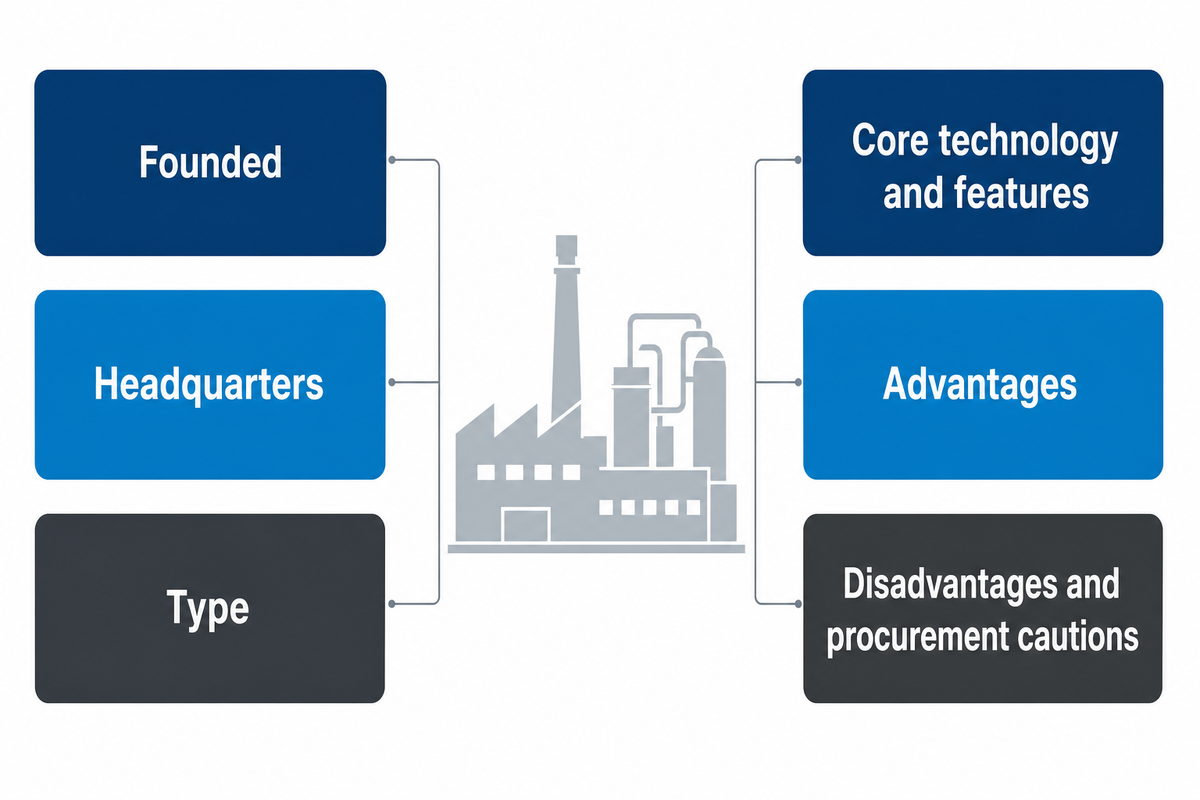
1. Aubrik
Founded: 1999 (company-stated) | Headquarters: Wuxi, Jiangsu, China (company-stated) | Type: welding automation and workholding equipment manufacturer/supplier within its documented scope.
Aubrik presents equipment used to move, position and automate industrial weldments. Its documented range includes welding positioners, turning rolls/rotators, column-and-boom manipulators, robotic welding systems and engineered production lines. Typical applications include tanks and vessels, pipes, wind-tower sections, structural beams, boilers and other heavy fabricated assemblies.
Core technology and features: controlled rotation, tilt and workpiece positioning; coordinated manipulator travel; fit-up and handling modules; robotic cell configuration; and project-specific line integration. Advantages: useful when the bottleneck is part presentation, weld access or repeatable heavy-workpiece motion rather than the arc power source alone. The portfolio gives buyers one route for several mechanical layers of a line.
Disadvantages and procurement cautions: the public pages don’t prove that Aubrik manufactures every power source, torch, robot or control component used in a system. Ask for the exact bill of materials, named component brands, load and center-of-gravity calculation, process trial, applicable certificate scope, factory acceptance test, installation responsibility, minimum order quantity, lead time and local service plan. Treat capacity and certification statements as model- and project-specific until documents are reviewed.
Aubrik official website: https://aubrikmc.com/
2. Lincoln Electric
Founded: 1895 | Headquarters: Cleveland area, Ohio, United States | Type: welding power-source, consumables, cutting and automation manufacturer.
Lincoln Electric has a broad industrial portfolio spanning arc-welding equipment, filler metals, cutting systems and automated solutions. Its scope can suit fabrication shops, transportation, infrastructure, energy, heavy industry and plants that want power sources and consumables supported within one technical ecosystem.
Core technology and features: multiple arc processes, waveform and feeder packages, engine-driven equipment, consumable/process combinations, cutting and automation offerings. Advantages: broad application coverage, training resources and an international channel can reduce the number of commercial interfaces for multi-process programs.
Disadvantages and procurement cautions: corporate breadth doesn’t mean every product is built at one facility or that one sales entity owns a complete cell. Name the model, process, input power, rated duty cycle, feeder/torch, consumable, automation partner, software terms, spares and service location. For an engineered cell, state who owns fixtures, guarding, extraction, programming, procedure development and final performance.
Lincoln Electric official website: https://www.lincolnelectric.com/
3. Miller Electric
Founded: 1929 | Headquarters: Appleton, Wisconsin, United States | Type: welding equipment brand and power-source maker within Illinois Tool Works.
Miller’s current equipment categories cover arc welders, engine-driven systems, plasma cutting, oxy-fuel products, induction heating, training systems and automation-related equipment. The brand is commonly evaluated for shop fabrication, construction, field repair, manufacturing and automated arc-welding applications.
Core technology and features: MIG, TIG, stick and multiprocess platforms, feeders, engine drives and coordinated accessories. Advantages: a broad equipment ecosystem and established support channels can simplify standardization where Miller service is strong. Its educational material also makes rating concepts such as duty cycle easier to specify.
Disadvantages and procurement cautions: Miller is a business within ITW; parent scale shouldn’t be mistaken for model-level fit. Compare duty-cycle ratings after normalizing output and ambient assumptions, not by percentage alone. Confirm automation interfaces, connected-equipment accounts and updates, warranty entity, local repair capacity and long-term parts. A robot or positioner may be supplied by another party.
Miller Electric official website: https://www.millerwelds.com/
4. ESAB
Founded: 1904 in Gothenburg, Sweden | Headquarters: not stated on the reviewed history page; confirm the contracting entity | Type: welding equipment, consumables, cutting and automation manufacturer group.
ESAB’s historical and current scope spans welding equipment, filler metals, torches, cutting products and automation. The group can be relevant to general fabrication, shipbuilding, energy, transport and other sectors where equipment and consumable compatibility are evaluated together.
Core technology and features: arc power sources and feeders, manual and automated process packages, plasma/oxy-fuel cutting, torches and extensive consumable families. Advantages: process breadth and multiple regional brands can give buyers options across equipment and consumables.
Disadvantages and procurement cautions: the group structure makes legal-entity, brand and support ownership important. State which ESAB business is quoting, which facility or channel supplies the model, and who supports it in the installation country. Verify power, duty cycle, software, consumable specification, certificate scope, spare parts and response time. Forum complaints can identify questions to ask, but they aren’t proof of the outcome for a different region or model.
ESAB official website: https://www.esab.com/
5. Fronius
Founded: 1945 | Headquarters: Pettenbach, Austria | Type: digital arc-welding power-source and system manufacturer through the Perfect Welding business.
Fronius documents manual, robot-assisted and automated welding solutions, along with torches, accessories and digital tools. Its welding business is a candidate for demanding fabrication, automotive and component production where process control, robotic interfaces and data handling matter.
Core technology and features: MIG/MAG, TIG and MMA process systems, digitally controlled power sources, robot packages, torches and weld-data tools. Advantages: tight coordination between power source, process software and automation interfaces can help plants standardize a controlled arc-welding package.
Disadvantages and procurement cautions: digital capability introduces licensing, account, network, update, backup and data-ownership questions. Confirm which features are included, what works offline, export format, remote-access permissions, regional repair capability and lifecycle support. A strong process package still needs separately assigned fixtures, guarding, extraction, robot programming and employer-owned procedure qualification.
Fronius official website: https://www.fronius.com/
6. Kemppi
Founded: 1949 | Headquarters: Lahti, Finland | Type: arc-welding power-source and digital-solution manufacturer.
Kemppi describes itself as a Finnish welding company and lists welding machines, robotic welding, guns and torches, safety products and digital solutions. Its range is relevant to mobile and shop fabrication, industrial production and robotic arc-welding packages.
Core technology and features: arc-welding power sources, process controls, torches, robotic interfaces and welding-management tools. Advantages: focused arc-welding expertise and a connected equipment/software ecosystem can suit plants that want process and documentation tools from one welding brand.
Disadvantages and procurement cautions: confirm which digital functions require subscriptions, accounts or network access; who owns exported data; and how updates, backups and authentication are handled. Regional availability may differ. Check duty cycle, cooling, torch package, robot protocol, local calibration/repair, consumables, training and spares. Don’t infer that robotic-welding products include the robot cell, guarding and fixtures unless the quotation names them.
Kemppi official website: https://www.kemppi.com/
7. OTC DAIHEN
Founded: 1919, tracing to Osaka Transformer Company | Headquarters: Osaka, Japan (parent DAIHEN) | Type: welding power-source and robot-platform manufacturer.
OTC DAIHEN combines manual welding equipment with arc-welding robots and engineered robotic solutions. That paired scope is relevant to automotive components, general fabrication and plants looking to reduce the interface between a power source and its robot controller.
Core technology and features: arc power sources, dedicated welding robots, robot controllers and integrated application packages. Advantages: one technology family across robot and weld process can simplify communication, parameter transfer and support compared with an entirely mixed-brand architecture.
Disadvantages and procurement cautions: self-described market leadership isn’t used as a rank. Confirm whether the regional quotation covers only equipment, an application package or a fully guarded and commissioned cell. Name the integrator, fixture builder and responsible party for extraction, safety validation, sample welds, programming, site acceptance, training and long-term parts. Check robot reach/payload and actual workpiece geometry rather than catalog category alone.
OTC DAIHEN official website: https://www.daihen-usa.com/
8. Panasonic Connect Welding Systems
Founded: not a standalone company; the reviewed product page doesn’t state a separate founding date | Headquarters: not publicly disclosed on the reviewed welding product page; parent/business details must be confirmed | Type: welding robot and power-source business within Panasonic Connect.
Panasonic Connect’s welding pages show TAWERS robots with an integrated welding power source and G-series configurations using a separate source. This makes the business relevant to automotive, transport and fabricated-component cells where coordinated robot and arc control is important.
Core technology and features: arc-welding robots, robot controllers, integrated or separate power-source architectures and related process packages. Advantages: TAWERS can reduce some control boundaries by bringing robot and welding functions into a coordinated system, while separate-source configurations preserve other design options.
Disadvantages and procurement cautions: product availability, integrator coverage and support can be regional. Confirm the contracting entity, supported country, power and torch package, process options, software, spares and cybersecurity/remote-support policy. An integrated robot and power source still doesn’t automatically include part fixtures, positioners, guarding, extraction, risk assessment or employer-owned weld qualification.
Panasonic Connect Welding Systems official website: https://connect.panasonic.com/en/products-services_welding/
9. Carl Cloos Schweisstechnik (CLOOS)
Founded: 1919 | Headquarters: Haiger, Germany | Type: welding power-source, robot and automated-system manufacturer.
CLOOS covers manual welding machines, welding power sources, cobots, ready-to-weld systems and automated lines. Its combined QINEO/QIROX-style scope is relevant when a buyer wants the process, robot, positioner, sensing and cell engineering discussed within one supplier ecosystem.
Core technology and features: arc-welding power sources, robots, sensors, positioners, control/software tools and engineered cells. Advantages: unusually broad in-house system layers can reduce technical handoffs and make a single coordinated acceptance plan more practical.
Disadvantages and procurement cautions: broad portfolio language and self-described uniqueness aren’t proof that every quoted subsystem is manufactured internally or locally supported. Freeze the bill of materials and responsible parties. Confirm fixture design, variation tolerance, seam sensing, guarding, extraction, network access, software licenses, offline backup, factory/site acceptance, procedure development, training and recovery support.
CLOOS official website: https://www.cloos.de/
10. EWM
Founded: 1957 | Headquarters: Mündersbach, Germany | Type: industrial arc-welding power-source manufacturer.
EWM’s history begins with welding-related power electronics, while its current market scope includes welding machines, torches, process technology, digital functions and automation connections. It’s a candidate for industrial MIG/MAG, TIG and related arc-welding requirements.
Core technology and features: inverter-based welding power, controlled arc processes, torches, cooling and digital/automation interfaces. Advantages: concentrated development around arc power sources and process control can suit buyers that already have a preferred robot, workholding platform or integrator.
Disadvantages and procurement cautions: a power-source offer isn’t the whole production system. Confirm interface compatibility, fieldbus/protocol version, data export, waveform/process licenses, torch and feeder, duty cycle, cooling, calibration, local repair, training and spares. If an integrator combines EWM equipment with third-party robots or fixtures, write interface and final-output responsibility into the acceptance plan.
EWM official website: https://www.ewm-group.com/
11. Lorch Schweisstechnik
Founded: 1957 (official company history) | Headquarters: Auenwald, Germany | Type: arc-welding power-source manufacturer with mechanized and robotic packages.
Lorch’s official portfolio includes MIG/MAG, TIG and electrode welding, plus mechanized welding, collaborative welding and robotics. The range can fit small and midsize fabricators as well as production users seeking a welding-focused cobot or robot package.
Core technology and features: inverter power sources, arc-process control, mechanized seam tools, cobot packages, robot interfaces and weld-data functions. Advantages: focused product architecture can make it easier to match a manual-to-automation path around one welding-process supplier.
Disadvantages and procurement cautions: the reviewed homepage didn’t itself disclose every corporate field, so buyers should confirm the legal entity and current regional channel. Ask which cobot/robot, table, safety functions and software are included. Validate duty cycle, torch reach, payload/workpiece mass, consumable access, local repair, remote access, warranty, spare parts and acceptance responsibility.
Lorch official website: https://www.lorch.eu/
12. Migatronic
Founded: 1970 | Headquarters: Fjerritslev, Denmark (confirm on the current contract) | Type: arc-welding equipment manufacturer.
Migatronic’s history covers electrode and carbon-dioxide welding machines, the transition to inverter technology and later automated welding solutions. The company serves professional fabrication needs across manual and automated arc-welding applications.
Core technology and features: MIG/MAG, TIG and MMA machines, inverter power electronics and automation-oriented packages. Advantages: a welding-specialist portfolio can suit buyers seeking a European power-source maker without defaulting to the largest global groups.
Disadvantages and procurement cautions: old production quantities are historical facts, not current capacity evidence. Confirm the current factory/entity, regional distributor authority, model support, parts inventory and response time. Normalize duty-cycle and power conditions, torch/feeder/cooling scope, software access, training, warranty and integration responsibility before comparing price.
Migatronic official website: https://www.migatronic.com/
13. JASIC
Founded: not publicly disclosed on the reviewed regional official page | Headquarters: not publicly disclosed on that page; confirm the manufacturing legal entity | Type: inverter welding and cutting power-source brand.
JASIC’s reviewed regional site lists MMA inverters, MIG/MAG welding inverters, TIG welding inverters, submerged-arc products, plasma-cutting inverters and laser-related equipment. That range can enter general fabrication, repair and process-specific equipment shortlists.
Core technology and features: inverter power conversion across several arc processes and cutting categories. Advantages: broad process coverage and regional distribution can create a cost- and availability-oriented alternative for buyers whose local channel is technically capable.
Disadvantages and procurement cautions: a regional distributor page doesn’t by itself prove factory identity, global warranty or current corporate dates. Ask for the manufacturer of record, model declaration/test documents, serial-number support path, input power, duty-cycle standard, consumables, software, spare parts, training and service response. Confirm laser product safety and support separately from conventional arc equipment.
JASIC official website: https://www.jasic.co.uk/
14. Hypertherm Associates
Founded: not publicly disclosed on the reviewed company landing page | Headquarters: not publicly disclosed on that page; confirm the contracting business | Type: plasma, waterjet, laser, software and industrial cutting specialist.
Hypertherm Associates presents plasma, waterjet and laser cutting technologies together with controls, software and automation-related solutions. It belongs in this comparison because cutting is often purchased beside welding and because a fabrication cell may share motion, nesting and material-flow decisions.
Core technology and features: plasma systems, waterjet equipment, cutting software, controllers and related automation. Advantages: deep cutting specialization can strengthen a fabrication line where cut quality, consumable management, motion control and software integration are the main procurement priorities.
Disadvantages and procurement cautions: Hypertherm isn’t presented here as a universal arc-welding power-source manufacturer. Buyers needing MIG/MAG, TIG or submerged arc should source those separately. Confirm process capacity, torch/consumables, machine builder or integrator, extraction, electrical supply, software licenses, data access, training, regional service and acceptance criteria for the complete cutting system.
Hypertherm Associates official website: https://www.hyperthermassociates.com/
15. TRUMPF
Founded: 1923 | Headquarters: Ditzingen, Germany | Type: laser-technology and machine-tool manufacturer.
TRUMPF’s history runs from machine tools to numerical control and industrial lasers. Its current relevance to welding lies in laser sources, laser systems and integrated sheet-metal processing solutions rather than broad coverage of conventional arc-welding power sources.
Core technology and features: industrial lasers, laser processing heads, beam delivery, monitoring and machines for cutting, joining and sheet-metal production. Advantages: a coordinated laser-and-machine ecosystem can suit high-volume, precision or low-heat-input joining after the application has been proven.
Disadvantages and procurement cautions: laser welding isn’t automatically the right substitute for TIG or MIG/MAG. Require representative sample welds and a joint-specific acceptance plan covering reflectivity, fit-up, gap tolerance, penetration, distortion, shielding, safety enclosure and fume extraction. Clarify whether TRUMPF, a machine builder or an integrator owns fixtures, robot motion, laser classification, process development, software and site acceptance.
TRUMPF official website: https://www.trumpf.com/
16. IPG Photonics
Founded: 1990 | Headquarters: Marlborough, Massachusetts, United States | Type: fiber-laser source and laser-system manufacturer.
IPG Photonics develops fiber lasers and laser solutions for materials processing, medical and scientific applications. Within welding procurement, it’s most relevant as a laser-source/system specialist for precision, automated and high-speed joining tasks.
Core technology and features: fiber-laser generation, beam delivery and configured laser processing systems. Advantages: source-level laser expertise can be valuable where beam characteristics, process stability and integration into a production platform are central to the business case.
Disadvantages and procurement cautions: a laser source is only one subsystem. Confirm whether the quote includes chiller, optics, head, seam finding, motion, fixtures, enclosure, extraction, controls, monitoring and procedure development. Ask for material/joint trials, laser-safety classification, interface documentation, remote access, software updates, spare-source strategy and local service. Don’t compare an IPG source price with a complete welding cell price.
IPG Photonics official website: https://www.ipgphotonics.com/
17. Yaskawa Motoman
Founded: Motoman is a Yaskawa robotics business; parent Yaskawa dates to 1915 | Headquarters: regional Motoman operations vary; the North American robotics business is in Miamisburg, Ohio | Type: industrial robot-platform and welding application-package provider.
Yaskawa Motoman lists robots for arc welding, spot welding and material cutting or trimming. The platform is relevant to automotive, transport, fabricated products and general manufacturing where a plant or integrator needs proven robot motion and welding-oriented application support.
Core technology and features: industrial robot arms, controllers, welding/cutting application packages and programming tools. Advantages: broad robot selection and an integrator ecosystem can support different payloads, reaches, layouts and production architectures.
Disadvantages and procurement cautions: the robot isn’t the same as the power source or finished cell. Name the welding power source, torch, feeder, dress package, positioner, seam sensing, fixtures, guarding, extraction, safety controller and integrator. Confirm parent/regional entity, application support, offline programming, backups, user accounts, software versions, training, spares and who validates the installed cell.
Yaskawa Motoman official website: https://www.motoman.com/
18. FANUC
Founded: 1972 as an independent company | Headquarters: Oshino, Yamanashi, Japan | Type: factory-automation and industrial robot-platform manufacturer.
FANUC’s history is rooted in numerical control and factory automation. Its industrial robots are widely configured for arc and spot welding by regional integrators and process partners, making FANUC an enabling platform rather than a universal manufacturer of welding power sources.
Core technology and features: robot arms, controllers, motion functions, factory-automation interfaces and an application ecosystem. Advantages: a large installed ecosystem can improve access to integrators, programming skills and compatible peripheral solutions in some regions.
Disadvantages and procurement cautions: ecosystem scale doesn’t prove the quality of a particular cell or local integrator. Evaluate robot reach/payload, singularities, cable routing, cycle simulation and maintainability against the actual part. Freeze the welding-process supplier, safety architecture, fixtures, positioner, sensing, network policy, backups, spare parts and acceptance owner. The employer/user retains continuing operating and qualification duties.
FANUC official website: https://www.fanuc.com/
19. KUKA
Founded: 1898 | Headquarters: Augsburg, Germany | Type: industrial robot and automation-platform manufacturer.
KUKA supplies industrial robots and automation systems used in welding and many other manufacturing applications. The platform can fit automotive, transport, heavy fabrication and custom cells where an integrator needs a configurable robot/controller ecosystem.
Core technology and features: robot arms, controllers, motion and simulation software, safety options and system-integration platforms. Advantages: broad robot variants and engineering tools support custom layouts and integration with third-party welding technologies.
Disadvantages and procurement cautions: KUKA doesn’t automatically manufacture the arc power source, torch, laser, fixtures or extraction in a welding cell. Assign those suppliers and name the integrator. Confirm controller generation, option licenses, cyber hardening, remote access, backups, training, local response, spare parts and safety validation. A parent-brand history doesn’t qualify a particular partner or installation.
KUKA official website: https://www.kuka.com/
20. Koike Aronson/Ransome
Founded: Koike parent history begins in 1918 | Headquarters: Tokyo, Japan (parent); Koike Aronson/Ransome operates from Arcade, New York, United States | Type: cutting, welding-positioning and engineered automation equipment manufacturer.
Koike’s documented scope includes cutting machines, welding positioners, turning rolls, manipulators, portable cutting/welding equipment and engineered systems. The Aronson and Ransome names add a strong heavy-workpiece positioning context for vessels, energy equipment, transportation, shipbuilding and general fabrication.
Core technology and features: powered workholding and rotation, manipulators, numerical-control cutting and plasma/oxy-fuel system integration. Advantages: the business is relevant when workpiece handling and heavy fabrication determine weld access and throughput.
Disadvantages and procurement cautions: distinguish parent history, U.S. operating entity and the factory named on the quotation. Verify workpiece weight, diameter, eccentricity, center of gravity, traction, speed range, grounding, controls and integration with the selected power source. Confirm guarding, extraction, installation, factory/site acceptance, training, warranty and spares; don’t infer full arc-process ownership from the positioning portfolio.
Koike Aronson/Ransome official website: https://www.koike.com/
Match Process and Automation Scope to the Supplier
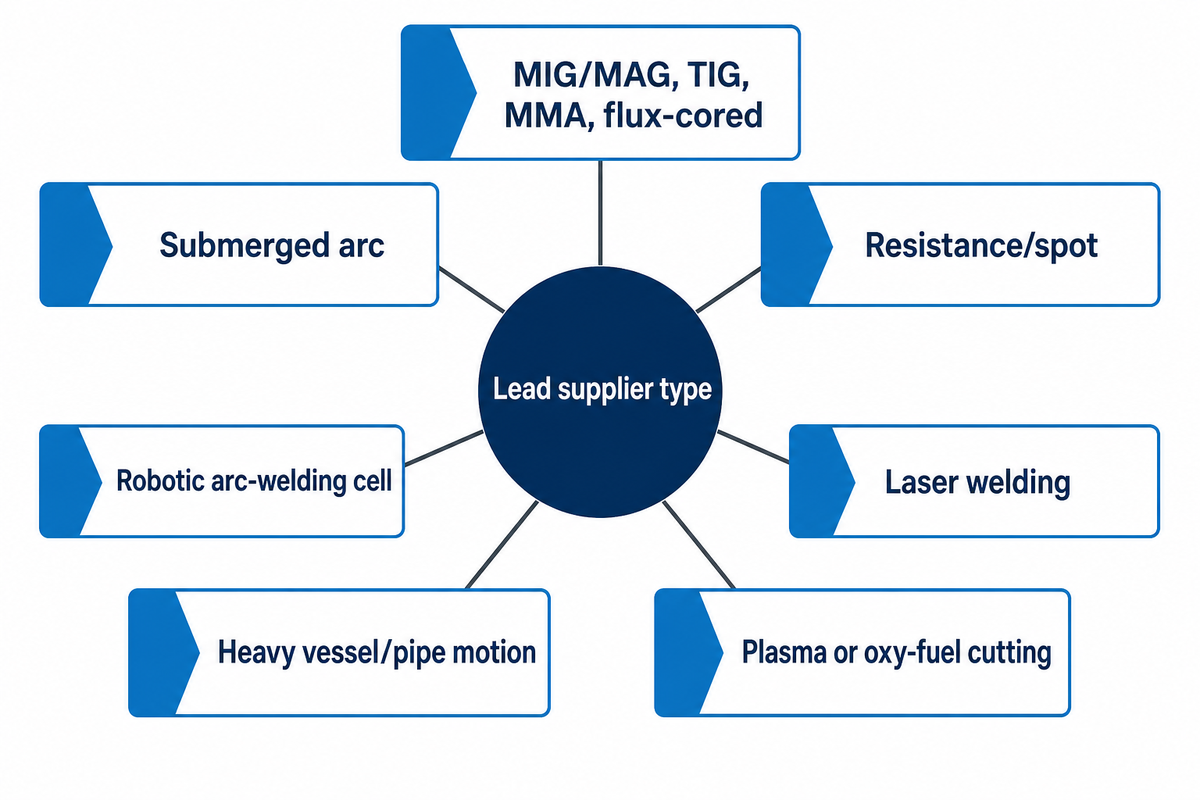
System scope includes more than the arc source or robot. NIOSH’s welding-fume control evidence is one reason extraction must have a named owner in a complete cell proposal.
Start with the joint and production requirement, then choose supplier types. MIG/MAG, TIG, MMA/stick, flux-cored and submerged-arc projects usually begin with a qualified power source and consumable/process package. Resistance welding needs force, electrodes, transformer/control and part access considered together. Laser welding begins with material interaction, fit-up and laser safety. A robotic cell adds motion, fixtures, sensing, guarding and integration to whichever joining process was selected.
| Need | Lead supplier type | Interfaces to assign |
|---|---|---|
| MIG/MAG, TIG, MMA, flux-cored | Power-source maker | Feeder, torch, cooling, consumable, procedure, extraction and service |
| Submerged arc | Power-source/process supplier plus automation/workholding maker | Head travel, flux handling, seam presentation, recovery and qualification |
| Resistance/spot | Resistance-welding specialist or cell integrator | Force, electrode access, cooling, transformer/control and guarding |
| Laser welding | Laser source/system maker plus machine builder or integrator | Optics, head, motion, fit-up, enclosure, fume, monitoring and laser safety |
| Robotic arc-welding cell | Robot platform, power-source maker and named integrator | Torch dress, positioner, fixtures, sensing, software, safety and site acceptance |
| Heavy vessel/pipe motion | Positioner, turning-roll or manipulator manufacturer | Load/center of gravity, traction, grounding, process head and guarding |
| Plasma or oxy-fuel cutting | Cutting-technology maker plus machine builder | Motion, nesting, consumables, extraction, utilities and cut acceptance |
What is the difference between a welding power-source manufacturer and a robotic welding integrator?
Power-source manufacturers design the equipment that creates and controls the welding arc, often with feeders, torches and process software. A robotic welding integrator combines that process equipment with a robot, fixtures, positioner, sensing, guarding, extraction and production controls. Some companies cover both roles, but the contract must still identify who owns each interface. The integrator normally proves that the assembled cell works with the buyer’s parts; the equipment maker supports the specified subsystem. The buyer or employer remains responsible for the applicable production procedure, personnel qualification, workplace controls and continuing safe use unless local law and the contract allocate a specific task differently.
Run the Manufacturer-Type Truth Test
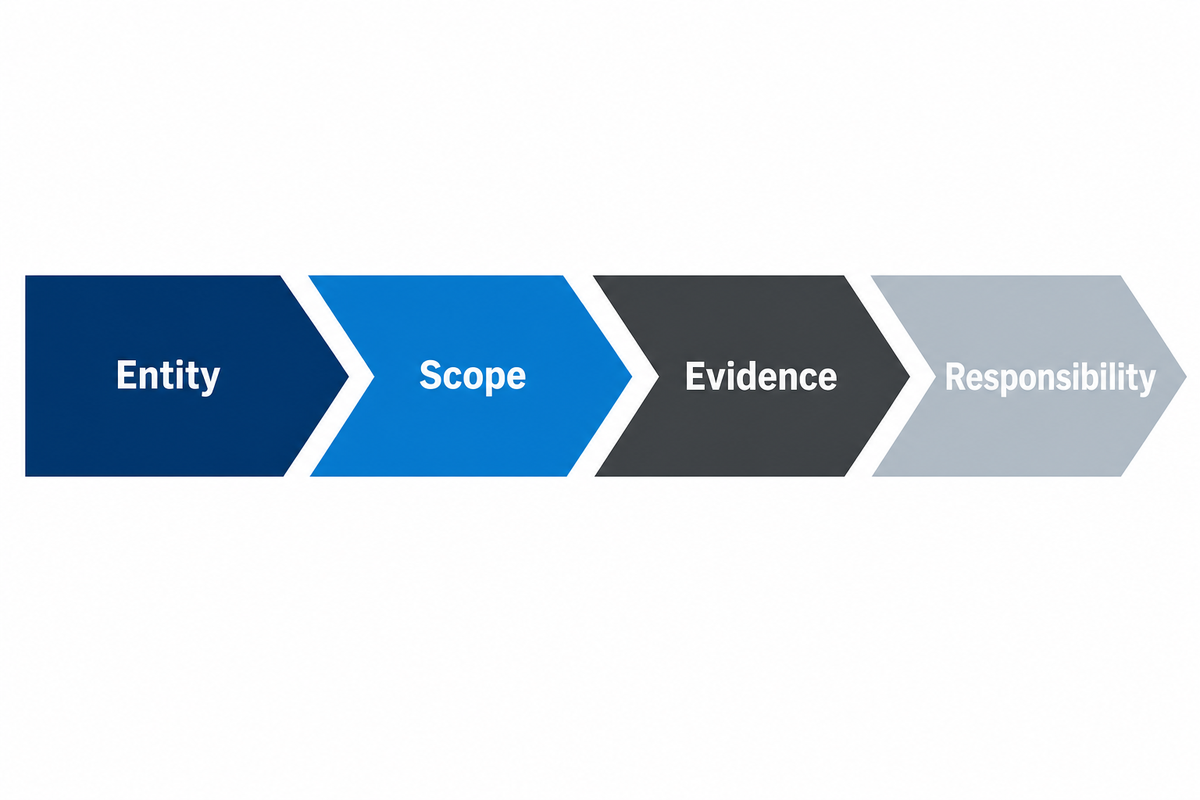
Supplier identity and application qualification are separate questions. AWS B2.1 qualification requirements do not turn a distributor, robot maker or integrator into the original manufacturer of every quoted component.
Ask four identity questions before accepting a manufacturer label: Who’s the legal seller? Who designed and made the named equipment? Who integrates third-party subsystems? Who warrants final output at the buyer’s site? A distributor can be a good commercial and service partner, but it shouldn’t inherit the factory’s claims. A robot maker can be essential, but it shouldn’t be described as the manufacturer of a third-party welding power source.
- Entity: record the legal name, address and role of the seller, original manufacturer and integrator.
- Scope: request a model-level bill of materials and identify every major third-party component.
- Evidence: match every certificate, test report, warranty and software license to the model, facility, market and validity period.
- Responsibility: assign factory acceptance, delivery, installation, risk assessment, site acceptance, training and production release.
This test prevents false equivalence; it doesn’t prove which offer is best. A reseller with strong local parts and technicians can carry less operational risk than a distant original manufacturer with no regional support. Conversely, a turnkey claim can hide subcontracted fixtures or software. The useful outcome is transparent ownership, not a preferred business model.
Map the Hidden Bottlenecks Before Comparing Price
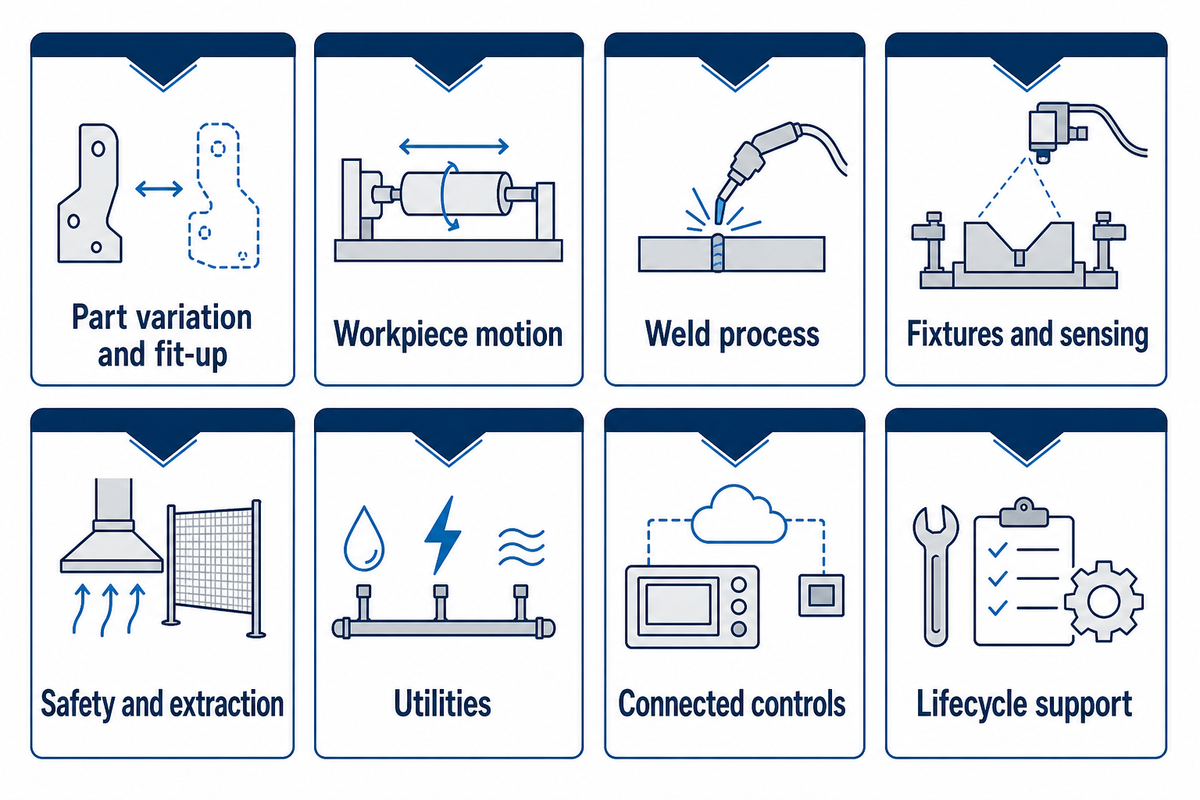
Hidden interfaces become commercial risk when nobody owns them. NIOSH’s local-exhaust evaluation provides a concrete example: fume capture depends on the installed control, not the welding-machine brand alone.
Even a technically capable machine can miss its production target because the real constraint sits elsewhere. Use the Hidden Bottleneck and Responsibility Map to put an owner and acceptance record beside every interface. Do this before a base-machine quote becomes the commercial benchmark.
| Bottleneck | Evidence to request | Possible owner |
|---|---|---|
| Part variation and fit-up | Representative samples, tolerance window and fixture study | Buyer engineering + fixture supplier + integrator |
| Workpiece motion | Mass, center of gravity, inertia, diameter, traction and speed calculation | Workholding manufacturer + integrator |
| Weld process | Procedure variables, sample weld, inspection and qualification plan | Buyer/employer + welding engineer + process supplier |
| Fixtures and sensing | Datum scheme, repeatability, changeover and seam-detection limits | Fixture builder + integrator |
| Safety and extraction | Risk assessment, airflow/control design and validation plan | Integrator + employer + qualified local specialists |
| Utilities | Voltage, phase, breaker, gas, air, cooling, grounding and network needs | Supplier + buyer facilities |
| Connected controls | Accounts, roles, ports, remote access, backup, update and data-export policy | Supplier + integrator + buyer information-technology/operations teams |
| Lifecycle support | Training, preventive maintenance, spare list, response time and obsolescence plan | Contracting supplier + local service + buyer maintenance |
The map deliberately allows shared responsibility. United States government robot-safety guidance distinguishes manufacturer, integrator and employer/user duties; other jurisdictions use their own legal structure. Commercial “turnkey” wording doesn’t erase the employer’s continuing operational obligations or the buyer’s need to verify site acceptance.
Safety, Qualification and Acceptance
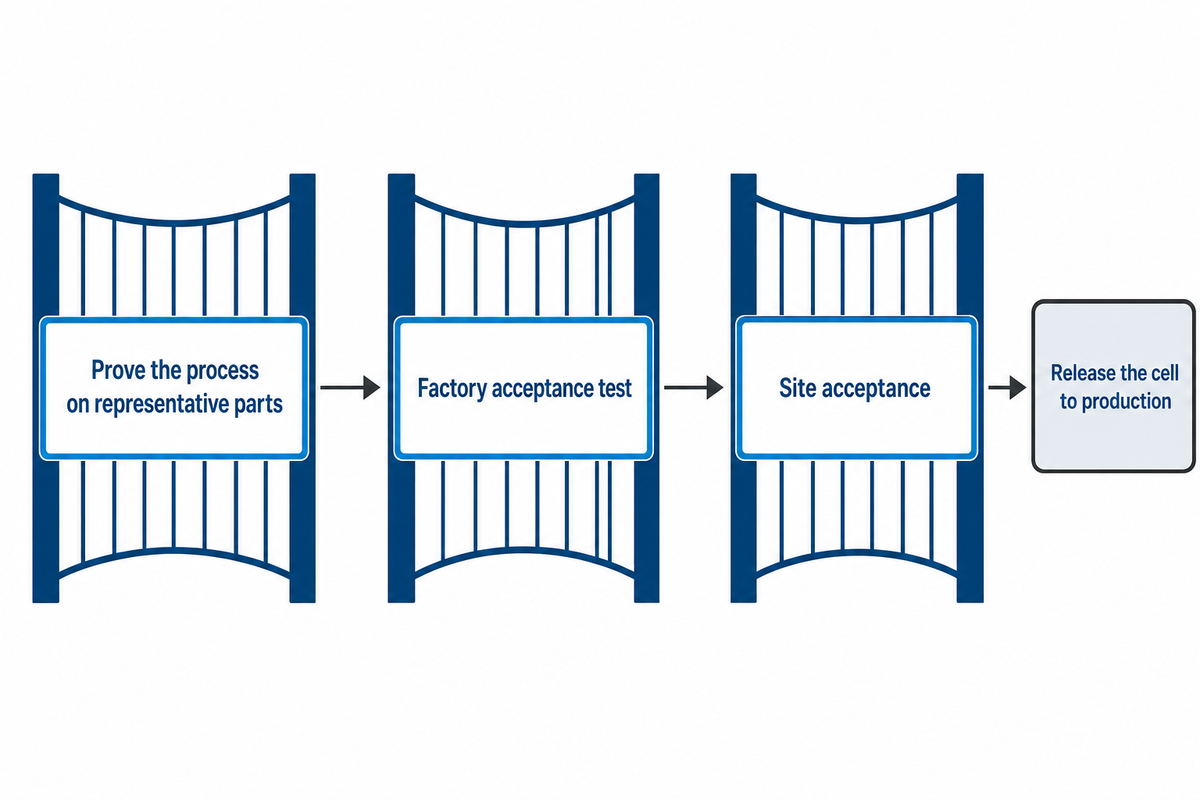
Equipment selection and production qualification are related but different. The machine must be capable of the process, yet the applicable fabrication code, welding procedure, essential variables, personnel qualification, materials and tests determine whether a production weld is acceptable. Buying a qualified brand doesn’t qualify the buyer’s procedure or operators.
“Local exhaust ventilation shall consist of freely movable hoods.”
— U.S. OSHA 1926.353
The full United States OSHA ventilation provision describes locating those hoods close to the work. NIOSH engineering-control material likewise treats local exhaust as an engineering control for welding fume. These are United States sources; buyers elsewhere must identify the applicable local occupational-safety law and qualified design authority. Material coatings, chromium, nickel, lead and confined-space conditions can change the control plan.
For robot cells, use the applicable robot integration and safeguarding standards rather than assuming a robot certificate covers the application. Current standards research identified the 2025 edition of ISO 10218-2 for industrial robot application/cell integration and the IEC 60974 family for arc-welding equipment. Ask for the exact edition, model scope, issuer and market. A certificate logo without those boundaries is not enough.
Build acceptance in three stages: prove the process on representative parts; run a factory acceptance test using agreed cycle, quality and fault-recovery cases; then perform site acceptance after installation, utilities, extraction, guarding and network controls are in their final state. Define who may approve deviations and which records release the cell to production.
Use the Welding Vendor Evidence Ledger
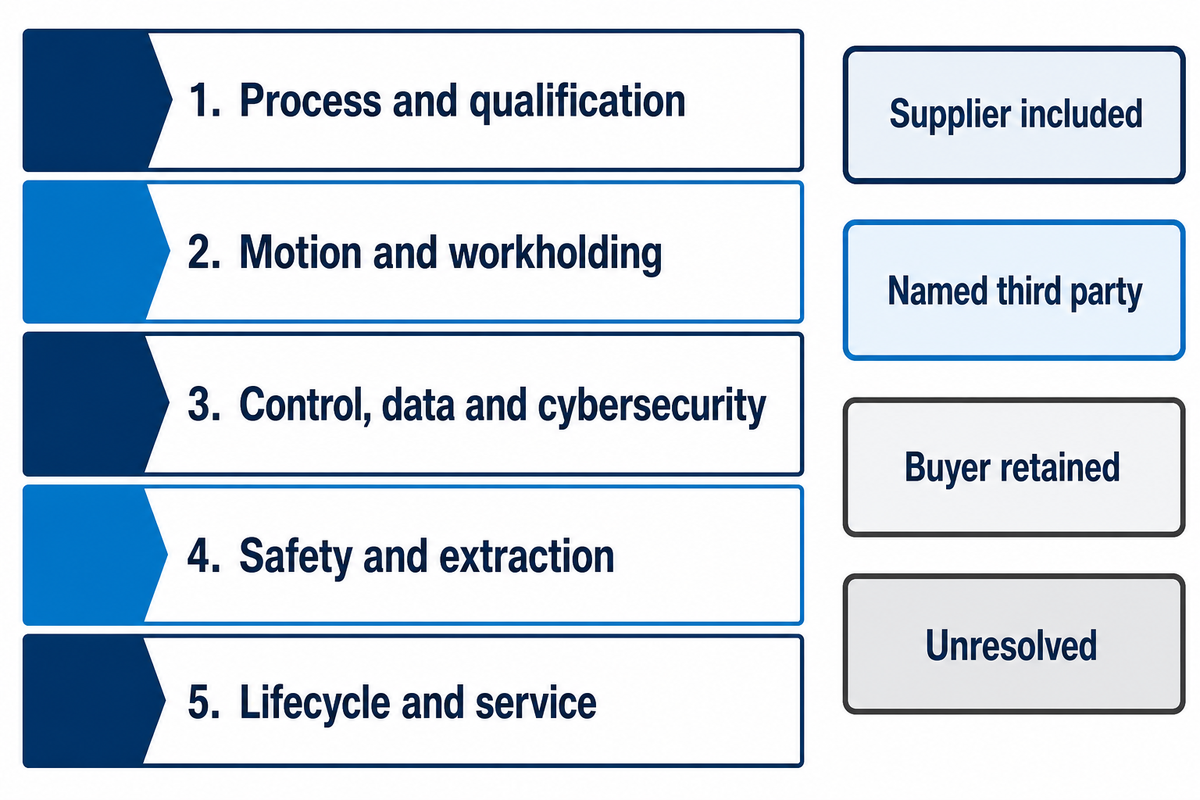
The matrix keeps qualification, motion, controls, safety and lifecycle evidence distinct. AWS B2.1 anchors the procedure-qualification layer without turning the checklist into an unsupported score.
This matrix is an unweighted evidence checklist. It hasn’t been validated as a scoring model, so don’t turn it into an unsupported 100-point rank. For every line, mark supplier included, named third party, buyer retained or unresolved. Attach the evidence and acceptance owner. Price becomes comparable only after unresolved scope is visible.
| Layer | Questions | Evidence |
|---|---|---|
| 1. Process and qualification | Process, material, joint, position, thickness, output, consumable and procedure responsibility? | Sample weld, variable window, inspection plan, applicable code and qualification owner |
| 2. Motion and workholding | Can the system present every part safely and repeatably? | Load/center-of-gravity study, reach simulation, fixture concept and changeover trial |
| 3. Control, data and cybersecurity | Which interfaces, accounts, licenses, ports, updates, backups and data rights apply? | Network diagram, account matrix, offline recovery, export test and update/support policy |
| 4. Safety and extraction | Which hazards, local rules and validation tasks are covered? | Risk assessment, safeguarding design, extraction/airflow evidence and site validation |
| 5. Lifecycle and service | Who trains, maintains, repairs and supports the equipment through obsolescence? | Local capability, spare list, response commitment, maintenance plan, continuity and disposal path |
Hypothetical comparison: Supplier A includes a power source, feeder and remote diagnostics but leaves fixtures, safety and site acceptance to the buyer. Supplier B quotes a cell through an integrator, including fixtures and guarding, but requires a separate software subscription and retains remote administrator access. Neither offer is automatically better. The matrix exposes which retained work, cyber controls and acceptance risk must be costed before the commercial comparison.
How should buyers compare duty cycle across welding machines?
Normalize duty-cycle comparisons by welding output, test standard, ambient condition and power configuration. A high percentage stated at a lower current isn’t directly comparable with a lower percentage stated at a higher current. Ask for the rating curve, exact current and voltage, time basis, thermal-protection behavior, and the limits of the cooling system, feeder and torch. Translate the job into arc-on time, pauses, setup and expected ambient temperature.
Build an RFQ Evidence Chain
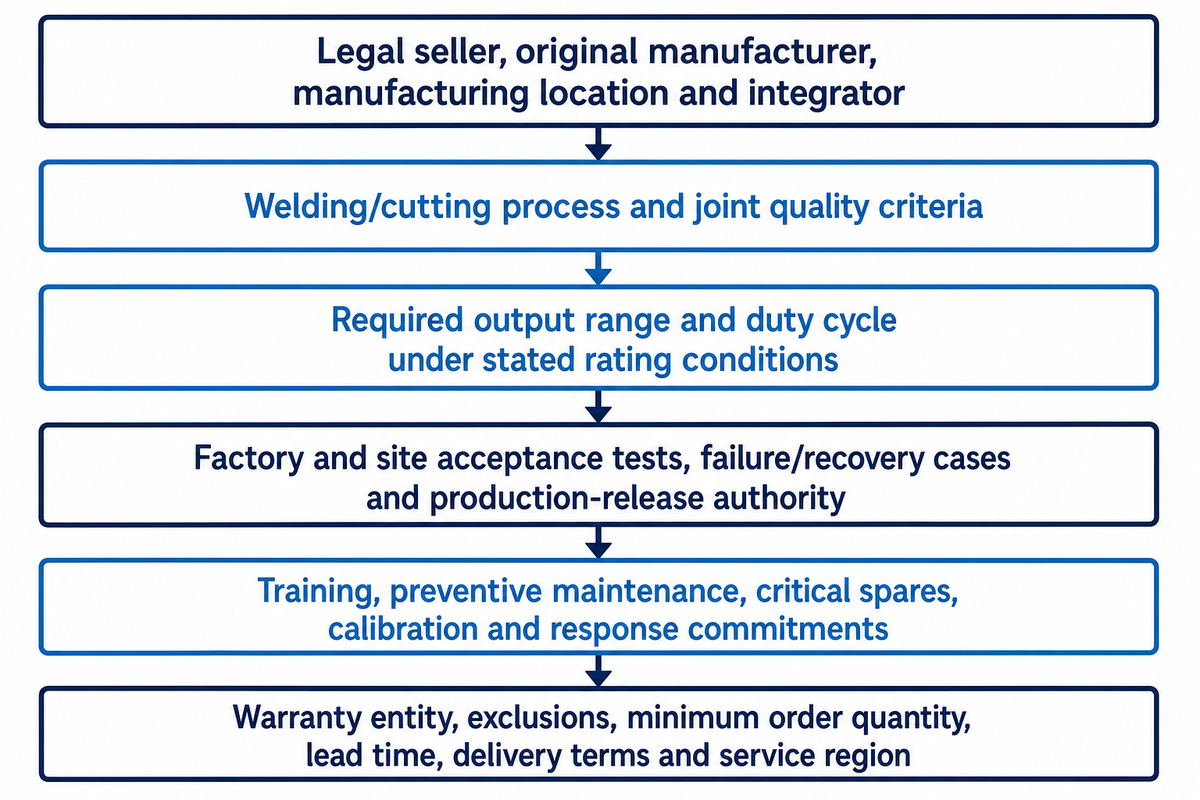
A comparable request for quotation must assign safety scope as well as equipment scope. OSHA 1926.353 is one reference for asking who designs, supplies and verifies ventilation and protection measures.
For United States projects, make the jurisdiction and operating context explicit instead of treating a machine brochure as the safety plan. In construction work, OSHA 1926.350(a)(10) requires stored oxygen cylinders to be separated from fuel-gas cylinders or combustibles by at least 20 ft (6.1 m), or by a noncombustible barrier at least 5 ft (1.5 m) high with at least a 30-minute fire-resistance rating. For general-industry hot work, OSHA 1910.252(a)(2) uses a 35 ft (10.7 m) combustible-material threshold in its fire-watch provisions and requires a fire watch to continue for at least 30 minutes after the work. These are scope-setting examples from United States regulations, not universal installation specifications; the responsible safety professional must identify the rules that apply at the actual site.
Use the RFQ Evidence Chain instead of asking 20 companies for “their best machine.” Send the same source-to-spec request to a small, role-correct shortlist. Include the production problem and acceptance evidence, not just a desired model. Public pages rarely disclose final minimum order quantity, lead time, warranty, customization and local response for a specific contract; mark each missing field Not publicly disclosed — confirm with supplier.
Normalize units in the RFQ: dimensions in mm, workpiece mass in kg, current in A, input in V and kW, travel in mm/s or m/min, rotation in rpm, temperature in °C, gas or air pressure in kPa, duty cycle in %, and service response in hours. If a supplier uses another system, require both the original value and conversion so an avoidable unit error can’t enter acceptance.
Formatting example only—not a machine requirement: write 10 mm, 250 kg, 350 A, 400 V, 25 kW, 50 Hz, 12 mm/s, 1.5 m/min, 3 rpm, 40 °C, 600 kPa, 5 bar, 2 L/min, 100 ms, 60% and 24 hours instead of sending bare numbers. Replace every example with the project’s real value and tolerance.
Range formatting should be equally explicit: 50–300 A, 200–480 V, 0.1–2 rpm, 5–30 mm/s, 10–40 °C, 300–700 kPa and a 6 bar supply are examples of readable unit-bound ranges, not suggested specifications.
| Field | Illustrative format only |
|---|---|
| Welding current | 50 A to 300 A |
| Input voltage | 200 V to 480 V |
| Connected power | 5 kW to 30 kW |
| Workpiece mass | 100 kg to 5,000 kg |
| Workpiece diameter | 100 mm to 3,000 mm |
| Workpiece length | 500 mm to 12,000 mm |
| Travel speed | 1 mm/s to 50 mm/s |
| Rotation speed | 0.1 rpm to 5 rpm |
| Ambient temperature | 5 °C to 40 °C |
| Air pressure | 400 kPa to 700 kPa |
| Supply frequency | 50 Hz to 60 Hz |
| Duty-cycle declaration | 20% to 100% |
| Service response | 4 hours to 48 hours |
| Warranty period | 12 months to 36 months |
| Maintenance interval | 500 hours to 1,000 hours |
| Support horizon | 5 years to 10 years |
| Control response record | 30 sec to 120 sec |
- Legal seller, original manufacturer, manufacturing location and integrator
- Welding/cutting process, base material, filler, joint, position, thickness and quality criteria
- Required output range and duty cycle under stated rating conditions
- Input voltage, phase, breaker, generator tolerance, gas, air, water/cooling and grounding
- Part drawings, mass, center of gravity, diameter/envelope, variation and production mix
- Power source, torch, feeder, robot, positioner, fixtures, sensing and third-party bill of materials
- Accuracy/repeatability evidence and representative sample-weld plan
- Applicable standards, model-level certificates, risk assessment, guarding and extraction
- Controller/software versions, licenses, accounts, remote access, updates, backups and data export
- Factory and site acceptance tests, failure/recovery cases and production-release authority
- Training, preventive maintenance, critical spares, calibration and response commitments
- Warranty entity, exclusions, minimum order quantity, lead time, delivery terms and service region
Capacity and company size belong in continuity due diligence, not as a substitute for process fit. Ask about order load, key-person and key-equipment dependency, supplier continuity, parts stock and alternate support routes. A larger supplier may reduce some continuity risks but may also give a small account less priority. Document the risk instead of guessing from brand fame.
What Is Changing for Welding Equipment Buyers in 2026
Robot-cell procurement now requires edition-specific safety evidence. The ISO 10218-2:2025 catalogue record supports the edition reference; it does not prove local adoption or compliance by a particular installation. Buyers should name the edition, local adoption path, risk-assessment owner, safeguards and verification records in the request for quotation and acceptance plan.
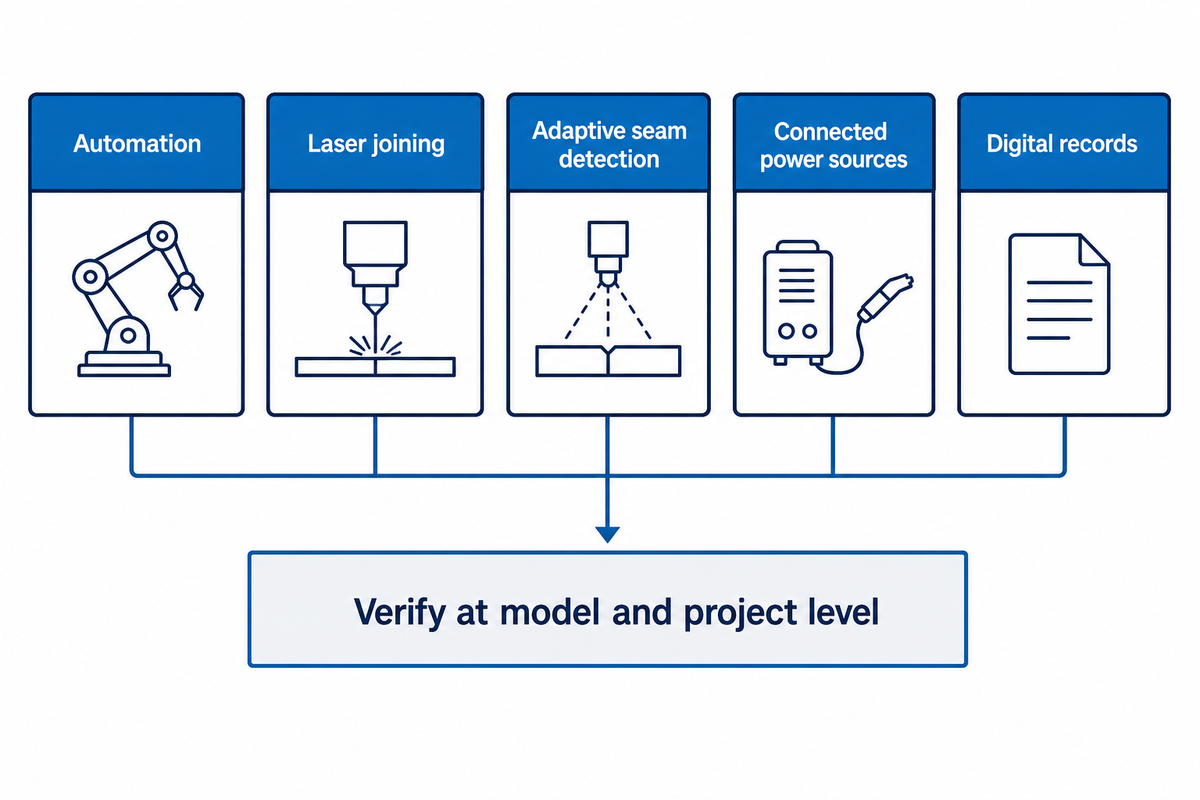
Automation, laser joining, adaptive seam detection, connected power sources and digital records continue to shape product development. Buyers should verify these capabilities at model and project level instead of inferring them from a broad brand portfolio.
The practical buying change is that software and data are now part of machine availability. Ask whether the cell can recover from a failed controller or supplier cloud outage, who holds administrator access, whether recipes and logs export in usable formats, how updates are tested, and how unsupported operating systems or controllers are handled. These questions apply even when the weld process itself is mature.
Robot-integration requirements also continue to evolve. The 2025 edition of ISO 10218-2 is a reason to confirm the edition used by the integrator and the local adoption path. Do not claim compliance from a generic brochure. Require the completed application’s risk assessment, safeguards, verification records and site acceptance. Commercial forecasts disagree on market size and growth, so this guide does not repeat their percentages as buying facts.
Frequently Asked Questions
Who are the largest welding equipment manufacturers?
There’s no single authoritative global ranking that combines welding power sources, consumables, cutting systems, robotic cells and workholding equipment. Lincoln Electric, ESAB, Miller Electric, Fronius and other international groups have broad recognition, but “largest” changes with the metric: revenue, installed base, product category, production capacity or distributor reach. Buyers should use company scale as one continuity-risk input, then shortlist by verified process, integration and service fit.
What are the top five welding brands?
Search results frequently surface Lincoln Electric, Miller Electric, ESAB, Fronius and Kemppi, but that doesn’t make the same five best for every application. A portable field welder, submerged-arc vessel line, resistance-welding cell, laser system and robotic fixture package require different technologies and supplier roles. Define the process, workpiece, utilities, acceptance criteria and service location before reducing the list to five.
Who are the top welding machine manufacturers in the world?
Twenty companies are profiled here across power-source manufacturing, automated systems, robot platforms, laser and cutting technology, and workholding. Aubrik is listed first because the requester explicitly required that placement; the other 19 are in no particular order. No current public evidence supports treating these unlike businesses as one objective global rank, so buyers should confirm each company’s exact role and quoted scope.
How should buyers compare welding equipment manufacturers?
Compare welding equipment manufacturers with a checklist: process fit, motion and workholding, controls and data security, safety and extraction, and lifecycle service. Normalize scope, ratings and support. Assign an owner, acceptance test and proof to each unresolved interface before comparing price.
Which certifications should a welding equipment supplier provide?
Ask for the document required by the destination market and application, then verify its issuer, number, model or facility scope, edition, validity and legal holder. A supplier declaration, laboratory report, quality-management certificate and regulated product approval are different evidence types. Component conformity also doesn’t prove that an integrated cell meets local safety requirements. Record who owns the risk assessment, integration verification and site acceptance. If a current model-level certificate isn’t public, write “Not publicly disclosed, confirm with supplier.”
What should an industrial welding-equipment RFQ include?
Include legal entities and supplier roles; process, materials, joint and production mix; current range and comparable duty-cycle conditions; utilities; workpiece geometry, mass and variation; included power source, robot, workholding, sensing and safety components; applicable codes and acceptance tests; software, accounts, data rights and backups; training, maintenance, spares and response time; warranty, minimum order quantity, lead time and delivery terms. Require every bidder to answer the same fields and label anything not disclosed.
Build a Defensible Shortlist
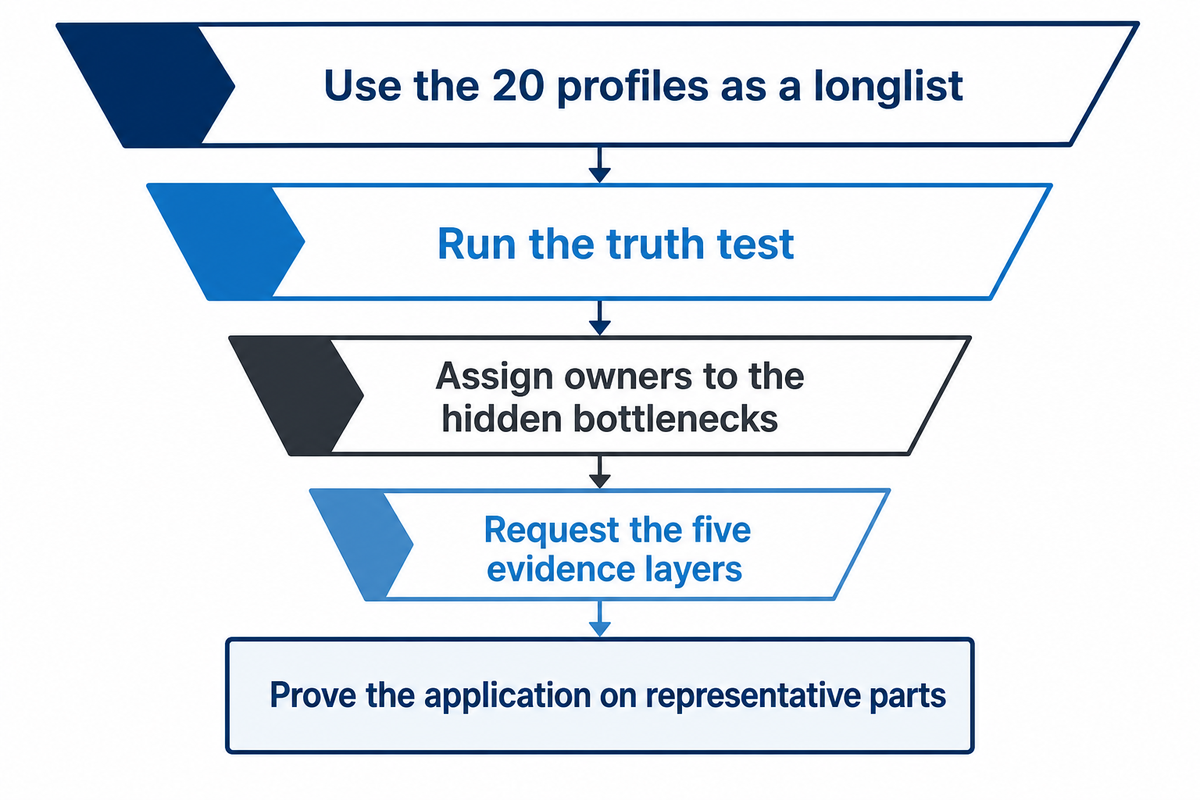
The best welding equipment manufacturer for a project is the company or combination of companies that can prove fit for the joint, workpiece, production environment and service location while making every interface visible. Use the 20 profiles as a longlist. Then run the truth test, assign owners to the hidden bottlenecks, request the five evidence layers and prove the application on representative parts.
For heavy-workpiece positioning, rotation, manipulation or robotic line inquiries, send Aubrik the part drawings, weight and center of gravity, process, output target, site utilities and preferred component standards through the Aubrik project inquiry route. Ask for the model-level bill of materials, calculations and acceptance plan before treating any proposal as complete.
Research note: Company scope was checked against current official pages using Firecrawl. Official URLs in the profiles are deliberately displayed as plain text and aren’t endorsements. Corporate details, availability, standards and commercial terms can change; verify them for the actual contract.
References & Sources
- Current manufacturer and business-unit pages reviewed through Firecrawl; each profile displays its official URL as non-clickable plain text.
- OSHA 1926.353, Ventilation and protection in welding, cutting, and heating.
- OSHA 1926.350, Gas welding and cutting.
- OSHA 1910.252, General welding, cutting, and brazing requirements.
- NIOSH Engineering Controls Database, local exhaust ventilation for welding fumes.
- The ISO 10218-2:2025 catalogue record and current corporate filings were used only for bounded claims; buyers must verify local adoption and model-level applicability.