Get in Touch with Aubrik Company
Contact Form using

Custom CNC Machining

Aubrik · Manufacturer-Direct Since 1999 · Exporting to Spain, Germany, Russia, India, Brazil & more

Custom CNC Machining Services — Precision Milling, Turning & 5-Axis Parts

Custom CNC machining service that reveals what other marketplaces hide – your exact tolerances, alloys specified by name, clearly itemized cost drivers, and predictable lead times. With Aubrik, you are working directly with the engineering team who will build your custom manufactured part – not a salesbot or a reseller who passes your job on.

Y-AXIS / 45.992
Precision Custom CNC Machining and 5-Axis Parts
3 / 4 / 5-Axis
Milling, Turning, Drilling & Finishing
±0.0005″
Tightest tolerance (small parts)
30+
Metals, plastics & exotic alloys
1 piece
MOQ for prototypes
3–7 days
Prototype lead time
ISO 9001 · CE
Certified + 1-year warranty

Tight Tolerances, Unpredictable Lead Times & Tariff Surprises — What Custom CNC Machining Solves

CNC machining is a process of using a block of metal or plastic as material to build a finished part with the computer control of the milling, turning and drilling machines. It is a manufacturing process which achieves dimensional accuracy down to a few ten-thousandths of an inch — the kind of general tolerancing defined in ISO 2768. Real competitive advantage among CNC machining service providers – not only their ability to machine metal, but also their capacity to plainly and directly inform buyers and planners about the underlying cost drivers for a specific part and how those factors will affect delivery timelines.

Very few custom sourcing delays start in the machine shop — most start in the quoting process, the step where key tolerance stack-ups stay hidden behind opaque numbers. You upload a CAD file, get back a number, and the trade-off between speed, price, and precision only becomes clear too late: after parts that miss spec and force a second cycle arrive two weeks late.

The three failure points Aubrik engineers around

 
Tolerance Rework in CNC Machining


Tolerance Rework:

Parts that don’t pass the specified measurement checks and require a second production run. Aubrik clearly states tolerance classes on the machining quotations you receive so that you know upfront how tightly manufactured your parts will be – before the first cut.

Schedule Drifts in CNC Machining


Schedule Drifts:

“As soon as possible delivery”-a vague promise that may as well mean that schedule is flexible-can delay product launches. Our lead-time bands are tied to batch quantity, so there are no surprises and plans stay achievable.

Landed Cost Shock in CNC Sourcing


Landed Cost Shock:

The price quoted for a single unit, before the cost of import tariffs, duties, and logistics is added to that cost. Those factors get clarified and folded in early, so a surprise shipment cost doesn’t kill your budget.

[ DATA_READ ]

In short, this means Aubrik serves as an alternative to instant quote marketplaces, connecting you directly with the machine shop to understand the parameters driving cost and lead times, in full. You’ll be able to find the details presented below in more detail tables below more often behind our competitors’ secure portal, if ever at all.

SYS // OVERVIEW

Our CNC Machining Processes & Capabilities

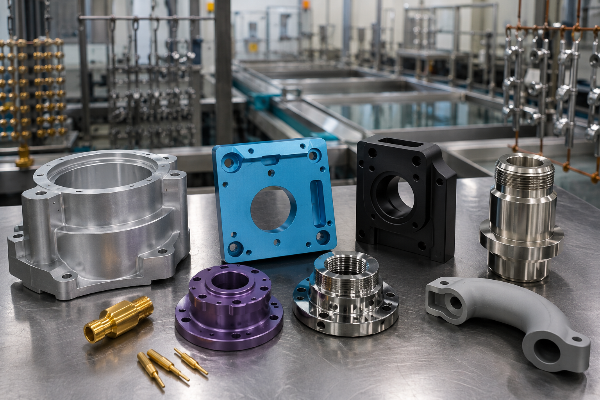
Engineers lose hours coordinating three outside suppliers for a single part — one to mill the rough shape, one to finish the slots, another to treat the surface for wear resistance. Each outsourced handoff adds a tolerance stack-up and a coordination gap that quietly costs you schedule. Aubrik brings every step of the subtractive manufacturing process under one roof — from rough cut to polished finish — so a single workpiece never leaves our factory’s quality system. Our CNC machining capabilities cover the full manufacturing process in-house, from rapid prototyping of custom parts to scalable CNC manufacturing of production parts in metal and plastic.

CNC Milling
[OPR-01]// MILLING

CNC Milling

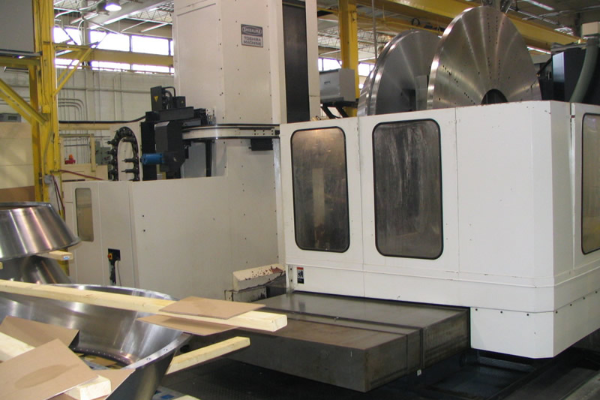
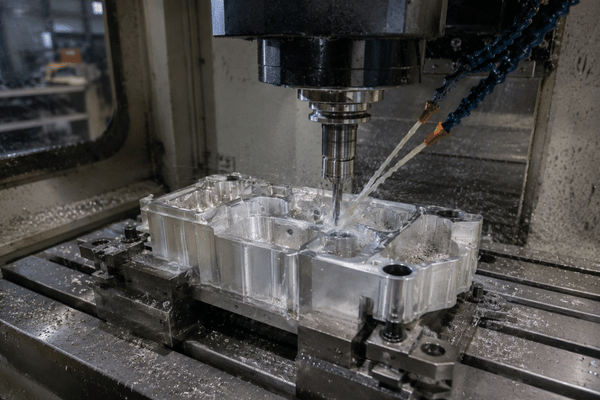
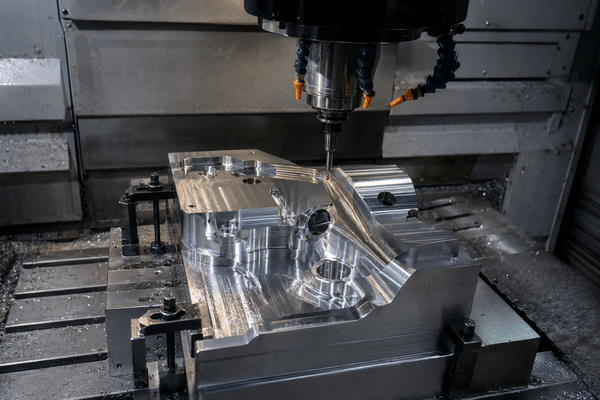
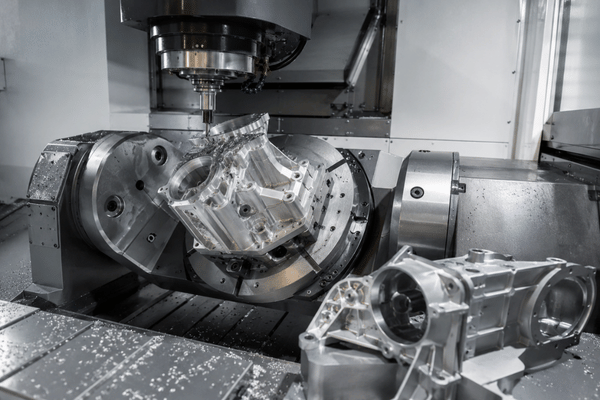
Complex 3-Dimensional and other surface geometry features including surfaces, slots, pockets, and bores. Precision 3, 4 and 5 axis CNC milling is applicable to any shape including parts requiring significant under cutting and complex side features in a single setup.

Best for: housings, brackets, manifolds, aerospace structural parts
CNC Turning
[OPR-02]// TURNING

CNC Turning

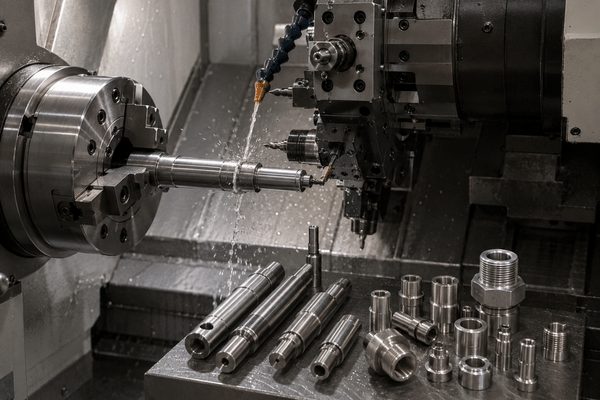
Consistent part profiles along a cylindrical part body including shafts, dowels, and bushings-precise tolerance on all diametrical dimensions. Any required hole locations (and threaded holes) in addition to the part dimensions can be achieved on parts produced from a live tooling lathe.

Best for: shafts, fittings, connectors, rotational parts
Drilling & Tapping
[OPR-03]// DRILL & TAP

Drilling & Tapping

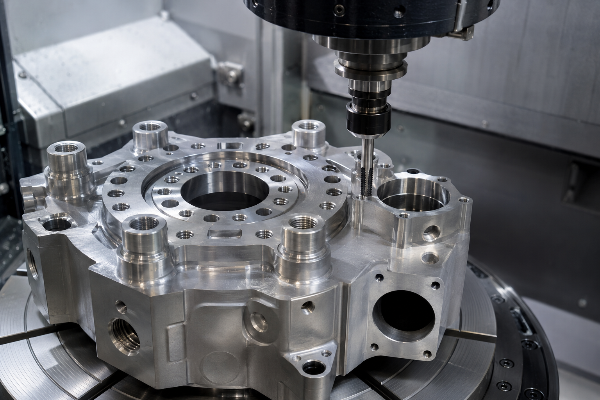
Repeatable patterns of bores (as well as tight concentricity between features and threads in features), producing tight angular and translational tolerance requirements between components so they can be precisely fitted, as required by engineering requirements and for parts that require tight fitting of threads.

Best for: bolt patterns, threaded bosses, fluid ports
Secondary & Surface Finishing
[OPR-04]// FINISHING

Secondary & Surface Finishing

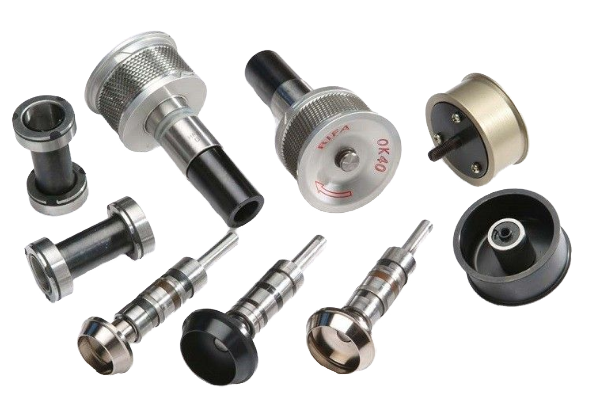
Anodizing, passivating, hard-coat anodizing, nickel plating, gold plating and ceramic coatings for your custom manufactured parts and more. Reduce suppliers to a single vendor.

Best for: corrosion resistance, cosmetic surfaces, fatigue life

More axes do have an effect on your cost, however, not so much with the geometry but with your setup costs. A workpiece that would take five setups on a three-axis needs just two or three setups on a five-axis, designed to reduce machining time and the re-fixturing errors that give you a tolerance problem when you shift between faces.

We standard-selected 5-axis any parts with features of more than three sides. There’s no point boasting on the machine – every set up re- fixturing on 3- axis can be risk for you to loose datums. And on the close tol house that would make the difference between good run and a spoiled part run.

Aubrik Machining Engineering Team

Machinable Materials & Tolerance Classes

This approach of solely picking material on strength is when part cost secretly explodes, since the machinability of the part-not only the alloy-affects machine time. For a part to work effectively, an aluminum 6061 bracket would suffice for most loads as the equivalent of 316 stainless steel; however, a stainless counterpart would take between 2 and 3 times longer to machine, due to material work-hardening and tooling abrasion.

The Machinability Atlas has been constructed using the tool response of Aubrik’s 3 material families and how expensive it is to cut - enabling an industrial purchaser to buy for the application without paying a premium for unnecessary machinability.

3-Family Machinability Atlas


Family Common Grades Machinability & Behavior Relative Machining Cost Typical Applications
Metals Aluminum 6061 / 7075, Stainless 304 / 316, Steel 4140 / 1018, Brass, Copper, Titanium Aluminum 6061 cuts fast (rating ~360% vs 1112 steel) but is "gummy"; 304 stainless work-hardens and holds heat Aluminum = baseline; stainless 2–3× aluminum Aerospace structures, automotive parts, industrial machinery, medical devices
Engineering Plastics ABS, POM (Delrin), PC, Nylon (PA), PEEK, PTFE Lightweight, chemical-resistant, low-friction; faster cycle times than most metals Low to moderate Consumer electronics, automotive interiors, medical tools, food-grade parts
Exotic Alloys Inconel, Hastelloy, Tungsten High-temperature and corrosion resistance; slow cutting speeds, specialized tooling, heavy heat management Titanium / Inconel 4–5× aluminum Aerospace engines, oil & gas equipment, high-performance industrial parts

That cost column is exactly what a quote engine hides. When a 4–5× machining-cost jump rides on the material choice alone, an Aubrik engineer will flag where Aluminum 6061 can replace Titanium on a non-critical part — often the single largest saving on the job, and a call you can only make if someone shows the trade-off first.

Beyond cutting, Aubrik finishes CNC machined parts in-house — anodizing, passivation, electrical discharge machining (EDM), and polishing — so precision parts leave the machine shop install-ready rather than waiting on a separate finishing vendor.

CNC Tolerance Class Window

Precision is where over-specification quietly drains the budget, and the data is blunt: more than 60% of CNC projects over-specify tolerance, inflating cost 25–40% with no functional gain — because moving from rough to precision tolerance multiplies cost roughly 4×, and ultra-precision up to 24×.


Tolerance Class Standard (ISO 2768-M) High-Precision Applicable Processes
Metals (Aluminum, Steel, Brass) ±0.005″ (±0.127 mm) ±0.001–±0.002″ (±0.025–±0.050 mm) Milling, Turning, Drilling
Plastics (ABS, POM, PC) ±0.010″ (±0.254 mm) ±0.003–±0.005″ (±0.075–±0.127 mm) Milling, Turning
Exotic Alloys (Inconel, Titanium) ±0.005″ (±0.127 mm) ±0.002″ (±0.050 mm) 5-Axis Milling, Precision Turning
Small Parts (≤1″ dia./length) ±0.003″ (±0.075 mm) ±0.0005″ (±0.0127 mm) Micro-Machining, Precision Drilling

Right-tolerance review, not blanket precision

An engineer in Aubrik's engineering staff will mark your print wherever your engineers’ tight tolerances incur cost without a requirement on the function of the product. Apply your general baseline band with ISO 2768-M, and hold precision band for the few features requiring it. This is a differentiator, and eliminating the 25-40% typical over-spec penalty for both US and EU customers.

SYS-01: Procurement + Management

What Actually Drives Your CNC Machining Cost (No Quote Required)

As an industry standard, your machine cost typically is made up of approximately 15-40% material costs, 30-50% machine utilization, and 20-40% overhead, including set-up, programming, and quality control — with tolerance scoped to dimensioning standards such as ASME Y14.5. Here, in the diagram 7- Lever Ledger, we’ve laid it out to indicate in which direction each lever goes and in which direction to pull.

The answer any competitor provides for "how much does CNC machining cost" is always a string of the same two words: get quote. But that isn't pricing - it is an access gate, shrouded by unnecessary opacity and risk. Understanding a machined part's cost simply involves pushing few levers - industrial purchasing teams could be designing and buying for significantly cheaper before file ever hits the shop floor.


25–40%
typical cost inflation from tolerance over-specification — the waste a right-tolerance review removes before production
Source: industry analysis of CNC tolerance over-specification (modus advanced, proleanmfg) — an industry-analysis framework, not a guaranteed figure

7-Lever CNC Cost-Driver Ledger

01
Material grade
↑↑↑
Why It Moves Price
Difficult alloys add 50–200% to base rate; Ti/Inconel 4–5× aluminum
How to Pull It Down
Use 6061 / 304 where strength allows
02
Tolerance band
↑↑↑
Why It Moves Price
Rough→precision ~4×; ultra-precision up to 24×
How to Pull It Down
Tight-tolerance only on functional features
03
Geometry complexity
↑↑↑
Why It Moves Price
Deep pockets, thin walls, multi-side features = 3–5 setups; single biggest factor
How to Pull It Down
Simplify features; consolidate faces for 5-axis
04
Surface finish
↑↑
Why It Moves Price
Anodizing, polishing, passivation add process steps
How to Pull It Down
Specify finish only where corrosion/cosmetic matters
05
Batch volume
↓↓↓
Why It Moves Price
Setup cost is fixed per batch — it amortizes as quantity rises
How to Pull It Down
Consolidate orders; commit to production runs
06
Lead time
↑↑
Why It Moves Price
Expedites drive overtime on material, machining, and finishing
How to Pull It Down
Plan standard lead times where schedule allows
07
Inspection level
Why It Moves Price
Full dimensional + material certification adds QC hours
How to Pull It Down
Match inspection depth to part criticality
>_
There are two dials at your fingertips, geometry complexity and tolerance bands. An Aubrik redesign of an Aubrik part to eliminate 2 setups and loosen 3 non-critical call-outs may result in a materially lower quote than the "instant" quote a marketplace provides on the original design because cost was dictated by decision, not physics.

Aubrik vs. Instant-Quote Marketplaces — The Manufacturer-Direct Difference

Speed by routing everything to whichever machine is available - that’s the strategy for online marketplaces to speed up turnaround. Engineering collaboration is exactly what online machine shops cannot provide. A direct connection to the people, machines and price logic responsible for your part guarantees nothing’s lost between what was intended and what is made.

What follows is our honest comparison of marketplace instant quotes vs Aubrik - with emphasis on where the value and engineering input goes, and the transparency industrial buyers rely on — specifications referenced to standards like ISO 2768 — when purchasing a component or manufactured product.

Dimension
Instant-Quote Marketplace
Aubrik (Manufacturer-Direct)
Who makes your part
One of thousands of unnamed network shops
Aubrik's own factory, every time
Pricing structure
Shop price + platform margin
Direct from the manufacturer — no middle layer
Engineering contact
Auto-DFM bot; sales tier for exceptions
Direct line to the engineers running your job
Cost transparency
Opaque — "get instant quote"
Published cost-driver ledger before you commit
Relationship model
One-off transaction per upload
OEM & build-to-print production partnership
Specs & tolerances
Behind the quote engine
Published on this page
[VERDICT]

The honest trade-off: a marketplace wins on instant self-serve checkout for a one-off prototype, while Aubrik wins when the part matters enough that you want the same engineers, the same machines, and a transparent cost structure from first prototype through full production — because the cheapest click is not the same as best landed value.

Quality, Certifications & Inspection You Can Verify

Custom CNC Machining Quality Verification Process

"Trust us" is not a quality system, and industrial buyers who have been burned by an overseas batch know it. The reason inspection-on-arrival became standard advice is that defects often aren't caught before shipment — a risk that turns one bad lot into weeks of rework. Aubrik moves verification upstream and puts it in your hands, backed by export-grade machining since 1999.

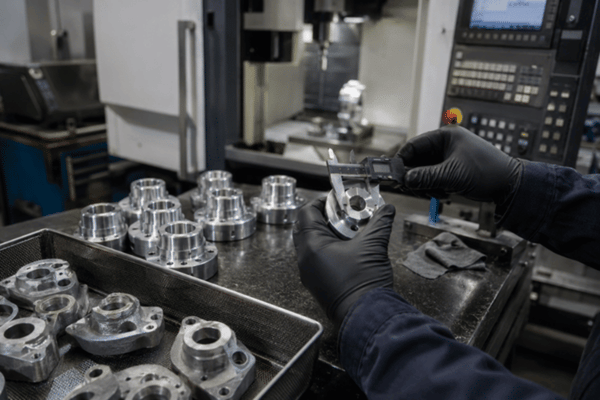
Every shipment leaving Aubrik's factory carries a certified QC report — dimensional measurements, tolerance verification, and material certification on request — so industrial buyers confirm conformance against the drawing, not against the word on a sticker. Aubrik runs one ISO 9001 quality system across every production batch, the consistency an ad-hoc audit can't promise and the differentiator a label can't fake.

ISO 9001

Quality management system

CE

European conformity

1-Year Warranty

On all products

Since 1999

20+ years machining

We were working with an industrial buyer in Germany, and before he’d release his PO, he requested we prove a lot of 316 stainless. We sent over the full set of measurements and material cert along with our physical part sample; he greenlit it that week. That's what expecting first inspection really is all about-never asking anyone to take quality on faith.
— Aubrik Quality Assurance Team

OEM, Build-to-Print & International Buyer Enablement Procurement

It is this element that trips up even the savviest international buyer: what is the “real” price when shipping, duties and unforeseen challenges, not to mention time zone issues, come into play to revise it after the click? At Aubrik, these are engineered solutions too - not inconvenient variables to a low click price that only look cheap on a static webpage.


From CAD to delivered part

The Part Process “Upload Your Drawing for Instant Quote“… We don’t have one! Why? Because your drawing is never finished until our team reviews it for manufacturing readiness. Send us any major file format (STEP, IGES, STL, SolidWorks, AutoCAD, Fusion 360, and more) and we’ll provide you with an engineer- reviewed quote - or if you don’t have a technical drawing yet, simply send us your concept sketch and our engineers can convert it into a machinable file for you.


Landed cost, handled in the open

U.S. imports of machined parts from China can carry stacked duties — Section 301 alone adds 25%, and layered tariffs have pushed effective rates far higher, inflating landed cost by roughly 10–40%. We quote with these realities on the table, advise on HTS classification and Incoterms, and is built around handling export documentation so the number you plan around is the number that clears customs.

We believe it’s this kind of upfront transparency that leads European and US companies in Spain, Germany, Russia, India, Brazil, France, Italy, and Vietnam to order again, and again, each because we consistently land their shipments precisely at their anticipated cost-with zero nasty surprises at the border.


Lead Times, MOQ & Production Scaling

An unpredictable delivery date is the pain that overseas sourcing is famous for — a schedule that slips with no warning and stalls the launch downstream. Aubrik commits to lead-time bands by batch size instead of one optimistic number, because a date you can plan around is worth more than a date that sounds fast. The uncertainty of a delayed production run is engineered out of the schedule, not wished away.


Lead-Time × Batch-Size Reference Grid DATA_MTX

Order Stage
Quantity
Standard Lead Time
Notes
Order Stage Prototype
Quantity 1 piece (MOQ)
Standard Lead Time 3–7 business days
Notes Simple geometry 3–5 days; complex / exotic 5–7 days
Order Stage Small Batch
Quantity 1–100 pieces
Standard Lead Time 7–14 business days
Notes Exotic materials toward the upper band
Order Stage Medium Batch
Quantity 101–1,000 pieces
Standard Lead Time 10–15 business days
Notes Expedited option available
Order Stage Large Batch
Quantity 1,001+ pieces
Standard Lead Time 15–25 business days
Notes Volume discounts apply

MOQ built for both prototypes and production

There’s no MOQ to prototypes, or to get your parts made - only to scale them up to production quantities (which we’ll discuss next). We will produce a single part as needed for fit check, proof of concept, or demonstration, and most materials include a low MOQ (we’re talking small for even a startups) for production volumes up to 10,000s+.

Because Aubrik can machine a single piece to a thousands piece batch, you can move seamlessly through your program life cycle - developing at prototype scale with the assurance that the exact machines, process and people used on the first piece will be employed for the hundredth piece, under one ISO 9001 quality record.

Aubrik Advanced Custom CNC Machining Engineering & Estimation Tools

CNC Cost Driver Estimator

Analyze part geometry to identify primary cost drivers and optimize CAD models instantly for competitive budgets.

Launch Cost Estimator

Tolerance Material Selector

Evaluate structural requirements and material properties to select the ideal metals or polymers for seamless production.

Open Material Selector

Lead Time MOQ Estimator

Calculate precise production timelines and Minimum Order Quantities based on your volume requirements.

Calculate Production Plan

Get a Transparent CNC Machining Quote

Simply upload your drawing and get a quote based on obvious cost drivers, achievable lead times and landed cost clarity, directly from the Aubrik engineers handling your work.

Request a Quote

FAQ — Custom CNC Machining

Here are some of the exact questions industrial buyers actually ask before making a purchasing commitment.Here too, we answer with the same transparency that has shaped our every quote because we know that an incomplete or vague response carries with it its own substantial risk factor.

We can achieve dimensional tolerances of as tight as ±0.0005” for small part feature sizes (<0.0005”), our standard steel features are within +/-0.005”, and tight tolerance steel feature dimensions come down to +/-0.001-0.002”; we recommend reserving very tight dimensional tolerances for functional features.Plastics typically feature within +/-0.010, or tighter (+/-0.003-0.005”) which would depend on ambient temperature relative to molding temperature for expanded range (again, reserve your tightest bands for key functionality).

The biggest levers on price-by far-are Material Grade, Tolerance Band, Geometry Complexity, Finishing Specification, Production Volume, Lead Time Requirements, and the Scope of Inspection performed.Overall production costs are generally distributed as: Material grade (15-40%), Machine time (30-50%), Overhead & Profit (20-40%),.You'll find the easiest price reductions when allowing for relaxed non-critical tolerances and minimizing Part Setups to reduce machine time for reduced part count.

Our MOQs are surprisingly flexible; it’s not cost-effective for us to do fewer than 5 parts of most material types, and prototypes are single pieces no matter how simple or complex they might be.As much as we support our low-volume production customers, at least several hundred-thousand pcs would be required for volume discount tier, so we can help start your low volume production on you own terms.

Prototype turn times are generally in the 3-7 business day range and production builds within 7-25 business days for most types of orders depending on complexity and volume. If you need parts sooner than that, just tell us the exact date required and we’ll tell you what is possible.

Our shop accepts STEP, IGES, STL, SolidWorks, AutoCAD and Fusion 360. NoCAD?Aubrik’s engineering team will work with you from concept sketchor drawingto machinable design- without the need for an outside designer.

Yes. Aubrik uses dedicated tooling and “tuned” cutting parameters for Inconel, Hastelloy, Titanium and Tungsten which control cutting speed and temperature in order to maintain dimensions of trickyto-machineto materials.

For U.S.-bound import components from China, landed cost for CNC machined parts can stack to be quite significant. The Section 301 tariff alone accounts for 25% and other layers mean effective landed cost inflation could range from 10%-40%. We quote all landed costs, we provide recommendations regarding the applicable Harmonized Tariff Schedule (HTS) classification and best Incoterms, and we manage all export documentation to ensure a smooth transition through customs.

Yes, of course. Our process - the ISO 9001 method - includes and end-of-lot verification report and a material certificate if you require. Our dimensions, tolerancemakeup or any aspect can be easily compared with your drawing prior to final acceptance.

Yes.Aubrik’s engineers will review your design and suggest how you can reduce your costs and lead times through slight adjustments to geometry, material and tolerances- all without compromising performance, just as in the 25-40% tolerance inflation reduction on the design.