Get in Touch with Aubrik Company
Cobot Welding
Cobot Welding Robot | Easy-Programming Welding Automation from $40K — Aubrik
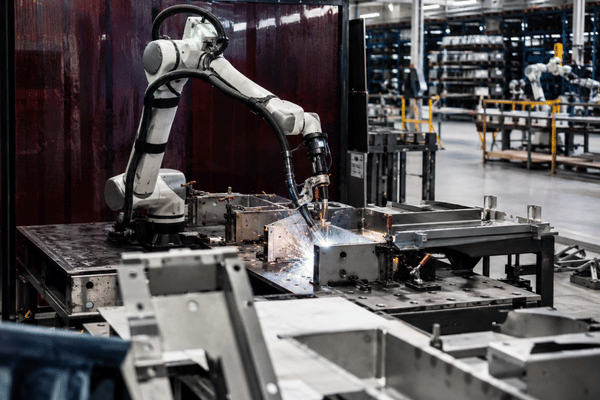
Cobot welding offers overseas SMEs ISO 15066-rated welding automations at one-third the price of industrial robots – 0.02mm repeatability, 3-20kg payload, 1-3 day deployment, we make collaborative welding robots safe around your existing operators, that learn a new part in under 20 minutes and ship $40,000 ex works per robot system.
Get a Free Quote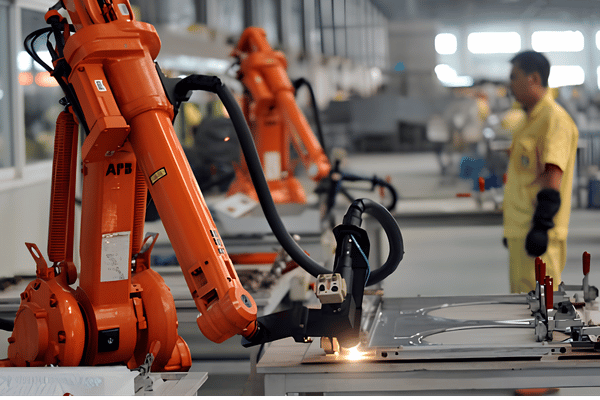
$40-70K
Price Range
1-3 days
Deploy Time
20 min
First Program
Welder Shortage and Quality Drift — How Cobot Welding Boosts Productivity in One Shift
Most fabrication shops that come to us wrestle with a set of compounding challenges – taking three-to-six months to hire the next skilled welder, maintaining five-to-12% rework in manual welding and dedicating between two-to-eight hours every Monday for part number changeover. cobot welding resolves all three by bringing robot-style welding speed without a fence-protected cell into an existing operator’s workspace via our collaborative robotic systems.
Collaborative robotic welding adoption topped 32% growth in 2026, according to ISO/TS 15066-aligned industry analysis. Growth is less dramatic in the automotive OEM sector, while fabricators with 50-200 workers invest aggressively to redeploy skilled welders from rote work into higher value-added fabrication, defending against the labor pressures documented in OECD manufacturing surveys.
Why manual welding lines stall before they scale:
01
Typical welder Hiring Cycle in Overseas Markets – 3-6 months for recruitment and certification in markets like: United States, Germany, France, Canada, South Korea, Mexico and the United Kingdom
02
Manual weld – 5-12% rework rate typical for conventional MIG and TIG process for high-value metal fabrication shops with moderate complexity of part numbers and geometric complexity, in regions of the world with developing manufacturing labor skills that prevent easy hiring of trained skilled labor from a pool that currently lacks qualified or available personnel, even with wage increases
03
Changeover on traditional robots: 2-8 hours of CAD or G-code modification to adjust trajectory and end-effector path per new part — punitive when small-lot manufacturing demands frequent mix changes across regions and customer segments.
04
Fenced cell – $15,000-$30,000 price for safety enclosure with standard guarding in markets such as Germany and Italy, in addition to floor space consumption and installation delays
Each Aubrik cobot welder directly addresses these challenges: no fence required (using ISO 15066 SSM mode), new path programming in under 20 minutes via direct teaching, magnetic mount option enabling transfer between multiple jigs in under 30 minutes. Each of your cobot system purchase decision will prove beneficial on your balance sheet through accelerated arc-on-time recovery and delayed welder replacements.
[SYS-01] Framework

Cobot Welding Robot vs Industrial Robot – 6-Factor Selection Framework
“Our experience shows cobot welding’s welding automations and industrial robot welding systems are complementary technologies – not direct substitutions, and successful cobot system procurement relies on six measurable criteria that most teams neglect in their initial robot acquisition.”
| Factor | Cobot Welding (Aubrik) | Industrial Robot Welding |
|---|---|---|
| Safety architecture | ISO 15066 SSM + PFL, no fence required, EU/US/JP certified | Safety fence + light curtain mandatory, full cell retrofit overseas |
| Programming time per new part | 20 minutes hand-guided teaching; drag-and-drop graphical edit | 2-8 hours G-code or CAD-to-path; trained robot programmer required |
| Deployment flexibility | 15-30 minute changeover, magnetic-base option, fits narrow workshops | Fixed installation, long commissioning, line rebuild for re-layout |
| Payload range | 3-20 kg (Light/Standard/Heavy tiers; 20 kg max on flagship) | 6-25 kg; engineered for heavy fixturing and large welding torches |
| Application fit | Small-batch high-mix; SMEs producing 20-200 parts per batch | Standardized mass production; lines running one part for months |
| Total system investment | $40,000-$70,000 per system; flexible payment terms | $80,000-$120,000 bare cell; renovation/maintenance adds 20-40% |
When Cobot Welding wins – and when it doesn’t
Cobot Welding:
Batch sizes under 200 pieces; high part mix changes; opportunity to redeploy skilled operator.
Industrial Robot:
Standardized parts over six month run duration; high arc-on-time duty cycle; payload requirement greater than 20 kg; extensive reach.
“We’ve discovered in field applications that the second cobot doesn’t double production capacity. Once welding is no longer the constraint, throughput bottlenecks shift elsewhere – whether it be jig setup time, upstream material handling, or downstream finishing. Plan your second cobot deployment around the *new* bottleneck, not the previous one.”
In a recent example, a manufacturer supplying automotive components realized a 40% reduction in labor cost and an improvement in pass rates from 92% to 99.2% in just an 8-minute standardized cobot cycle, without adding any additional welding equipment or labor personnel.
[SYS-01] PORTFOLIO OVERVIEW
Aubrik Cobot Welding Product Line — Three Payload Tiers + Compatibility Window
Aubrik currently produces cobot welders in three payload classes to match the needs of small and medium-sized fabricators. Select the payload tier for the combined mass of the welding torch, mounting hardware, and sensors, and check the manufacturer’s payload and center-of-gravity limits for the complete tool assembly.
[HARDWARE] PAYLOAD MATRIX
01
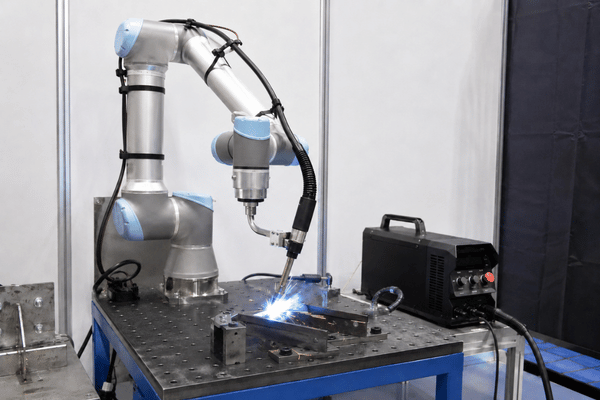
Light Series — 3 to 5 kg
- Payload 3-5 kg (torch+cables<4kg)
- Processes MIG, TIG (thin gauge)
- Best For precision auto parts, electronics
- Footprint desktop or wall-mount
From $40,000
02
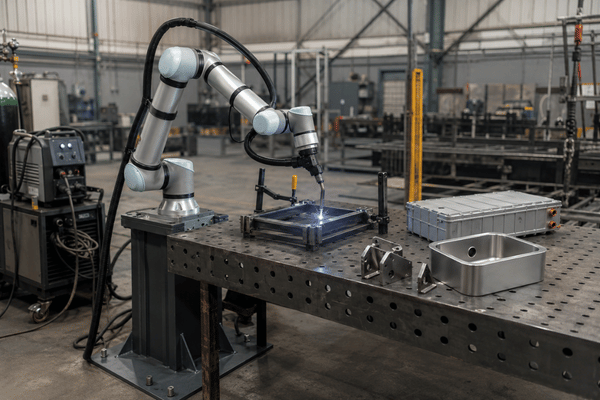
Standard Series — 5 to 10 kg
- Payload 5-10 kg (mainstream)
- Processes MIG, TIG, laser compatible
- Best For auto batches, new energy
- Footprint magnetic base or pedestal
From $48,000
03
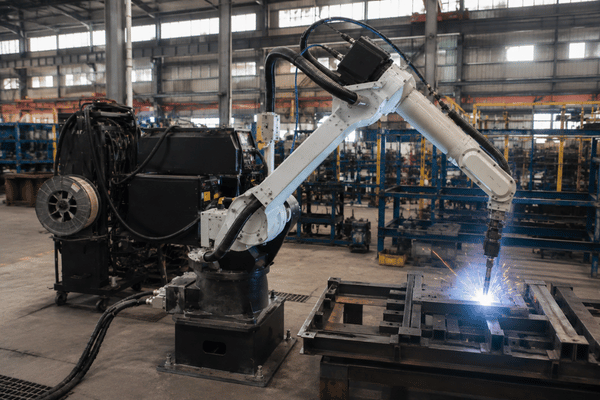
Heavy Series — 10 to 20 kg
- Payload 10-20 kg (multi-pass)
- Processes MIG, TIG, sub-arc
- Best For steel structure, marine
- Footprint floor-mount with rail
From $55,000
[DATA] PROCESS FIT
Cobot Welding Process Compatibility Window
Ensure that the material, thickness and process match the appropriate payload tier to enable ordering. There’s a range within the material compatibility range which was determined based on Aubrik deployment data and AWS D1.1 structural welding code.
| Material | Thickness Range | Process Fit | Recommended Payload Tier |
|---|---|---|---|
| Carbon steel | 1.5 – 12 mm | MIG (mainstream) | Standard 5-10 kg |
| Carbon steel | 12 – 25 mm | MIG multi-pass | Heavy 10-20 kg |
| Stainless steel | 0.8 – 8 mm | TIG or MIG | Light 3-5 kg or Standard 5-10 kg |
| Aluminum alloy | 1 – 6 mm | Pulse MIG or laser | Standard 5-10 kg |
| High-spec aluminum | 6 – 12 mm | Laser welding cobot | Heavy 10-20 kg |
| Galvanized steel | 1 – 4 mm | Pulse MIG with shielding gas | Light 3-5 kg |
[INTEGRATION] POWER SOURCE
Power Source Compatibility
Aubrik cobot welders communicate with more than 13 major welding machine manufacturers such as Lincoln Electric, Miller, Fronius, ESAB, OTC Daihen, and Panasonic via the common analog and digital ports. Existing power source can be untouched, it is only the manipulator that needs to be replaced.
Payload declaration at the face of earth.
In order to determine the payload a welding torch already weighs (with shielding gas line and feed wires attached) 3-6 kgs without the sensor; size cobot tier 1st know torch model then determine correct size with 1.5 safety factor – calculation performed by engineers at Aubrik upon quote review.
[EXTENSION] BEYOND COBOTS
Related Aubrik Welding Automation Solutions
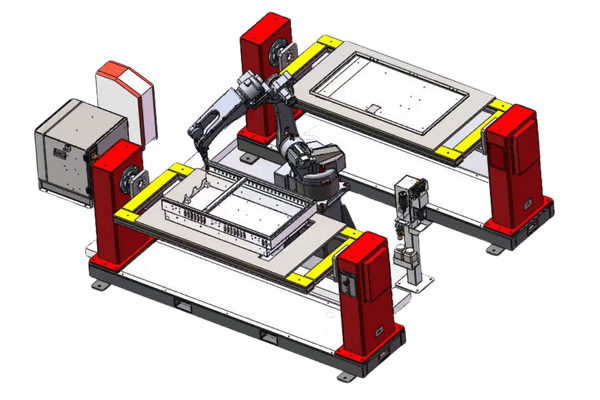
For applications outside the cobot envelope — large structural fabrications and long pipe seams — see our companion product lines: column and boom welding manipulators for tank and vessel fabrication, and pipe welding manipulators (FWM Series) for 50-3000 mm pipe diameter range.
Programming Methods and 10.1-inch Multilingual Teach Pendant — 20-Minute First Program
10.1-inch Touch Teach Pendant
The teacher pendant is the only interface your operator uses in the course of a day. We grew it for fabrication-shop rather than engineering offices.
- Display 10.1-inch full touch screen with glove-friendly capacitance
- Languages English, Mandarin Chinese, Spanish, German, and Japanese.
- Control torch-mounted control buttons for in-place learn and tune
- Monitoring Monitoring weld: speed, current, voltage, and gas flow in real-time on one single screen
- Connection Connection: wired and wireless (Wi-Fi 6) modes
Four Programming Methods Aligned to Operator Skill
OP-M01
Hand-Guided Teaching
Drag the arm through the path; record start, end, and key waypoints. Workshop operator completes a first program in 20 minutes.
OP-M02
Graphical Programming
Drag-and-drop icons set trajectory, speed, current, voltage on the pendant or tablet. Edit and duplicate trajectories.
OP-M03
APP Remote Programming
Beacon-compatible mobile app handles programming, parameter tune, and fault diagnostics from anywhere on the shop floor.
OP-M04
Automatic Wizard
Built-in welding application wizard with touch sensing generates multi-layer paths and optimizes subsequent welds from the first pass.
Time-to-First-Program Comparison
Aubrik-cobot: 20 minutes- operator drag-teach.
20 MIN
Manual setup: 4 hours -fixture + jig prep.
4 HRS
Industrial robot: 2-8 hours-G-code+ CAD path.
8 HRS
Five Industry Applications and Three Customer Cases — Consistent Weld Quality at 99.2%
Aubrik cobot weldersl are installed in 5 industry verticals around the globe. Every industry requires a specific payload with different levels of flexibility, accuracy and process flexibility.
Five Industry Applications
[ 01 ]
Auto-parts (Europe/USA/Japan)
seatframe, headlightbracket, battery-pan; highly welding Precision; LowThermalDeflection; Quick ToolChangeover; mixed-line Production
[ 02 ]
Steel structure & construction machinery
thick plate welding with multi-pass welding process for frame assembly and boom. Structural assembly – heavy layer structure configuration
[ 03 ]
Hardware processing & bathroom
hardware processing and kitchen and bathroom manufacturer : Flexible deployment, non-standard production Small and medium volume The simple operator Friendly setup.
[ 04 ]
New energy
For lithium battery assemblies and photovoltaic mounting brackets, confirm the material, joint design, and welding procedure before selecting a cobot setup.
[ 05 ]
Ship Building
exhaust assemblies – small shell sections high-precision with shipyard constraints IP protection IP65 – IP67
Three Customer Cases
Customer Case — Deangelo Marine Exhaust (USA, Marine)
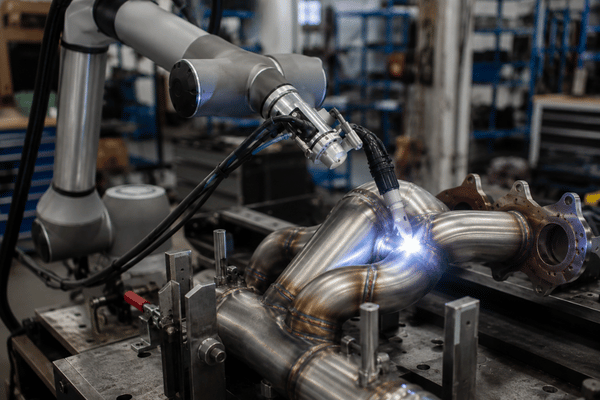
USA Deangelo Marine Exhaust — TIG welding marine engine exhaust components
Before Situation welder stock, ineffective welding with TIG, largest delivery time to 65 days was experienced. None of 7 largest welding enterprises of robot were tested before Deangelo approached with Aubrik to conform the technical difficult quality required for TIG.
After Optimization The operators understood the cobot in only 20 minutes. welding went ten times faster, defection level went down at a remarkable pace and within days the delivery backlog was dealt with. Double capacity, new contracts secured with new clients in Europe and Asia, and payback within 8 months!
Customer Case — Tramétal (France, Precision Sheet Metal)
FRA Tramétal — Precision sheet metal subcontractor, replacing 5 traditional industrial robots
Before Situation Five older generation robots driven by custom programming, high changeover, complex task and a considerable effort of the existing welder team. For the European small lot, on demand contracting, Tramtal wanted a more Agile welding option.
After Optimization This replaced the old Teach pendant workflow. A single button press to record your path! There is no need for professional programmers and the welder can be put to more effective work on fabrication. And your workshop is more stable and safer. You can see increased retention within the European market.
Customer Case — Auto Parts Enterprise (Europe + USA OEM contracts)
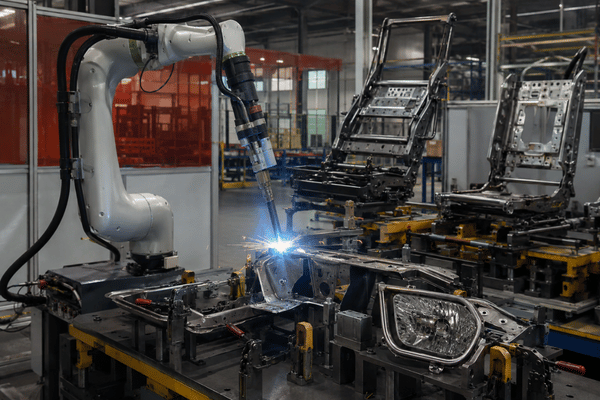
EU/US Auto parts manufacturer — seat frames and headlight brackets, EU and US automaker contracts
Before Situation Multi-variety mixed-line production, long changeover times and welding pass rate only 92% with stringent EU/US auto quality standard.
After Optimization 12 product variants in mixed-line production with sub-20 minute changeovers, weld pass rate 99.2% up from 92%, labor cost 40% lower and all deployments completed within one day. secured EU/US OEM contracts and extended global reach.
Certifications and Compliance — ISO 15066, ISO 9001, CE, FDA, UL
No OEM outside China would allow an uncertified Chinese-made cobot in their EU/US facility. Built the certification stack first, second the product.
ISO 15066
ISO 9001
CE
FDA
UL
Each certification carries a specific buyer outcome.
01
ISO 15066
collaborative-robot safety technical specification: Four collaborative Modes (our cobot use SSM mode for welding) defining limits on allowable power/speed in human spaces.
02
ISO 9001
production quality management system certificate for annual production capacity of 1,000 welding systems and 200 cutting systems.
03
CE
for direct deployment into European factories without remanufacturing.
04
FDA + UL
for US safety/electrical standards; no surprise after-shipment certifications required by US buyers.
Honest Safety Disclosure — Why PFL Alone Is Not Enough
ISO 15066 Power and Force Limiting (PFL) keeps the cobot safe to touch. But PFL doesn’t make a hot welding tip safe or an unprotected torch safe. The end effector’s end tip retains thermal energy. Our deployment combines SSM, operator training, and optionally weld area light curtains-not just PFL.
IP65-IP67 rated for ingress resistance.
Independent of our safety layers, IP-rated protection ensures the same cobot runs at a mine site maintenance workshop, a marine exhaust line, or a kitchen fixture assembly process without ingress of dust, welding splatter or humidity failures.
[SYS-DOC-TCO]
Procurement Guide — Cobot Welding Cost-Of-Ownership Ladder
Most cobot welder buyers price the robot on cost and ignore four additional cost components that effectively double the final cost. The five tiers of Aubrik Cost-of-Ownership for our customers:
Aubrik: $40,000-$70,000 covers manipulator + controller + torch + standard fixturing kit. Industry median for comparable cells: $103,000+ (market survey of Hirebotics, Lincoln Cooper, FANUC CRX, and US distributor listings).
1-3 days on-site with Aubrik engineer included. Most competing systems quote 1-2 weeks installation plus an integrator fee of $5,000-$15,000.
20-minute first program for a fabrication shop welder; no robot programmer hire. Industrial robot training typically requires a $50,000-$80,000 specialist.
Fixturing is the hidden cost most buyers underestimate — for complex parts it can equal the robot. We supply standardized fixturing kits with the Heavy tier and engineering support for custom jigs.
Warranty (1 year free, extended available), maintenance contract, spare parts, and software updates. Our 5-year operating cost runs 30-40% below imported cobot brand equivalents because of regional service network density.
Procurement decisions extend to supply chain and support structure.
- 1 Year FREE warranty on all cobot welding systems.
- Three regional after-sales and service hubs (Europe, USA, Southeast Asia) supported by field engineers for in-country support, maintenance and training.
- 24/7 Online technical support with technical manuals available in multi-languages including English, Spanish, German, Russian, Vietnamese, and Portuguese.
- Customization for special torch mounts, custom workholding fixture kits, branding and other requirements on request.
- Flexible payment terms tailored to overseas buyer cash-flow cycles.
“We disclose the $40,000-to-$70,000 price ranges upfront for transparency as our competitors offer pricing on a case-by-case basis and profit during configuration to make up the difference. SMEs in overseas markets require upfront costs for their planning models. We show customers both ends of the range.”
Automated Cobot Welding Evaluation & Engineering Tools
Payback Calculator
Quantify your operational cost savings and project your exact ROI timeline for automated integration.
Launch Calculator
Selection Quiz
Identify the ideal robotic setup matched specifically to your production volume and welding paths.
Start Selection Quiz
Compatibility Window
Verify power source compatibility, structural payload tolerances, and part dimensions instantly.
Check Compatibility