Get in Touch with Aubrik Company

A slewing bearing excavator assembly links the rotating upper house to the track undercarriage and typically turns below 10 RPM under intermittent digging loads, while ISO 76:2006 governs its static load rating. Acting as the primary rotating bearing on the machine, it handles vertical weight, radial thrust, and heavy boom overturning moments at once. Most early failures trace to warped mounting flanges, lost bolt preload, or dirty grease rather than raw fatigue. Sizing for tilting moment and recording a Day-1 dial-indicator baseline support bearing selection and help crews detect growing play during service.
How an Excavator Slewing Bearing Works Under Combined Loads
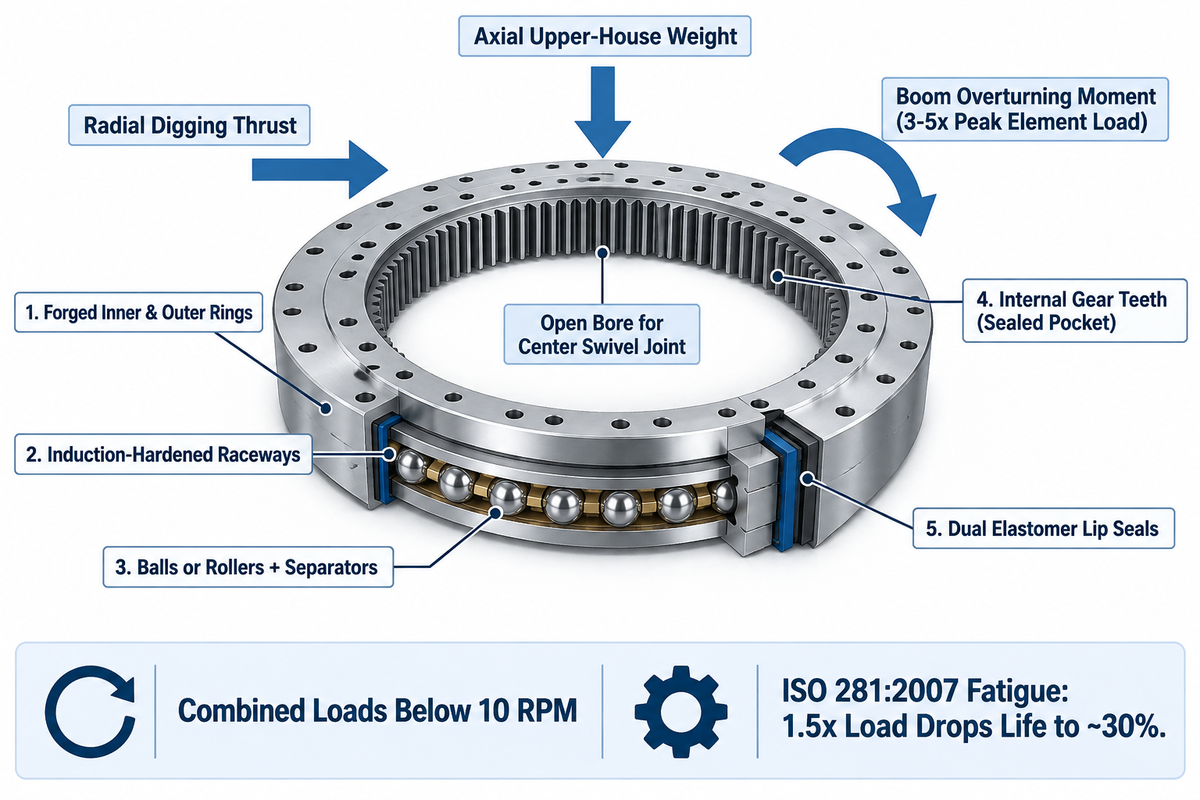
An excavator slewing bearing runs below 10 RPM in intermittent cycles while carrying three loads inside one compact ring. It supports axial upper-house weight, radial digging thrust, and boom overturning moments. At maximum tipping force a single rolling element is capable of taking 3-5 times the load of an average element within the load so the tilting moment is the primary life factor.
Like other rotating heavy machinery, a crawler excavator transfers full superstructure loads through one bolted turntable bearing. Ordinary radial ball bearings or plain bearings manage loads in one primary plane around a spinning axle. A slewing ring joins the upper frame and lower carbody directly, no central shaft in-between.
That open bore leaves clear room for the hydraulic center swivel joint feeding the travel motors and blade.
Five integrated components allow this combined-load rotation inside a single ring bearing:
- Forged alloy steel inner and outer rings bolt rigidly to the undercarriage carbody and upper house.
- Induction-hardened, precision-ground internal raceways distribute contact stress across the hardened circumference.
- Hardened steel balls or cylindrical rollers carry loads while polyamide or steel separators block sliding friction.
- The vast majority of hydraulic excavators incorporate fixed internal gear teeth into the stationary inner ring such that the upper pinion rotates within a sealed grease pocket.
- Dual elastomer lip seals contain raceway grease and prevent coarse mud, dirt and water from the jobsite.
Dynamic fatigue ratings follow ISO 281:2007 (scheduled for replacement by ISO/DIS 281), where rolling-contact fatigue scales inversely with the cube of load for ball bearings and the 10/3 power for roller bearings. On a ball ring, a peak element load only 1.5 times the average shortens that element’s calculated fatigue life to about 30 percent of the uniform-load value. On working construction equipment, dirty grease, abrasive wear, corrosion, torn seals, or loose bolts—failure modes outside ISO 281 rolling-contact fatigue—usually end bearing life long before theoretical fatigue arrives.
Before pulling a suspect excavator slew ring, mechanics must separate three distinct sources of cab play. Play between the inner ring and outer ring points to internal bearing clearance growth. Movement between a bearing ring and its steel flange signals loose, stretched, or broken mounting bolts. Rotational clunking during swing reversals signals pinion-to-ring gear backlash rather than vertical wear. For passive rotary table setups, review general slewing bearing fundamentals.
What is a swing motor in an excavator?
An excavator swing motor is the hydraulic motor that’s attached to the top of the planetary reduction gearbox inside the upper house. Oil under pressure rotates the motor shaft and the planetary gearbox increases torque and decreases speed. Its vertical output pinion meshes directly with the slewing bearing’s internal gear teeth to rotate the cab 360 degrees.
Since the swing motor and slew ring work in tandem, crews frequently incorrectly diagnose poor rotation. A worn swing motor or planetary gearbox causes weak swing torque, hydraulic drift on slopes, or gear-oil leaks into the pinion cavity. A worn swing bearing results in vertical cab rock when buckets hit, grinding under load, and quantifiable axial lift across the rings.
Single-Row Four-Point Ball vs. Crossed Roller vs. Triple-Row Roller Bearings
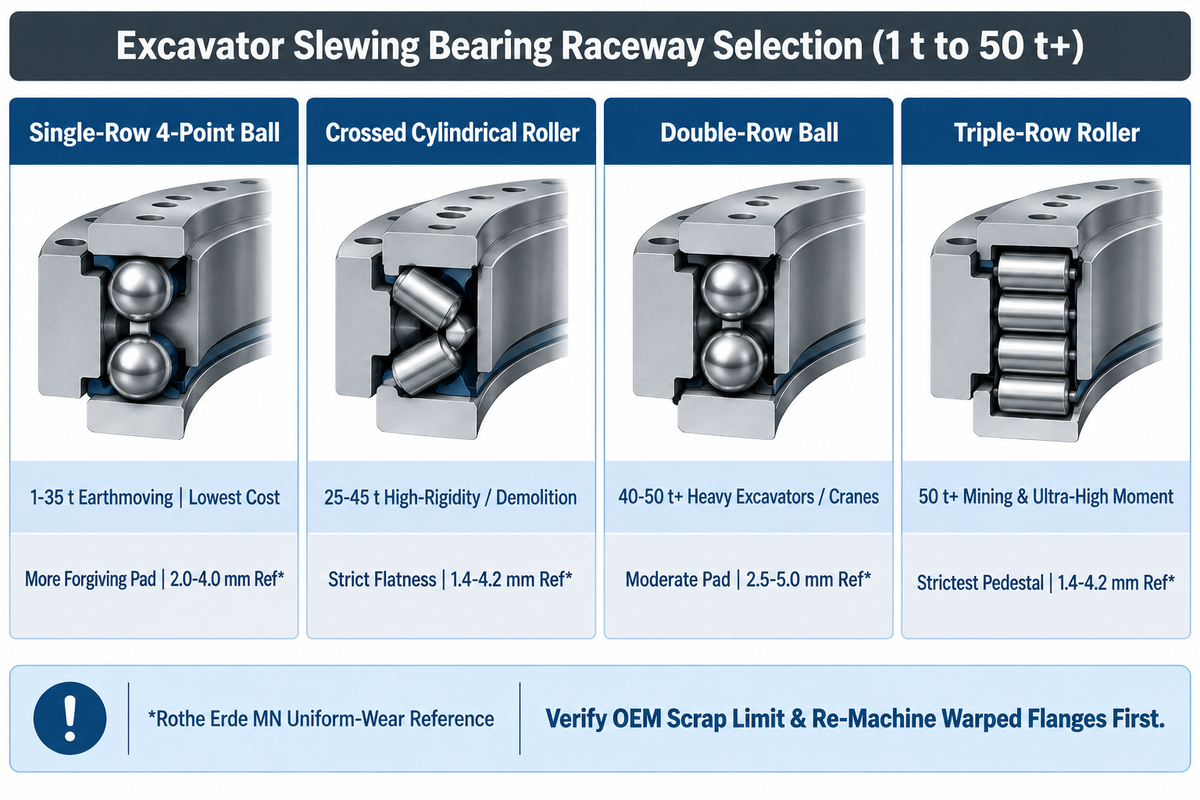
Slewing bearings for excavators use four main raceway designs. On a 20-ton to 35-ton hydraulic excavator, pick a single-row four-point contact ball ring when it meets static safety, fatigue, mounting-envelope, and stiffness targets.
A crossed roller ring fits jobs needing higher tilting stiffness on a flat, rigid frame, while triple-row roller rings serve 50-ton+ mining duty.
A stiffer roller ring isn’t reliable in platforms with a flexible welded carbody frame. Four-point ball rings roll on elliptical points at 45 degrees to the track, with comparatively low rolling friction (around 0.003-0.008 coefficient).
Even so, ball rings are not immune to mounting distortion: bolted-ring oval warp still shifts contact angles, drops load-sharing ball counts, and shortens fatigue life.
Roller rings trade forgiveness for higher moment density. Crossed cylindrical roller bearings alternate rollers at 90 degrees with line contact, pushing relative moment capacity to roughly 1.6 times a same-envelope four-point ball ring. They also generate higher friction and require far stricter flange flatness.
Triple-row roller bearings divide downward thrust, upward lift and radial loads over three separate roller tracks. That boosts moment capacity beyond 2.5 times baseline, but demands taller axial height and stiffer machined pedestals.
| Engineering Criterion | Single-Row 4-Point Ball | Crossed Cylindrical Roller | Double-Row Ball | Triple-Row Roller |
|---|---|---|---|---|
| Contact Geometry | Point contact, 45° angle | Line contact, 90° alternating | Dual-track ball point contact | Three dedicated roller tracks |
| Relative Moment Capacity | 1.0× baseline | ~1.6× baseline | ~1.5×–2.0× baseline | 2.5×+ baseline |
| Tilting Rigidity | Medium | Very high | Medium-high | Highest |
| Running Friction Torque | Lowest (μ ≈ 0.003–0.008) | Medium-high | Low-medium | Highest |
| Axial Height Profile | Slim (single row) | Slim (single row) | Tall (stacked rows) | Tallest (3 independent rows) |
| Mounting Flatness Tolerance | More forgiving (still requires flat pad) | Strict; edge-loads fast on warp | Moderate | Strictest machined support needed |
| Rothe Erde Uniform-Wear Reference (MN Tables; verify OEM scrap limit) | MN 06/09/25/23/28 (Ø20–70 mm balls): 2.0–4.0 mm | MN 12/13/19 (Ø16–100 mm rollers): 1.4–4.2 mm | MN 01/08 (Ø18–70 mm balls): 2.5–5.0 mm | MN 12/13/19 (Ø16–100 mm rollers): 1.4–4.2 mm |
| Relative Unit Cost | Lowest | Medium-high | High | Highest |
| Primary Excavator Fit | 1–35 t general earthmoving | 25–45 t high-rigidity / demolition | 40–50 t+ heavy excavators / cranes | 50 t+ mining & ultra-high moment |
Raceway Selection Decision Tree (20 t–50 t+ Excavators)
- For standard 20–35 t dirt work, pick a single-row four-point ball ring when static, fatigue, envelope, and stiffness checks pass. It offers the lowest friction, slim height, and best unit cost.
- For 25–45 t long-reach demolition or sorting grapples, a crossed roller bearing suits machines that need higher tilting stiffness or moment capacity on a sufficiently flat, rigid mounting frame.
- For 50 t+ quarry and mining duty, pick a double-row ball or triple-row roller bearing matched to a rigid support pedestal.
- If a welded flange doesn’t pass the flatness limits, first re-machine the mounting pad. A stiffer roller ring on a warped mounting flange puts load on fewer rolling elements and can result in an early failure. As documented in TGB Group’s mounting flatness engineering analysis, oversizing or stiffening the ring cannot compensate for a deficient mounting surface; fixing the mounting interface is required.
Internal vs. External Gears, 42CrMo Steel, and Raceway Hardening Specs
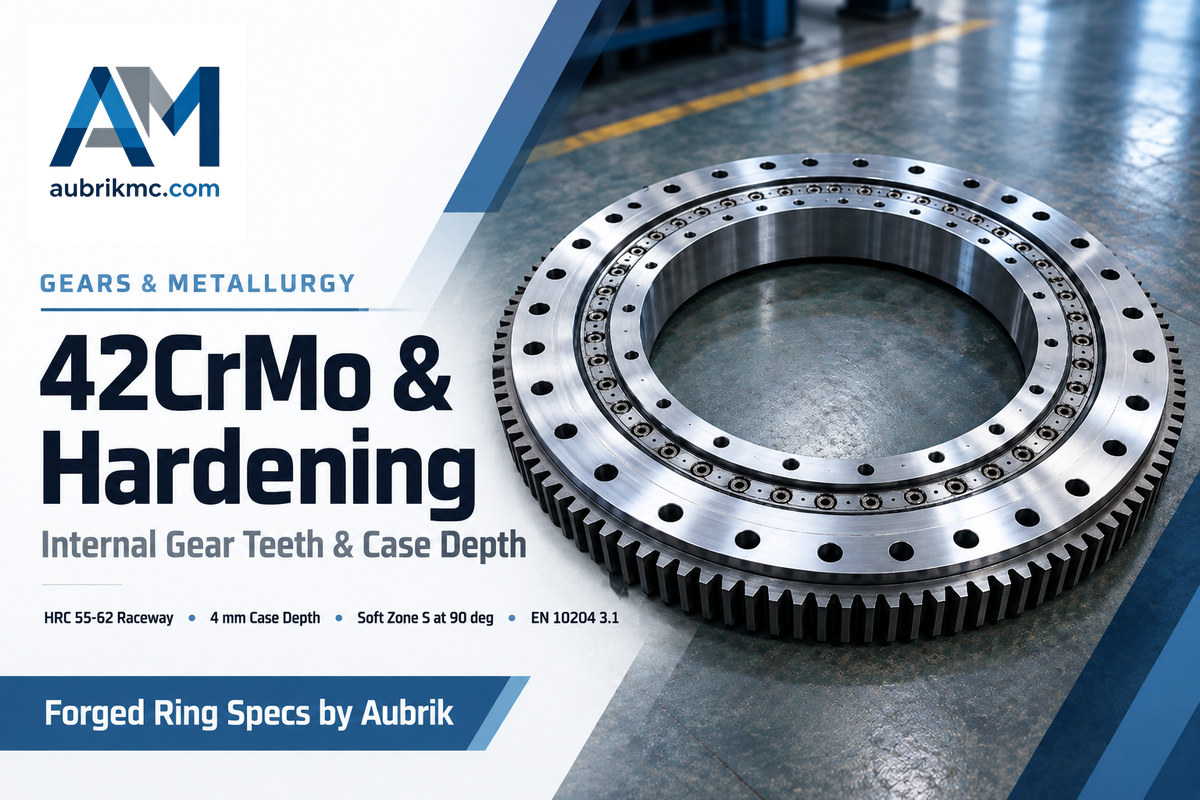
A high-quality slew ring for heavy hydraulic excavators can use forged 50Mn or 42CrMo rings with machined internal gear teeth and induction-hardened raceways reaching HRC 55–62. Effective hardened case depth beneath the raceway surface governs subsurface shear resistance and static load rating. Surface hardness alone is never enough.
Internal gears place machined teeth along the inner bore of the stationary ring. The swing pinion descends from the top house into a sealed grease cavity, protecting the mesh from stones and debris. External gear slewing bearings place teeth along the outer diameter.
They appear mostly on mini excavators, tower cranes, and truck lifts where external pinion access saves chassis space. Gearless rings serve passive rotary tables driven by belts or external motors.
Ring metallurgy separates durable heavy excavator parts from budget replacements. Factories forge rings from 50Mn carbon-manganese steel or 42CrMo (AISI 4140) alloy steel, then quench and temper the core for toughness. Compared with 50Mn, 42CrMo hardens deeper through thick forged sections and resists shock cracking better.
In a comparative laboratory test published by NGSWBTEC, 42CrMo delivered 30% to 40% longer contact fatigue life than 50Mn under identical contact stress.
| Specification Item | 50Mn Forged Steel | 42CrMo (4140) Alloy Steel | Buyer Verification Check |
|---|---|---|---|
| Typical Excavator Class | Light to moderate duty (mini & utility) | Medium, heavy, breaker & mining excavators | Require EN 10204 3.1 mill heat certificate |
| Raceway Surface Hardness | HRC 55–62 induction hardened | HRC 55–62 induction hardened | Confirm effective case depth, not surface HRC alone |
| Hardenability & Shock Core | Smaller critical hardening diameter | Deep hardenability in heavy forged sections | Request quenched-and-tempered core hardness log |
| Machined Gear Quality (Process-Driven) | Cut or contour-hardened per gear drawing for either steel grade | Cut or contour-hardened per gear drawing for either steel grade | Specify gear grade (e.g., ISO 7–9, m 2.1–41.8) & tooth hardening on drawing |
| Non-Destructive Testing (NDT) | Visual + basic dimensional check | Ultrasonic (UT) forging + magnetic particle (MT) raceway | Require signed UT/MT report before shipment |
Require documented effective induction hardened case depth, such as 4 mm vs. under-quenched 2.5 mm case, on each quote along with HRC 55-62 surface hardness. A raceway quenched to only 2.5 mm passes a handheld surface HRC check yet suffers subsurface case crushing under digging impact. Induction hardening also leaves a narrow unhardened transition band called the soft zone, stamped with an “S” or plug mark.
Position that soft zone 90 degrees off the boom load axis during assembly so peak tipping force stays on hardened steel.
Excavator Slewing Bearing Dimensions and How to Measure for Replacement
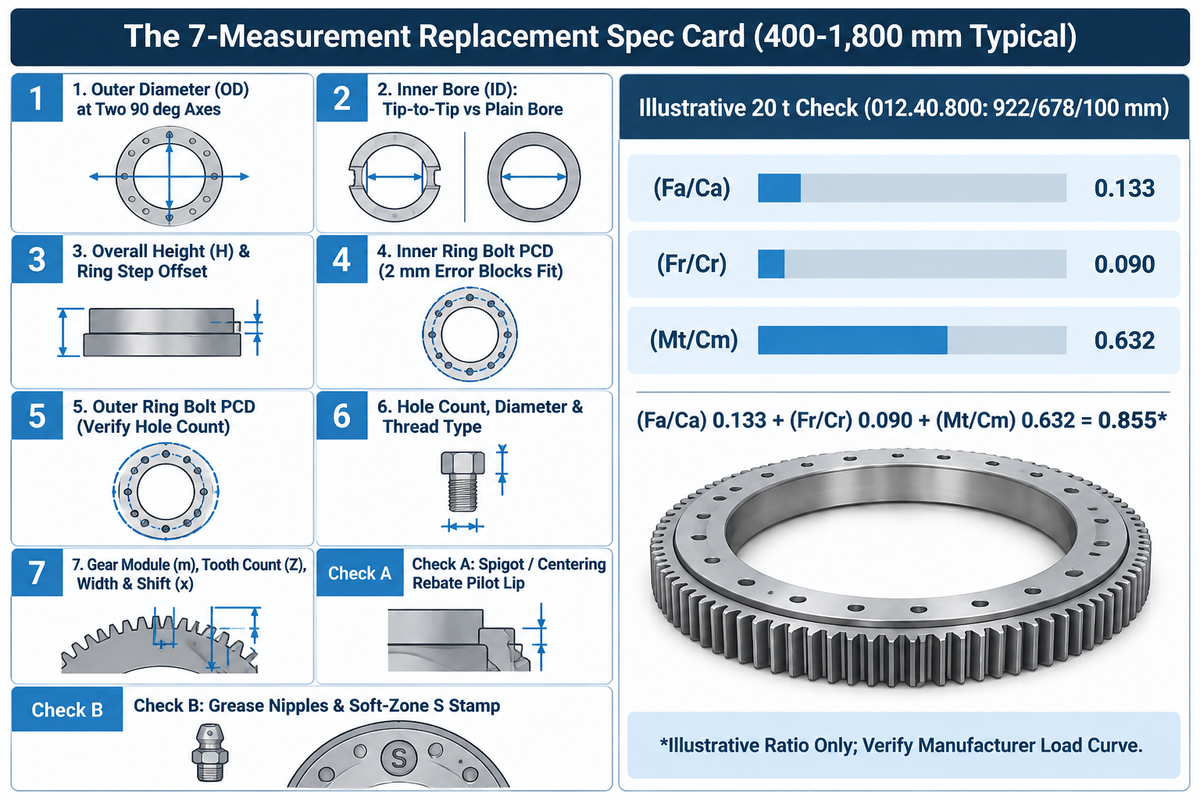
Excavator slewing bearings span roughly 400 mm to 1,800 mm in outer diameter across compact through 50-ton machines. Full industrial catalog lines run from 200 mm to 6,000 mm, with segmented mining rings extending larger.
Measuring only OD, ID, and height is never enough. Catalogs separate gear tip diameter from plain ring bore, and one wrong bolt-circle measurement forces expensive re-craning.
Follow The 7-Measurement Replacement Spec Card below prior to placing any purchase order. Logging every dimension on the shop bench eliminates bolt collisions and pinion binding. Read standard part strings with Aubrik’s slewing bearing designation decoder or consult open dimension tables on slewing bearing specifications and custom sizing.
| # | Dimension / Parameter | How to Measure Accurately | Common Ordering Trap to Avoid |
|---|---|---|---|
| 1 | Outer Diameter (OD) | Measure across outer ring body at two 90° axes (mm) | On external gears, do not confuse gear tip diameter with ring OD |
| 2 | Inner Bore Diameter (ID) | Measure tooth tip-to-tip on internal gear rings and note plain bore | Mixing root diameter with tip diameter causes pinion interference |
| 3 | Overall Height (H) & Ring Step | Measure total height between mounting faces plus inner/outer ring height | Ignoring ring step offset misaligns seal lips and pinion height |
| 4 | Inner Ring Bolt PCD | Measure center-to-center across opposite mounting holes on inner ring | Even a 2 mm pitch circle error prevents bolt insertion |
| 5 | Outer Ring Bolt PCD | Measure opposite hole centers across outer ring circumference | Never assume inner and outer hole counts match |
| 6 | Hole Count, Diameter & Thread | Count every hole; note plain through-holes vs tapped metric threads & counterbores | Missing 2 skipped holes near grease ports breaks bolt symmetry |
| 7 | Gear Module, Tooth Count & Width | Count total teeth (Z), measure gear face width, and check module (m) | Ignoring profile shift coefficient (x) ruins pinion backlash |
| Check A | Spigot / Centering Rebate | Check whether inner or outer ring has a machined pilot lip | Missing a pilot step shifts concentricity onto bolts |
| Check B | Grease Nipples & Soft Zone | Log nipple thread size, face/radial location, and “S” soft-zone stamp | Blocked grease ports prevent routine relubrication after assembly |
Worked Combined-Load Check (Illustrative 20-Ton Excavator Ring)
Before consulting model-specific combined-load curves, Aubrik’s engineering guide illustrates load balance with the simplified dimensionless index (Fa / Ca) + (Fr / Cr) + (Mt / Cm). The worked example below uses explicit assumed inputs matching Aubrik’s 012.40.800 envelope (922 mm OD, 678 mm bore, 100 mm height, and 220 kg mass):
- Assumed peak digging loads: axial load Fa = 160 kN, radial thrust Fr = 45 kN, and tilting moment Mt = 240 kN·m.
- Assumed allowable static ratings (after safety factor): Ca = 1,200 kN, Cr = 500 kN, and Cm = 380 kN·m.
- Illustrative load index: (160 / 1,200) + (45 / 500) + (240 / 380) = 0.133 + 0.090 + 0.632 = 0.855 (illustrative ratio; final qualification requires the model’s load curve).
In this assumed example, the tilting-moment term equals 0.632 of its assumed static rating, while the assumed axial digging load term equals 0.133 of its rating. Final bearing selection relies on manufacturer combined-load curves, duty-cycle fatigue life calculations (combining ISO 281 with manufacturer-specific methods per the Schaeffler load-life guide), and supporting structure stiffness analysis. You can test your machine loads directly in Aubrik’s tilting moment calculator before requesting a drawing.
Matching Slewing Bearing Designs to Excavator Tonnage and Severe-Duty Cycles
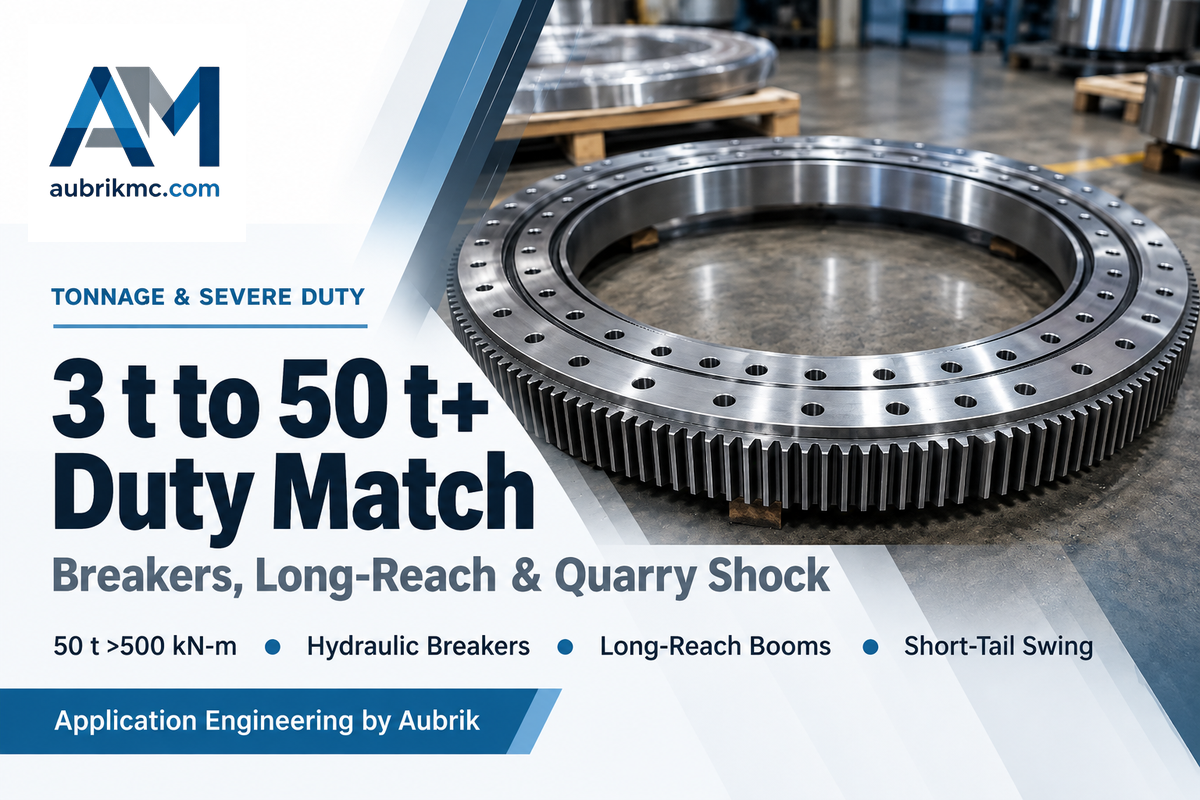
Spanning a 3-ton mini excavator to Aubrik’s 50-ton heavy-digging reference case above 500 kN·m, each machine needs a bearing sized to its own digging loads. Fitting a standard earthmoving bearing onto a dedicated hydraulic breaker or long-reach demolition machine routinely cuts service life sharply, requiring upgraded ring section, gear hardening, and seal protection matched to actual duty shock.
Jobsite layout shifts load patterns just as much as tonnage. Regulators such as the UK Health and Safety Executive (HSE) warn against slewing crush hazards—trapping workers between the rotating excavator and fixed structures—and promote tight-tail-swing machines in confined spaces. Short-tail-swing excavators pack heavier counterweights closer to the swing axis, changing rear-quadrant load distribution.
Severe attachments also change the dominant failure mode: hydraulic breakers send high-frequency shock spikes that brinell raceways, while long-reach booms raise continuous front overturning moments.
| Machine Class / Duty | Common Bearing Type | Typical Gear & Steel | Key Upgrade / Risk Factor |
|---|---|---|---|
| Mini Excavators (1–6 t) | Single-row 4-point ball | Internal or external gear; 50Mn or 42CrMo | Compact seals vulnerable to trench mud & pressure washers |
| Medium Excavators (15–35 t) | Single-row 4-point ball (heavy series) | Internal gear; 42CrMo quenched & tempered | Localized raceway wear from repetitive trenching arcs |
| Heavy Excavators (35–50 t) | Crossed roller (35–45 t), double-row ball (40–50 t), or triple-row roller (45–50 t severe duty) | Internal gear; 42CrMo with deep hardened case | High cyclic overturning moments; flange flatness becomes critical |
| Mining Excavators (50 t–80 t+) | Triple-row roller (single-piece or bolted segment) | Internal gear; high-purity 42CrMo with full UT/MT inspection | Bolted segment assemblies simplify transport on oversized mining rings |
| Hydraulic Breaker / Demolition | Up-rated ball or crossed roller (check flatness) | 42CrMo + induction-hardened gear flanks | High shock spikes demand strict bolt re-torque & frequent grease |
| Long-Reach / Amphibious | High-moment ball or multi-row roller | 42CrMo + corrosion coating & double-lip NBR/Viton seals | Water ingress and continuous front overhang moment govern life |
Excavator Swing Bearing Failure Symptoms and Dial-Indicator Play Inspection
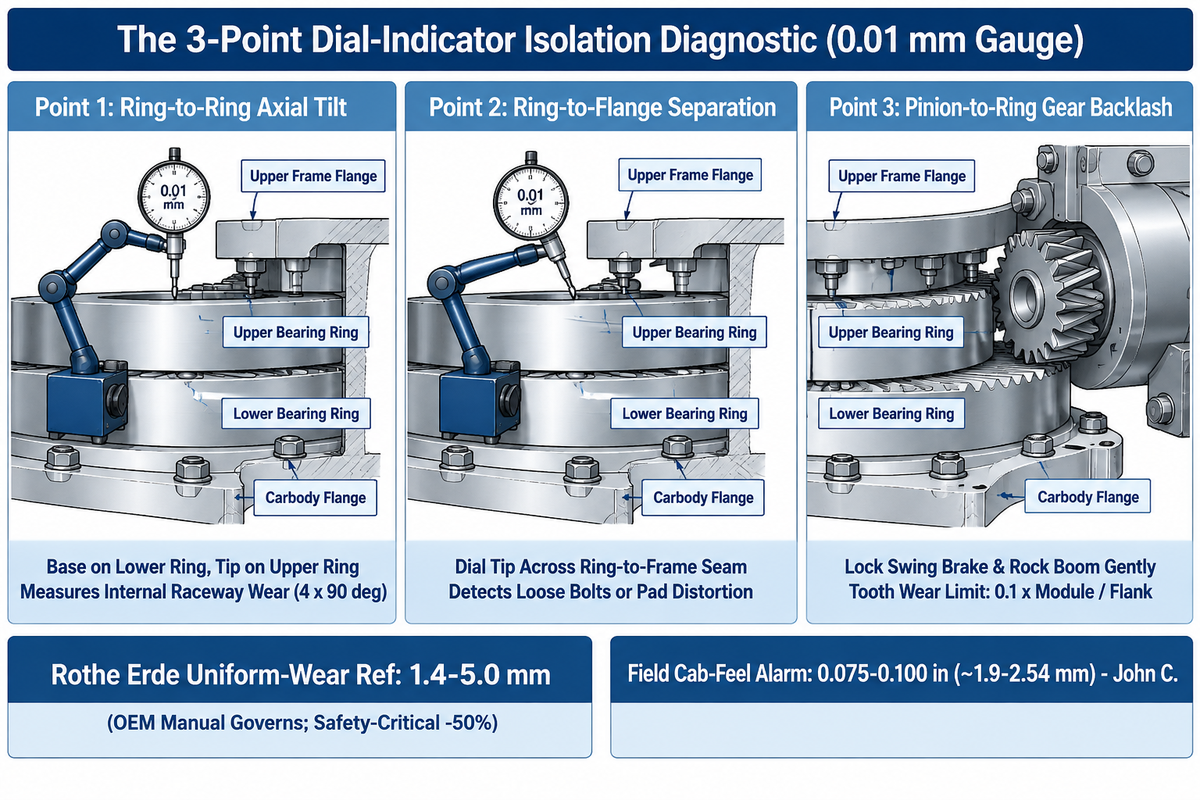
Accurate swing bearing diagnosis uses a 0.01 mm dial indicator tracked against a commissioning baseline. Waiting for abnormal noise or loud grinding risks sudden bolt failure. Matching the MN-series bands in Table 1, Thyssenkrupp rothe erde’s wear tables set maximum uniform tilting-clearance increases from 1.4 to 5.0 mm across 16 to 100 mm rolling elements.
Safety-critical machines can cut those catalog limits by 50%, and the excavator OEM manual always sets final scrap thresholds. In daily fleet work, crews often feel play well before reaching upper catalog ceilings. Machinery appraiser John C., who has inspected hundreds of excavators on Heavy Equipment Forums, describes what field mechanics see:
“You will feel it in cab when you get to 0.075 [inches, ~1.9 mm] and possibly see metal flakes in the grease. I’ve seen them over 0.100 [inches, ~2.54 mm] before and had to tell the owners they were in danger of someone getting hurt.”
Rothe Erde tables measure incremental wear from a Day-1 baseline scaled by ball or roller diameter. John C.’s 0.075–0.100 inch range marks practical cab-feel alarms when no baseline sheet exists.
Check the gear teeth too: Rothe Erde sets permissible tooth-flank wear up to 0.1 × module per tooth flank before gear replacement.
The 3-Point Dial-Indicator Isolation Diagnostic
Park on a flat, firm surface and wire-brush the steel mounting locations clean. Use a short-arm magnetic base so any flex of the frame won’t distort gauge travel (Baumaschinenteile field protocol). Perform these three isolated checks before ordering components:
- Point 1 (ring-to-ring axial tilt for internal wear): clamp the magnetic base to the lower ring and place the 0.01 mm tip vertically on the upper ring. Zero the gauge with slight downward bucket pressure lifting the front idlers, then raise the bucket to reverse the moment at four 90° marked swing positions.
- Point 2 (ring-to-flange separation for joint movement): move the dial tip across the seam between the bearing ring and its bolted frame flange. Detectable relative movement indicates a need to check for loose or stretched bolts, thread stripping, or disfigured mounting pads before writing off the raceway.
- Point 3 checks pinion-to-ring rotational play for gear backlash. Lock off the swing brake, slowly rock the boom from side to side and observe the mesh through the cover. Rotational clunking together with typical Point 1 vertical readings indicates worn pinion teeth or gearbox backlash, not a ruined track.
How do I measure excavator slew ring wear?
Always park on firm, level ground before running the Point 1 ring-to-ring dial-indicator check above so track settlement does not skew your reading. Use your commissioning baseline and OEM scrap limit as guideposts for all four 90-degree quadrants instead of a one-shot test.
Factories will seldom ship excavators with a signed clearance baseline sheet. Record your initial dial-indicator measurement when you begin operation with a new machine or a new bearing. Re-measuring every 500 to 1,000 hours catches rising raceway wear months before seizure.
Power the machine off immediately when measured wear hits the published scrap limit.
| Observed Symptom | Likely Root Cause | Diagnostic Verification | Immediate Action |
|---|---|---|---|
| Cab rocking during boom reversal | Excessive internal raceway wear or loose bolts | Run Point 1 & Point 2 dial-indicator checks | Compare to OEM limit; stop machine if past threshold |
| Continuous grinding during rotation | Raceway spalling, pitted balls, or dry track | Pull grease sample and inspect with magnet | Plan bearing teardown; check pinion for secondary damage |
| Sharp popping or cracking sound | Broken spacer cage, brinelled track, or snapped bolt | Check bolt torque, inspect fastener heads for shear, and check seal gap | Halt operation immediately to prevent house separation |
| Metallic flakes in purged grease | Active subsurface raceway flaking or tooth chipping | Separate fine steel dust vs large gear chunks | Measure axial clearance & source replacement ring |
| Uneven sticky spots while swinging | Warped mounting flange or tight gear high-spot | Monitor hydraulic swing pressure over 360° | Check pinion backlash & mounting pad flatness |
| Protruding or torn rubber lip seal | Over-greasing in static position or frozen mud | Visual circumference inspection under house | Replace seal strip promptly; purge contaminated grease |
| Thin oily soup in swing gear tub | Swing motor shaft seal leaking hydraulic oil | Dipstick check swing gearbox & gear cavity level | Rebuild motor/gearbox seal; clean & refill gear tub |
| Clunk only when reversing swing | Excessive pinion-to-ring backlash or gearbox wear | Run Point 3 check & measure tooth flank wear | Inspect gearbox bearings; scrap gear past 0.1×module wear |
| Rising hydraulic swing pressure or heat | Binding raceway or high tilting drag | Monitor hydraulic swing circuit pressure and oil temperature across 360° | Check lubrication, bolt torque, and clearance immediately |
Grease Selection, 90-Degree Relubrication, and Lip Seal Maintenance
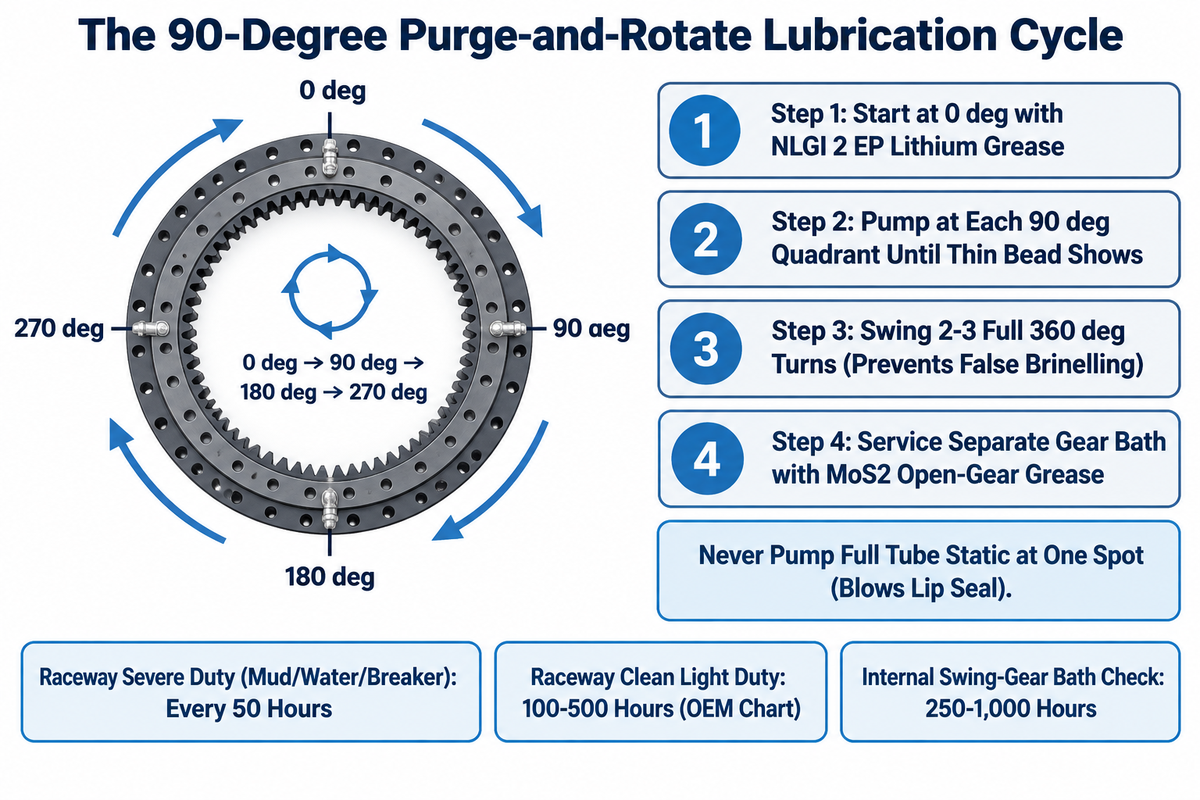
Relubricate the excavator slewing bearing raceways every 50 operating hours in wet, dusty or breaker service, or up to 500 hours in clean light duty. Use NLGI 2 extreme-pressure lithium grease (GB7324 No.2 equivalent) while swinging the house in 90 degree steps. Clean grease and intact lip seals protect swing performance and reliability far better than raw catalog ratings alone.
Never mix incompatible grease thickeners, and keep raceway lubrication separate from the swing-gear bath.
Two lubrication mistakes ruin otherwise good swing bearings.
1. Operators pump a full grease tube while stopped in a single position. High gun pressure blows out the elastomer lip seal on one side while leaving three-quarters of the track dry.
2.
Crews fail to catch hydraulic oil leaking past a worn swing motor shaft seal into the gearbox and ring-gear tub (Heavy Equipment Forums field reports). Hydraulic oil thins gear grease into watery slurry, scoring tooth flanks and flushing grit into the lower seal.
The 90-Degree Purge-and-Rotate Lubrication Cycle
- Start at 0° by wiping every grease nipple clean and pumping steady shots of NLGI 2 EP lithium grease without excessive gun pressure.
- Rotate the upper house 90°, 180°, and 270° between rounds, pumping at each quadrant until a thin clean bead barely shows along the seal lip.
- Swing through two or three full 360-degree turns after greasing so oil film redistributes during short-arc trenching and prevents false brinelling.
- Inspect the internal gear tub through the top cover on its own interval, draining oil-diluted slurry, fixing leaking motor seals, and refilling with MoS2-fortified open-gear grease.
How often should I grease my excavator slew ring?
In mud, water, demolition dust, or hydraulic breaker work, stick strictly to the 50-hour raceway purging interval rather than waiting for scheduled engine service. Clean light duty allows 100 to 500 operating hours based on the machine’s OEM chart.
Inspect the separate internal swing-gear bath every 250 to 1,000 hours, and regrease raceways right after deep-water work or pressure washing.
Inspect lip seals at each fuel stop. A torn dust seal lets silica grit enter the raceway, turning grease into grinding paste outside ISO 281 fatigue curves. Unmanaged friction and tilting drag force the hydraulic swing circuit to work harder, driving up operating pressure and hydraulic oil temperatures as an early warning alarm.
Excavator Slewing Bearing Replacement, Frame Flatness, and Bolt Preload Rules
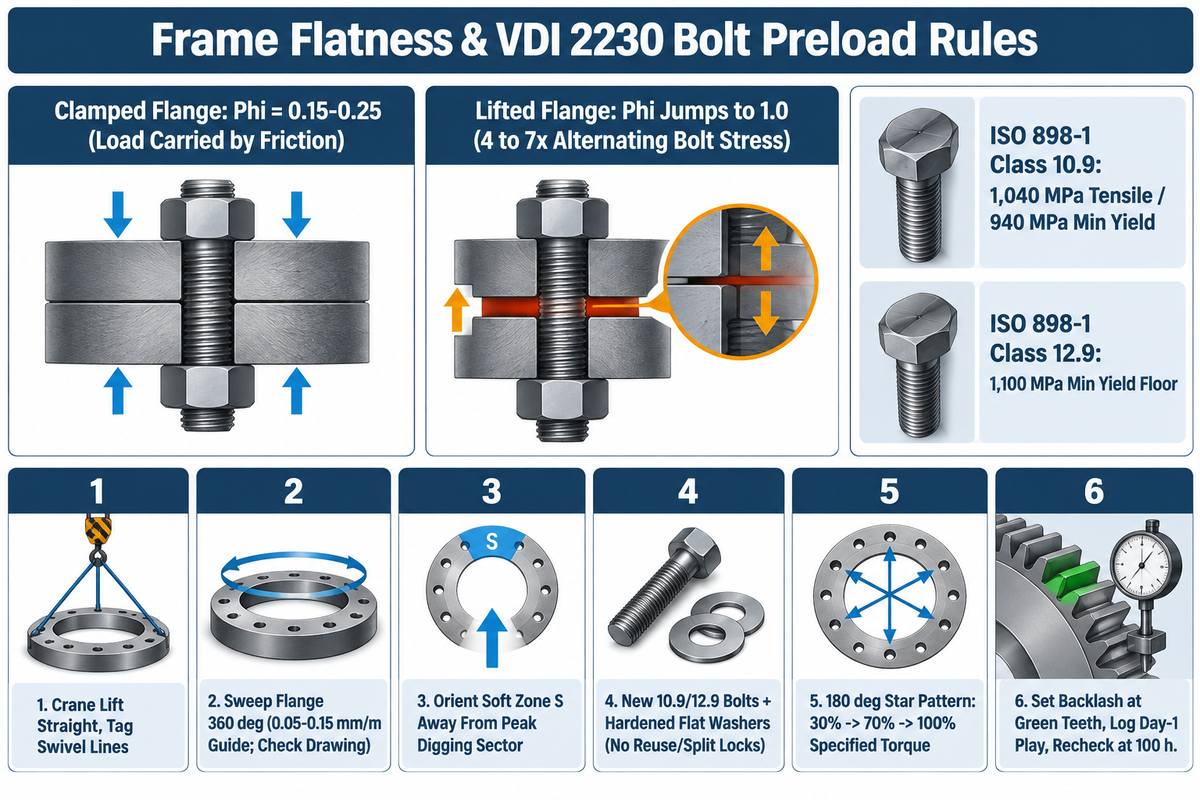
A new excavator slewing bearing fails fast if bolted onto a warped carbody flange or fastened with reused Grade 10.9 or 12.9 bolts. Typical flatness limits are approximately 0.05 to 0.15 mm/m, but real-world diameter-banded tolerances are always specified by the bearing drawing. Reliable replacement treats the mounting pad and clamped bolted joint as one structural system.
Two documented engineering rules govern installation life. First, the bearing ring bends to copy whatever steel flange sits underneath it. As TGB Group’s Technical Engineering Department reported in June 2026:
“In industrial practice, premature wear in slewing rings is rarely caused by the bearing component itself. The more frequent root causes are mounting surface deviations, insufficient structural rigidity, uneven bolt preload or loss of preload over time.”
Second, bolts don’t survive by carrying boom loads in raw tension or shear. In Technical Publication DYCO-TP-109 Revision 3 (September 2026), DYCO Research and Development states: “A slewing ring bearing does not carry its load through its bolts; it carries it through the clamped interface those bolts create.”
Under VDI 2230 Part 1 for a representative steel flange (clamped stiffness 3 to 6 times bolt stiffness), the bolt load factor Φ stays near 0.15 to 0.25 while compressed. Once preload drops and the flange lifts open, Φ jumps to 1.0. That multiplies alternating bolt stress by 4 to 7 times in that stiffness model and snaps fasteners within shifts. Actual separation margins vary with load height and frame stiffness, making rated clamp force mandatory.
Match bolts strictly to ISO 898-1:2013 property classes. Under ISO 898-1 mechanical acceptance standards, Class 10.9 requires 1,040 MPa minimum tensile strength and 940 MPa minimum yield, not the nominal 1,000 / 900 MPa labels. Class 12.9 sets a 1,100 MPa minimum yield floor. Obtain final tightening torque values from the excavator or bearing manufacturer’s installation drawing based on specified thread friction conditions.
- Match crane capacity to upper-house weight. Tag hydraulic lines around center swivel joint. Lift straight, no side-loading dowels.
- Strip paint, burrs, and weld spatter from both flanges, sweep 360 degrees with a dial gauge or laser level, and re-machine any warped pad before setting the ring.
- Orient the stamped “S” soft zone away from the highest digging-load sector during ring placement.
- Install brand-new ISO 898-1 Grade 10.9 or 12.9 bolts with hardened flat washers, never reusing old bolts or fitting split lock washers (see flange geometry in USPTO patent US4906113A).
- Tighten opposite 180-degree bolt pairs in a three-stage star pattern at 30%, 70%, and 100% of specified tightening torque with calibrated wrenches, then check smooth rotation.
- Set pinion-to-ring backlash at the green-painted maximum radial runout teeth, spin 360 degrees to confirm clearance, log your Day-1 dial-indicator baseline, and recheck bolt torque after 100 operating hours.
How Much Does an Excavator Slewing Bearing Cost? Part Price and Installed Total
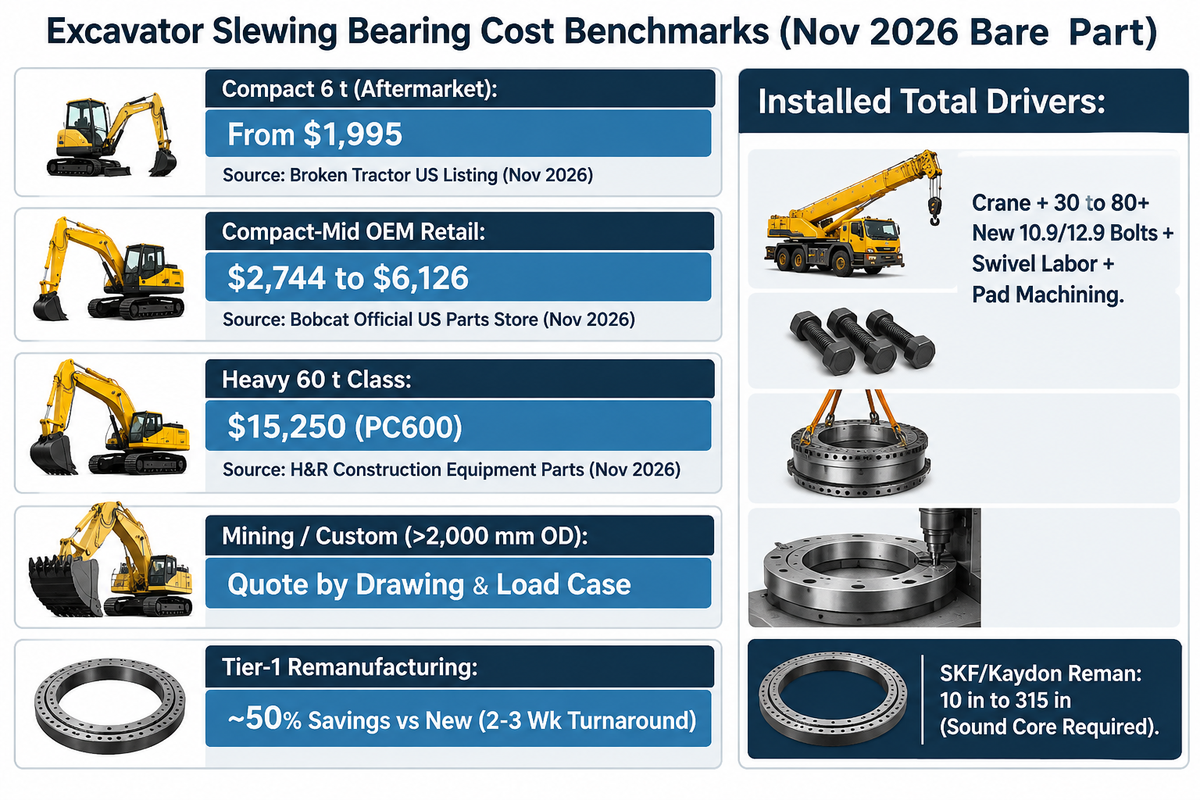
Across OEM and aftermarket US catalogs, bare excavator slewing bearing prices scale steeply from compact utility machines up to 60-ton quarry classes, as itemized in the November 2026 benchmark table below. Freight, new Grade 10.9 or 12.9 bolt kits, crane rentals, and shop hours are added to all bare part prices. Low-cost industrial turntable rings sold online for packaging tables and robotics lack the hardened raceways and shock capacity required on excavators.
Installed totals shift sharply with machine tonnage and downtime location. Separating the upper house requires disconnecting the center swivel joint and craning multi-ton superstructures off the tracks. Crews must also inspect flange flatness and torque 30 to 80+ high-tensile bolts.
On mid-size excavators, crane and labor charges routinely match or exceed the bare bearing cost.
| Excavator Class / Option | Public Part Listing Reference | Pricing Source & Date | Additional Installed Cost Drivers |
|---|---|---|---|
| Compact Excavator (6 t, Aftermarket) | From $1,995 (Komatsu PC60, Part #203-25-61100) | Broken Tractor US listing (Nov 2026, bare part) | New bolt kit, swivel reseal, shop hoist labor |
| Compact–Mid Excavator (OEM Retail) | $2,744 (#7256685) to $6,126 (#7302897) | Bobcat official US parts store (Nov 2026, bare part) | Freight, Grade 10.9/12.9 fasteners, dealer shop hours |
| Heavy Excavator (60 t Class) | $15,250 (Komatsu PC600, Part #21M-25-11100) | H&R Construction Equipment Parts (Nov 2026, bare part) | Heavy mobile crane, multi-tech teardown, flatness machining |
| Mining / Custom (>2,000 mm OD) | Quote by engineering drawing & load case | Direct OEM / ISO factory RFQ | Special freight, bolted segment assembly, NDT certification |
| Tier-1 Bearing Remanufacturing | About 50% savings vs. new replacement | SKF / Kaydon Remanufacturing Program | 2–3 week turnaround; requires sound core removed before seizure |
When does bearing remanufacturing beat buying new?
Published SKF and Kaydon Bearings white papers show that sound rings from 10 inches (25 cm) to 315 inches (8 m) can be reground and rebuilt into serviceable assemblies. Rebuilders restore internal clearance by fitting slightly oversized rolling elements, new spacers, and fresh elastomer seals into the reground rings. Individual regrinding holds axial face runouts of 0.0002 to 0.0030 inches versus 0.005 to 0.010 inches on typical batch-ground new units.
On 5-to-15-ton machines, stocked new rings win on speed; on 40-ton+ mining fleets, rotating one spare core slashes emergency downtime.
OEM vs. Aftermarket Slewing Bearing Suppliers, Lead Times, and 2026 Buyer Shifts
Confirmed domestic stock for major excavator brands such as Caterpillar, Komatsu, and Hitachi ships within days when available locally. Non-stock OEM backorders and tailored mining rings take several weeks to manufacture. Entering 2026–2027, fleet buyers are moving away from unit-price shopping toward drawing-first specs, dual sourcing, and verified mill paperwork.
Three concrete market forces explain this procurement shift.
1. First, EU Machinery Regulation (EU) 2023/1230 (adopted June 14, 2023) replaces Directive 2006/42/EC on January 20, 2027. Substantial modifications such as non-OEM heavy booms on EU machines trigger new conformity assessments.
2. Major bearing makers including Liebherr deploy bearing clearance monitoring (BCM) sensors inside heavy roller rings for predictive swaps, as documented in patent US20260140016A1.
3. Third, steady equipment growth into 2027 is highlighted by S&P Global Market Intelligence in Power & Motion. Separately, Transparency Market Research projects the global slewing ring market rising from $5.2 billion in 2025 toward $8.3 billion by 2036 (4.4% CAGR), encouraging fleets to qualify secondary suppliers early.
| Sourcing Tier | Representative Channels | Typical Lead Time | Best Procurement Fit |
|---|---|---|---|
| Tier 1: Machine OEM Dealers | Cat, Komatsu, Hitachi, Volvo dealers | Days if stocked; several weeks on backorder | Machines under warranty or superseded serial-number updates |
| Tier 2: Tier-1 Bearing OEMs & US Stock Distributors | SKF/Kaydon, Thyssenkrupp rothe erde, Schaeffler, Liebherr, ConEquip, H&R | Days if domestic stock; 2–3 weeks reman (SKF/Kaydon); multi-week factory build | Emergency breakdown spares & high-value mining remanufacturing |
| Tier 3: ISO-Audited Direct Factories | Specialized factories such as Aubrik (200–6,000 mm, 42CrMo, ISO 9001 + BV) | Quoted by drawing / batch (planned spares & OEM builds) | Fleet planned spares, custom OEM load cases, and dealer bulk inventory |
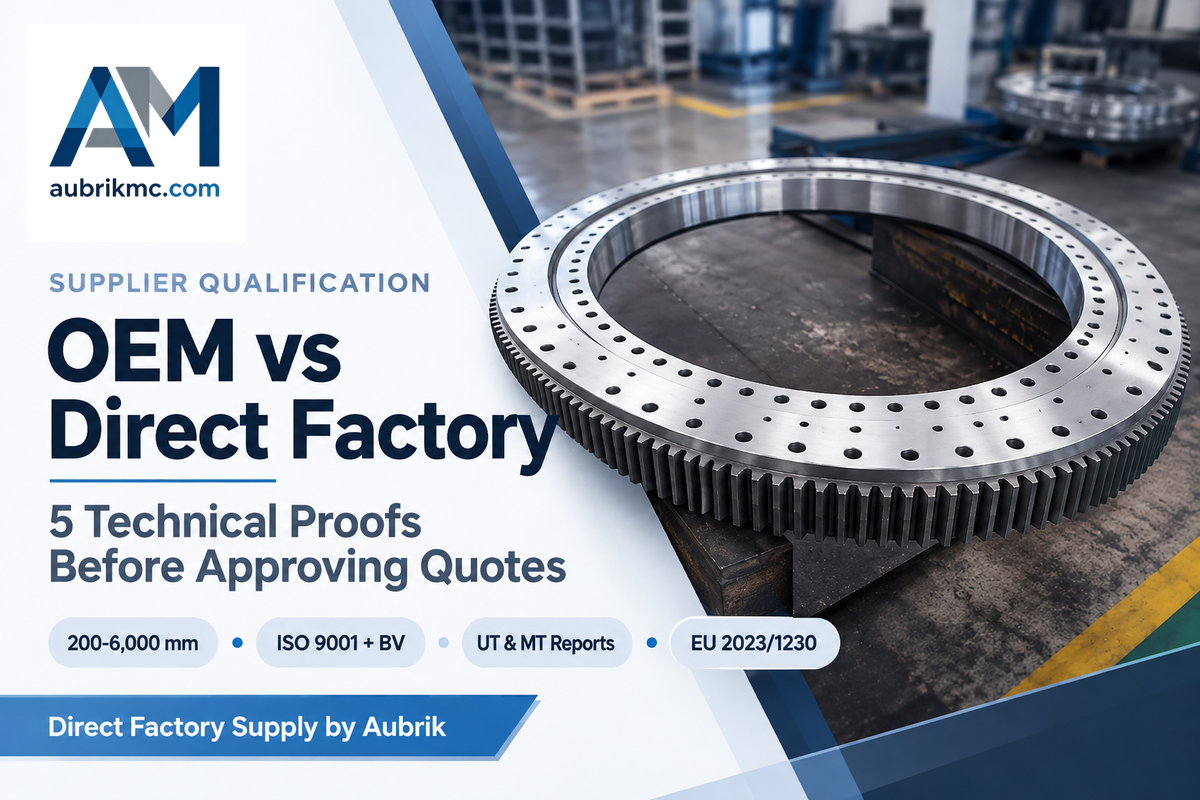
Require five technical proofs before approving any aftermarket or direct-factory quote. First, sign off on all seven replacement spec-card parameters plus profile shift and soft-zone marking. Second, collect the 42CrMo mill certificate and core hardness log. Third, confirm HRC 55–62 surface hardness alongside documented effective hardened case depth. Fourth, demand signed ultrasonic (UT) and magnetic particle (MT) reports. Fifth, lock written warranty terms and realistic door-to-door delivery dates. Compare supplier files easily using our slewing bearing selection guide and open directories like GlobalSpec.
Looking for Open Dimension Tables or a Drawing-Matched Excavator Slewing Bearing Quote?
Aubrik (Wuxi ABK Machinery) builds four-point ball (010–014), cross roller (110–112), and three-row roller (130–134) slewing rings from 200 mm to 6,000 mm. Two plants under an ISO 9001 quality system with BV factory approval produce over 70,000 units annually. Submit your 7-measurement spec card, machine serial number, or load case on our slewing bearing specifications and custom sizing hub for a drawing match.
Frequently Asked Questions
What does a slewing bearing do on an excavator?
An excavator slewing bearing rotates the rotary superstructure on the stationary track undercarriage. It lets the cab, boom, and stick swing 360 degrees smoothly under heavy work. Its hardened raceways take the superstructure mass while supporting the side digging loads and cantilevered boom moments at the same time. Integral gear teeth also mesh directly with the hydraulic swing motor pinion.
How long does an excavator slew ring bearing last?
A well-maintained excavator slew ring bearing runs for years in standard dirt work before reaching its OEM tilting-clearance wear limit (1.4 to 5.0 mm in Rothe Erde uniform-wear tables), whereas warped mounting flanges, dirty grease, or hydraulic breaker shock cut service life sharply. Keeping clean NLGI 2 extreme-pressure grease inside intact lip seals and holding rated bolt preload preserves raceway longevity far better than theoretical fatigue ratings alone.
Can I replace an excavator slew ring with a different brand?
Yes, cross-brand replacement works cleanly when all seven physical interface dimensions, gear parameters, and original load ratings match. Match OD, ID, height, inner and outer bolt PCDs, hole number and thread, gear module, tooth number and port position. Also require 42CrMo metallurgy certificates, verified induction case depth, and ultrasonic test reports.
Where is the slew ring located in an excavator?
The slew ring bolts horizontally between the track undercarriage carbody and the revolving upper house frame. It encircles the center swivel joint and directly engages the vertical swing gearbox pinion.
Why do excavator slewing bearing mounting bolts loosen or snap after replacement?
Post-replacement bolt failures happen when crews reuse yielded fasteners, bolt onto a warped flange, or skip hardened flat washers. Tightening bolts in a circle instead of a calibrated star sequence also leaves uneven preload. Once clamp force drops, cyclic boom loads shift into direct alternating bolt stress and snap fasteners rapidly. Clean paint and burrs off both steel seats, use calibrated wrenches, and recheck torque after initial break-in hours to keep the joint compressed.
Who makes slewing bearings for heavy excavators?
Heavy excavator slewing rings are manufactured by Tier-1 bearing makers like SKF/Kaydon, Thyssenkrupp rothe erde, Schaeffler, and Liebherr Components, plus ISO-audited direct factories supplying 42CrMo rings through OEM and aftermarket channels.
References & Sources
- International Organization for Standardization ISO 76:2006 Rolling bearings, Static load ratings
- International Organization for Standardization ISO 281:2007 Rolling bearings, Dynamic load ratings and rating life (pending ISO/DIS 281 revision)
- International Organization for Standardization ISO 898-1:2013 Mechanical properties of fasteners made of carbon steel and alloy steel
- European Commission – Machinery Legislation: Regulation (EU) 2023/1230 Replacing Directive 2006/42/EC
- UK Health and Safety Executive (HSE) – Excavators: Overview and Slewing Hazards
- Thyssenkrupp rothe erde Technical Basics on Bearing Inspection and Wear Measurement (Tables 1–3 & Gearing Check)
- DYCO Research and Development Department DYCO-TP-109 Rev. 3: Preload and Fatigue in Slewing Ring and Final Drive Bolted Joints (Sept 2026)
- TGB Group Technical Engineering Department – Mounting Tolerances and Surface Flatness in Slewing Rings (June 2026)
- SKF / Kaydon Bearings How Bearings Are Remanufactured and Repaired (White Paper #5)
- Schaeffler Medias Knowledge Center – Load Carrying Capacity and Life (DIN ISO 281 Swivel Motion)
- Göncz, P. et al. (2013) ScienceDirect – Static Capacity of a Large Double Row Slewing Ball Bearing (ISO 76 / ISO 281)
- BioPDI / Mardoqueu M. Costa (Sept 2026) ISO 898-1: Bolt Property Classes (8.8, 10.9, 12.9), Proof Load and Testing
- Power & Motion (NFPA IEOC 2026) – 2027 Market Outlook for Construction Equipment and Motion Control
- Google Patents / USPTO US20260140016A1: Large Roller Bearing with Integrated Clearance Monitoring & US4906113A: Slew Ring Bearing Bolted Flange
- GlobalSpec Engineering Guide Slewing Rings and Turntable Bearings Selection Guide
Technical Review & Scope Note: Checked by the Wuxi ABK Machinery technical team. All engineering standards, wear limits, bolt specifications, and public retail pricing benchmarks cited above were verified against primary standards portals, Tier-1 bearing catalogs, and dated US supplier listings as of November 2026. Final bearing selection, mounting flatness tolerances, tightening torques, and scrap clearance thresholds for any specific excavator follow the machine OEM service manual and signed engineering drawing.