Get in Touch with Aubrik Company
Industrial Shot Blasting Machines — Aubrik 5-Model Series for Steel Structures, Castings & H-Beams
Industrial shot blasting machine for steel workpieces, 800-mm to 3-m envelopes. Sa2.5 finish in 2–3 minutes. Abrasive media recovered at 30–40% per cycle. 1-year warranty with 3–7 day global parts delivery. One wheel-blast platform sizes castings, H-beams, auto-parts, and structural steel — and prevents the 60–70% throughput trap that under-sized machines cause.
Request a Custom Quote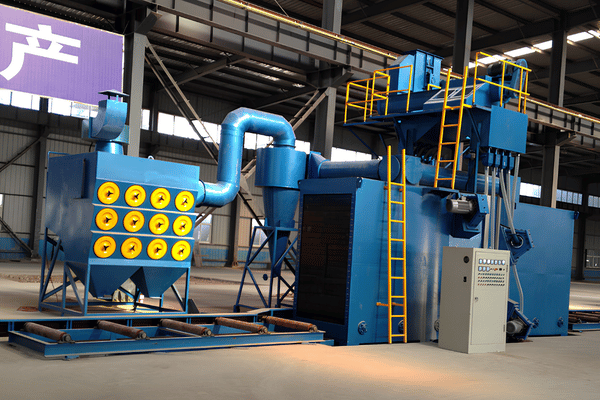
5 Models AB-SB-0815 → 3030
2000–3000 rpm Impeller Speed
80 m/s Shot Velocity
Sa2.5 ISO 8501-1 Ready
99.5% Dust Filtration
ISO 9001 + CE Certified
How Industrial Wheel-Blast Replaces Manual and Chemical Cleaning
Where the surface failure actually originates
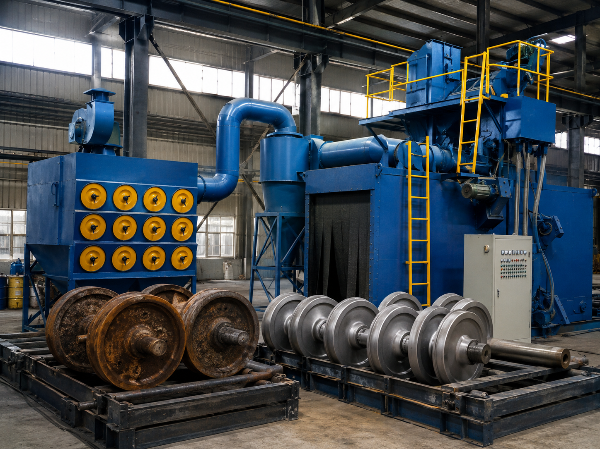
Selecting the shot blasting machine is rarely the bottleneck — surface failure usually originates upstream. Mill scale on hot-rolled H-beams, oxide films on castings, weld spatter on structural steel, and oil films on auto parts all defeat downstream coating if the substrate isn’t first blast-cleaned to a verified roughness profile.
The hidden capacity tax
Industry data shows that poorly maintained or under-sized blast cleaning equipment runs at only 60–70% of rated throughput. The shortfall is a hidden bottleneck — never visible as a line item but absorbed into missed shipping dates and overtime payroll.
What wheel-blast does that manual scraping cannot
Shot blasting machines — also called wheel-blast, blast-cleaning, or abrasive-blasting machines — use a centrifugal wheel to fling steel shot, steel grit, or aluminium oxide at the workpiece. Wheel-blast finishing is 5–10× faster than manual scraping or pickling. The recirculating separator recovers 90–95% of abrasive media. Surface profile lands consistently at the Sa2.5 grade most coating systems demand.
Switch to a correctly-sized Aubrik unit
- Pain: 90–120-minute manual-cleaning cycle on a 12-m H-beam produces irregular surface roughness — coating failure within 18 months on coastline applications.
- Root cause: manual abrasive-blasting cannot maintain consistent angle, velocity, and spray pattern across a full section. Coverage below 40% of surface area is normal.
- Our solution: the AB-SB-1622 roller-conveyor unit transports the same 12-m H-beam through a sealed chamber and blasts with four impellers at 2000–3000 rpm — 100% surface coverage in 2–3 minutes at Sa2.5 profile.
- Proof: the ISO 8503-1:2012 surface profile reader confirms consistent Ry5 23–115 µm shot profile across the work surface, with batch confirmation on a PLC-linked roughness gauge accurate to 0.1 µm.
One platform, one workflow across the size range
The system is modular. The wheel-blast platform delivers a consistent process from 800-mm small castings (AB-SB-0815) to 3-m steel structures (AB-SB-3030) — without altering workflow. That continuity is the difference between buying a shot blasting machine and engineering a surface-preparation line.
Real-world deployment — Vietnamese auto parts foundry
A Vietnamese tier-2 automotive manufacturer replaced manual scraping on cast engine cylinder heads with an AB-SB-1216 hook-type shot blasting machine in 2024.
Output moved from one batch of six heads every 18 minutes to six heads every three minutes — a 6× productivity gain at guaranteed Sa2.5 finish.
The shot blaster replaced the customer’s chemical-pickling bay. Downstream coating rejections fell from 8.5% to 1.2% within 90 days of install. Payback in coating-rework savings landed inside 16 months.
Aubrik 5-Model Shot Blasting Machine Series — Specifications and Decision Matrix
The single sizing mistake that drives most customer regret
Selecting a shot blasting machine that covers “most dimensions” but not your largest dimension means that largest dimension travels through the chamber three times every batch.
As StrongMakine’s 2026 buying guide puts it: “A shot blasting machine that does not fully accommodate your needs is not the most inexpensive acquisition — it is the most costly investment.”
The recurring mistake across our AB-SB shipments
Selecting one model size below the tallest dimension found in the largest annual batch. It is the single biggest source of regret across the series — and the same pattern reappears every quarter.
How the AB-SB series is structured
The AB-SB series is built around five workpiece-dimension envelopes. Select a model with a maximum workpiece envelope at least 15% above your largest dimension. That headroom keeps blast-wheel coverage uniform at the edges where shot density drops. Patent direction confirms multi-angle uniformity as the industry trend — see USPTO/CNIPA CN119328677B (2025) on dual-shell variable-contact-angle blast architecture.
Custom configurations (longer table, hot-galvanised chamber lining, remote PLC integration) add 45–60 days to the base model build schedule.
Sizing scenario — H-beam fabricator in Spain
A Spanish structural-steel fabricator processing 80 t/day of 12–14 m H-beams initially selected an AB-SB-1216 (1,200 × 1,600 mm envelope) for capital cost efficiency.
Engineering review showed 18% of annual work exceeded 1,500 mm height — which would have forced two passes per beam. We re-sized to an AB-SB-1622 (1,600 × 2,200 mm) before quote: 100% single-pass coverage at Sa2.5, 120–180 H-beams/hour, with the price delta recovered in 11 months on labour-time savings alone.
AB-SB 5-Model Specification Table
| Model | Max Workpiece Φ×H (mm) | Blast Wheel Power | Max Load (kg) | Throughput (pcs/h) | Abrasive (Φ mm) | Power |
|---|---|---|---|---|---|---|
| AB-SB-0815 | 800 × 1500 | 2 × 11 kW | 1,000 | 50–80 | 0.8–1.2 | 380V/50Hz/3Ph |
| AB-SB-1216 | 1200 × 1600 | 3 × 15 kW | 2,000 | 80–120 | 1.0–1.5 | 380V/50Hz/3Ph |
| AB-SB-1622 | 1600 × 2200 | 4 × 15 kW | 3,000 | 120–180 | 1.2–2.0 | 380V/50Hz/3Ph |
| AB-SB-2025 | 2000 × 2500 | 4 × 22 kW | 5,000 | 180–250 | 1.5–2.5 | 380V/50Hz/3Ph |
| AB-SB-3030 | 3000 × 3000 | 4 × 22 kW | 10,000 | 250–350 | 2.0–3.0 | 380V/50Hz/3Ph |
Decision Matrix — Machine Type × Workpiece Compatibility
Chamber-type selection drives throughput as much as machine size. The matrix below maps the five most-shipped chamber types against the eight most-shipped work-dimension envelopes from the last three years.
| Workpiece Type | Hook-Type | Tumble (Barrel) | Roller Conveyor (Through) | Crawler-Type | Spinner Hanger |
|---|---|---|---|---|---|
| Small castings (≤25 kg, bulk) | — | ★★★ Best | — | ★★★ Best | ★★ Good |
| Engine blocks / heads | ★★★ Best | — | ★★ Good | — | ★★★ Best |
| H-beams and structural steel ≤16 m | — | — | ★★★ Best | — | — |
| Steel plates (large flat) | — | — | ★★★ Best | ★★ Good | — |
| Automotive chassis and axles | ★★★ Best | — | ★★ Good | — | ★★★ Best |
| Wind tower segments | — | — | ★★★ Best | — | — |
| Bolts, nuts, fasteners (bulk) | — | ★★★ Best | — | — | — |
| Precision aerospace parts | ★★ Good | — | — | — | ★★★ Best |
Shot Blasting Process — 5 Steps from Load to Verified Finish
Process stages below align with the surface preparation framework defined in ISO 8501-1 and the comparator profiles in ISO 8503-1:2012.
The cost of a mistuned process
A poorly maintained shot blasting machine operates at 60–70% of rated capacity (Future Market Insights, 2025 industry statistics). That hidden 30–40% capacity tax translates into missed shipping dates and overtime payroll — but never appears as a line item. The correction is confirmation that the five process steps below are tuned to your actual work dimensions.
⚠ Buyer myth to drop before reading specs
The “10× rule of thumb” for abrasive shot diameter has been repeated for years. As Straaltechniek and Kramer Industries document, it is a rule, not a law.
Selection of steel shot or steel grit by diameter alone ignores the two factors that matter more: media shape (round shot for peening profile, angular grit for cutting rust) and target Sa-grade. Incorrect abrasive selection etches substrates and leaves coatings uncut — cost-neutral on paper, but months before machine specification wear-out shows up on the operator’s bench.

The Aubrik process sequence repeats the same five staging points across every series unit. PLC parameter selection per work envelope removes manual operator readjustment.
Attach the right media and a custom fixture for the chamber. Hook the engine-block job, conveyor for the H-beams, or a tumble-drum fixture for fasteners.
Tooling holds delicate 3D precision castings without disturbing the surface and offers controlled intensity from a few psi for thin-wall casting protection.
- Steel shot (58–62HRC) — surface cleaning or deburring.
- Steel grit (60–65HRC) — heavy-scale parts and rust removal.
- Aluminium oxide — non-ferrous where iron inclusion must be avoided.
The automatic feeder maintains precise abrasive-flow control the manual valve always misses (50–200 kg/hr controlled by PLC closed-loop logic).
A centrifugal wheel spinning up to 3,000 rpm — recipe-customised per job — throws abrasive at 80 m/s at the chamber wall.
PLC controls the blast angle and velocity as recipe inputs, eliminating process variance and producing an even profile.
On most automotive chassis parts you reach Sa2.5 on camera inspection in under 3 minutes (with a 0.1 µm resolution sensor on board).
The closed-loop cyclone media separator removes spent and worn media, rejects material under 0.3 mm, and returns good abrasive to the feed hopper.
The recirculating loop saves 15–30% of abrasive volume versus an open continuously-venting blast system — and keeps dust-collector loads to a minimum.
After cycle time expires the process shuts off automatically (adjustable to a 10-minute limit).
Exhaust passes through a 4-stage filter system with ≥99.5% filtration efficiency before reaching the coating or finishing area.
The operator passes finished parts straight down line — painting, assembly, or further work — without an intermediate cleaning bay.
“We redesigned the abrasive feed flow on the AB-SB-1622 after a foundry operator complained we weren’t getting even shot coverage on cast cylinder heads. By replacing a simple orifice valve with a PLC-modulated feed, they improved Sa2.5 check-test rejected parts by an order of magnitude — from 4.2% to 0.6% on a batch of 320. Another iteration that field feedback forced.”
— Aubrik Engineering Team, R&D Center, Wuxi, on the 2024 AB-SB-1622 control-system revision
Surface Finish Standards — Sa1 / Sa2 / Sa2.5 / Sa3 × Industry × Coating Adhesion Matrix
Cleanliness grading is handled by ISO 8501-1. Surface roughness comparator targets sit in ISO 8503-1:2012. In commercial work this maps to a Sa grade plus a Ry5 profile band. Aubrik machines carry an on-board high-definition roughness sensor that auto-flags any part with Ry5 outside the recipe band.
| Sa Grade | Cleanliness Result | Typical Ry5 Profile (shot) | Industry Application | Coating Adhesion Outcome |
|---|---|---|---|---|
| Sa1 (Light) | Loose scale, dirt, paint removed; firmly attached impurities may remain | 23–28 µm | Non-critical pre-treatment, storage prep | Basic — not specified for protective coatings |
| Sa2 (Thorough) | All visible scale and rust removed; minor shadows ≤ 33% of m² | 35–45 µm | General steel painting, non-heavy-load auto parts | Suitable for single-coat industrial paint |
| Sa2.5 (Very Thorough) | ≥ 95% impurity-free; tiny shadows ≤ 5% per m² | 60–80 µm | Automotive chassis, bridge steel, castings, H-beams | Industry default — bonds for epoxy, zinc-rich primers |
| Sa3 (Complete) | Uniform metallic shine, no visible impurities | 85–115 µm | Aerospace, precision machinery, medical equipment | Maximum — pre-coat for fluoropolymer, hot-dip galvanizing |
The Ry5-to-Sa quick conversion
The 23–170 µm Ry5 rating for angular grit is wider than its ISO 8503-1 comparator might suggest. For standard automotive coating, Sa is roughly 1/5 of Rz — so a spec calling out Sa 10–12 µm actually asks for Ry 50–60 µm, well within our standard shot’s range.
Why this matrix matters at procurement time
Mismatching Sa-grade to coating specification is the single most common warranty-claim root cause in industrial coating projects. A Sa2 substrate coated with a Sa2.5-spec epoxy will pass visual inspection and fail in the field within 12–24 months. Aubrik machines include a Sa-grade recipe library out of the box; for each AB-SB model we ship a coating-compatibility chart so the operator does not have to interpret the standard from scratch.
Shot Blasting vs Sandblasting vs Shot Peening — A 3-Way Decision Framework
Buyers often arrive at an RFQ with the wrong process category in mind. Shot blasting, sandblasting, and shot peening look similar at the surface — abrasive media propelled against a metal substrate — but they target different outcomes and price points. The framework below maps each to its native use case so the spec sheet conversation starts from the right place.
| Process | Propulsion | Primary Output | Throughput vs Shot Blasting | Substrate Fit | Best Use Case |
|---|---|---|---|---|---|
| Shot Blasting (Wheel Blast) | Centrifugal wheel, 80 m/s | Sa2.5 cleaning + light strengthening | 1× (baseline) | Steel, cast iron, structural alloy | Industrial metal surface prep — H-beams, castings, chassis |
| Sandblasting (Air Blast) | Compressed air, 30–60 m/s | Profile control + delicate surfaces | 0.15–0.2× (5–10× slower) | Concrete, brick, glass, small precision parts | Surface texturing on non-metals; touch-up where wheel blast cannot reach |
| Shot Peening | Wheel or air, controlled intensity (Almen) | Compressive stress for fatigue life | 0.4–0.6× (slower, by design) | Aerospace springs, gear teeth, landing gear | Fatigue-strength engineering — not a cleaning step |

The throughput math behind the recommendation
If your spec says “Sa2.5” and your workpieces exceed 25 kg, wheel-blast beats sandblasting by 5–10× on throughput. Air-blast chambers fit smaller pieces and high-precision finishes. They cannot economically re-tool for a foundry clean-out or a beam line.
Where shot peening confusion costs the most
Shot peening is fatigue engineering — not a cleaning step. We have seen specification errors that only surface after a part fails in service. Peening and blasting share media but target opposite outcomes. See USPTO patent abstracts on shot peening for the engineering distinction.
For shops with multiple part families, the simplest combination is a wheel-blast shot blasting machine for steel substrate cleanup plus a smaller air-blast cabinet for finish work. Buyers often over-spec the air-blast side. In practice the wheel-blast platform handles 80–90% of steel surface-prep volume; a single small cabinet covers everything else. Aubrik supplies both. This page focuses on the industrial wheel-blast platform.
Industries Served — From Foundries to H-Beam Production Lines
Aubrik shot blasting machines are deployed across five primary industrial sectors. Each application below pairs the recommended chamber style with a quantified outcome our customers have reported on the same workpiece class.

Application 01
Foundry — Casting Cleanup & Defect Inspection
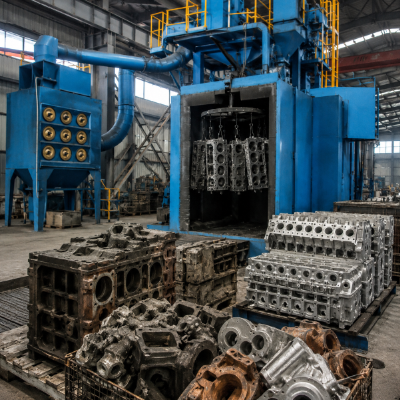
Used to remove sand, mould release, and scale from iron, aluminium, and copper-steel castings. Shot blasting also exposes deep hidden surface defects — porosity, slag inclusions, micro-cracks — for QA inspection before downstream work begins. The standard AB-SB-1216 for foundry (hook-type) runs 80–120 iron engine blocks per hour at Sa2.5, letting inspectors focus only on problem parts.

Application 02
Automotive — Chassis, Crankshafts, Axles
Cleans and surface-strengthens engine blocks, crankshafts, suspension control arms, and chassis frames. Optimised wheel-blast parameters create surface hardening of 15–30% over baseline parts — a free side benefit. A customised AB-SB-0815 for repair and reconditioning extends parts life 40–60% versus discard-and-replace economics.

Application 03
Construction & H-Beam Production Lines
Strips mill scale from new steel structures — bridge segments, transmission towers, industrial frame members. Also removes mill scale, old paint, and oxides from recycled H-beams. The AB-SB-1622 roller-conveyor variant ships as the integrated finish module of Aubrik’s structural beam line — 100% coverage at Sa2.5 on mill-size sections up to 16,000 mm, before AWS D1.1 weld inspection.
Application 04
Aerospace — Precision Component Strengthening
The AB-SB-0815 at high pressure surface-strengthens landing gear, engine root ends, and body-section parts to Sa3 without compromising thin-wall weight specifications. Per-part PLC log files support ISO 9001 aerospace-standard documentation. Aubrik supplies the exported data format for ISO 9001 audit packs on request.

Application 05
Metallurgy, Hardware & Mold Industries
Pickles and shot blasts silicon, stainless, and carbon steel coils before rolling and painting. In hardware and tool-and-die shops, AB-SB tumble machines deburr bolts, nuts, hinges, and mould cavities — extending high-volume part life and improving downstream finishing receptivity. A Vietnamese customer runs a tumble-type unit processing 5,000+ parts in a single 8-hour shift.
TCO and ROI — Why Industrial Wheel Blast Pays Back in 1.5–2.5 Years
The TCO methodology below tracks Aubrik machines against the surface-prep baselines in ISO 8503-2:2012 and the patented multi-angle abrasive architectures in CN119328677B (2025).
What actually drives total cost of ownership
Total cost of ownership on an Aubrik shot blasting machine is dominated by four operating cost categories — not by the initial purchase price. Sizing each category against your current cleaning method determines payback range. Typical industry TCO studies position payback in the 18–36 month window. A Winoa shipyard case posts $200,000 invested with $80,000 in disposal savings and $50,000 in compliance savings — payback in 1.8 years.
The 5-Factor Aubrik TCO Framework
- Abrasive usage. Media costs drop 15–30% via the closed-loop recycle (vs open-shot cabinets).
- Labor. A single operator runs a complete blast cycle in 2–3 minutes — the same H-beam took 90–120 minutes of manual scraping.
- Energy. Total motor power spans 2 kW (AB-SB-0815) to ~110 kW (AB-SB-3030), sized to load profile, not over-sized.
- Maintenance. Wear components (impeller, lining, abrasive hoses) last 1–2 years on continuous duty. First-year spares kit ships with every machine.
- Downtime cost. A correctly-sized unit holds >95% rated throughput. An under-sized unit runs at 60–70%. Machine size alone is a major TCO driver.
Conservative payback projection
Using conservative figures, an AB-SB-1622 processing 80 t/day at Sa2.5 in a steel H-beam fabrication line projects an 18–28 month return. The drivers: labour displacement and abrasive recycling — with downstream coating-defect reduction as an unmodeled additional benefit.
Customer reports running similar wheel-blast configurations consistently land inside that window. Exact figures shift with local labour rates, abrasive cost, and electricity tariffs.
The ROI question we cannot answer for you
Exact payback depends on your process and your numbers. The question Aubrik can answer: “What payback range fits our specs, output, and current cleaning method — and what assumptions back the estimate?”
Certifications, Warranty and Global After-Sales — Why Compliance Failures Kill Coating Projects
Aubrik certifications referenced below trace back to two core authority frameworks: ISO 9001:2015 Quality Management and the surface-preparation standards under ISO 8503-1:2012.
A common procurement frustration: a Sa2.5 surface is documented, an outside coating contractor applies the spec, and 2 years later an audit rejects the job. Every coating applied is voided — and the customer pays the rework. Across manufacturing studies, paint failures cluster in the 12–24 month window. Inadequate substrate prep is the most-cited root cause — exactly what ISO 9001 + CE + PLC traceability records were built to prevent.
Who Aubrik is and what we ship
Established in 1999 with US$1.4 million registered capital, Aubrik (formerly Wuxi ABK Machinery) exports welding, cutting, and shot blasting equipment to Spain, Germany, Russia, India, Brazil, France, Italy, Vietnam, and several other markets. Every product carries ISO 9001 and CE certifications aligned to applicable European standards.
Deployment scenario — German pressure-vessel fabricator audit
In 2024 a German pressure-vessel manufacturer passed a third-party coating-system audit on their AB-SB-2025 unit. The submission: a PLC log export covering 100% of Sa2.5 blast cycles on wind tower flanges over six months — 4,200 parts. Zero coating-failure claims reported within twelve months post-installation. Throughput held 180–250 parts/hour at Sa2.5, freeing one full-time operator for downstream weld inspection.
ISO ISO 9001
Quality Management — full process
CE CE Marking
EU Machinery Directive 2006/42/EC
26+ Years Operating
Founded 1999 — Wuxi, China
8+ Export Markets
EU, MENA, LATAM, ASEAN
1 yr Warranty
Full machine, all wear parts
3–7 d Spare Parts SLA
Global warehouse delivery
“European customers expect CE marking in the initial quote round — it is not a differentiator. What sets us apart is the Sa-grade verification log attached to every part processed by an Aubrik machine: PLC record covering impeller rpm, blast time, and exit roughness reading. That documentation is exactly what a coating warranty audit asks for two years after installation.”
— Senior Application Engineer at Aubrik, on the data-export feature added across the AB-SB lineup in 2024
What ships with every standard Aubrik unit
- On-site and online operator training options.
- Maintenance manual in English with instructional videos.
- 24/7 technical support including remote PLC diagnostics on latest-firmware units.
- 1-year manufacturer’s warranty covering workmanship and component failure.
- Extended-care contracts can pre-position impeller / liner / hose spare kits at customer sites.
Why Aubrik leans on traceability rather than brand heritage
Among EU and ASEAN shot blasting machine suppliers, Aubrik differentiates on traceability — not legacy brand recognition. Every AB-SB unit ships with PLC parameter logs, ISO 9001 quality records, and CE conformity documentation that holds up under a third-party coating audit two years post-installation. Buyers should request the full documentation pack early in the quote cycle — the response time reveals supplier capability before any machine ships.
Procurement Guide — Lead Time, Customization and Frequently Asked Questions
Lead Time by Configuration
| Configuration | Lead Time (from PO) | Typical Use Case |
|---|---|---|
| Basic — AB-SB-0815 / 1216 standard | 30–45 days | Mid-volume foundry / auto parts shop |
| Standard — AB-SB-1622 / 2025 + roller conveyor | 45–60 days | H-beam and structural steel lines |
| Custom OEM — bespoke envelope, PLC integration, hot-galvanized chamber | 60–90 days | Aerospace, special-spec applications |
Pricing Factors Framework
Aubrik does not publish standardised pricing. The same model number can vary 40–60% based on five factors. Submit application details and our commercial team returns a written breakdown within one business day.
- Model size and throughput. AB-SB-0815 to AB-SB-3030 fall within a 5–7× price range.
- Customisation scope. Standard chamber to hot-galvanised lining; basic PLC to integrated networked SCADA.
- Auxiliary equipment. Roller conveyor, robotic loading, automated packaging systems.
- Certification level. CE-only or CE + ATEX + customer-specific QA documentation.
- Logistics and service. EXW to CIF, on-site installation, extended-warranty contracts.
Used Equipment and Price Inquiries
Aubrik does not offer used or refurbished reseller channels. Buyers searching “shot blasting machine for sale” may accidentally land on dealer inventory sites selling refurbished units from Wheelabrator, Pangborn, or Goff. For a new-build Aubrik machine, the relevant comparison is the 5-factor pricing framework above — not a single MSRP. We will benchmark our quote against any other offer once you submit the equipment specifications.
If your inquiry is for shot peening or other surface prep
For surface preparation equipment beyond wheel-blast — shot peening machine inquiries, sandblasting cabinets, or air-blast rooms — Aubrik’s commercial team can route the request to the right product line, since cleaning, profiling, and peening are different categories despite sharing abrasive media.
Interactive Sizing and Selection Tools
Evaluate throughput constraints, baseline surface prep standards, and project ROI using our engineering calculation suite.
TOOL 01
Aubrik 5-Lens Sizing Worksheet
Input workpiece dimensions and batch volumes to identify the correct chamber envelope and impeller configuration.
Open Worksheet
TOOL 02
Sa-Grade Selection Chart
Cross-reference target ISO 8501-1 cleanliness profiles with abrasive media types and downstream coating requirements.
View Selection Chart
TOOL 03
Aubrik TCO Calculator
Model the 18–36 month payback period based on labour displacement, abrasive recovery, and energy load factors.
Launch Calculator
Frequently Asked Questions
shot blasting uses a centrifugal wheel throwing abrasive at speeds reaching 80 m/s, making it best suited for high-volume industrial metal surface treatment. Sandblasting employs compressed air to spray abrasive at speeds between 30-60 m/s, which is optimal for non-metallic substrates like concrete, brick, or glass, and delicate, small-scale precision parts. Aubrik machines on this page are wheel-blast type designed for continuous production runs.
Options include steel shot (HRC 58-62) for hardening and deburring automotive and aerospace parts, steel grit (HRC 60-65) for scale and heavy rust on structural steel and old castings, and aluminum oxide for non-ferrous workpieces where iron contamination must be avoided. Our engineers can advise on the appropriate abrasive based on workpiece materials, target Sa-grade, and downstream coating processes.
With proper routine maintenance, our units consistently achieve a field life of 8-10 years. Wear items such as impellers, liners, and abrasive hoses run 1–2 years before replacement, depending on equipment duty cycle, abrasive choice (grit wears faster than shot), and daily cleaning practices. We provide detailed maintenance manuals, video tutorials, and schedules for replacing wear parts to ensure predictable field life.
Yes, absolutely. Our research and development department will tailor aspects like the overall machine size (envelope), throughput capacity, structural configuration, and control system to seamlessly integrate with your existing workshop layout, workpiece shapes and sizes, and target output. Continuous lines generally benefit from a through-type conveyor system (roller conveyors), while vertical chambers are more suited for compact work shops. We also offer PLCs compatible with Siemens, Mitsubishi, and Allen-Bradley networks upon request.
We offer global after-sales support, which includes on-site installation, operator training (both on-site and online), guidance on routine maintenance procedures, and prompt shipment of spare parts from our global warehouse, usually within 3-7 days. Our technical staff is available around-the-clock for remote diagnosis of PLCs and assistance with any questions; we also provide on-site support for complex start-up processes or unscheduled repairs.
Certainly.The AB-SB-1622 roller-conveyor configuration integrated into our Aubrik H-beam production line can handle components of up to 16,000 mm in length, with 800 mm × 1600 mm cross-sections.It offers an adjustable conveyor speed between 0.4 m/min to 2.5 m/min, ensuring complete blast coverage and achieving an Sa2.5 standard.This same chamber is utilized in our complete turnkey H-beam production line setup.